A business owner considering AI has a practical decision to make: which problem is worth solving, and what would a workable solution require?
That decision brings together technology, data, skills, cost and responsibility. Someone who manages a factory, runs a professional services firm or is building a startup should be able to explore those questions without first becoming an AI engineer.
This was the starting point for the NVIDIA ecosystem tool we developed at ztudium, published on IntelligentHQ. We wanted to make a complex technology landscape easier to understand and help people identify a sensible next step.
For me, AI awareness and education are central to that work. People need the knowledge and confidence to decide how these technologies fit their organisations and communities.
AI education should strengthen people’s judgment
My writing on artificial intelligence and education has explored how technology changes the way we learn and develop skills. The question also matters in a business: how do people acquire enough understanding to make a responsible decision?
AI literacy gives an owner a language for discussing a proposal, a professional a way to examine a recommendation, and a student a connection between technical concepts and practical work.
That includes asking what data a system needs, who will check its output, what happens when it makes a mistake and how its value will be measured.
I want educational tools to help people become more capable of asking those questions. A reader should leave with an understanding they can use in a conversation with a developer, a colleague or a supplier.
This is particularly important for smaller organisations. Their leaders need an accessible starting point for research, especially when they are working without a dedicated AI team.
Why we focused on the NVIDIA ecosystem
NVIDIA’s ecosystem brings together computing hardware, developer tools, AI software and technologies for analytics, robotics and simulation. It provides a useful lens through which to explain how different parts of an AI system connect.
Those connections matter. A company exploring an internal AI assistant faces different requirements from a manufacturer investigating visual inspection or a warehouse operator considering a digital twin.
We wanted readers to understand the role of each technology within a possible solution. That understanding makes it easier to discuss dependencies, deployment options and the expertise a project may require.
The platform is an independent educational resource. It is not affiliated with, sponsored by or endorsed by NVIDIA.
Learning through a business problem
The Solution Architect offers two starting points: explore potential applications for your organisation, or develop an idea you already have. It identifies opportunities, explains their relative value and difficulty, and provides an initial architecture, gaps to address and a phased roadmap.
The educational value comes from connecting those results to the reader’s own circumstances.

Start with a small, testable part of a larger business challenge.
Consider an illustrative example: a services firm wants employees to spend less time searching internal documents. A useful first discussion would cover which documents are reliable, who has permission to access them, how answers will be checked and what improvement would justify further work.
A pilot could begin with one department and a defined collection of documents. The team could measure time spent finding an answer and the proportion of answers that meet an agreed accuracy standard.
This example is a planning exercise. It shows how a broad interest in AI can become a testable business question. The tool’s output gives that conversation a structure; implementation still requires technical validation.
Making costs and readiness easier to examine
Education also involves understanding the conditions under which a project makes economic and operational sense.
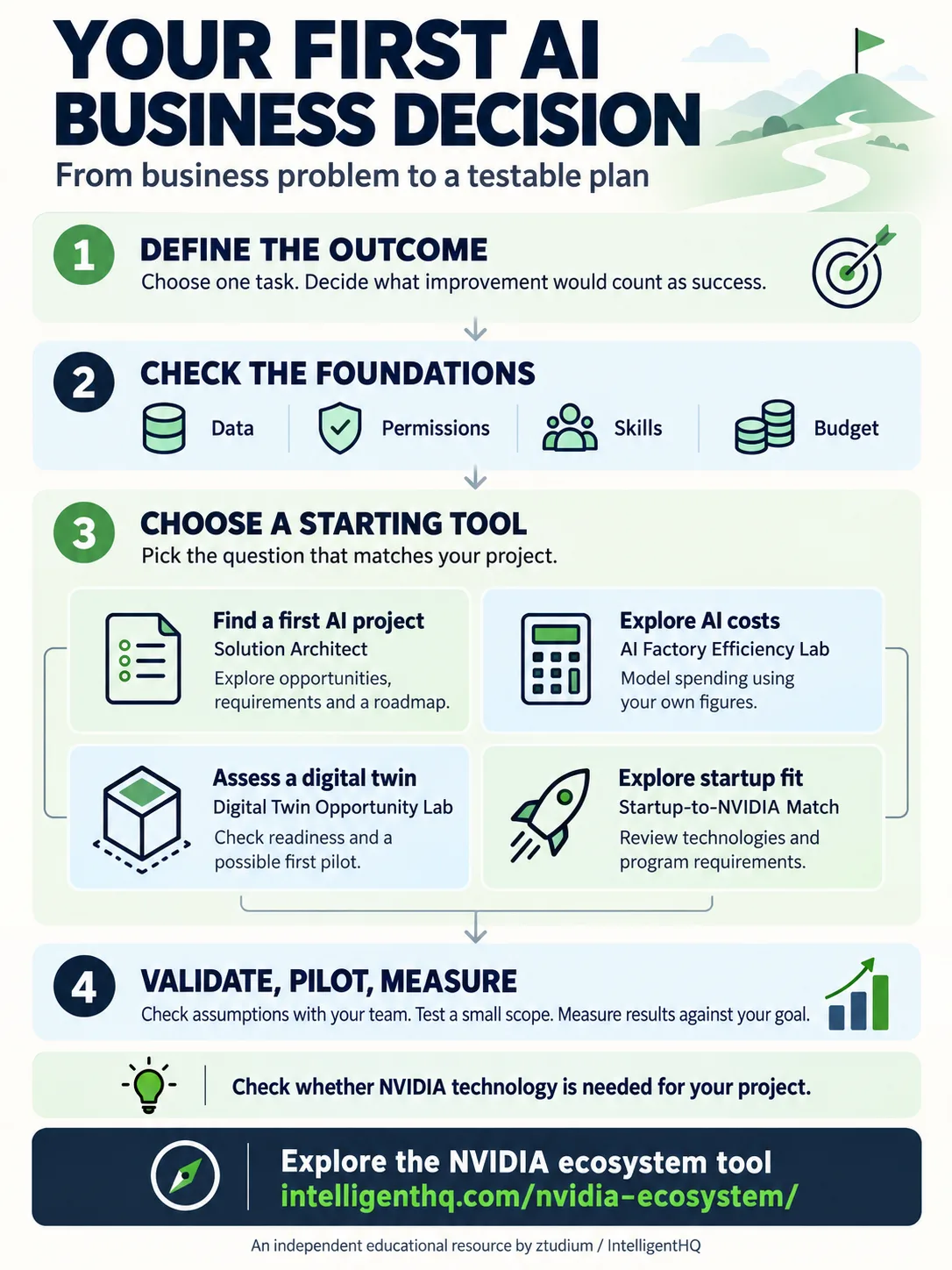
The platform includes several ways to investigate those conditions:
| Question to explore | Starting point |
| Which AI opportunities fit our business, and what would they require? | Solution Architect |
| How could our AI computing costs change as usage grows? | AI Factory Efficiency Lab |
| Are we ready for a digital twin, and what should a first pilot address? | Digital Twin Opportunity Lab |
| Which technologies and startup resources could fit what we are building? | Startup-to-NVIDIA Match |
Take a simple cost example. Suppose a business spends $3,000 a month on AI inference, the process of running models to produce outputs. If its cost per token halves while usage triples, the modeled monthly spending becomes $4,500:
$3,000 × 3 ÷ 2 = $4,500
This is an illustrative scenario using a constant unit-cost assumption. It shows why efficiency and total expenditure need to be considered together. The calculator lets readers examine that relationship using their own figures.
For digital twins, the questions concern data, integration, validation and operational readiness. The assessment can help an owner investigate whether a focused pilot is justified. For startups, the matching tool offers an initial reading of technology fit and published program requirements; NVIDIA decides admission to Inception.
Understanding the reasoning behind a recommendation
I believe an educational tool should make its reasoning open to examination.
Our published methodology and editorial standards explain how the planning tools calculate and recommend. The recommendations use published rules, and the platform distinguishes vendor claims, customer reports, illustrative assumptions and calculated results.
Those distinctions help readers understand what a statement can support. A result reported by a supplier needs to be read in its original context. An illustrative calculation helps explore an assumption. A proposed architecture needs checking against the actual workload.
The tools can also identify situations where NVIDIA technology is unnecessary. That is an important part of helping someone make a proportionate decision about their business.
The planning tools work in a browser without requiring an account. We wanted people to be able to begin exploring a question while it was still taking shape.
A practical invitation to learn
My ambition for this resource is to help more people participate confidently in decisions about AI. Business leaders need to understand what they are commissioning. Professionals need to see where their expertise fits. Students need ways to connect learning with practical problems.
For readers ready to develop deeper technical skills, the NVIDIA Deep Learning Institute provides courses, workshops and learning paths. Our tool offers a starting point for deciding what to investigate and learn next.
Explore the NVIDIA ecosystem tool with one business problem in mind. Examine a relevant pathway, check the assumptions and identify what you still need to learn. Then use that work to define a conversation with your team or a small pilot with a measurable goal.