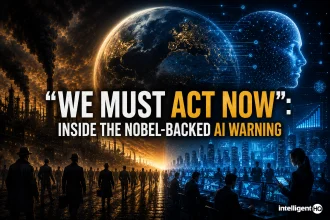
Two hundred economists and sixteen Nobel laureates just told the world AI could reshape the economy faster than the Industrial Revolution ever did. Within days, one of AI’s own founding thinkers refused to sign and explained exactly why.
There is a recurring law of tech disruption worth naming: the bigger the transformation, the smaller the words used to announce it. This week gave the world a textbook case.
What Is the “We Must Act Now” AI Statement?
On July 13, 2026, a group of the world’s most decorated economists released a statement carrying just three short paragraphs and an unmistakably large title: “We Must Act Now: A Statement on AI’s Transformation of the Economy.” Organized out of Stanford’s Digital Economy Lab by economists Erik Brynjolfsson, Ajay Agrawal, Anton Korinek and Tom Cunningham, it was signed within days by more than 200 economists and AI researchers, including sixteen Nobel laureates, senior figures from Anthropic, OpenAI and Google, and a signatory list spanning Paul Krugman to Niall Ferguson. By this week it was closing in on 2,000 names.
The statement itself is brief almost to the point of austerity. It says AI “may become radically more powerful over the next 10 years,” and could drive “an unprecedented transformation of our economy, larger than the Industrial Revolution, but unfolding over a vastly shorter time frame.” It warns of risks including large-scale job displacement, alongside the possibility of major gains in living standards. And it calls on economists, policymakers and technology leaders to act now to build what it calls the incentives, guardrails and institutions needed to steer AI toward complementing, rather than replacing, human work.
What the Nobel Laureates and Economists Are Actually Saying
Nobel laureate Michael Spence of NYU described it as a call for an “all hands on deck” approach to steering AI in beneficial directions. MIT’s Daron Acemoglu, another Nobel laureate and long one of the most vocal critics of unchecked automation, said he was glad to join the call to “redirect AI so that its risks are minimized” for workers and society. Anton Korinek of the University of Virginia, currently on leave at Anthropic, put the historical framing sharply: “Steam, electricity, and computers each gave societies decades to adapt; AI may give us only a few years,” he said and we cannot improvise our institutions in the middle of the transformation. METR’s Tom Cunningham summed up the mood of the whole exercise in a single image: economists, he said, are “driving in the fog.”
Acemoglu pressed the point further on X in the days after the statement’s release, arguing that the current focus on artificial general intelligence is, in his words, “an agenda for displacing humans from meaningful work.” That single sentence, more than anything in the formal statement, is the line Ben Goertzel took direct aim at.
It is the kind of statement that is almost impossible to disagree with on its face. Who, exactly, is against preparing responsibly for a technology this consequential?
That is precisely the question AI researcher and AGI pioneer Ben Goertzel decided to answer publicly, by declining to sign.
Why AGI Pioneer Ben Goertzel Refused to Sign
In an essay published on his Substack, Eurykosmotron, Goertzel laid out his objection in the sharpest possible terms. His issue isn’t with the diagnosis; he agrees AI could reshape the economy on a compressed timeline. His issue is with the word hiding inside the statement’s own title. “Who is the ‘We,’ and what kind of action?” he asked, echoing a similar critique from economist Noah Smith.
Goertzel’s argument is that the statement’s call to “steer AI in a direction that complements humans” is not the neutral, motherhood-and-apple-pie language it appears to be. He reads it as a tell, a signal of what he calls the Acemoglu school of thinking, oriented toward redirecting AI development away from autonomous, general-purpose systems and toward tools that stay firmly in a human-assistive role. Layered underneath that, he argues, is an even bigger assumption: that some sufficiently wise committee of experts can look at a technology that barely exists yet and correctly pre-determine which direction it should be steered in.
A History of “Nothing-to-Object-to” Statements
His historical comparison is where the piece gets genuinely provocative. Goertzel places “We Must Act Now” in a lineage of blandly agreeable public statements that concealed sharper agendas underneath, from the tobacco industry’s 1954 “Frank Statement” that opened decades of manufactured doubt about smoking, to the 1998 Oregon Petition against climate action, to 2023’s “Pause Giant AI Experiments” letter and the Center for AI Safety’s one-line extinction-risk statement. His throughline: a statement engineered so that no reasonable person could object to it is, in his words, “the ideal vehicle for a contestable agenda”, because broad, easy consensus on the surface quietly transfers credibility onto whatever specific policies show up later.
Decentralization as the Alternative to Centralized AI Governance
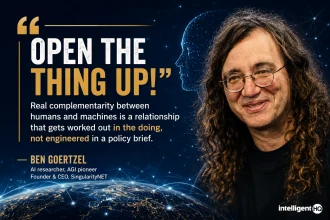
His alternative is not inaction. It is the opposite of centralization: development of AI and AGI that is as decentralized, participatory and self-organizing as humanity can manage, many architectures, many value systems, many economic experiments running in parallel, correcting each other in real time rather than being pre-approved by a committee. His rallying cry is blunt: “Open the thing up!” Real complementarity between humans and machines, he argues, is a relationship that gets worked out in the doing, not engineered in a policy brief.
A Position Goertzel Has Held All Along
This is not a new position for Goertzel. In an earlier conversation on the Dinis Guarda Podcast, powered by Businessabc.net, Citiesabc.com, Wisdomia.ai and Sportsabc.org, the SingularityNET founder and CEO laid out the same worldview well before this statement existed. Discussing the decentralised infrastructure behind SingularityNET and the incoming ASI blockchain, Goertzel described blockchain as the best coordination technology available today for a global network of machines “without a central owner or controller.” He argued that open, decentralised AI networks benefit from more people watching for flaws and building in safeguards from the ground up, much the way open-source software has long argued its security case against proprietary alternatives.
He also made clear, in that same interview, that AGI is not a switch anyone flips centrally: it is layers of infrastructure, chips, neural-symbolic architectures, cognitive frameworks, blockchain coordination, being built out by a distributed community of researchers and developers rather than handed down from a single lab or committee. Seen against that backdrop, his refusal to sign “We Must Act Now” reads less like a contrarian one-off and more like the natural continuation of a stance he has been building in public for years.
Two Visions, One Shared Warning About AI and Jobs
Both sides of this debate are, in their own way, making a bet about the same underlying fact: that AI’s economic impact over the next decade will be larger and faster than anything in modern economic history. Where they diverge is on the mechanism for navigating itm coordinated institutional preparation on one side, decentralized emergence on the other. Notably, the “We Must Act Now” signatory list itself spans a wide ideological range, from Krugman to Ferguson, suggesting the coalition is broader, and the underlying anxiety more universal, than any single interpretation of “the We” can capture.
What is not in dispute, on either side of this argument, is the timeline. Whether you believe the answer is guardrails or openness, committees or markets, the numbers behind the statement are the same numbers keeping boardrooms and finance ministries up at night: a transformation potentially larger than the Industrial Revolution, compressed into years rather than generations.
That, more than any single signature, is the story.
Sources
- Stanford Digital Economy Lab, “We Must Act Now”: Sixteen Nobel Laureates Join Leading Economists and AI Researchers in Call to Prepare for AI’s Economic Transformation
- We Must Act Now — A Statement on AI’s Transformation of the Economy
- NBC News, Hundreds of economists say ‘we must act now’ on AI’s economic impact and job displacement risks
- Mashable, About 200 economists warn that more AI job losses are coming: “We must act now”
- Axios, Nobel laureates, economists: “We must act now” on AI
- Ben Goertzel, Eurykosmotron (Substack) — “Why I Didn’t Sign ‘We Must Act Now'”
- Dinis Guarda Podcast, Decentralised AGI, Secure LLMs, And the ASI Blockchain: Dinis Guarda Interviews Ben Goertzel, Founder And CEO Of SingularityNET : https://www.intelligenthq.com/dinis-guarda-interviews-ben-goertzel-founder-and-ceo-of-singularitynet/