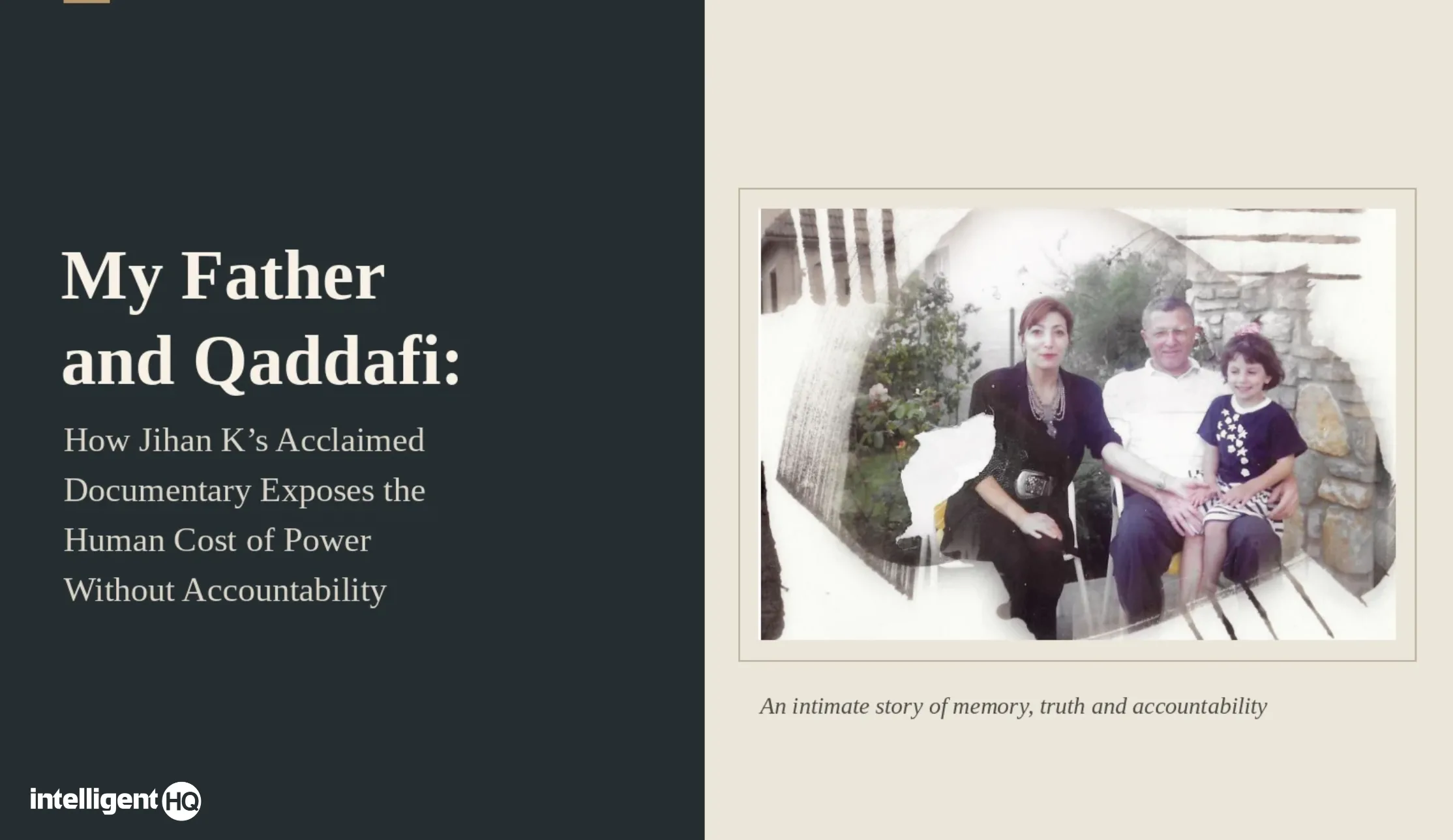
Through the disappearance of Libyan diplomat and human rights advocate Mansur Rashid Kikhia, filmmaker Jihan K examines the consequences of authoritarian leadership, the erosion of institutional trust, and the role of independent storytelling in preserving truth and demanding justice.
What happens when political power operates without accountability? When institutions designed to protect citizens become instruments of control? And when the disappearance of a single individual exposes the fragility of an entire system of governance?
These questions lie at the centre of My Father and Qaddafi, the internationally acclaimed documentary by Libyan filmmaker Jihan K, whose investigation into the disappearance of her father reveals the devastating consequences of authoritarian leadership and the enduring importance of institutional accountability.
The documentary, which premiered at the Venice International Film Festival in 2025, follows Jihan’s search for the truth about Mansur Rashid Kikhia, a former Libyan foreign minister, United Nations ambassador, and prominent advocate for human rights and political reform.
Kikhia disappeared in Cairo in December 1993 after becoming an outspoken opponent of Muammar Qaddafi’s regime. His disappearance triggered a decades-long search for answers and became emblematic of the repression experienced by political opponents under Qaddafi’s 42-year rule.
Yet My Father and Qaddafi is more than a historical investigation into one political disappearance.
It is an examination of how concentrated power can undermine institutions, distort public narratives, suppress dissent, and leave lasting consequences for families, communities, and future generations.
As the documentary gains international recognition and is positioned for consideration in the 2027 Academy Awards cycle, it also contributes to contemporary debates about ethical leadership, democratic resilience, and the mechanisms societies need to prevent abuses of power.
The film raises a question with relevance far beyond Libya: Can any society, institution, or organisation remain sustainable when power is separated from transparency, responsibility, and accountability?
The Fragility of Institutions When Political Power Becomes Absolute
The political history explored in My Father and Qaddafi illustrates how authoritarian governance can transform the relationship between individuals and institutions.
During Muammar Qaddafi’s rule from 1969 to 2011, Libya’s political system became increasingly concentrated around the authority of the country’s leader and the institutions supporting his regime.
Independent political opposition faced severe restrictions, while public institutions operated within a system where loyalty to the leadership frequently took precedence over pluralism and independent oversight.
The consequences extended beyond political repression.
The concentration of power weakened the institutional mechanisms through which citizens could challenge decisions, demand transparency, or hold authorities accountable.
Mansur Rashid Kikhia’s story reflects this environment.
A senior diplomat who had served within Libya’s political establishment, Kikhia eventually became a prominent advocate for political reform and peaceful opposition.
His disappearance in 1993 demonstrated the risks faced by individuals who challenged authoritarian systems.
The case also raises broader questions about institutional responsibility.
When the mechanisms intended to safeguard rights and enforce the rule of law become compromised, individuals may have little protection against abuses of political authority.
The implications extend beyond government.
Across political, corporate, and institutional environments, concentrated authority without effective oversight can create conditions in which dissent is discouraged, decision-making becomes opaque, and accountability deteriorates.
Although the consequences differ dramatically across these contexts, the underlying governance principle remains important: sustainable leadership requires mechanisms capable of questioning and constraining power.
Mansur Rashid Kikhia: A Political Leader Who Challenged the System From Within
One of the documentary’s most compelling dimensions is its examination of Mansur Rashid Kikhia’s political evolution.
Kikhia was not simply an external critic of Qaddafi’s government.
He had served in senior diplomatic and political positions, gaining firsthand experience of the country’s governance structures and international relationships.
Over time, his political convictions led him towards opposition to the regime.
He became associated with efforts to promote political participation, human rights, and reform through peaceful means.
His trajectory raises an important question about leadership and institutional integrity: what responsibility do individuals have when the organisations or political systems they serve begin to conflict with their principles?
For Kikhia, challenging the political establishment carried extraordinary personal risks.
His disappearance deprived Libya of an influential political voice while leaving his family without answers for nearly two decades.
For his daughter, Jihan, the search for those answers eventually became a documentary investigation into the political system that shaped her father’s life.
“I realized I did not want my father to disappear a second time,” Jihan explained in an interview about the film.
Her determination to preserve his memory reflects a broader principle: when institutions fail to acknowledge injustice, individuals often become responsible for preserving evidence, challenging official narratives, and demanding accountability.
When Political Systems Control Information, Truth Becomes a Form of Resistance
A central theme of My Father and Qaddafi is the relationship between political power and control over information.
Authoritarian systems frequently seek to influence how events are documented, interpreted, and remembered.
Through restrictions on independent journalism, political opposition, and public discourse, governments can shape dominant narratives while marginalising alternative perspectives.
The result is not simply a lack of information.
It is the gradual erosion of society’s ability to establish a shared and reliable understanding of its own history.
For Jihan K, reconstructing her father’s life required navigating fragmented archives, personal testimonies, historical records, and memories shaped by decades of political uncertainty.
The filmmaking process involved conversations with more than sixty people, including diplomats, relatives, political figures, and members of an older generation whose experiences provided essential context.
These testimonies helped reconstruct a history that could not be understood through official political narratives alone.
The documentary therefore illustrates the importance of independent documentation in societies where institutional records may be incomplete, inaccessible, or politically influenced.
For contemporary audiences, this theme carries particular relevance.
In an era shaped by digital platforms, algorithmic information distribution, artificial intelligence, and increasingly sophisticated forms of misinformation, the ability to distinguish verified evidence from manipulated narratives has become a central challenge for public trust.
Although My Father and Qaddafi is not a documentary about artificial intelligence or digital technology, its investigation highlights the enduring value of source verification, archival preservation, and independent inquiry.
Technology can accelerate the production and distribution of information, but it cannot replace the ethical responsibility to establish truth.
Documentary Filmmaking as an Instrument of Accountability
The documentary also demonstrates how independent media can contribute to public accountability when formal institutions have failed to provide answers.
Jihan K spent nearly a decade developing the film, combining investigative research with personal reflection and historical analysis.
Her approach required navigating complex ethical questions about representation, political responsibility, and the boundaries between personal memory and public history.
As both the filmmaker and the daughter of the disappeared diplomat, Jihan occupied a position that demanded particular sensitivity.
She was not an impartial observer of her father’s disappearance, nor did she attempt to conceal her personal connection to the events.
Instead, she acknowledged that her perspective formed an essential part of the documentary’s narrative.
This approach offers an important example of transparency in storytelling.
Rather than presenting her interpretation as the only possible account of Libya’s history, Jihan sought to establish a narrative grounded in testimony, evidence, and an awareness of the limits of her own perspective.
Reflecting on the ethical responsibilities of her investigation, she explained:
“I didn’t want to appropriate Libya’s suffering. I wanted to state it as fact, not as a wound.”
The statement reveals a fundamental principle of responsible journalism and documentary production.
Stories involving political violence and human rights violations require sensitivity towards those affected, but they also demand factual rigour.
By bringing personal testimony into conversation with historical evidence, My Father and Qaddafi demonstrates how storytelling can preserve information, challenge institutional silence, and encourage public scrutiny.
It also highlights the importance of independent filmmakers, journalists, and researchers in protecting historical records from political distortion.
The Long-Term Cost of Authoritarian Leadership
The consequences of authoritarian governance rarely end when a political leader leaves office.
Political institutions, civic relationships, and public trust can remain damaged for decades.
Libya’s experience following the overthrow of Qaddafi in 2011 illustrates the difficulties of rebuilding governance systems after prolonged concentration of political power.
The country has continued to experience political fragmentation, armed conflict, competing authorities, and challenges to institutional legitimacy.
These developments cannot be attributed to a single cause. They reflect a complex combination of historical, political, economic, and international factors.
However, the absence of resilient and independent institutions under authoritarian rule can complicate the transition towards more accountable governance.
My Father and Qaddafi approaches these questions through the experience of individuals whose lives were directly affected by political repression.
The film demonstrates that the consequences of institutional failure are not confined to government structures or political processes.
They extend into families, education, cultural identity, and relationships between generations.
Children inherit unanswered questions. Communities lose experienced leaders. Families struggle to establish the truth about past events.
The cumulative effects can weaken the social trust required for long-term institutional development.
For policymakers and organisational leaders, the documentary offers an opportunity to reflect on the importance of governance systems that outlast individual leaders.
Effective institutions require clear responsibilities, independent oversight, transparent processes, and mechanisms for correcting abuses.
Without these safeguards, political or organisational systems become vulnerable to the decisions and interests of those who control them.
Women, Civic Leadership, and the Pursuit of Justice
While the documentary investigates the disappearance of Mansur Rashid Kikhia, it also highlights the extraordinary leadership of his wife, Baha Al Omary.
A Syrian artist and mother, Baha spent years campaigning for information about her husband’s fate.
Her efforts involved engaging with political authorities, diplomatic representatives, and international institutions while maintaining responsibility for her family.
The documentary portrays her not merely as a victim of political repression, but as an individual who exercised agency and leadership in exceptionally difficult circumstances.
Her experience challenges narrow assumptions about who participates in political advocacy and how leadership is exercised.
Leadership does not always emerge through formal authority, institutional positions, or public office.
It can also take the form of sustained civic action, moral conviction, and the determination to demand accountability when established systems fail.
Baha’s campaign illustrates how individuals outside formal political structures can influence public conversations and preserve pressure for justice.
It also highlights the role of women in human rights movements, particularly in societies where political institutions and public leadership have historically been dominated by men.
Through Baha and Jihan, the film presents two generations of women whose efforts to establish the truth become acts of civic responsibility.
Their stories demonstrate that accountability is not sustained by institutions alone.
It also depends on individuals willing to question authority, preserve evidence, and refuse the normalisation of injustice.
Preserving Institutional Memory in an Age of Information Overload
One of the documentary’s most relevant contributions to contemporary governance debates is its exploration of collective and institutional memory.
Political systems depend on records, archives, public testimony, and historical documentation to establish continuity and accountability.
When these sources are destroyed, manipulated, or neglected, societies can lose the ability to understand how decisions were made and who was responsible for their consequences.
Jihan’s investigation reveals the challenges of reconstructing a life from incomplete records and fragmented memories.
Her conversations with older generations also demonstrate the urgency of preserving knowledge before it disappears.
Some individuals who contributed to the documentary did not live to see its completion.
Their participation nevertheless ensured that their experiences could become part of a lasting historical record.
This theme has particular relevance in the digital age.
Governments, organisations, and media institutions now generate unprecedented volumes of information.
Yet the existence of data does not automatically guarantee transparency, accessibility, or historical accuracy.
Information must be preserved, contextualised, verified, and made available through trustworthy systems.
As artificial intelligence increasingly influences how information is searched, summarised, and distributed, questions about provenance, authenticity, and accountability become even more significant.
The documentary offers a reminder that historical truth depends not simply on the quantity of information available, but on the integrity of the processes used to preserve and interpret it.
In this sense, Jihan’s work connects a deeply personal historical investigation with some of the defining challenges of the contemporary information environment.
International Recognition and the Role of Independent Cinema in Global Dialogue
Since premiering at the Venice International Film Festival in 2025, My Father and Qaddafi has attracted international attention through its festival screenings and critical reception.
The documentary’s Middle East and North Africa premiere at the Doha Film Festival marked an important milestone in bringing the story to regional audiences.
Its international journey has also created opportunities for conversations about Libya’s political history, human rights, and the role of documentary cinema in examining authoritarianism.
As the film is positioned for consideration in the 2027 Academy Awards cycle, its growing visibility highlights the significance of independent filmmaking in international cultural dialogue.
For countries whose political histories are frequently interpreted through external perspectives, cinema can provide an opportunity for local voices to contribute their own accounts.
Jihan’s documentary challenges audiences to look beyond familiar geopolitical narratives and consider the experiences of people whose lives were shaped by political decisions.
The film’s international reception also demonstrates how personal storytelling can make complex governance and human rights issues accessible to wider audiences.
Rather than relying exclusively on political analysis or historical commentary, the documentary allows viewers to understand institutional failure through the experiences of a family.
That approach gives abstract concepts such as accountability, justice, and political repression a tangible human dimension.
Ethical Leadership Begins With Accountability
Ultimately, My Father and Qaddafi is a documentary about the relationship between power and responsibility.
Through the life and disappearance of Mansur Rashid Kikhia, it examines what can happen when political authority operates without effective institutional constraints.
Through Baha Al Omary’s campaign for answers, it demonstrates the importance of civic courage and the persistence required to challenge institutional silence.
And through Jihan K’s filmmaking, it illustrates how independent storytelling can preserve evidence, challenge dominant narratives, and contribute to public understanding.
The documentary does not suggest that cinema alone can deliver justice or resolve the political consequences of authoritarian rule.
Instead, it highlights the role that historical memory, independent inquiry, and public dialogue can play in supporting accountability.
Its message is particularly relevant at a time when governments, corporations, and emerging technologies are reshaping the relationship between authority, information, and public trust.
As societies confront increasingly complex governance challenges, the need for transparent institutions and responsible leadership remains fundamental.
For IntelligentHQ’s global audience, My Father and Qaddafi offers an important perspective on a principle that applies across political and institutional environments:
Power without accountability creates vulnerability. Institutions without transparency lose trust. And societies without reliable historical memory risk repeating the failures they have not fully confronted.
Jihan K’s documentary demonstrates why preserving truth is not simply an act of remembrance.
It is a responsibility to the generations that inherit the consequences of today’s decisions.
And in giving a voice to those whose experiences were suppressed, My Father and Qaddafi reminds audiences that the pursuit of justice begins with the refusal to allow history to disappear.
About My Father and Qaddafi
My Father and Qaddafi is a feature documentary directed by Jihan K that investigates the disappearance of her father, Mansur Rashid Kikhia, a former Libyan foreign minister, United Nations ambassador, and human rights advocate who disappeared in Cairo in 1993. Combining family archives, personal testimony, and historical investigation, the film explores the consequences of authoritarian governance, political repression, enforced disappearances, and the pursuit of truth and justice.
Official website: https://www.myfatherandqaddafi.com
About IntelligentHQ
IntelligentHQ is a global digital platform covering leadership, business transformation, emerging technologies, governance, innovation, and the ideas shaping the future of organisations and societies. Through thought leadership, research, interviews, and editorial analysis, IntelligentHQ examines the intersection of technology, institutional change, and responsible leadership.