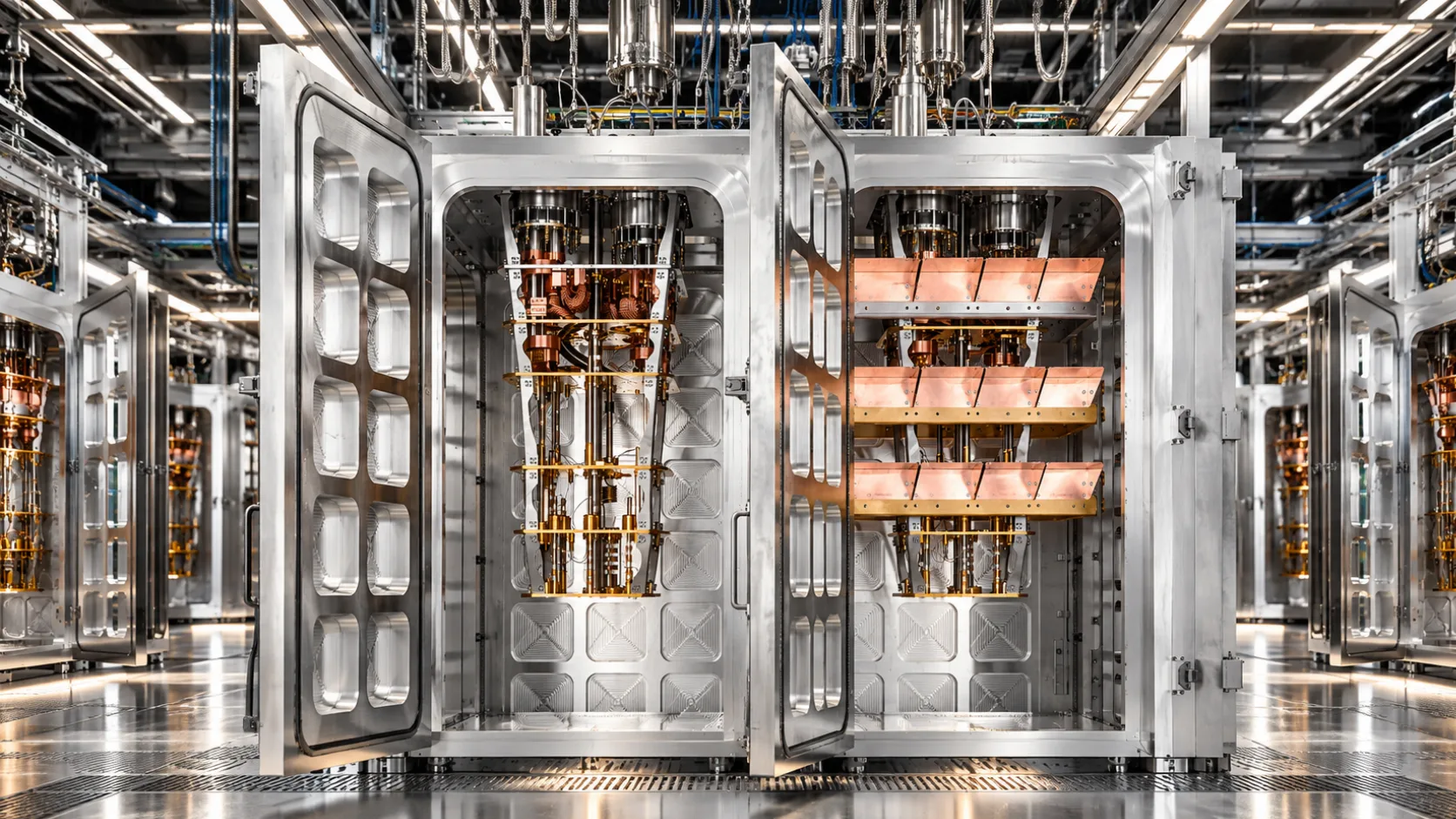
30 October 2026 – IBM Research has announced a significant advance in modular quantum computing, successfully connecting two IBM Quantum Nighthawk processors and achieving an average quantum state transfer fidelity of 99% across four long-range quantum interconnects.
The research, published on 27 October 2026 and highlighted in IBM Research’s latest Circuit Breaker newsletter, addresses one of the central challenges facing quantum computing: how to build larger systems without relying entirely on increasingly complex individual processors.
The experiment used four long-range connections, known as l-couplers, to transfer quantum information between separate superconducting processors. IBM reports that the technique could support larger quantum algorithms and more advanced error-correction codes, both essential components of its roadmap towards fault-tolerant quantum computing.
The announcement comes during a week of broader research developments at IBM, including deeper integration of its Spyre AI accelerator with PyTorch and celebrations marking 70 years of IBM Research in Zurich, Switzerland.
Why Quantum Computing Needs to Move Beyond a Single Processor
Quantum computers use quantum bits, or qubits, to process information through principles such as superposition and entanglement.
Unlike conventional computers, which represent information using binary bits, quantum processors can exploit quantum properties to perform certain types of computation differently.
However, increasing the number of qubits within a single processor presents substantial engineering challenges.
Larger systems require more complex wiring, sophisticated control mechanisms and extremely low operating temperatures. Quantum information is also sensitive to environmental disturbances and operational errors.
IBM’s approach to addressing these challenges involves modular quantum computing.
Rather than attempting to build a single processor containing every qubit, the company is developing systems in which multiple quantum processing units work together.
For this architecture to function, quantum information must move reliably between individual chips.
The latest l-coupler experiment demonstrates progress towards establishing those connections while maintaining sufficiently high fidelity to support increasingly complex operations.
How IBM Connected Two Nighthawk Quantum Processors
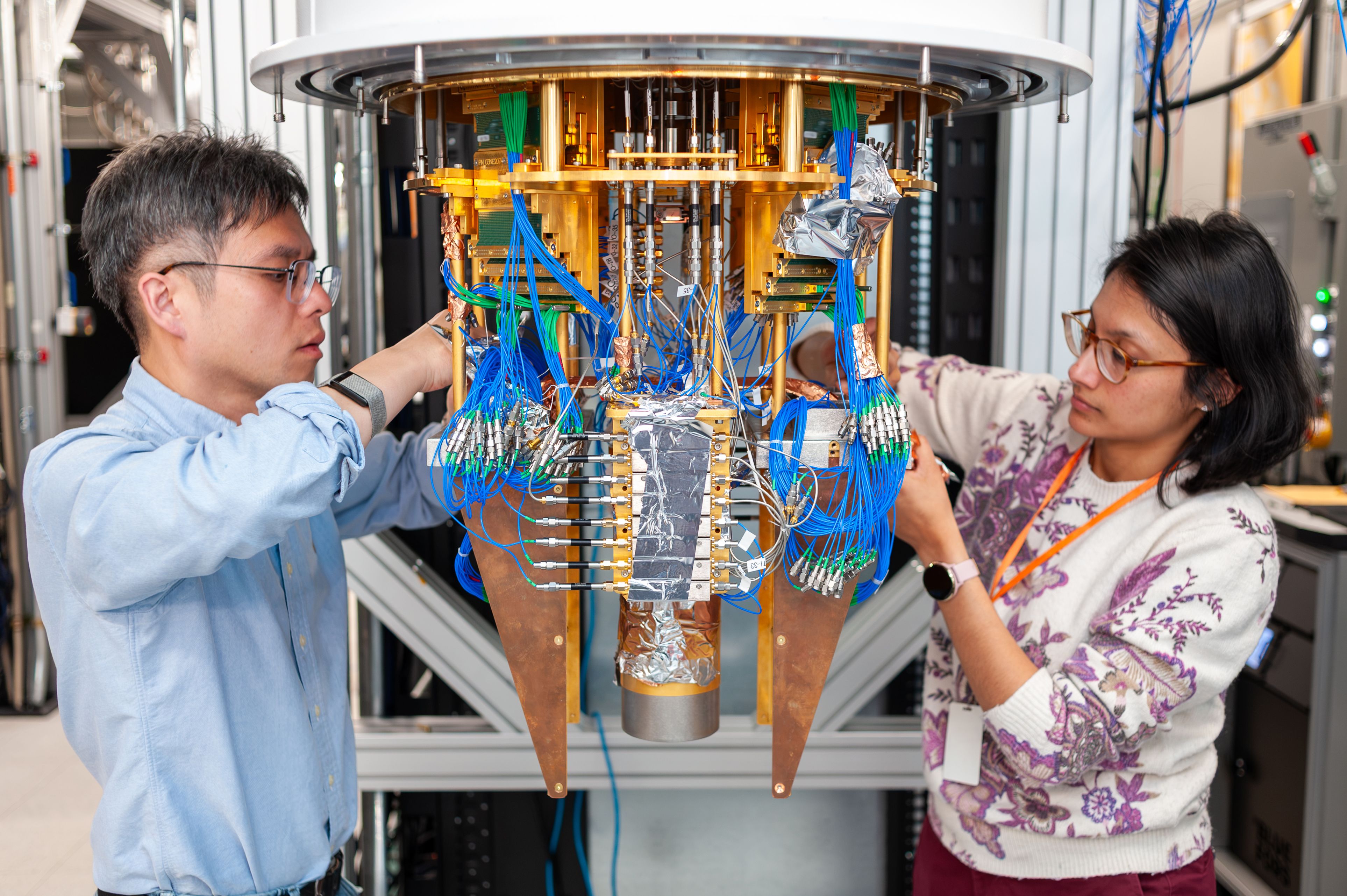
IBM researchers connected two Quantum Nighthawk R1 processors inside a dilution refrigerator using four aluminium-based l-couplers.
Each connection incorporated an 80-centimetre cable and components designed to transfer quantum states between processors.
The experiment achieved average quantum state transfer fidelity of 99%, with individual measurements reaching 99.3%.
In practical terms, IBM reports that the quantum state was transferred correctly approximately 99% of the time on average.
Researchers also demonstrated controlled-Z (CZ) operations between the two modules, achieving an average two-qubit gate fidelity of 94.75% across the four connections.
These operations enabled the creation of entangled states shared between the processors.
The demonstration is significant because the researchers were able to operate multiple connections within a hardware design intended to be compatible with larger superconducting quantum processors.
However, the experiment used only a subset of each processor’s qubits for development purposes. It does not represent a complete fault-tolerant quantum computer.
What Are L-Couplers and Why Do They Matter?
An l-coupler is a long-range connection designed to transfer quantum information between separate processing modules.
In IBM’s superconducting quantum architecture, these connections are distinct from the shorter couplers used to connect qubits within an individual chip.
The new design includes coaxial cables, specialised interface qubits, tunable coupling components and supporting control electronics.
One important engineering feature is that the connections can be installed after processors have been mounted inside a cryogenic system.
This could make it easier to construct modular systems and connect additional processing units as hardware capabilities expand.
IBM considers high-fidelity interconnects necessary for running quantum algorithms and error-correction schemes across larger numbers of qubits.
Although a 99% state transfer fidelity represents encouraging progress, further reductions in errors will be required before these connections can support the demands of large-scale, fault-tolerant computation.
IBM Quantum Starling and the Road to Fault-Tolerant Computing
The research contributes to IBM’s longer-term plans for IBM Quantum Starling, a proposed fault-tolerant quantum computing system.
Fault-tolerant quantum computing involves using error-correction techniques to protect quantum information and enable reliable calculations despite errors in underlying hardware.
Such systems require more than a large number of physical qubits. They also need accurate operations, reliable connections and architectures capable of supporting quantum error correction.
IBM’s modular approach aims to distribute computing tasks across interconnected processors, allowing systems to grow beyond the limitations of individual chips.
The company intends to improve the reproducibility and reliability of its l-couplers, increase the number of available connections and integrate them into larger quantum systems.
For industries studying quantum computing, including pharmaceuticals, chemistry, materials science and financial modelling, scalable fault-tolerant systems remain a long-term research objective rather than an established commercial capability.
The latest experiment is therefore best understood as an advance in the infrastructure required to build such machines.
IBM Spyre AI Accelerator Gains Deeper Integration With PyTorch

Spyre is a specialised accelerator designed for AI inference, including workloads involving language models, financial analysis and enterprise applications.
The accelerator uses a dataflow architecture with 32 AI-optimised computing cores, differing from the execution model of conventional GPUs.
IBM’s latest work focuses on integrating Spyre into the widely used PyTorch ecosystem through software including torch-spyre, PyTorch Inductor and vLLM.
The objective is to allow developers to run familiar AI models on different hardware without rebuilding their applications around entirely separate programming frameworks.
According to IBM Research, the integration supports thousands of models from ecosystems such as Hugging Face and vLLM, while reducing the amount of specialised code required to operate the accelerator.
Improving AI Performance and Hardware Portability
IBM reports that its updated PyTorch compiler architecture is approximately seven times smaller than the previous implementation, making it easier to maintain and integrate improvements.
The company has also demonstrated performance improvements in specific workloads involving its Granite language models.
In one test using Granite 3.3 8B, changes to graph construction and execution reduced processing overhead, contributing to improvements of up to 1.7 times for prefill and 2.4 times for decoding.
These results relate to particular configurations and should not be interpreted as universal performance improvements across all models.
IBM is also working with open-source collaborators to improve compatibility testing, distributed inference and hardware-independent AI model implementations.
For enterprise technology teams, greater portability could make it easier to select AI hardware according to workload requirements, deployment environments and operational constraints.
The developments reflect a broader industry effort to make AI software less dependent on any single accelerator architecture.
IBM Research Zurich Celebrates 70 Years of Scientific Innovation
IBM’s latest research announcements coincide with the 70th anniversary of its Zurich laboratory, established in 1956 as the company’s first research facility outside the United States.
The laboratory has contributed to developments in nanotechnology, computing and materials science.
Among its historical achievements is the invention of the scanning tunnelling microscope by IBM researchers Gerd Binnig and Heinrich Rohrer, recognised with the 1986 Nobel Prize in Physics.
The Zurich laboratory held anniversary celebrations on 12 and 13 October 2026, bringing together researchers, industry partners and scientific institutions.
In a new interview, laboratory director Alessandro Curioni discussed IBM’s continuing work in advanced algorithms and its vision for integrating classical computing, quantum computing and artificial intelligence.
Curioni described a future in which CPUs, GPUs and QPUs operate together, supported by agentic AI systems that coordinate computing resources.
His perspective highlights the growing importance of combining different architectures rather than expecting one type of processor to handle every computational challenge.
The Future of Computing May Depend on Interconnected Systems
IBM’s latest developments illustrate two related directions in advanced computing.
The first involves connecting quantum processors to build systems capable of performing larger and more reliable quantum computations.
The second involves making AI accelerators compatible with common software frameworks, enabling organisations to use different computing architectures through familiar development tools.
Together, these research efforts demonstrate the increasing importance of interoperability, modularity and software integration.
Quantum computers will still need substantial improvements in error correction before they can deliver reliable fault-tolerant operations at scale. Similarly, specialised AI accelerators must demonstrate consistent performance, compatibility and economic value across real enterprise workloads.
Nevertheless, IBM’s announcement demonstrates measurable technical progress in both areas.
The successful transfer of quantum information between Nighthawk processors at 99% average fidelity provides a foundation for further modular quantum experiments, while Spyre’s deeper integration with PyTorch addresses practical barriers to adopting alternative AI hardware.
As IBM Research enters its eighth decade in Europe, its work increasingly reflects a vision in which classical computing, artificial intelligence and quantum processors operate as complementary technologies.
The challenge ahead is converting these research advances into reliable, scalable systems capable of supporting scientific discovery and practical industrial applications.
About IBM Research
IBM Research is the research and development organisation of IBM, working across artificial intelligence, quantum computing, semiconductors, hybrid cloud, cybersecurity and advanced computing.
Its global laboratories collaborate with universities, businesses and scientific institutions to develop new technologies and explore their commercial and societal applications.
IBM Research Zurich, established in 1956, is one of the organisation’s major European research centres and has contributed to scientific advances including scanning tunnelling microscopy and quantum computing.
Official website: https://research.ibm.com/
Sources
1. IBM Quantum — Modular Quantum Computing Takes Shape With L-Couplers, 27 October 2026
https://www.ibm.com/quantum/blog/connecting-quantum-processors-with-l-couplers
2. IBM Research — PyTorch Opens the AI Ecosystem to a New Class of Accelerators, October 2026
https://research.ibm.com/blog/pytorch-spyre-accelerator-software-ecosystem-updates
3. IBM Research — Integrating the IBM Spyre Accelerator, PyTorch Conference 2026
https://research.ibm.com/publications/integrating-the-ibm-spyre-accelerator
4. IBM Research — How Zurich Is Shaping the Future of Algorithms, 70 Years In, October 2026
https://research.ibm.com/blog/celebrating-70-years-ibm-research-europe