NVIDIA expands its Agent Toolkit with Agent Knowledge Foundation, introducing Nemotron Retriever, new Kumo AI models and accelerated data-processing libraries to help businesses build AI agents that understand company information, make predictions and support operational decisions.
NVIDIA has introduced Agent Knowledge Foundation at GTC Berlin 2026, expanding its open-source Agent Toolkit with new technologies designed to connect autonomous AI agents to enterprise information. Announced during CEO Jensen Huang’s keynote on October 21, the framework combines accelerated computing libraries, retrieval models and predictive AI capabilities to help organisations make better use of their proprietary data.
The new foundation addresses one of the central challenges facing enterprise AI adoption: enabling intelligent agents to work with the information, relationships and operational context that businesses already maintain across documents, databases and software platforms.
NVIDIA says Agent Knowledge Foundation can help organisations build agents that retrieve relevant information, interpret business relationships and make predictions without requiring companies to move their data or replace existing workflows.
The announcement is part of a broader expansion of NVIDIA Agent Toolkit, which brings together AI models, enterprise knowledge, tools and secure execution environments to support increasingly sophisticated autonomous systems.
NVIDIA Agent Knowledge Foundation: Turning Enterprise Data Into Intelligence
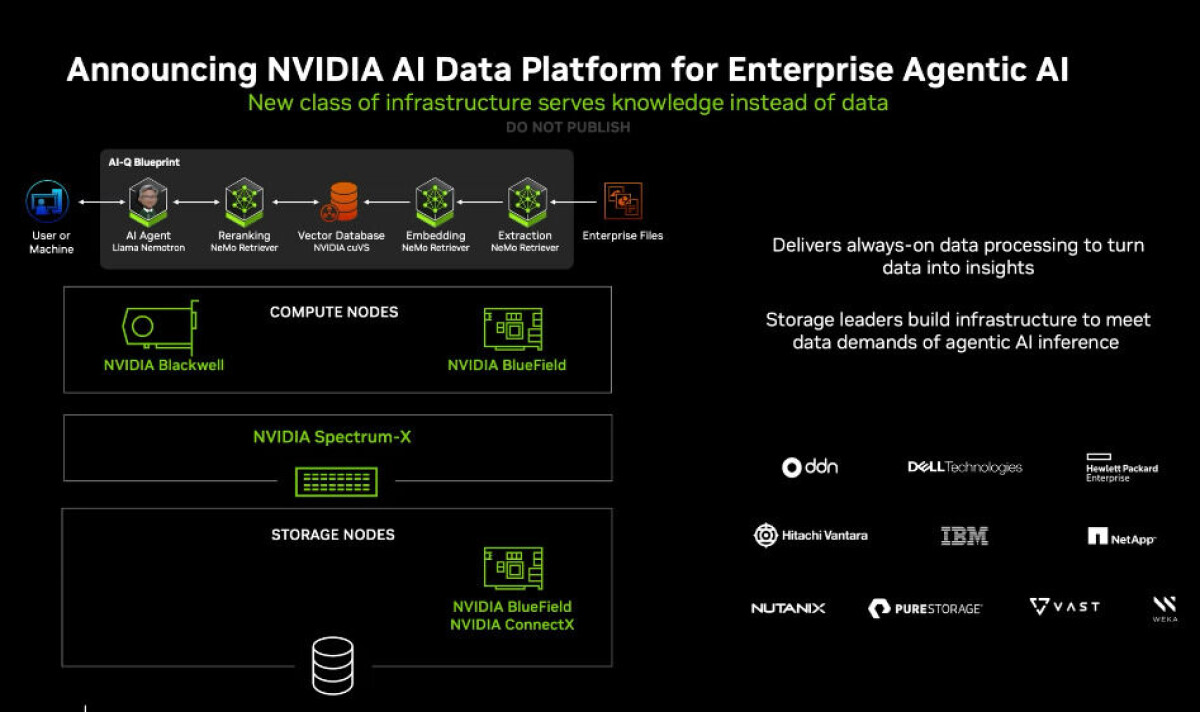
Businesses generate substantial volumes of information through customer interactions, financial transactions, supply chains, operational systems and internal documentation. However, this information is often distributed across databases, enterprise applications and document repositories.
For AI agents to perform useful work, they need more than access to a powerful language model. They must also identify relevant information, understand its business context and operate within the permissions established by the organisation.
NVIDIA Agent Knowledge Foundation aims to address these requirements by combining data processing, information retrieval, machine learning and business knowledge representation.
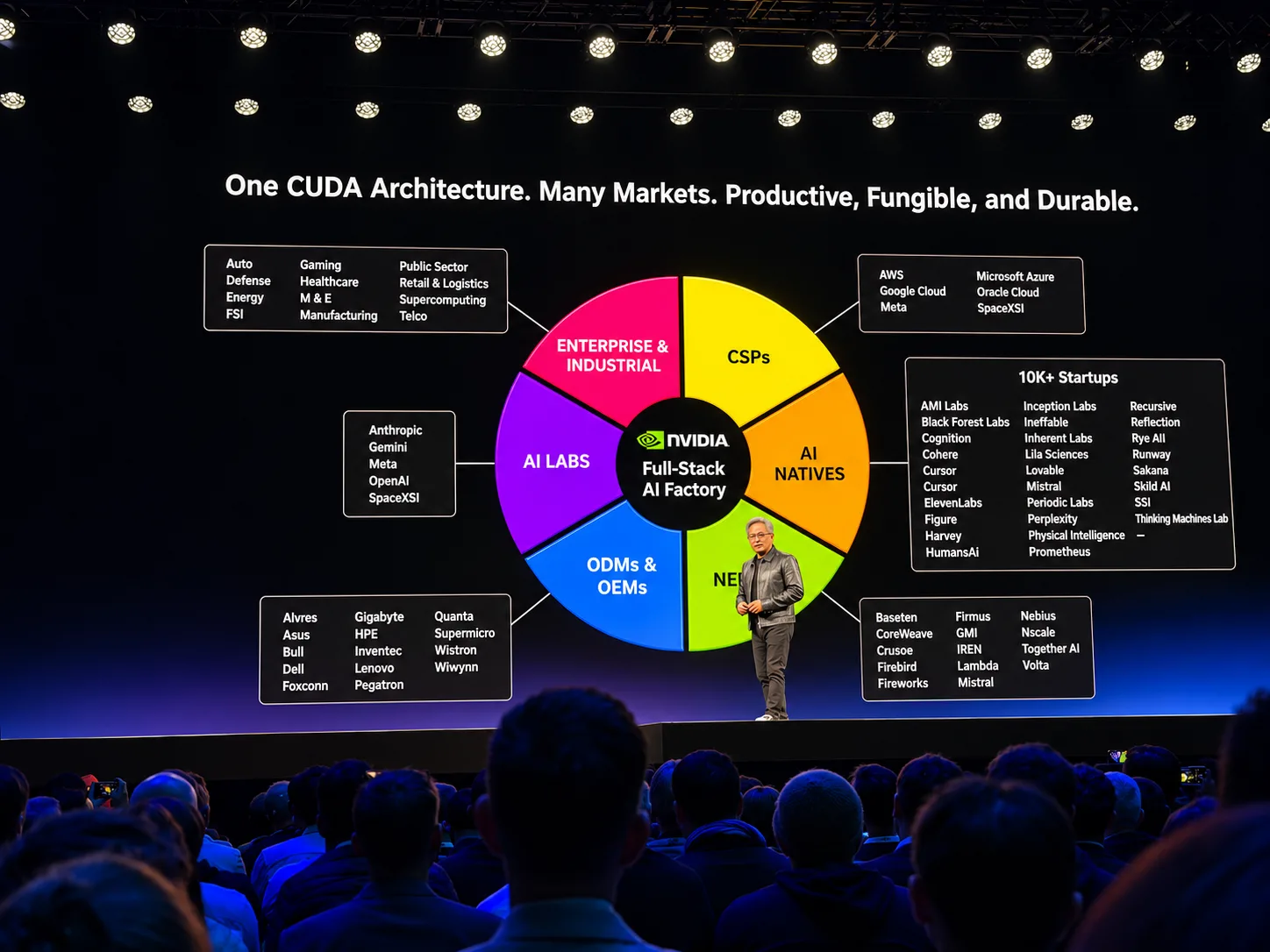
The framework includes NVIDIA CUDA-X libraries such as cuDF, cuGraph, cuML, cuOpt and cuVS, which support GPU-accelerated data processing, graph analytics, machine learning, optimisation and vector search.
These technologies allow developers to build workflows that analyse information from different sources and make it accessible to AI applications.
A key addition is NVIDIA Auto-Ontology, a library designed to translate raw enterprise data into recognisable business concepts such as customers, products, suppliers and orders. It also helps represent relationships between these concepts.
For example, an enterprise agent investigating a delivery delay may need to understand how an order relates to a supplier, a warehouse, an inventory record and a customer. Establishing these relationships can help the agent interpret the available data more effectively.
By combining these capabilities, NVIDIA aims to help enterprises develop agents that move beyond retrieving isolated facts towards understanding how information connects across business operations.
Nemotron Retriever and NVIDIA Kumo Bring Search and Prediction Together
Two important components of Agent Knowledge Foundation are NVIDIA Nemotron Retriever and the newly introduced Kumo Structured model family.
Nemotron Retriever supports the information-retrieval capabilities required by enterprise AI systems. These include finding relevant documents, representing information through embeddings and ranking search results to identify the most useful content.
Such capabilities are important for retrieval-augmented generation, or RAG, which allows AI systems to answer questions using information retrieved from external sources rather than relying entirely on their training data.
The NVIDIA Kumo family extends the approach to structured enterprise information.
The models include Kumo Tabular, Kumo Relational, Kumo Time Series and Kumo Forecast, supporting different forms of structured data analysis and prediction.
These capabilities could help businesses develop applications that examine customer behaviour, identify unusual patterns, estimate demand or analyse operational performance.
For instance, a logistics organisation could combine information about orders, delivery schedules and historical performance to support demand forecasting. A financial institution could use structured-data analysis to identify patterns requiring further investigation.
The distinction is important: retrieving information helps an agent understand what is known, while predictive modelling helps it estimate what may happen next.
NVIDIA is bringing both capabilities into an integrated framework for enterprise agents.
Palantir, Snowflake and Databricks Expand Enterprise Applications
NVIDIA has identified several technology partners already incorporating Agent Knowledge Foundation into their enterprise platforms.
Working with Palantir, NVIDIA’s own supply chain organisation is using Agent Knowledge Foundation through Palantir Foundry, Ontology and AIP to deploy specialised agents that analyse proprietary information, predict outcomes and support decision-making.
Databricks is combining NVIDIA Kumo Anomaly with Databricks Genie Ontology to support context-aware AI agents that can interpret structured enterprise data.
Snowflake is enabling customers to use NVIDIA Kumo Engine and Kumo Relational models within Snowflake Notebook environments, creating opportunities for predictive analytics within existing data workflows.
These integrations reflect NVIDIA’s strategy of bringing AI capabilities to enterprise information rather than requiring organisations to rebuild their technology environments around a new standalone platform.
NVIDIA also highlighted improvements achieved by partners using Nemotron Retriever models.
According to the company, SAP achieved nearly three times faster execution with a fine-tuned reranking model, while ServiceNow improved retrieval quality and reduced latency by nearly 25%.
Amazon OpenSearch Service reported improvements in search relevance with fewer retrieval steps, while Zoom is using Nemotron Retriever to support document understanding and context retrieval for its AI services.
These are partner-reported results associated with specific implementations and should not be interpreted as guaranteed improvements for every enterprise workload.
From AI Assistants to Agents That Understand Business Context
The introduction of Agent Knowledge Foundation reflects a wider change in the design of enterprise artificial intelligence.
Traditional AI assistants generally respond to questions using information provided through a prompt or retrieved from an external source.
More advanced agents can combine information retrieval with reasoning, tools and multiple steps of execution.
However, granting agents access to company data introduces challenges involving accuracy, confidentiality, permissions and accountability.
An AI system may retrieve technically accurate information but still misunderstand its significance within a particular business process. It may also produce unreliable recommendations when the underlying data is incomplete or outdated.
Developers must therefore evaluate the quality of retrieved information, the reliability of predictions and the permissions assigned to each agent.
These considerations become increasingly important when AI agents move from providing recommendations to executing actions within operational environments.
Security and Governance Remain Essential
NVIDIA Agent Knowledge Foundation is part of a wider Agent Toolkit that also includes OpenShell, NemoClaw and additional tools for building and operating AI agents.
OpenShell provides an isolated runtime intended to control what an agent can access and execute. NVIDIA NemoClaw blueprints offer reference designs for developing specialised agents with security considerations incorporated into their architecture.
The combination reflects NVIDIA’s approach to separating an agent’s intelligence from the systems governing its behaviour.
An enterprise agent may be capable of analysing sensitive financial information or identifying potential changes to operational processes, but the organisation must still determine whether that agent is authorised to act on its findings.
This distinction is particularly important in regulated industries, where companies must maintain appropriate safeguards around confidential information and operational decisions.
Businesses evaluating such systems should consider data quality, access management, auditing, human oversight and the reliability of the underlying models.
NVIDIA’s tools provide technical capabilities for developing these environments, but responsible deployment also depends on organisational policies and effective implementation.
What NVIDIA’s Announcement Means for Enterprise AI Adoption
The introduction of Agent Knowledge Foundation illustrates how the enterprise AI market is moving towards systems that combine models with structured business knowledge and operational tools.
For organisations, the potential value lies in making existing information more useful.
Employees frequently spend time searching internal systems, reconciling information from different sources and interpreting operational data before making decisions. AI agents capable of accessing relevant information and understanding business relationships could help streamline parts of these processes.
However, the business case will vary depending on the complexity of the task, the quality of the underlying data and the costs of deployment.
Not every organisation requires a sophisticated autonomous system. In some cases, conventional analytics, database queries or simpler automation may provide a more reliable and economical solution.
As explored in IntelligentHQ’s enterprise AI assistant use-case guide, an effective starting point is often a clearly defined business problem supported by permission-aware data retrieval and measurable outcomes.
NVIDIA’s Agent Knowledge Foundation expands the technical options available to organisations pursuing more advanced applications.
By connecting retrieval, structured-data analysis, predictive models and secure agent execution, NVIDIA is building towards an environment in which AI agents can work more effectively with the information businesses already possess.
The central challenge for enterprises will be translating these capabilities into reliable applications that improve productivity, support decisions and deliver measurable value without compromising data security or organisational control.
Sources
- NVIDIA Blog — NVIDIA Agent Toolkit Expands, Grounding Enterprise Agents in Company Data (21 October 2026)
https://blogs.nvidia.com/blog/enterprise-platforms-agent-toolkit/ - NVIDIA Blog — GTC Berlin 2026: Live Updates From NVIDIA CEO Jensen Huang’s Keynote (21 October 2026)
https://blogs.nvidia.com/blog/gtc-berlin-2026-keynote/ - IntelligentHQ — Enterprise AI and Agents With NVIDIA NIM, NeMo and Nemotron
https://www.intelligenthq.com/nvidia-ecosystem/solutions/enterprise-ai-agents/ - IntelligentHQ — Build an Enterprise AI Assistant: RAG Architecture, Roles and Risks
https://www.intelligenthq.com/nvidia-ecosystem/use-cases/enterprise-ai-assistant/