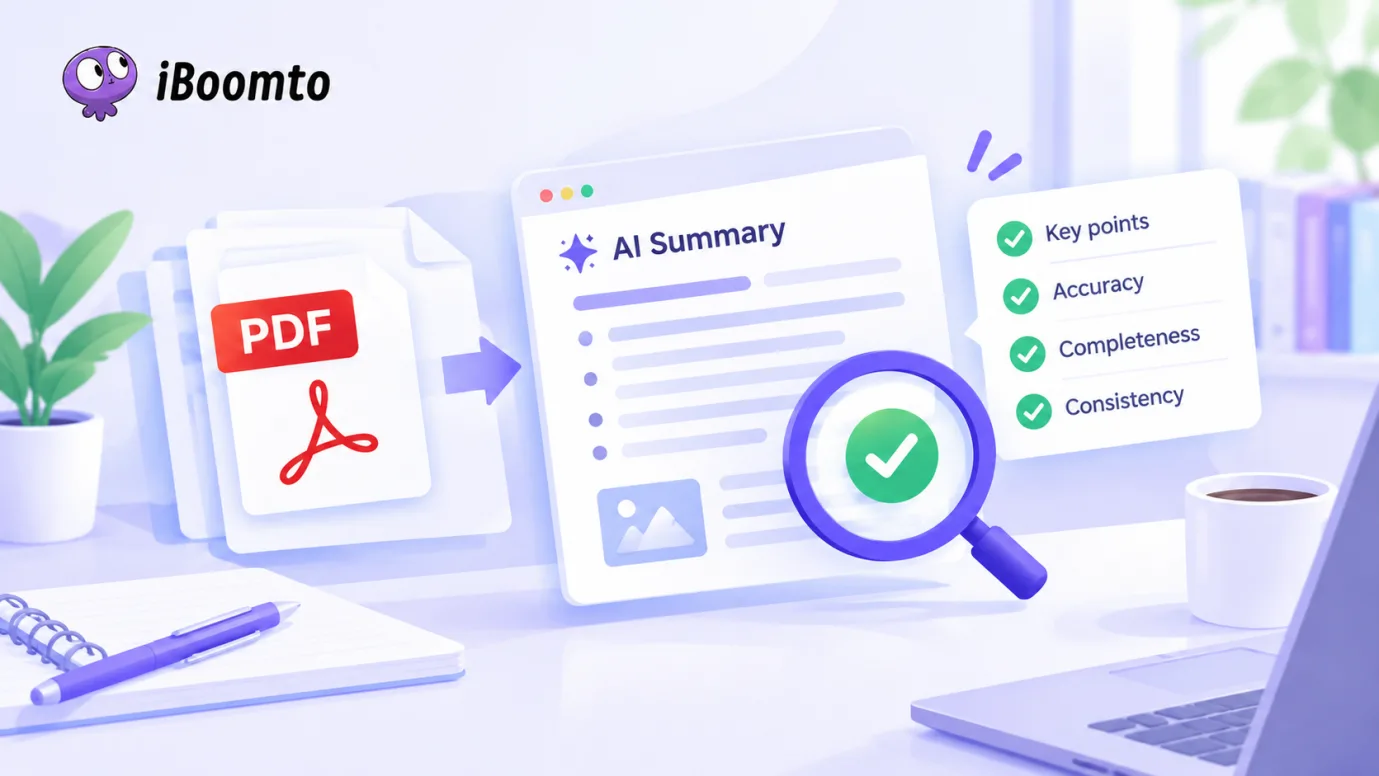
AI-powered PDF summarization tools make it easier to understand lengthy documents without reading every page. From research papers and business reports to technical manuals and financial documents, these tools can save time by highlighting essential information. However, AI-generated summaries are not always completely accurate. They may misinterpret numbers, omit important conditions, or present conclusions that the original document does not fully support.
Therefore, verifying a summary before using it is essential. With a systematic approach and tools such as iBoomto, readers can simplify document analysis while maintaining accuracy and confidence in the information they use.
1. Verify Numerical Accuracy
Numbers are among the most critical details in any PDF summary. A small mistake involving a percentage, date, financial figure, or measurement can significantly change a document’s meaning.
For example, a business report might state that revenue increased by 12% while operating costs rose by 7%. An AI-generated summary could accidentally reverse these figures or confuse actual results with forecasts.
Before relying on a summary, check all important numerical claims against the original PDF. Pay attention to percentages, totals, dates, reporting periods, statistical findings, and units of measurement. Tables, charts, and footnotes deserve particular attention because their information can be difficult for AI systems to interpret correctly.
If a summary states that sales increased by 15%, confirm whether the original document reports an actual increase, a projected result, or growth within a specific market segment. Accurate numbers are useful only when their original context is preserved.
2. Identify Missing Conditions and Exceptions
An AI-generated summary can contain accurate statements while still leaving out details that change their meaning. This often happens when a model simplifies complicated information to produce shorter, more readable text.
For instance, a contract might permit refunds only within 30 days and subject to specific eligibility requirements. A summary that simply states that customers can request refunds omits important conditions.
To identify these gaps, compare the summary with the relevant sections of the source document. Look for qualifying expressions such as “unless,” “subject to,” “provided that,” “except,” and “only when.” Review disclaimers, limitations, eligibility requirements, and exceptions as well.
This step is particularly important when summarizing legal agreements, financial policies, academic research, and compliance documents. A reliable summary should preserve the conditions that affect how a statement should be understood.
3. Check the Evidence Behind Conclusions
AI tools can sometimes make conclusions sound more certain than the source material justifies. A research paper might describe a possible relationship between two variables, while its summary incorrectly presents one as the cause of the other.
To prevent this, examine every important conclusion and ask whether the original document provides sufficient evidence to support it.
For research papers, review the methodology, results, and limitations. For business reports, examine the underlying data and assumptions. For legal documents, consult the relevant clauses rather than relying exclusively on a simplified explanation.
Whenever possible, use summaries that provide page references or supporting quotations. These features make it easier to locate the original evidence and verify individual claims.
If a summary includes a recommendation or prediction, check whether it represents a confirmed finding, an estimate, or an opinion. This distinction helps prevent unsupported conclusions from influencing important decisions.
4. Use iBoomto to Simplify PDF Review
iBoomto is a tool to consider when looking for ways to simplify PDF reading and summarization. An AI PDF summarizer can help readers identify key points, understand the central ideas of lengthy documents, and determine which sections require closer examination.
Using the iBoomto AI PDF summarizer readers can explore an AI-assisted approach to working with PDF content. Rather than treating a generated summary as a final authority, users should use it as a starting point for a more focused review of the original document.
For example, imagine summarizing a business report that discusses potential cost savings from a proposed investment. If the summary presents those savings as guaranteed, compare the statement with the original report to determine whether the figures are forecasts based on assumptions or results already demonstrated.
A practical verification process when working with iBoomto includes the following steps:
- Review key claims: Identify important figures, dates, findings, and recommendations in the summary.
- Compare the source: Locate the corresponding information in the original PDF.
- Check missing details: Review footnotes, disclaimers, exceptions, and limitations.
- Evaluate conclusions: Confirm that the supporting evidence justifies the summary’s wording.
- Resolve uncertainties: Investigate claims that cannot be clearly traced to the original document.
This workflow helps make AI-assisted document review more efficient without sacrificing careful judgment. Before relying on any particular feature, users should also confirm its availability in the tool they are using.
5. Understand Cloud-Based vs. Local AI Models
The quality of an AI-generated summary depends partly on the model, the document’s structure, and the processing method. Choosing between cloud-based and local AI models can influence both performance and privacy.
Cloud-based models may provide access to advanced AI systems, larger context windows, and sophisticated document-processing capabilities. These features can be useful when summarizing lengthy reports or connecting information across multiple sections. However, accuracy varies by model and implementation.
Local AI models run on a user’s own computer or private infrastructure. They can provide greater control over sensitive documents and reduce reliance on external services. Their performance depends on the model’s capabilities, available hardware, and ability to process long documents and complex tables.
Neither approach guarantees an accurate summary. When evaluating a tool such as iBoomto, focus on the quality of its actual output, the accuracy of extracted information, and the ease of checking claims against the source. For confidential documents, review the service’s privacy and data-handling policies before uploading files.
Conclusion
AI-generated PDF summaries can save time, but their usefulness depends on accurate information and responsible verification. Check numerical claims, identify omitted conditions, and confirm that conclusions are supported by the original evidence.
Tools such as iBoomto can help readers approach lengthy PDFs more efficiently, while a consistent verification process reduces the risk of overlooking important details. Whether using a cloud-based service or a local AI model, the best results come from combining automated summarization with human judgment.
Before using a summary for research, professional communication, or business decisions, take the time to verify its most important claims against the original document.