Anyone who has been tracking NFT developments and news in real time knows that the NFT market today in 2026 doesn’t resemble the 2021 boom period in any way. Big names are quietly disengaging or shutting down their NFT projects.
Remember Nike’s RTFKT NFTs? Nike sold it to an undisclosed buyer in January 2026. Remember Nifty Gateway? One of the original blue-chip platforms. It closed on 23 February 2026. NFT Paris cancelled its entire 2026 conference, with organisers stating plainly that “The market collapse hit us hard.”
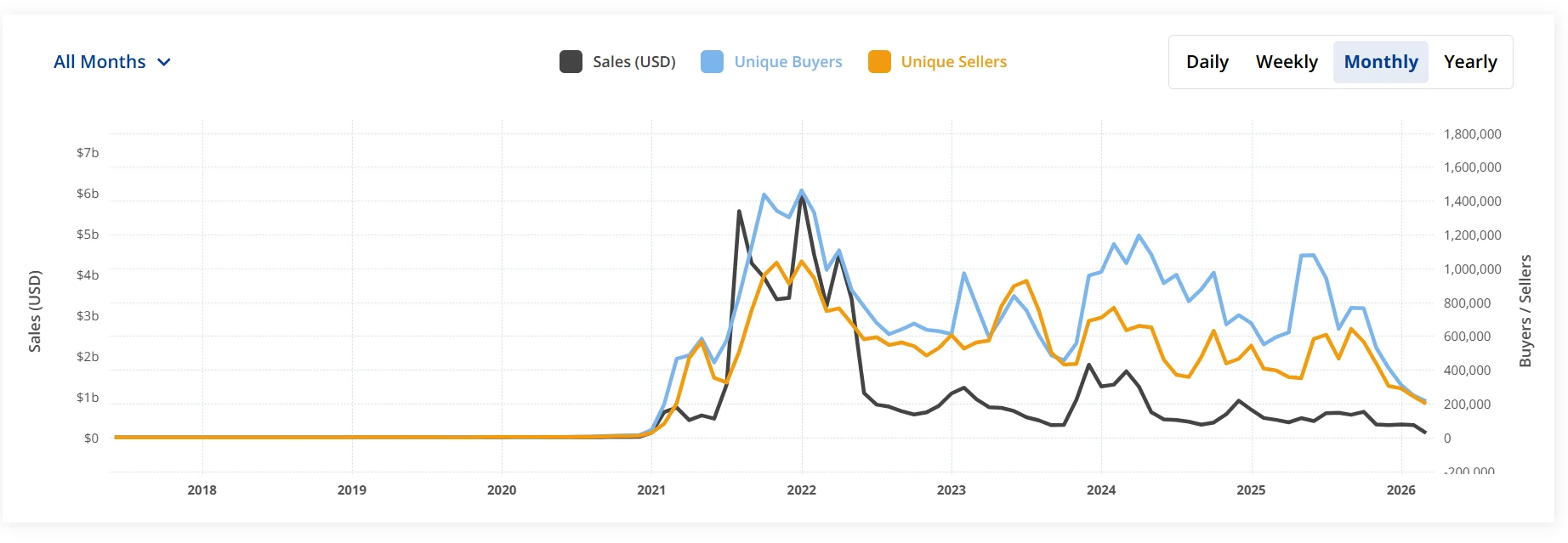
The NFT market cap sits at $1.5 billion, roughly 95% down from its 2021 levels. Monthly trading volume, which peaked at $6 billion in early 2022, printed at $106 million on March 1, 2026, according to CryptoSlam.
Is the NFT market dead?
By NFTs, if you mean the ‘JPEG art selling for millions,’ you are right. The casino-like speculation period has given way to a quieter, more specific, and in some ways more durable NFT market. The next-generation NFT projects are exploring practical use cases in gaming assets, digital identity, provenance authentication, and the early infrastructure for real-world asset tokenisation.
That context matters for understanding the NFT market today in 2026. The sector continues its structural reset. This article covers what collapsed, what survived, and what is genuinely emerging on the other side.
The Bursting of the Speculative Bubble (2022–2025)
The Numbers Are Worse Than the Headlines Suggest
The 2021 boom saw NFT trading volume swell, led by hype and speculation. In 2022, NFT sales peaked at roughly $23.7 billion. Everyone was rushing to buy NFTs, and every other person with a digital pen became an NFT artist.
NFTs were now the new-age collectibles. What started with CryptoKitties, prompting users to ‘breed’ digital cats, had celebrities like Paris Hilton, Bella Hadid, Takashi Murakami, and Jeff Koons, and brands like Reebok, Adidas, Louis Vuitton, Cartier, and Starbucks coming up with their own NFT collections.
Projects like Bored Ape Yacht Club and CryptoPunks were selling each of their NFTs for millions. It was a mad, mad rush, and until the bubble burst in mid-2022, when the FTX crash had the market spiralling downwards.
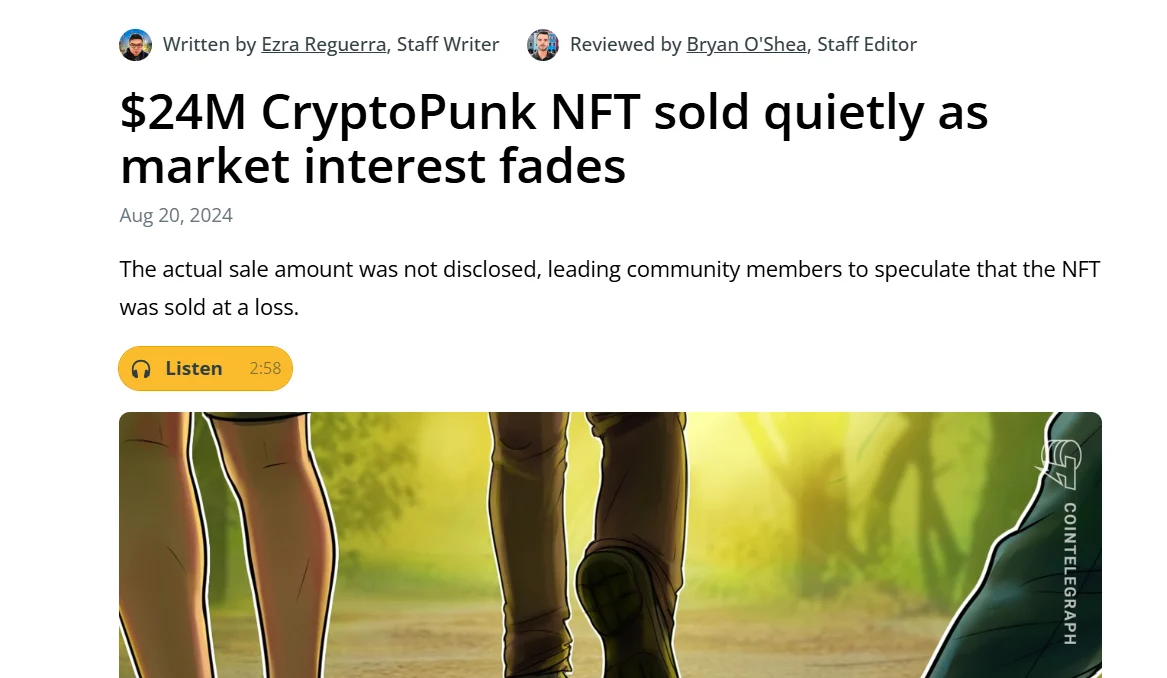
And as happens during hard times, people exercise caution and cut back on their ‘extra’ spending. NFTs were the discretionary splurge people were engaging in during good times. As soon as liquidity disappeared from the crypto market, the NFT market crashed.
By 2025, the annual NFT volume had fallen to $5.5–5.6 billion, showing a 37% decline from 2024 levels. The average sale price of Art NFTs had dropped from $462 per sale in 2021 to less than $100 by 2025.
A Supply Problem, Not Just a Demand Problem
Beyond the price charts, the NFT market also encountered a huge supply-demand problem. In 2025, the NFT supply climbed to 1.3 billion items, up 25% year-on-year. The total sales, on the other hand, had declined by 37%, and so had the number of unique buyers. As of March 1 2026, there were just 216K unique buyers.
The market is bloated with inventory that no one wants to price honestly. Minting NFTs costs almost nothing, but the signal value of owning one is also approaching nothing. The slow rind has given way to a clean reset.
What Actually Caused the Collapse
Three major events or forces caused the 2021 NFT market to collapse:
- Wash trading: happens when wallets sell to themselves to inflate prices. It masked true demand during the boom period. A Dune Analytics study found that over 80% of January 2022 NFT trading volume was wash trading.
- Macro tailwinds: First, there was Terra/LUNA’s collapse in May 2022, then the FTX implosion in November, which drained liquidity from all crypto markets. NFTs were at the highest-risk, lowest-liquidity tier of the market, and were hit first and hardest.
- Low-quality projects: Thousands of collections launched with no utility, no community, and no plan beyond the initial mint. Buyers had nothing to hold on it when prices stopped rising, and rug pulls became common.
The Exits That Confirm the Cycle Has Ended
Many substantial NFT projects closed during 2023-2026. Nifty Gateway, owned by Gemini and once the platform that hosted Beeple’s work and paid out over $500 million to artists over its lifetime, closed on 23 February 2026.
Some other names that shut down include Kraken NFT, X2Y2, LG Art Lab, Rodeo, and MakersPlace. Even OpenSea, the largest NFT marketplace, rebranded itself and postponed its IPO, citing bad market conditions.
Corporate retreats also kept happening simultaneously. Nike’s RTFKT Starbucks Odyssey loyalty NFT programme, and Reddit’s Collectible Avatars stack – all wound up quietly.
Why the Crash Was a Structural Correction, Not a Death
The 2021 crash and the aftermath don’t tell you whether the NFT market is dead. Rather, the crash stress-tested the market and filtered out projects that never meant business. Those that survived continue engaging a community and have inspired other good projects.
Good Projects Continue Engaging Communities
The collections with genuine community, real utility, or credible development teams are still operating. For instance,
- BAYC and CryptoPunks control the majority of the NFT market today.
- Pudgy Penguins pivoted beyond the PFP status. The project launched the $PENG token, introduced Soulbound Badges for community engagement, built Pudgy World (a browser-based metaverse), and launched Abstract Chain, its own Layer-2 built on Ethereum.
- Azuki launched AnimeChain in partnership with Arbitrum.
Layer-2 Infrastructure Got Developed
During the 2022-2024 market downturn, all the unglamorous work happened. For instance, Arbitrum, Optimism, and Base led the race for Layer-2 scaling on Ethereum. Ethereum’s upgrades helped reduce transaction costs. Account abstraction removed the need for users to manage seed phrases and gas fees manually.
Web3 infrastructure has now become effectively invisible to end users. These developments favoured the NFT market. For instance, Base recorded $122 million in NFT trading volume and 6.7 million sales in 2025, with June alone seeing a 336% month-on-month increase in volume.
Rise of Real-World Assets (RWAs)
The collapse of speculative art NFTs coincided with the rise of real-world asset (RWA) tokenisation. RWA tokenisation uses NFT-style smart contract infrastructure to represent on-chain ownership of physical or traditional financial assets, such as property, bonds, treasuries, fine art, and private credit. Total value locked in RWA tokenisation projects reached $65 billion in 2025, an 800% increase from 2023 levels, with over 200 active projects.
Tokenised US Treasury products are the biggest on-chain RWA category. BlackRock’s BUIDL fund on Ethereum holds $1.9 billion in assets. JPMorgan’s Onyx platform has processed over $900 billion in tokenised repo transactions. Goldman Sachs and BNY Mellon are tokenising money-market funds.
In fine art tokenisation, Louis Vuitton’s VIA programme, active through 2025, is a good example. It uses NFT membership passes to grant holders access to private channels, exclusive product drops, and limited-edition collectibles.
Ticketmaster has promoted token-gated sales, where holding a specific NFT unlocks presales, upgraded seats, or packaged experiences. Coachella sold lifetime festival-access NFTs with VIP perks. Lacoste’s UNDW3 programme connects NFT holders to creative contests and interactive experiences. All these projects have utility-first designs.
NFT Market Value in 2026: What Is Actually Worth Holding
There are quite a few ways NFTs are delivering value in 2026. Here are the top three use cases being considered a success in the 2026 NFT market:
On-Chain Royalties and IP Rights
Whichever NFT collections survive today, IP rights and royalties are a part of their value proposition. Yuga Labs gave BAYC holders commercial rights to their ape images early on. This model is being applied across gaming assets, music NFTs, and digital media. Holding an NFT in these ecosystems means holding a licence. Whenever a secondary sale happens, it triggers an automatic payment to the owner of the NFT.
Cross-Chain Interoperability and Liquid Assets
Blockchain interoperability is being made possible largely by cross-chain protocols. However, the tech is still maturing. Interoperable NFTs and RWAs offer greater practical utility and can serve much more than just as collectibles. An NFT on Ethereum that can be used as collateral on Solana, traded on Base, and verified on Polygon is a meaningfully more liquid asset than one locked to a single chain.
On-Chain Yield and Restaking
Tokenised Treasury NFTs function as yield-bearing instruments. A holder receives on-chain yield paid in stablecoin, and the NFT represents the legal claim to that yield stream. Over 30% of institutional NFT deals in 2025 featured fractional ownership structures or embedded yield mechanisms. Restaking protocols like EigenLayer allow staked assets to secure multiple networks simultaneously, generating layered yield.
Moving Towards A Smaller, More Honest NFT Market
The NFT market today, in 2026, is not the one that made headlines in 2021. Most of what made headlines in 2021 no longer exists. Monthly volumes are back to pre-boom levels. The average sale price is below $100. The market is smaller, more price-sensitive, and less forgiving of speculation without substance.
Gaming assets, digital identity, provenance authentication, and the early infrastructure for real-world asset tokenisation are areas drawing genuine institutional attention for their utility. The market is increasingly embedded in infrastructure that most users will never notice is built on NFT rails. That is a less exciting story than 2021, but much more utilitarian.