Did you know companies with strong training programs retain 94% of their employees? Corporate training isn’t an expense – it’s your secret weapon for closing skill gaps, boosting productivity, and future-proofing your organisation. How are top companies using AI-powered learning to transform their workforce and crush the competition?

Ever wondered why some companies seem to have it all together? Their teams are motivated, their productivity is soaring, and they’re consistently ahead of the curve. Well, here’s a little secret: it’s not just about hiring the right people. It’s about continuously developing them. That’s where corporate training comes in!
In today’s fast-paced business world, corporate training has evolved from a mundane HR checkbox to a strategic powerhouse. Whether it’s teaching new hires the ropes, upskilling seasoned professionals, or fostering the next generation of leaders, corporate training is the magic ingredient that keeps organisations agile, competitive, and future-ready.
But what exactly is corporate training? Why does it matter so much in 2025? What are the different types, and how can businesses implement them effectively? Let’s dive!
What is corporate training?
Corporate training is an organised effort by companies to enhance their employees’ skills, knowledge, and competencies through structured learning programmes. These programmes are designed to improve employee performance, boost productivity, and ultimately help the organisation achieve its goals. It spans a broad range of activities—from onboarding new hires and compliance training to leadership development and the acquisition of new technical or soft skills.
Employees often wonder why they need to dedicate precious working hours to training, but companies face continuous challenges such as adopting new technologies and adapting to industry changes. Corporate training equips employees to meet these challenges head-on, making them more capable and motivated contributors to the company’s success.
Training is typically orchestrated by Learning & Development teams in larger firms or Human Resources departments in smaller companies, who identify skills gaps, create relevant programmes, and evaluate their effectiveness.
Types of corporate training
Corporate training isn’t one-size-fits-all. Different goals require different approaches. Here are some of the most common types of training programmes organisations use today:
1. Onboarding training
Onboarding is all about helping new hires integrate seamlessly into the company. It goes beyond basic orientation to include role-specific training, mentorship, and cultural immersion. Effective onboarding can boost productivity and significantly reduce early turnover.
2. Compliance training
This type of training ensures employees adhere to legal and organisational standards. Think cybersecurity protocols, health and safety guidelines, diversity and inclusion policies, and industry-specific regulations. It’s essential for minimising risk and fostering a safe, ethical workplace.
3. Leadership development
These programmes prepare employees for management roles by honing skills like decision-making, communication, and emotional intelligence. Investing in leadership development helps cultivate future leaders from within and ensures consistency in leadership quality.
4. Technical skills training
As technology evolves, employees must keep up. Technical training focuses on job-specific hard skills, whether it’s coding for developers, data analysis for marketers, or mastering enterprise software for operational staff.
5. Soft skills training
Often called “power skills” in 2025, these include communication, teamwork, problem-solving, and adaptability. With automation on the rise, these human-centric skills are becoming even more critical for collaboration and innovation.
6. Diversity, equity, inclusion, and belonging (DEIB) training
DEIB initiatives aim to create more inclusive workplaces by addressing unconscious bias, promoting equity, and fostering a sense of belonging. Companies that prioritise DEIB tend to have higher employee engagement and better business outcomes.
7. Product training
Especially crucial for sales and customer-facing teams, product training ensures employees deeply understand the company’s offerings. This leads to better customer interactions, higher sales, and improved satisfaction.
Why is corporate training important?
Corporate training isn’t just a “nice-to-have”—it’s a strategic imperative. Here’s why:
Close skill gaps
Rapid technological advancements and shifting industry demands have created significant skill gaps. Training helps bridge these gaps, ensuring employees remain competent and confident in their roles.
Boosts employee engagement and retention
Employees are more likely to stay with a company that invests in their growth. In fact, 94% of employees would stick around longer if their organisation offered learning opportunities. Training shows employees they’re valued, which fuels loyalty and reduces turnover.
Future-proofs the organisation
Companies that prioritise training are better equipped to adapt to market changes, embrace digital transformation, and innovate. It’s no surprise that organisations with strong learning cultures are 52% more productive and more likely to innovate.
Enhances organisational culture
Training programmes, especially those focused on soft skills and DEIB, contribute to a positive, inclusive, and collaborative work environment. This strengthens company culture and improves overall morale.
Benefits of corporate training
The right training programmes deliver tangible benefits for both employees and organisations:
For employees:
- Skill enhancement: Employees gain new competencies, boosting their confidence and career prospects.
- Career growth: Training opens doors to promotions and internal mobility.
- Job satisfaction: Learning opportunities increase engagement and fulfilment at work.
For organisations:
- Increased productivity: Well-trained employees work more efficiently and effectively.
- Higher retention: Investing in development reduces turnover and recruitment costs.
- Better risk management: Compliance training mitigates legal and operational risks.
- Improved leadership: Homegrown leaders are more aligned with company values and goals.
- Competitive advantage: A skilled workforce drives innovation and helps companies stay ahead.
Best practices for effective corporate training
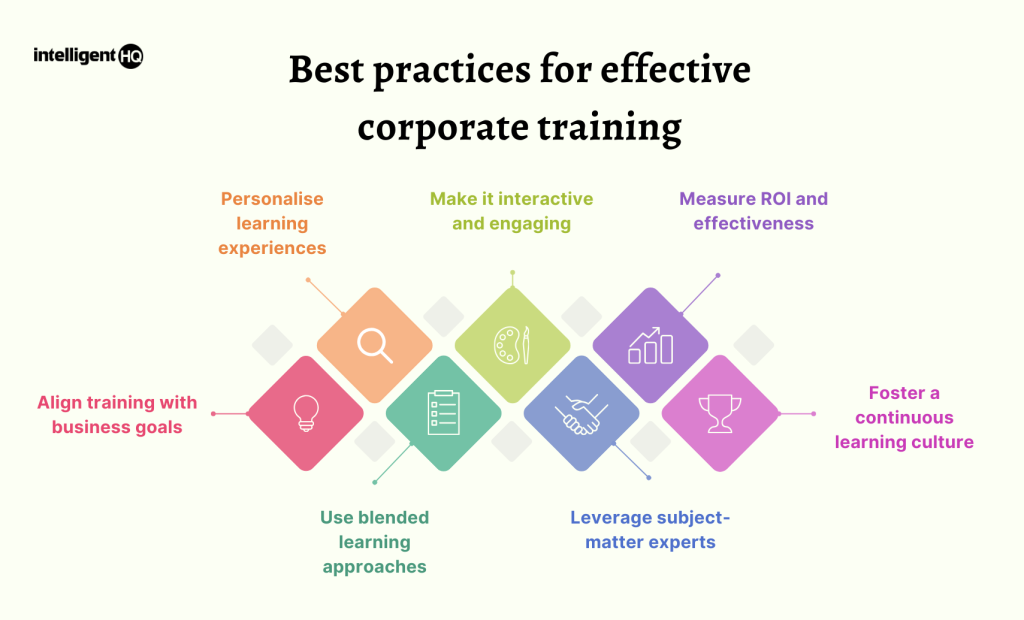
Want your training programmes to actually stick? Here are some best practices to follow:
- Align training with business goals: Before designing any programme, identify how it supports broader organisational objectives. Whether it’s improving sales, enhancing safety, or driving innovation, training should be strategically purposeful.
- Personalise learning experiences: Thanks to AI and data analytics, training can now be tailored to individual needs, preferences, and skill levels. Personalised learning paths improve engagement and outcomes.
- Use blended learning approaches: Combine online modules with in-person sessions, microlearning, and on-the-job training. This flexibility caters to diverse learning styles and busy schedules.
- Make it interactive and engaging: Ditch the boring PowerPoints! Use gamification, simulations, quizzes, and role-playing to make learning fun and memorable. Interactive elements boost knowledge retention and participation.
- Leverage subject-matter experts (SMEs): Tap into the knowledge within your organisation. Involving SMEs in content creation ensures training is relevant, practical, and trusted by learners.
- Measure ROI and effectiveness: Track metrics beyond completion rates. Look at performance improvements, productivity gains, employee retention, and other business outcomes to prove the value of training.
- Foster a continuous learning culture: Training shouldn’t be a one-off event. Encourage ongoing development through mentorship, knowledge sharing, and easy access to learning resources.
Corporate training in 2025: What’s next?
The future of corporate training is exciting! Here are a few trends shaping the landscape:
- AI-powered learning: AI is making training more adaptive and personalised, with tools that recommend content based on individual progress and needs.
- Microlearning: Bite-sized, on-demand lessons allow employees to learn in the flow of work, making training less disruptive and more applicable.
- Focus on soft skills: As automation grows, skills like critical thinking, empathy, and creativity are becoming even more valuable.
- Purpose-driven learning: Training programmes now often include sustainability, ethics, and social responsibility, reflecting broader corporate values.
Online vs offline training: Which is better?
Each mode of training has its pros and cons:
- Offline training:
- Pros: Familiar format, encourages interaction, easy to maintain.
- Cons: Higher per-learner costs, requires physical space, limits class size.
- Online training:
- Pros: Flexible location, scalable, cost-effective over time, accessible on demand.
- Cons: Possible lack of engagement, dependent on internet and tech skills, less immediate feedback.
Final thoughts
Corporate training is no longer a luxury but a necessity for companies aiming to thrive in today’s competitive landscape. It benefits employees by expanding their career horizons and boosting job satisfaction, while organisations enjoy improved productivity, innovation, and retention.
Invest in well-planned corporate training programmes that suit your company culture and objectives. Whether through in-person workshops or interactive online platforms, continuous learning is your organisation’s secret weapon to staying ahead of the curve.
Remember, training is not just about adding hours to the workweek, it’s about investing in your greatest asset: your people. When done right, corporate training leads to a motivated, skilled, and resilient workforce ready to meet the challenges of the future head-on.
This makes corporate training the smart choice for any forward-thinking organisation in 2025 and beyond.

Himani Verma is a seasoned content writer and SEO expert, with experience in digital media. She has held various senior writing positions at enterprises like CloudTDMS (Synthetic Data Factory), Barrownz Group, and ATZA. Himani has also been Editorial Writer at Hindustan Time, a leading Indian English language news platform. She excels in content creation, proofreading, and editing, ensuring that every piece is polished and impactful. Her expertise in crafting SEO-friendly content for multiple verticals of businesses, including technology, healthcare, finance, sports, innovation, and more.