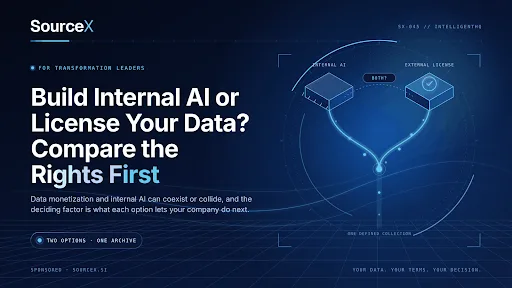
Data monetization and internal AI can coexist or collide, and the deciding factor is what each option lets your company do next.
Two proposals reach the executive agenda in the same illustrative quarter, and both want the same ten years of support history. The product group wants to train an internal assistant on it. Finance has heard the same history could be licensed to AI developers for a one-time fee.
Both sound like a smart use of an asset the company already owns, and both can be. The mistake is settling it by which idea sounds bigger in the meeting.
Framed as data monetization vs internal AI, it sounds like a choice between two strategies; it is really a decision about specific uses of a specific collection. Keeping your original records does not, by itself, keep every future option open.
Put a name and a date on the internal plan
Internal AI ambitions vary widely: one team wants a retrieval assistant that surfaces current guidance for staff. Another wants to fine-tune a model on a recurring task. A third may really need better reporting, not AI at all.
Write down the expected benefit, the records it needs, the owner and the timetable. A plan with all four is a real competing claim on the data. A plan with none of them is a hope.
This discipline cuts both ways. It stops a concrete external offer from being rejected because of a vague future project, and it stops a valuable internal project from being sidelined by an attractive headline number.
A plan with all four is a real competing claim on the data. A plan with none of them is a hope.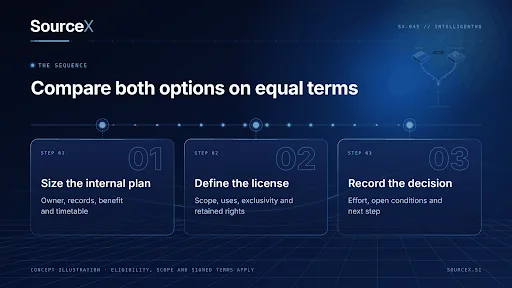 Compare both options on equal terms. A conceptual sequence drawn from this article, not a measured result or a completed transaction.
Which licensing rights affect internal AI plans?
Any external license worth considering should spell out:
- Which records are selected, and which are excluded
- The permitted uses and any onward rights for the licensee
- Duration, exclusivity and exactly what that exclusivity restricts
- What the company retains the right to do with its own data
Ownership of the originals is only one line in that list. A company can keep its records while granting durable rights over the prepared dataset and accepting limits on licensing similar material to other AI buyers.
So map precisely which future activities would be affected. Sometimes a narrower snapshot, a shorter period or a tighter purpose changes the whole comparison, if the counterparty agrees to it.
How should you compare the cost of each option?
Internal AI needs engineering, maintenance, adoption and ongoing evaluation. Licensing needs inventory work, rights review, preparation and delivery support. Neither path is free.
Keep indicative licensing compensation apart from contracted payment, and keep hoped-for productivity apart from measured gains. Blend them and you get a spreadsheet that looks precise and decides nothing.
You do not need false precision. A clear account of what is known, what is estimated and what is still open beats an elaborate model built on guesses.
Before you choose a path: the four checks this article walks through.
The clauses to hold against your roadmap
Take SourceX as one concrete route. It licenses approved business records from companies for AI training and evaluation, and the company contracts with SourceX directly, with no broker or marketplace in between; SourceX manages qualification, scope, rights review, preparation and payout under signed terms.
The company keeps ownership of its original records. Selected data is exclusive to SourceX for AI training for the term in the Dataset Deal Confirmation. Separately, SourceX’s rights over the deidentified dataset are perpetual, irrevocable, transferable and sublicensable, including model training and evaluation, use in products and onward distribution. Once the fee is paid, those rights survive termination, with no obligation to untrain or delete models already built from the data.
SourceX advertises up to $4 million for the largest enterprise datasets, not a typical payout or a guaranteed offer. Leave the ceiling out of your base case. The signed Dataset Deal Confirmation fixes the actual collection, fee and rights; acceptance and Closing still have to follow.
Extraction and delivery require a signed Master Supplier Licensing Agreement, a signed Dataset Deal Confirmation and SourceX’s go-ahead. Signing does not guarantee a purchase: SourceX may decline the delivered data. Written acceptance and every Closing condition lead to a Closing Notice, then an invoice. Under standard terms, payment is due within 60 calendar days after SourceX receives a valid invoice, unless different terms are signed. Data that does not reach Closing earns no payment.
Write a one-page decision record
Give leadership a single page covering six things: the collection, the internal use, the proposed external rights, the effort each path requires, the unresolved conditions and the next step.
If the answer is to explore licensing, list the new information that could reverse the decision. If the answer is to keep the data for internal use, name the project owner and the reason. The choice then becomes reviewable rather than reflexive.
Ask in writing how the proposed rights affect internal training and retrieval. Read that answer with the full grant and your product roadmap.
Can a company license its data and still use it for internal AI?
Potentially, yes, but only if the signed terms say so. Put one question to the counterparty in writing: does the AI-training exclusivity limit our own internal training and retrieval on these records, or only licensing them to other AI buyers?
Read that answer with the full grant, including onward rights, duration and any restrictions on internal training or retrieval. Ask for a signed clarification or amendment where needed. Then compare a concrete internal project with the proposed license, including the effort and conditions on each side.
Until leadership can say in one sentence what each option lets the company do next, the data monetization vs internal AI debate is still a debate about headlines.
Start with SourceX‘s no-upload company fit check if an external license merits review. Compare the actual proposed rights with a named internal project before committing the same records to either plan.
About the founder
Noah Loul is a four-time founder and the founder and CEO of SourceX, which licenses business data directly from companies for AI training and evaluation. He previously founded B2B Rocket, acquired by Blackpearl Group. His work focuses on building permission-based data infrastructure for AI.