Keeping every employee aligned once meant emailing a PDF and ticking a box. Today, regulators insist on iron-clad proof that every worker has read, understood, and signed every policy. Yet 47 percent of compliance leaders still cite employee training as their top headache. Manual trackers and scattered SharePoint folders simply don’t scale.
We reviewed dozens of policy-management tools and narrowed the field to 5 enterprise-ready platforms. Each automates the full lifecycle—draft, approve, publish, attest, and audit—while surfacing real-time dashboards your board and regulators can trust. Use this guide to choose the partner that turns policy chaos into audit-ready clarity.

How we evaluated and ranked these platforms
Choosing a policy tool isn’t about pretty dashboards; it’s about proving, on demand, that every policy is current and every employee is covered. To separate true enterprise-grade solutions from slick point products, we followed a two-step vetting process.
Inclusion criteria
First, we drew a hard line around what matters to large and mid-market organisations. A platform had to:
- Target enterprise buyers with SOC 2 or ISO 27001 security.
- Deliver built-in employee attestations, no bolt-on e-signature hacks.
- Automate at least one compliance task beyond reminders (for example, control mapping or evidence pulls).
- Show real-world traction: more than 50 recent G2, Gartner, or analyst reviews.
- Offer transparent customer support, roadmap visibility, and clear commitments.
Anything that missed those checkpoints fell off the list immediately.
Scoring factors
Qualifying products then earned a composite score out of five across six weighted factors:
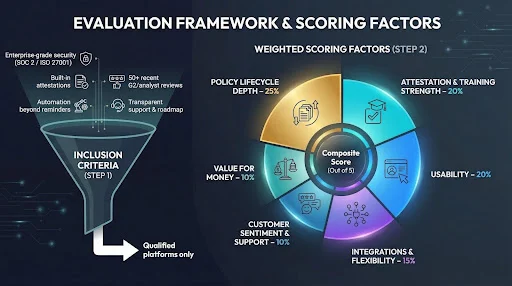
- Policy lifecycle depth (25 percent): from drafting to archival, plus workflow transparency.
- Attestation and training strength (20 percent): how reliably the system secures signatures and proves understanding.
- Usability (20 percent): a clean interface that busy employees and auditors grasp in seconds.
- Integrations and flexibility (15 percent): SSO, HRIS, IT controls, and open APIs that cut manual work.
- Customer sentiment and support (10 percent): recent analyst notes and user ratings.
- Value for money (10 percent): pricing clarity relative to automation depth.
Weighting favours features that reduce manual effort; after all, 56 percent of large enterprises already rely on automation to manage compliance. Our final ranking reflects each product’s blended score, so you can see, in black and white, who leads and why.
With the yardstick set, here are the contenders.
1. Vanta: AI-powered compliance automation for continuous policy and control alignment
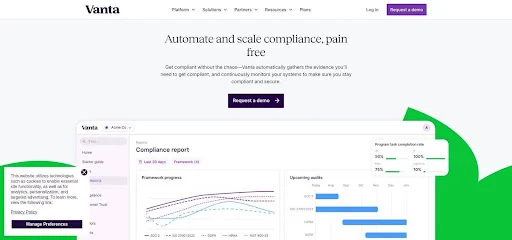
Vanta is an AI-powered compliance automation platform that brings policy management, staff attestations, and continuous control monitoring into one system. For teams that need to prove policies are current, mapped to real controls, and acknowledged by the right people, Vanta focuses on speed and audit-ready evidence. Vanta also maintains a buyer-facing comparison, the 5 best GRC software solutions of 2026, which walks through the criteria most teams apply when shortlisting.
Vanta is best for:
- Mid-market to enterprise security, compliance, and GRC teams scaling across one or more audits at once
- Organizations pursuing security and privacy frameworks where policies and technical controls need to stay linked
- Teams that want to reduce manual evidence collection and policy administration through integrations and automation
Policy lifecycle and employee attestations
Vanta covers the full policy loop, from drafting through approvals, publishing, and versioned recordkeeping. Smart Policy Builder uses AI to generate policies tailored to your company context, supported by 100+ vetted templates. You can also import existing policies in bulk.
For attestations, employees get a clean portal showing exactly what they need to read and sign. Signatures are tied to the employee’s SSO identity, with automated reminders and escalation for overdue acknowledgments. If you connect your HRIS, Vanta can automatically assign required policies to new hires on day one, which keeps onboarding from becoming a spreadsheet exercise.
Framework mapping that scales across audits
Vanta supports 35+ frameworks and maps policies to controls across those frameworks, so one policy can satisfy multiple overlapping requirements. This matters when your program expands beyond a single audit and you need to avoid rewriting and re-attesting the same intent in three different places.
Integrations and continuous automation
Vanta connects to 375+ tools across cloud infrastructure, identity, HRIS, device management, and DevOps. Those integrations drive continuous monitoring and evidence collection, with evidence pulled hourly so drift is visible quickly, not at the end of the quarter.
Beyond policy workflows, Vanta also automates adjacent compliance work such as access reviews and vendor risk workflows. It also supports questionnaire automation through QAuto.
AI features that reduce busywork
Vanta’s AI capabilities are built into day-to-day workflows, not positioned as a separate add-on experience. That includes the Vanta AI Agent, AI-powered remediation guidance, and an employee-facing policy chatbot for natural-language Q&A. The goal is to move faster on drafting, understanding, and closing gaps when controls or evidence fall out of date.
Reporting and audit readiness
For audit readiness, Vanta provides real-time dashboards plus a dedicated read-only auditor portal. It also offers a Trust Center designed to share security and compliance information with external stakeholders without constantly routing requests through your team.
Deployment, implementation, and pricing
Vanta is cloud SaaS, with no on-prem option. Initial implementations are typically 2 to 4 weeks for a first framework, and many teams aim to become audit-ready in under 30 days, then layer additional frameworks over time.
Pricing is package-based and scales with employee count, framework scope, and add-on modules such as vendor risk management, Trust Center, and access reviews. For current packages, reference vanta.com/pricing.
Trade-offs to know upfront: Vanta is strongest for security and technology-driven compliance programs. If you need deep, industry-specific policy content for areas like highly specialized financial regulation or pharmaceutical GxP, you may still need supplemental content and processes.
Choose Vanta if you want policies, attestations, and technical evidence living in one place, with automation and AI that keeps you continuously ready for audits, not just prepared once a year.
2. ConvergePoint: policy management that stays inside Microsoft 365
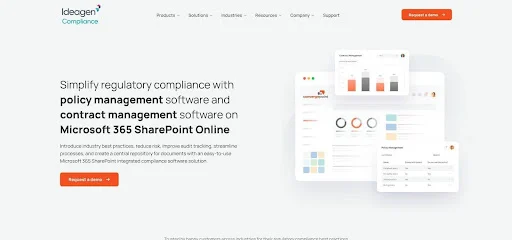
ConvergePoint is a SharePoint-native policy and compliance platform designed for organizations that want formal policy workflows and attestations without moving content into a separate SaaS system. Policies, approvals, and acknowledgment records can stay inside your Microsoft 365 tenant, which is a practical advantage for teams with strict security or data-residency expectations.
ConvergePoint is best for:
- Enterprises that already run policy work through SharePoint, Teams, and Outlook
- Regulated industries that prefer tenant-bound storage and, in some cases, on-prem SharePoint deployments
- Compliance teams that want targeted distribution and clear audit trails, without changing the employee experience
Policy lifecycle coverage: familiar tools, enterprise workflow control
ConvergePoint builds on what Microsoft already does well. Policy authors can work in familiar Office tooling within SharePoint, while approval workflows can be configured as multi-step routes and pushed through the channels employees already use, including Outlook and Teams. SharePoint versioning underpins change history, and retirement can follow established retention and archival practices.
Attestations: Azure AD identity plus targeted distribution
For staff acknowledgment, ConvergePoint uses Azure AD credentials for SSO-based sign-off. Distribution can be tightly scoped using Azure AD groups, so a policy can be sent only to the population that actually needs it, such as region, department, or role-based cohorts. The system tracks acknowledgments with timestamps, sends reminders, and rolls results into audit-ready reports.
Framework mapping: tagging and categorization, not automated control testing
ConvergePoint supports regulatory tagging for common standards and internal frameworks, but this is primarily a categorization approach. It does not provide automated policy-to-control testing or continuous technical evidence collection the way compliance automation platforms do.
Integrations and automation: strongest in the Microsoft ecosystem
Where ConvergePoint stands out is depth inside Microsoft 365. It aligns closely with SharePoint, Outlook, Teams, Azure AD, and can extend workflows and reporting with Power Automate and Power BI. Outside Microsoft, integrations are more limited, and it is not designed to pull technical evidence from cloud infrastructure or DevOps tools.
AI capabilities are also limited from a purpose-built compliance perspective. Where customers use AI, it is typically through Microsoft’s Copilot ecosystem rather than ConvergePoint delivering its own compliance-specific AI features.
Reporting, deployment, and implementation reality
Reporting is built around what auditors ask for in policy programs: version history, lifecycle events, and proof of attestation completion. Deployment can run on SharePoint Online or SharePoint On-Premises, which matters for organizations that cannot go cloud-only.
Implementation is rarely “turn it on and go.” A typical rollout takes about 4 to 8 weeks, and you should plan for SharePoint admin involvement or professional services to get permissions, workflows, and information architecture right.
Pricing and trade-offs
Pricing is quote-based, licensed per user and per module, and is generally geared toward larger headcounts. ConvergePoint does not publish standard pricing publicly, and available market estimates vary by scope.
Trade-offs to know upfront: ConvergePoint is a strong fit if Microsoft is your operating system for compliance. If you need broad, out-of-the-box integrations beyond Microsoft or automated technical evidence collection, you will likely need additional tooling.
Choose ConvergePoint if your priority is to formalize policy workflows and attestations while keeping everything inside your Microsoft environment, with minimal disruption to how employees already work.
3. NAVEX One (PolicyTech): policies that connect to the rest of your ethics program
If your compliance program lives in more than one lane – policy management, training, hotline reports, third-party risk – NAVEX One is built for that reality. PolicyTech is NAVEX’s policy module, and its advantage is not just getting signatures. It is keeping policy work connected to the events that trigger policy changes.
NAVEX One is best for:
- Large enterprises running a formal ethics and compliance program across multiple regions
- Teams that want policies, training, and incident reporting tied together in one environment
- Organizations that need policy workflows that match enterprise governance, not lightweight document routing
Policy lifecycle coverage: enterprise approvals and predictable governance
PolicyTech supports end-to-end lifecycle management with a familiar authoring experience and structured approvals. Teams can draft in a WYSIWYG editor using templates, route content through multi-step workflows, and use conditional reviewers or parallel approvals when different functions need to sign off. Version history and comparisons make it easier to show exactly what changed between releases, and review and expiry reminders keep policies from going stale.
Attestations and training: one program, one record
When a policy is published, PolicyTech can automatically launch an attestation campaign. Employees typically acknowledge via email-based workflows, with reminders and escalation when deadlines slip. If you need stronger proof than a click, PolicyTech supports attaching quizzes or tests, and it can connect acknowledgement to NAVEX e-learning so training and policy sign-off sit under the same program umbrella.
Regulatory mapping: strong tagging, lighter automation
NAVEX is effective when you need to organize policies against a regulatory universe. PolicyTech uses regulatory tagging for areas like GDPR, SOX, HIPAA, anti-bribery programs such as FCPA and the UK Bribery Act, and broader DOJ-aligned guidance. That tagging can help highlight coverage gaps, but it is not the same as automated control mapping or continuous technical testing.
Integrations and automation: suite-first by design
NAVEX One’s integrations are strongest inside its own suite, tying policies to hotline or incident workflows, training content, and third-party risk activities. It also supports common enterprise needs like SSO/SAML and HRIS-based employee data sync. It is not designed for cloud and DevOps evidence collection, so security teams pursuing SOC 2 or ISO 27001 automation typically handle technical evidence in a separate system.
AI capabilities: present, but not the core policy differentiator
NAVEX has introduced AI capabilities in parts of its broader platform, including areas like analytics and hotline-related workflows. For PolicyTech specifically, AI-driven policy drafting and remediation are not positioned as leading differentiators compared to purpose-built compliance automation platforms. Capabilities in this area change quickly, so verification is recommended during evaluation.
Reporting, implementation, and pricing
Reporting spans the ethics program, not just the policy repository. That makes it easier to connect policy activity to training completion and incident trends, especially for executive or board-level views.
Implementation depends on scope. PolicyTech alone is often in the 4 to 8 week range. Full NAVEX One deployments are more commonly 8 to 16 weeks, and multi-module enterprise rollouts can extend to 3 to 6 months. Pricing is quote-based. Market ranges for mid-to-large enterprises are often cited around $50,000 to $200,000+ per year depending on which modules you include, with PolicyTech alone costing less than the full suite.
NAVEX serves 13,000+ organizations, and PolicyTech is reviewed on G2 at approximately 4.0/5.
Trade-offs to know upfront: NAVEX One is a strong choice when policies must connect to hotline reporting, training, and third-party risk. If your primary requirement is continuous technical evidence tied to cloud controls, you will need complementary tooling.
Choose NAVEX One (PolicyTech) if your policy program sits inside a broader ethics and compliance ecosystem and you want one system of record from incident signal to updated policy and renewed attestation.
4. MetricStream: regulatory intelligence at enterprise scale
MetricStream is built for organizations that treat policy management as a global operating system, not a document library. Its defining capability is regulatory change intelligence. When guidance shifts, MetricStream helps you identify which policies are affected and pushes owners to review and update, so the impact is visible in hours, not weeks.
MetricStream is best for:
- Global enterprises, often 10,000+ employees, operating across multiple jurisdictions
- Highly regulated industries such as banking, pharmaceutical, and insurance
- Compliance programs that need centralized oversight plus local execution by region, business unit, and policy owner
Policy lifecycle coverage: governance built for geography and complexity
MetricStream supports end-to-end policy management with workflows designed for large org charts. Policies can move through multi-tier review and approval paths that vary by geography and business unit, with full lineage tracking to preserve what changed, when, and who signed off. Distribution is role-based and location-aware, so employees see policies that match their function and region rather than a one-size-fits-all list.
Review cycles can also be triggered by regulatory change signals, which keeps the program current without waiting for annual policy refreshes.
Attestations and exceptions: tasks, escalation, and visible deviations
Attestation in MetricStream is task-driven. Employees receive assignments by email, reminders go out automatically, and escalations kick in when deadlines are missed. Completion rolls up into dashboards that can be filtered by country, department, or policy family.
MetricStream also supports exception request workflows, so when a deviation is approved, it stays tracked and auditable instead of disappearing into email threads. For large enterprises, that visibility often matters as much as the attestation itself.
Framework and regulatory mapping: built for change, not just categorization
MetricStream supports broad mapping across major frameworks and regulations, including SOX, Basel III, GDPR, MiFID II, HIPAA, FDA, NIST, ISO standards, and jurisdiction-specific requirements. The key value is not just coverage; it is the ability to link requirements to policies and see what breaks when the regulatory landscape moves.
Integrations and automation: enterprise systems first
MetricStream includes an enterprise integration layer and APIs, with connectivity to systems such as ERP platforms and third-party regulatory content providers. It is less focused on cloud-native DevOps integrations and automated technical evidence collection than compliance automation tools designed around AWS, GitHub, and identity provider telemetry.
Automation is strongest around regulatory change detection, impact analysis, workflow routing, and escalation, which is the work that typically consumes global compliance teams.
AI capabilities: strengthening analysis and gap identification
MetricStream AI supports areas like regulatory change analysis, risk assessment, and recommendation engines, including AI-assisted policy gap analysis. These capabilities can accelerate prioritization and review, even though the platform’s core differentiator remains regulatory intelligence and enterprise workflow scale.
Reporting, deployment, implementation, and pricing
Reporting is built for executive oversight, with enterprise dashboards and drill-down views by region, business unit, and regulation. MetricStream is primarily delivered as cloud SaaS, with on-premises and hybrid options available for organizations that require them.
Implementation is substantial. Large enterprise deployments typically take 6 to 12+ months, often phased across business units and geographies, and commonly involve professional services.
Pricing is enterprise-only and quote-based. For large deployments, annual contracts commonly exceed $250,000 per year, and global programs can be higher depending on scope.
MetricStream is used by major global banks, pharmaceutical companies, and insurers. It has been recognized in Gartner’s Integrated Risk Management landscape, and it is reviewed on G2 at around 4.0/5.
Trade-offs to know upfront: MetricStream is designed for global scale and regulatory change management. That also means higher cost and longer implementation. If your primary goal is fast, integration-driven technical evidence collection for security audits, MetricStream may be heavier than you need.
Choose MetricStream if your core problem is staying current across fast-moving regulations and complex organizational hierarchies, and you want policy management that updates as the regulatory world changes.
5. ServiceNow GRC: compliance inside everyday IT workflows
ServiceNow GRC is a practical option when your organization already runs critical operations in ServiceNow. Instead of treating policy management as a separate compliance destination, it brings policies and control objectives into the same environment as incidents, changes, assets, and security operations. For many enterprises, that is the difference between “we have a policy” and “the workflow actually enforces it.”
ServiceNow GRC is best for:
- Enterprises already using the Now Platform for ITSM, SecOps, IT asset management, or CMDB-driven operations
- Organizations that want governance embedded into change and incident workflows, not managed after the fact
- Teams that can support platform configuration and ongoing administration
Policy lifecycle coverage: governance built on the Now workflow engine
ServiceNow supports creating or importing policies, routing them through approvals using the platform’s workflow capabilities, and managing policy lifecycle review schedules. Policies can be mapped to control objectives and connected to the same operational records your IT teams work with daily.
This approach tends to work well for enterprises that want consistent governance mechanics across multiple processes, not just policy publishing.
Attestations: campaign-based certifications, not a standalone “policy portal”
For staff acknowledgment, ServiceNow commonly uses survey and campaign-based certification workflows. Results can roll into the same executive dashboards used for operational performance.
That said, the attestation experience can feel more “survey-like” than tools built specifically for mass policy read-and-sign programs. Some organizations address that by pairing GRC workflows with an employee-facing experience through HR Service Delivery.
Framework mapping and content
ServiceNow GRC supports common frameworks and regulations, including SOX, GDPR, HIPAA, NIST, ISO 27001, and PCI DSS, plus custom frameworks. Content packs help standardize control objectives and mappings, especially for teams that want a consistent enterprise control model.
Integrations and automation: strongest when your data already lives in ServiceNow
ServiceNow’s integration advantage is proximity. Policies and controls can sit next to the CMDB, change requests, incidents, and Security Operations workflows. When governance is connected to real operational data, you can flag issues closer to the moment they occur.
ServiceNow also offers a large catalog of IntegrationHub connectors. In practice, the most meaningful automation comes when your controls are tied directly to ServiceNow-native workflows and records.
AI capabilities
ServiceNow has introduced Now Assist for GRC, bringing AI support into areas like risk assessment and workflow guidance. These capabilities are evolving. They are most useful when paired with strong underlying process design and consistent data in the platform, rather than treated as a replacement for program ownership.
Reporting, deployment, implementation, and pricing
ServiceNow provides enterprise reporting through Performance Analytics and GRC dashboards, and it can connect to audit management workflows for end-to-end governance reporting.
Deployment is cloud SaaS on the Now Platform. Implementation typically runs 3 to 6 months for organizations already operating on ServiceNow. For organizations new to the platform, timelines can extend to 6 to 12+ months once platform rollout is included.
Pricing is module-based on top of the Now Platform. The Policy and Compliance module typically starts around $70,000 per year, and the base platform is required.
Trade-offs to know upfront: ServiceNow GRC is compelling when you are already invested in ServiceNow and want policy and compliance to ride the same operational rails. If you want a lightweight, purpose-built policy distribution and attestation tool with minimal configuration, the platform’s cost and complexity can outweigh the benefit.
Choose ServiceNow GRC if your goal is to make policy compliance part of daily IT execution, with governance signals showing up where work already happens.
Quick comparison snapshot
We have reviewed each platform in depth, but sometimes you need a quick reference. The table below lines up the factors that matter most when you shortlist: workflow depth, attestation approach, automation reach, integration breadth, and starting price. Use it to spot-check which tools deserve a closer demo.
| Platform | Workflow depth | Attestation style | Automation scope | Integration highlights | Typical entry price* |
| Vanta | Templated, rapid start | Bulk e-sign with live dashboard | Continuous control checks | 400+ cloud and DevOps | $10,000 (250 users) |
| ConvergePoint | SharePoint-native routes | AD-linked sign-offs | Leverages Microsoft stack | M365, Teams, Outlook | Custom quote |
| NAVEX One | Multi-stage with regulation tags | Recurring certs and quizzes | Connects to hotline and training | Suite APIs, SSO | Custom quote |
| MetricStream | Global, multi-hierarchy | Task-driven sign-offs | Regulatory change intelligence | HR feeds, content feeds | $250,000+ |
| ServiceNow GRC | Embedded in IT workflows | Survey-based certs | Live IT control tests | 100+ Now integrations | $70,000 add-on |
*Pricing represents typical annual starting tiers for a mid-market deployment. Actual quotes vary by size, modules, and frameworks.
Conclusion
Keep this grid handy when stakeholders ask, “Which three should we evaluate first?” It condenses a week of research into one coffee-break read.