The technology collaboration with IBM and the U.S. Department of Energy’s Fermi National Accelerator Laboratory (Fermilab) unveils a new quantum error-correction decoding algorithm capable of delivering up to 13,000 times faster performance in specified research workloads, potentially reducing computations that previously required 12 weeks to approximately 45 minutes.
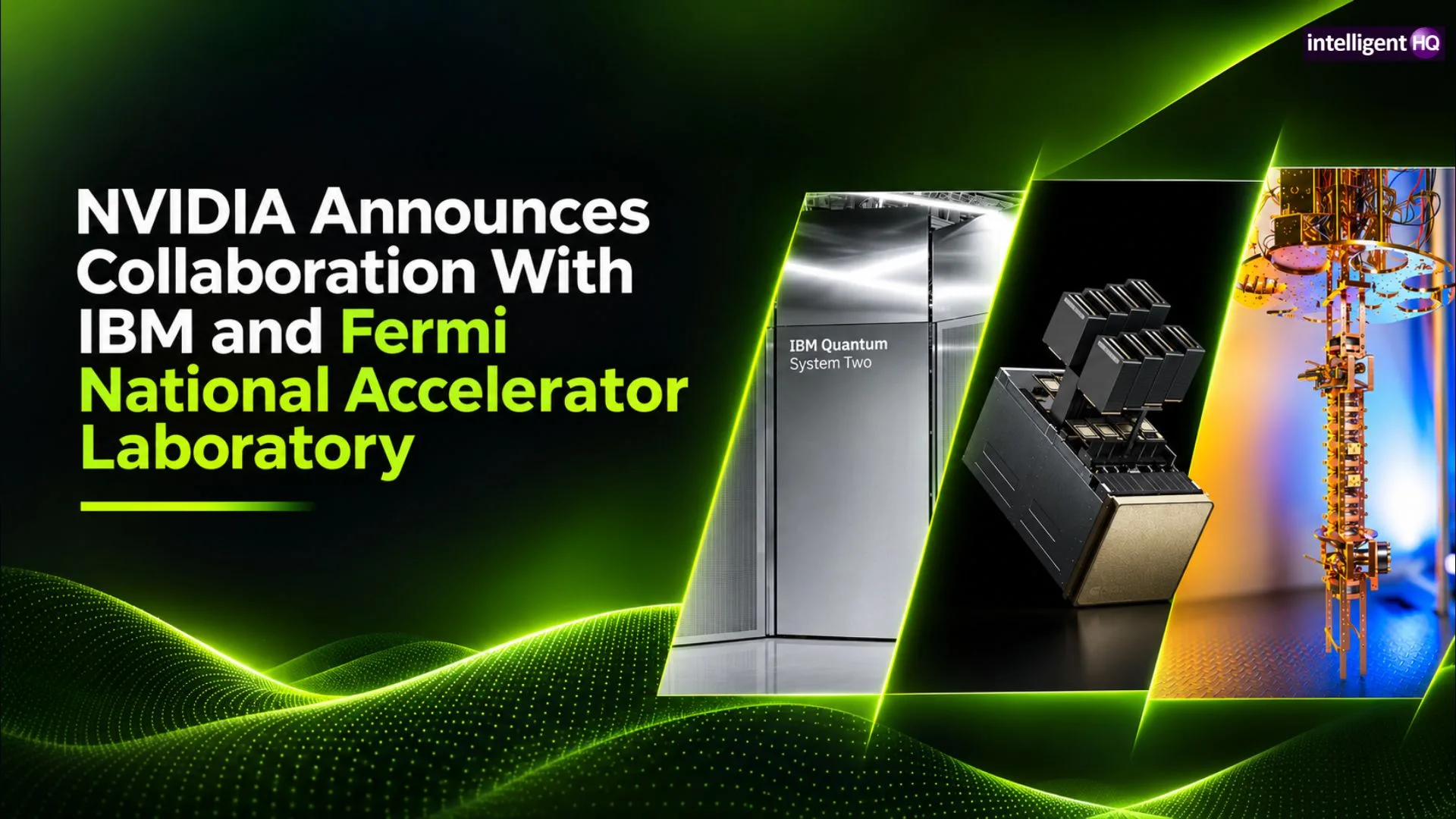
NVIDIA has announced a major collaboration with IBM and the U.S. Department of Energy’s Fermi National Accelerator Laboratory (Fermilab) to accelerate the development of practical quantum computing through a new quantum-classical codesign platform.
Announced on 16 November 2026, the initiative brings together NVIDIA’s accelerated computing technologies, IBM’s quantum processors and Fermilab’s scientific expertise to address some of the most significant challenges preventing quantum computers from operating reliably at scale.
Alongside the collaboration, NVIDIA unveiled a new quantum error-correction decoding algorithm capable of delivering up to 13,000 times faster performance in specified research workloads, potentially reducing computations that previously required 12 weeks to approximately 45 minutes.
Explore how your business can leverage the NVIDIA tech ecosystem
Building the next generation of quantum-classical computing
Unlike conventional computers, which process information through binary bits, quantum computers use quantum bits, or qubits, to perform certain categories of computation in fundamentally different ways. However, quantum systems remain vulnerable to errors caused by noise and interference, limiting their ability to execute complex calculations reliably.
The collaboration between NVIDIA, IBM and Fermilab aims to address these limitations by combining quantum hardware with powerful classical computing systems. Under the initiative, NVIDIA DGX B200 accelerated computing systems will be collocated with IBM quantum computers, including systems powered by IBM Quantum Nighthawk, the company’s most advanced quantum processor at the time of the announcement.
The jointly developed platform will allow researchers to investigate quantum error correction, decoding algorithms and modular architectures capable of connecting multiple quantum processors. Fermilab will contribute expertise in high-energy and nuclear physics, helping researchers explore applications involving particle interactions, nuclear simulations and other computationally demanding scientific problems.
NVIDIA’s 13,000x breakthrough in quantum error-correction research
One of the most significant developments is NVIDIA’s introduction of TCBP-JOBS, a new decoding algorithm available through its CUDA-Q QEC 0.9.0 library. Quantum error correction is essential for building fault-tolerant systems because quantum information is exceptionally sensitive to environmental disturbances.
The new algorithm accelerates computationally intensive decoding research by up to 13,000 times compared with leading existing approaches, according to NVIDIA. In one highlighted benchmark, a research computation that previously required approximately 12 weeks could be completed in just 45 minutes.
This improvement could enable scientists to test more error-correction methods, evaluate different quantum architectures and identify more efficient ways to use physical qubits. Importantly, the performance gain relates to error-correction research and decoding workloads, rather than a general 13,000-fold increase in quantum computer performance.
Integrating quantum processors into supercomputing infrastructure
The collaboration also addresses the operational challenge of incorporating quantum processors into existing high-performance computing environments. NVIDIA is expanding the open-source Slurm workload management system to support quantum computing resources alongside conventional CPUs and GPUs. IBM is contributing integration through its Quantum Resource Management Interface.
The objective is to allow researchers to schedule and manage quantum workloads using familiar supercomputing tools, reducing the complexity of hybrid quantum-classical infrastructure. This could become increasingly important as research institutions transition from standalone quantum experiments toward integrated computing systems capable of supporting complex scientific applications.
From quantum research to scientific and industrial applications
The announcement also highlighted progress in quantum-classical chemistry research involving IBM and Japan’s RIKEN research institute. Using IBM quantum computing resources alongside RIKEN’s ROQUO GPU supercomputer, researchers modelled protein-ligand complexes containing up to 12,635 atoms, more than 40 times the size of a previous 303-atom quantum-classical benchmark.
The research, which explores molecular interactions relevant to drug discovery, was named a finalist for the 2026 ACM Gordon Bell Prize. Although large-scale fault-tolerant quantum computers remain a research objective, developments in hybrid computing could create new opportunities in pharmaceutical research, materials science, energy systems and fundamental physics.
A new computing architecture for the AI and quantum era
The partnership reflects an important evolution in computing infrastructure. Rather than treating quantum computing as a standalone replacement for conventional systems, NVIDIA and IBM are developing an architecture in which quantum processors and accelerated classical computing operate together.
Krysta Svore, NVIDIA’s Vice President of Applied Research for Quantum Computing, emphasised the importance of advancing error correction, scientific applications and the systems that connect quantum processors with accelerated computing. The broader implications extend beyond hardware development.
As quantum systems become more complex, classical computing and AI-assisted techniques may play increasingly important roles in system calibration, error decoding, optimisation and real-time control. For enterprises, research institutions and technology developers, the emerging quantum-classical model represents a potential foundation for the next generation of scientific computing. The NVIDIA–IBM–Fermilab collaboration marks another step towards that future, although scalable, commercially practical fault-tolerant quantum computing will require further advances in hardware, software and system integration.