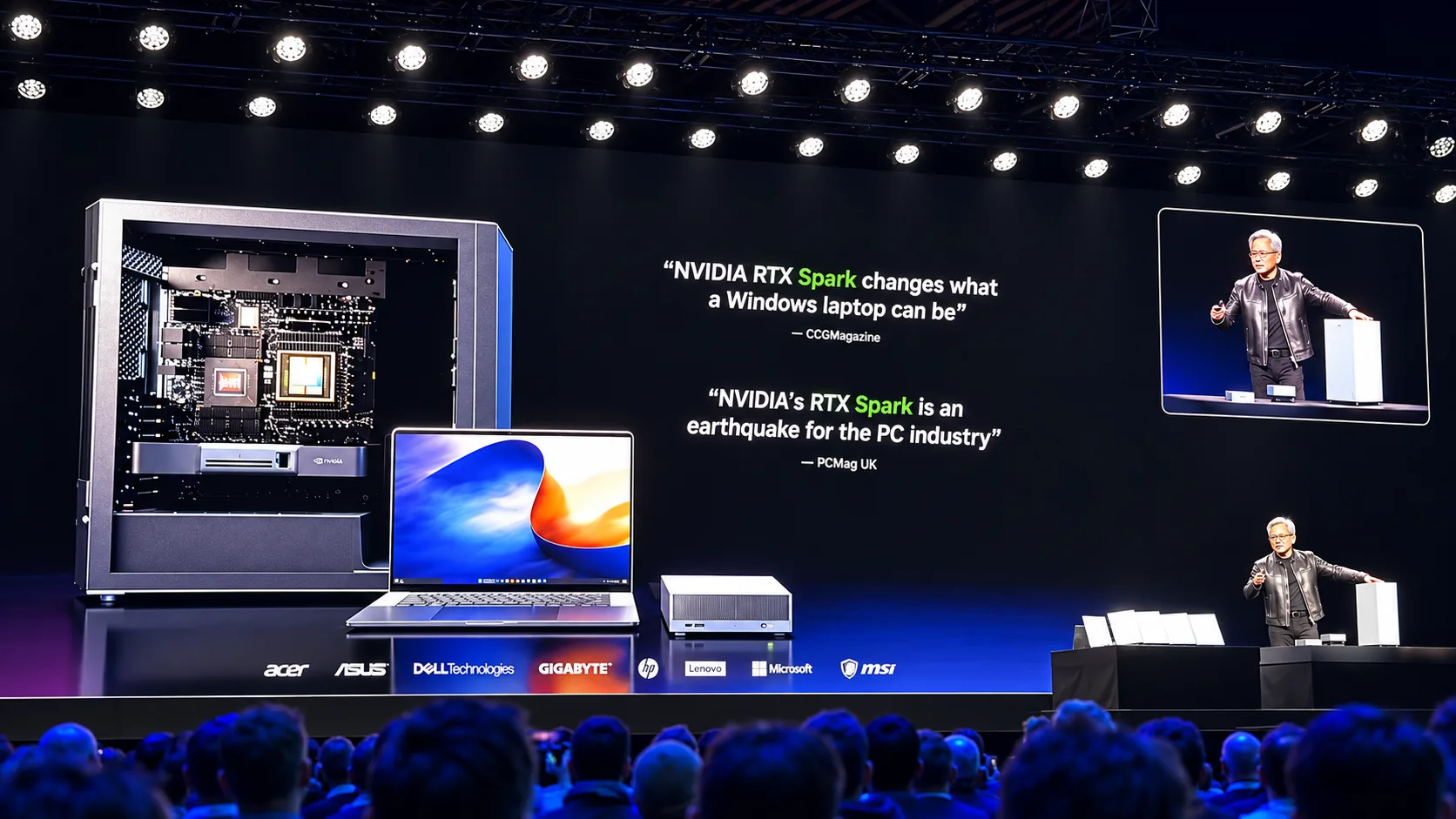
NVIDIA CEO Jensen Huang demonstrates how RTX Spark combines high-performance AI computing, autonomous agents and robotics, bringing advanced AI capabilities closer to developers, creators and businesses.
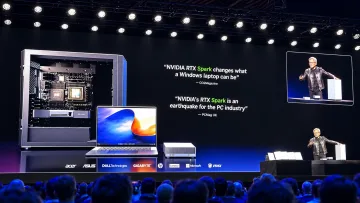
NVIDIA CEO Jensen Huang highlighted the growing importance of personal AI computing during his keynote at GTC Berlin 2026 on October 21, showcasing the company’s RTX Spark platform and its ability to support advanced artificial intelligence applications on compact Windows computers.
Officially launched on October 16, RTX Spark combines NVIDIA Blackwell RTX graphics, Grace CPU technology and up to 128GB of unified memory. According to NVIDIA, the platform delivers up to one petaflop of FP4 AI computing performance, enabling developers and businesses to run demanding AI models, autonomous agents and creative applications locally.
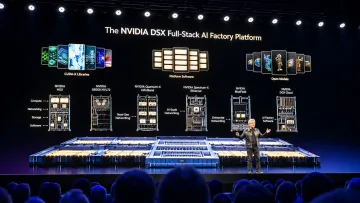
The development reflects a broader shift towards distributing AI computing across personal devices, enterprise infrastructure and cloud-based AI factories.
Bringing Advanced AI Computing to Personal Devices
NVIDIA RTX Spark integrates a Blackwell GPU with a Grace CPU, supported by high-bandwidth communication and unified memory architecture.
The platform is designed to handle AI inference, software development, content creation and advanced graphics workloads without requiring every task to be processed in the cloud.
During the keynote, Huang compared RTX Spark with the original NVIDIA DGX-1 supercomputer delivered to OpenAI in 2016. Both were presented with headline figures of one petaflop and 128GB of memory, although their different architectures and numerical precision mean the performance figures are not directly equivalent.
The comparison nevertheless illustrates how AI computing capabilities are becoming available in increasingly compact devices.
RTX Spark laptops are offered through manufacturers including ASUS, Dell, HP, Lenovo, Microsoft and MSI, with configurations targeting developers, researchers and professional users.
AI Agents and Robotics Take Centre Stage
One of the most engaging moments of Huang’s keynote demonstrated how RTX Spark could support robotics development alongside cloud infrastructure.
The presentation featured Hugging Face’s Microduck robots, which were developed using a combination of NVIDIA Isaac Sim, cloud-based training and local evaluation.
An AI agent helped prepare a simulated training environment before sending computationally demanding workloads to cloud infrastructure. The resulting robot control policies were then evaluated using RTX Spark before deployment to physical robots.
Four Microducks subsequently joined Huang onstage, demonstrating movements including standing, sitting and responding to instructions.
The demonstration highlighted how personal AI systems can complement large-scale infrastructure rather than replace it.
Developers can use cloud platforms for demanding model training while relying on local machines for experimentation, testing and selected inference workloads.
What RTX Spark Means for Businesses and Creators
Local AI computing offers potential advantages for organisations working with sensitive information, large media files or specialised applications.
Developers can test models without constantly relying on remote services, while creative professionals may benefit from accelerated rendering, video production and AI-assisted design tools.
RTX Spark also supports NVIDIA’s broader software ecosystem, including technologies used for AI agents and accelerated computing.
However, local processing does not automatically guarantee data security. Autonomous applications still require appropriate permissions, monitoring and safeguards.
Businesses must also assess hardware costs, performance requirements and whether local deployment provides meaningful advantages over existing cloud services.
The Future of AI Is Both Local and Cloud-Based
RTX Spark illustrates NVIDIA’s strategy of extending accelerated computing beyond data centres into everyday professional environments.
As AI models become more capable, businesses will increasingly need to determine which workloads should run locally and which require large-scale computing infrastructure.
Local systems can provide flexibility and control, while cloud-based AI factories remain essential for resource-intensive training and deployment.
Huang’s demonstration at GTC Berlin showed how these environments can work together, connecting personal AI computing with autonomous agents, simulation and robotics.
The broader opportunity is making advanced AI capabilities more accessible while ensuring that the technology delivers practical value for developers, enterprises and users.
Sources
- NVIDIA Newsroom — NVIDIA RTX Spark PCs Available Today: A New Beginning for Windows PCs (16 October 2026)
https://nvidianews.nvidia.com/news/nvidia-rtx-spark-pcs-available-today-a-new-beginning-for-windows-pcs - NVIDIA — GTC Berlin 2026: Jensen Huang’s Keynote (21 October 2026)
https://blogs.nvidia.com/blog/gtc-berlin-2026-keynote/ - NVIDIA — RTX Spark and Local AI Computing
https://blogs.nvidia.com/blog/local-ai-rtx-spark-windows-laptops-celebration/