
A difficult paragraph rarely announces exactly why it is difficult. The vocabulary may look familiar, yet the point refuses to settle. A definition appears halfway through the sentence. A condition changes the meaning of the claim. By the end, the reader remembers the topic but has lost the argument.
Asking AI to summarize an entire document can make that moment feel even more distant. A better reading method stays close to the paragraph and moves through a short ladder of questions. Each question does one job. The first finds the plain meaning, the second reveals the structure, and the third connects the passage to the larger idea.
The result is less like receiving an answer and more like holding a conversation with the text. It works for research papers, policy reports, technical essays, and any long page that asks the reader to carry several ideas at once.
First Ask What the Paragraph Says
Begin with one complete paragraph. Read it once, then hear it aloud at a measured pace. Listening often makes the sentence boundaries more noticeable. Repeated terms stand out, and a phrase that looked like a side note may reveal itself as the main condition.
Now ask the smallest useful question: “What is this paragraph saying in plain language?” Keep the scope tight. The aim is to express the same point with a clearer surface, not to replace a whole section with a general summary.
Try answering before requesting help. Even an incomplete sentence gives the mind something to compare. Perhaps the paragraph says that a new model improves speed only when it receives two types of input. That provisional sentence becomes the first rung of the ladder.
Once the explanation arrives, read the original again. The author’s wording will often feel more organized because the central idea now has a name.
Then Ask How the Pieces Connect
Understanding the topic is different from understanding the logic. The next question looks at the relationship between sentences: “How does the second point support, qualify, or illustrate the first?”
This is especially useful when a passage contains a claim, an example, and a consequence. Give each part a short label in the margin. “Claim,” “evidence,” and “result” may be enough. In another paragraph, the labels might be “problem,” “mechanism,” and “proposal.”
Read the passage again with those roles in mind. Instead of meeting one dense block, the reader now sees movement. The author introduces something, does something with it, and arrives somewhere. That shape is easier to remember than the original sentence count.
For a research paper, the connection may run from method to finding. In a business report, it may run from market change to strategic response. In a philosophy essay, it may be an objection followed by a reply. The question stays the same even when the material changes.
Ask Why This Point Appears Here
The third rung widens the view: “Why did the author place this paragraph at this point in the document?” Look at the heading above it and the paragraph that follows. The answer may introduce a new stage, narrow an earlier claim, or prepare the reader for a recommendation.
This question protects the thread of a long document. A paragraph no longer sits alone; it has a job within a section. Write that job in seven or eight words: “defines the measure used in the results,” or “links customer behavior to the pricing decision.”
Those short notes become navigation aids. When a later section refers back to the same idea, the reader can recover its role quickly rather than starting over. They also make it easier to explain the document to someone else, because the notes preserve both meaning and sequence.
Keep the Explanation Beside the Source
The question ladder works smoothly when the original passage, spoken reading, and explanation share one space. CastReader’s Read & Explain feature keeps the selected text visible while the reader listens and asks for focused help. The explanation remains connected to the exact passage that prompted the question.
In practice, the rhythm feels simple: read one paragraph, ask one question, then return to the paragraph with a clearer frame. A moving highlight helps the eye follow the spoken line. Different explanation depths make it possible to begin with a concise meaning and stay with the same passage when a closer walkthrough is useful.
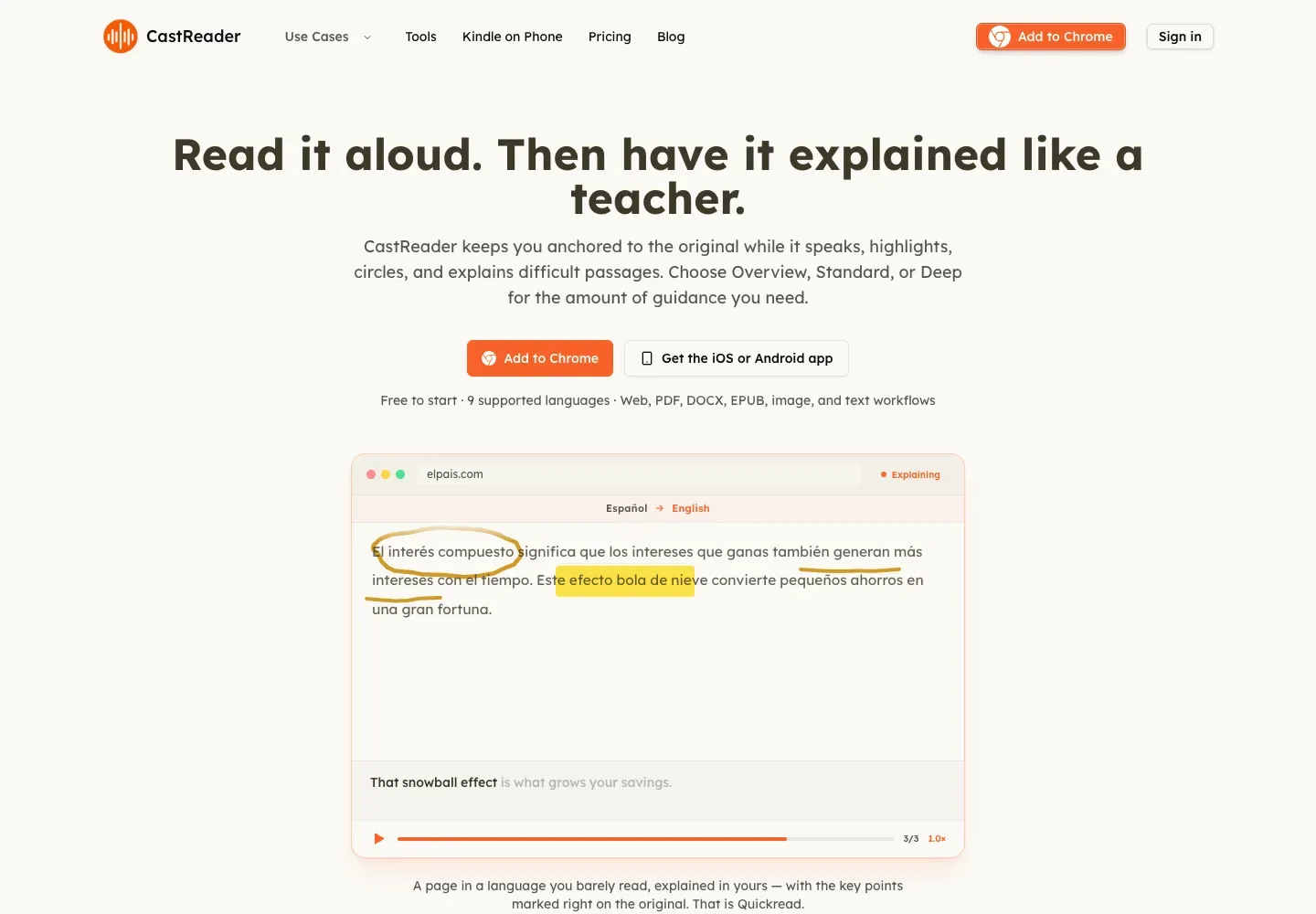
Figure 2. CastReader Read & Explain presents the original passage beside spoken guidance and highlighted context. Source: official CastReader website; © CAST AI PTE. LTD. Provided by CastReader for editorial use.
The important part is the short return to the source. After reading the explanation, give the paragraph another pass and say its point in your own words. That sentence becomes the bridge to the next paragraph.
Turn the Ladder Into a Working Note
A useful note from this method is compact. Write the key claim on the first line. On the second, record how the parts connect. On the third, state why the passage matters in its section. Three lines are enough to preserve the work of the question ladder.
For example, a note might read: “The model combines historical and live data. Live data adjusts the baseline forecast. This explains the improved response during sudden demand changes.” The note is brief, but it holds the logic that made the original paragraph demanding.
At the end of a page, read the notes in order. They should form a miniature outline of the argument, written in the reader’s language. Add a short heading that captures the page’s job, such as “How the system adapts to new information.”
The same habit can support cross-language reading. Keep important terms in their original form, then write the explanation in the language that makes the relationship clearest. The reader gains access to the idea while continuing to learn the vocabulary used in the source.
Read the Next Difficult Page One Question at a Time
Dense writing becomes manageable when the unit of work becomes smaller. One paragraph leads to one plain-language sentence. One connection reveals the structure. One final question places the idea inside the larger argument.
Choose a passage that has slowed you down and begin with the first rung: what is this paragraph saying? The next question will grow naturally from the answer, and page by page, the document will begin to feel like an argument you can follow rather than a wall of information.