
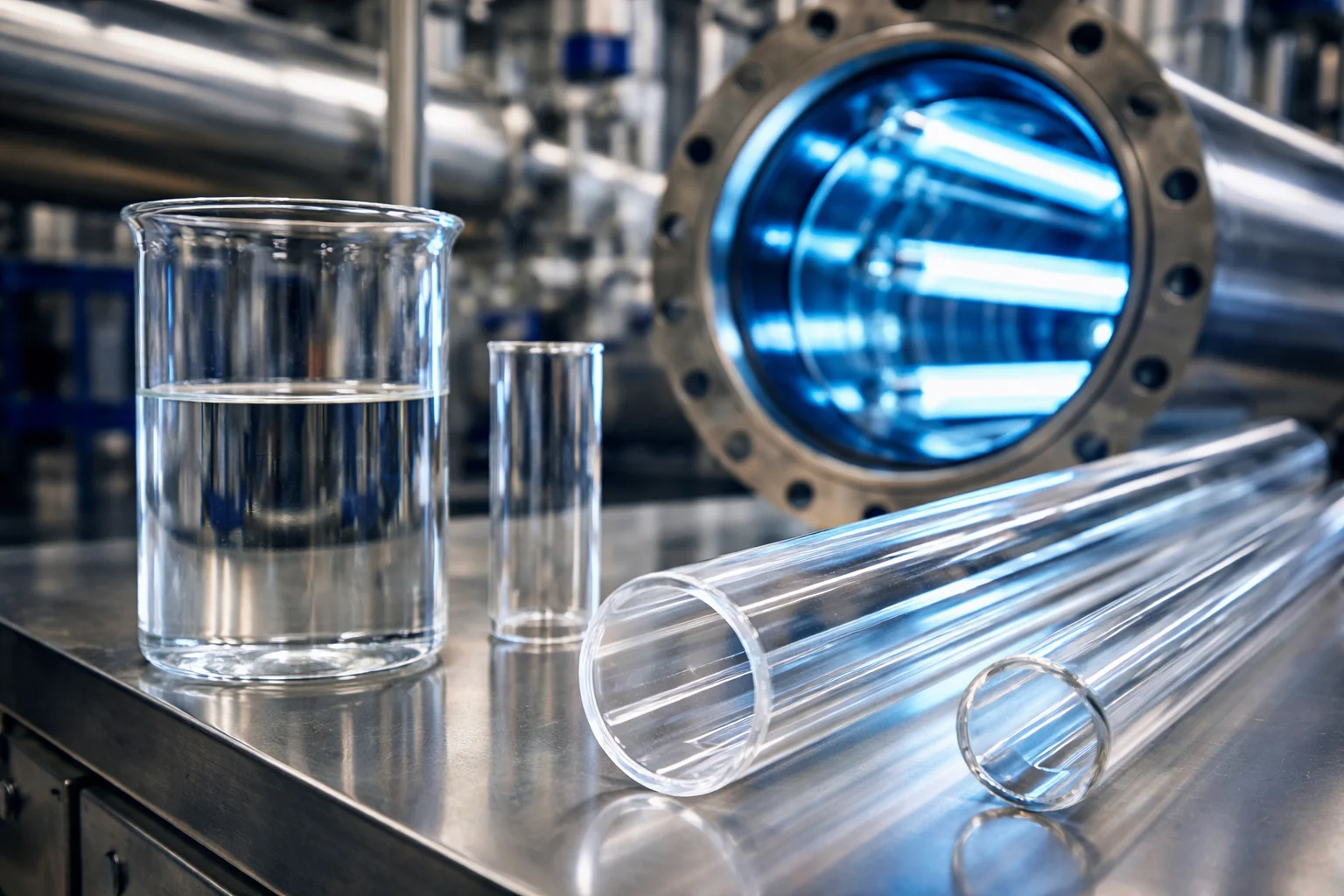
In these systems, the sleeve surrounding the UV lamp directly affects delivered UV dose, thermal behavior, fouling tolerance, and maintenance intervals. For this reason, high-purity fused silica tubes engineered for sustained UV-C transmission stability are commonly specified in performance-driven UV-C designs.
Borosilicate glass, while cost-effective and mechanically robust for general-purpose labware, is often not suitable for sustained UV-C transmission at 254 nm in standard formulations. This article provides engineering selection criteria—fused silica vs. borosilicate—specifically for high-intensity UV water treatment environments.
1) Delivered UV Dose: Why Sleeve Transmission Dominates System Efficiency
UV inactivation is governed by delivered dose (mJ/cm²). In plain engineering terms:
Delivered UV Dose (mJ/cm²) = Irradiance (mW/cm²) × Exposure Time (seconds)
If the sleeve material attenuates 254 nm radiation, the reactor must compensate via higher electrical power, tighter hydraulics, or longer residence time—each increasing operating cost or reducing throughput.
Design implication: In high-intensity reactors, even small transmission losses can materially change energy-per-m³ and validated performance margins.
2) 254 nm Transmission: What “Standard Borosilicate” Usually Means
For UV-C systems, what matters is transmission at (and near) 254 nm. Fused silica is widely used for UV optics because it maintains high transmission into the UV region.
By contrast, standard borosilicate glass is frequently described as transmitting well down to “around 300 nm,” which is above the 254 nm germicidal peak—making it generally unsuitable as a 254 nm optical window in typical thicknesses.
Practical Transmission Snapshot (Illustrative)
| Material / Example Data | Thickness | Transmission at 254 nm | Engineering Notes |
| UV-grade fused silica (typical UV optics behavior) | few mm | High (commonly >90% region in UV-grade optics context) | Low absorption; favored for UV windows and sleeves |
| Borosilicate (example: SCHOTT MEMPax spectral data) | 0.2 mm | ~28% | Transmission drops rapidly with thickness; not a sleeve material for 254 nm |
| “UV-transmitting” specialty borosilicate (non-standard formulations) | ~2 mm (example patent target) | can be engineered to high values | Specialty glass exists, but is not representative of standard borosilicate supply |
Engineering conclusion: For most practical sleeve thicknesses, fused silica is the default material for 254 nm transmission performance; borosilicate requires either special UV-transmitting compositions or impractically thin sections.
3) Solarization and UV-Induced Transmission Decay
Under prolonged UV exposure, glass can develop defect centers (“solarization”), which increases absorption and reduces transmission over time. This effect is particularly important in continuous-duty systems (e.g., 8,000+ hours/year).
Fused silica generally demonstrates stronger UV durability than standard borosilicate in UV-C duty because its network is closer to pure SiO₂ (lower concentration of modifiers that can participate in defect formation). In performance validation terms, this translates into slower drift of UV output at the target wavelength, supporting more stable compliance margins over lamp life.
4) Thermal Load, Expansion, and Seal Reliability
High-intensity UV systems can impose meaningful thermal gradients across the sleeve due to lamp heat, water temperature changes, and flow-driven convective cooling.
A key differentiator is coefficient of thermal expansion (CTE):
- Fused silica CTE: approximately 0.5 × 10^-6 /K (very low)
- Typical borosilicate CTE: approximately 3.2–3.4 × 10^-6 /K (higher)
Engineering impact:
- Lower CTE reduces thermally induced stress, especially around end fittings and seals.
- It also reduces dimensional drift, supporting alignment and sealing stability in modular reactor designs.
5) Fouling and Maintenance: Transmission Margin as a “Service Buffer”
Sleeve fouling from hardness scale, iron, organics, or biofilm reduces UV transmittance in operation. Even when cleaning systems exist (mechanical wipers, chemical cleaning, periodic manual maintenance), higher initial optical transmission provides a larger operating margin before dose drops below validated thresholds.
Operational reality: In high-output systems, designers often prefer fused silica not because borosilicate cannot be cleaned, but because fused silica maintains higher UV-C throughput and gives more usable “fouling headroom” before performance becomes dose-limited.
6) Lifecycle Cost Engineering: Replace-by-Performance, Not Replace-by-Calendar
The wrong comparison is “material cost per sleeve.” The correct comparison is “cost per validated m³ treated over lamp life,” which includes:
- power needed to compensate optical losses
- downtime or labor for cleaning
- replacement cadence driven by performance drift (not just breakage)
Simplified Lifecycle View (Qualitative)
| Parameter | Fused Silica | Standard Borosilicate |
| 254 nm transmission capability | High | Low at practical thickness |
| UV durability / solarization resistance | Strong | Weaker in UV-C duty |
| Energy compensation needed | Minimal | Often significant or infeasible |
| Maintenance tolerance (fouling margin) | Higher | Lower |
| Typical suitability as 254 nm sleeve | Yes | Generally no |
7) Where Quartz Crucibles Enter the UV Water Treatment Ecosystem
While quartz sleeves are the main optical interface in UV disinfection, UV water treatment engineering often requires reliable UV transmittance measurement at 254 nm (UVT), plus repeatable sample handling in lab validation workflows (e.g., dose validation, photochemical testing, or material compatibility screening).
In these R&D and validation contexts, optically stable quartz crucibles designed for high-energy ultraviolet processing environments can be used when process conditions demand high purity, UV stability, and thermal robustness in controlled testing environments.
8) Engineering Decision Matrix: When Each Material Makes Sense
| Operating Condition | Recommended Material |
| Continuous 254 nm duty with high validated dose margin requirements | Fused silica |
| Medium/high-intensity reactors where sleeve thickness is several mm | Fused silica |
| Cost-driven, low-UV or non-UV-C optical requirements | Borosilicate (conditional) |
| Specialized UV-transmitting borosilicate explicitly specified and verified | Possible, but verify spectral data at thickness |
9) Conclusion
For high-intensity UV water treatment systems operating at 254 nm, sleeve material selection is fundamentally an optical engineering decision. Fused silica is typically selected because it supports high UV-C transmission at practical thickness, offers stronger UV durability, and provides better lifecycle stability under thermal and fouling stresses.
Standard borosilicate glass remains valuable in many industrial and laboratory applications, but for 254 nm high-intensity UV treatment—especially where validation and long-term performance stability matter—fused silica is the technically justified default.
References (Numbered for CMS Compatibility)
[1] UV disinfection technical guidance and dose concepts (EPA UV Disinfection Guidance Manual).
[2] Borosilicate UV cutoff behavior and suitability limits for UV detection/windows.
[3] Example spectral transmittance data for borosilicate at 254 nm (thin sheet) demonstrating strong attenuation.
[4] Fused silica thermal expansion and materials-property summaries supporting low-CTE design rationale.
[5] Example of engineered “UV-transmitting borosilicate” showing specialty compositions exist (not typical standard borosilicate).
[6] Industry UV association note on germicidal wavelength usage around 254 nm.











