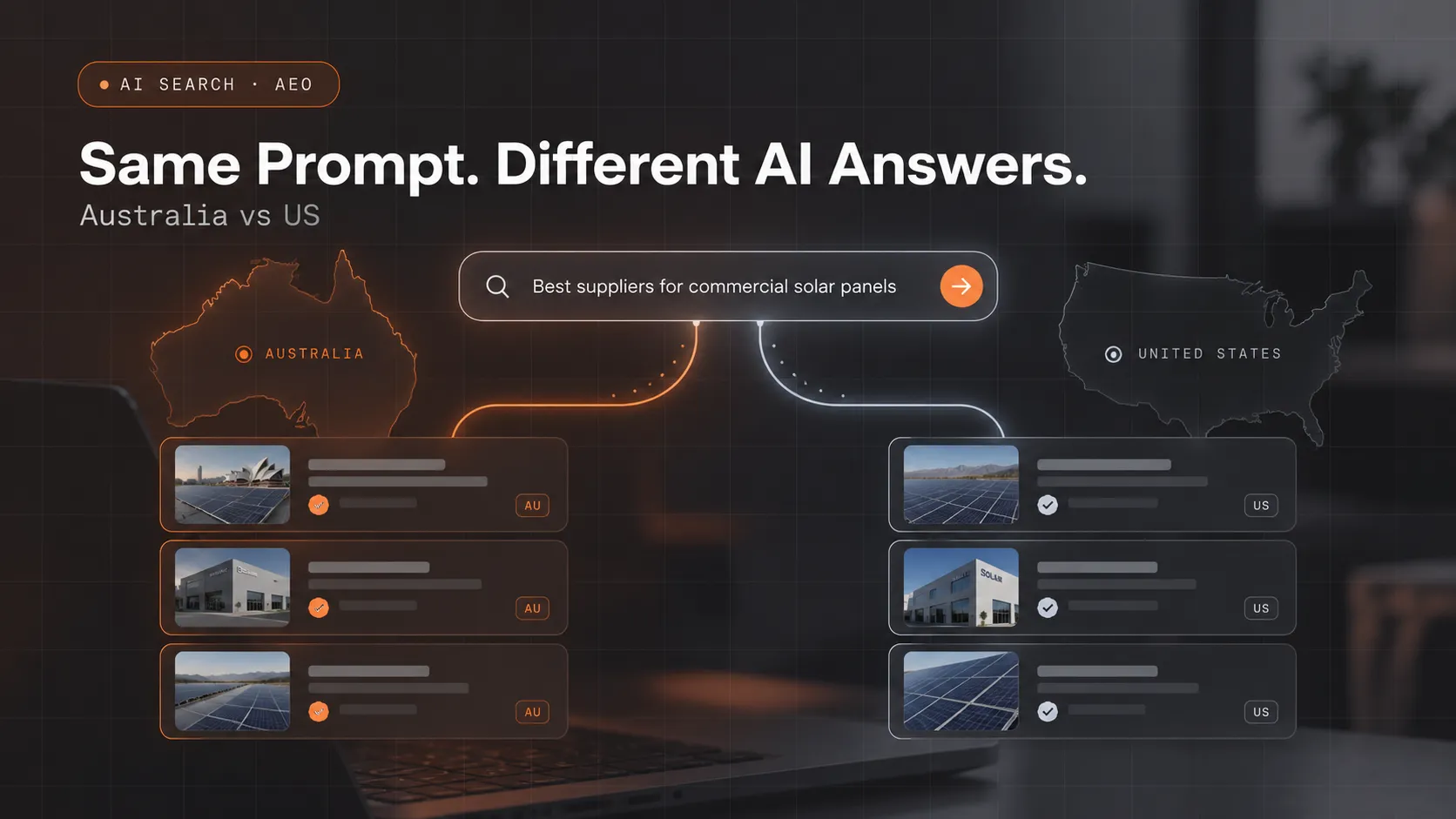
Search-enabled AI tools use geographic context to determine which sources to retrieve before synthesising an answer. Two buyers in different countries submitting the same commercial question can receive different supplier recommendations because the local evidence available to the AI differs: regional domains, local directories, and market-specific publications vary by market.
Key Facts
- Location changes what the AI retrieves, not just what it shows: Geographic context can alter which sources a search-enabled AI considers when constructing an answer, changing the companies named.
- Australian and US buyers can receive different suppliers from the same question: The local evidence pool differs by market. Regional domains, local publications, and industry directories produce different citation sets.
- Global authority does not guarantee local AI visibility: A brand prominent internationally can be absent from Australian AI answers if competitors have stronger local corroboration in directories, reviews, and editorial sources.
- Local AI visibility requires a tracked prompt set: A single screenshot cannot establish whether Australian buyers consistently encounter your brand across AI platforms over time.
- The goal is a consistent Australian citation ecosystem: Build clear first-party Australian entity information and credible third-party corroboration from local sources.
Why Does the Same Prompt Not Always Produce the Same Search Result?
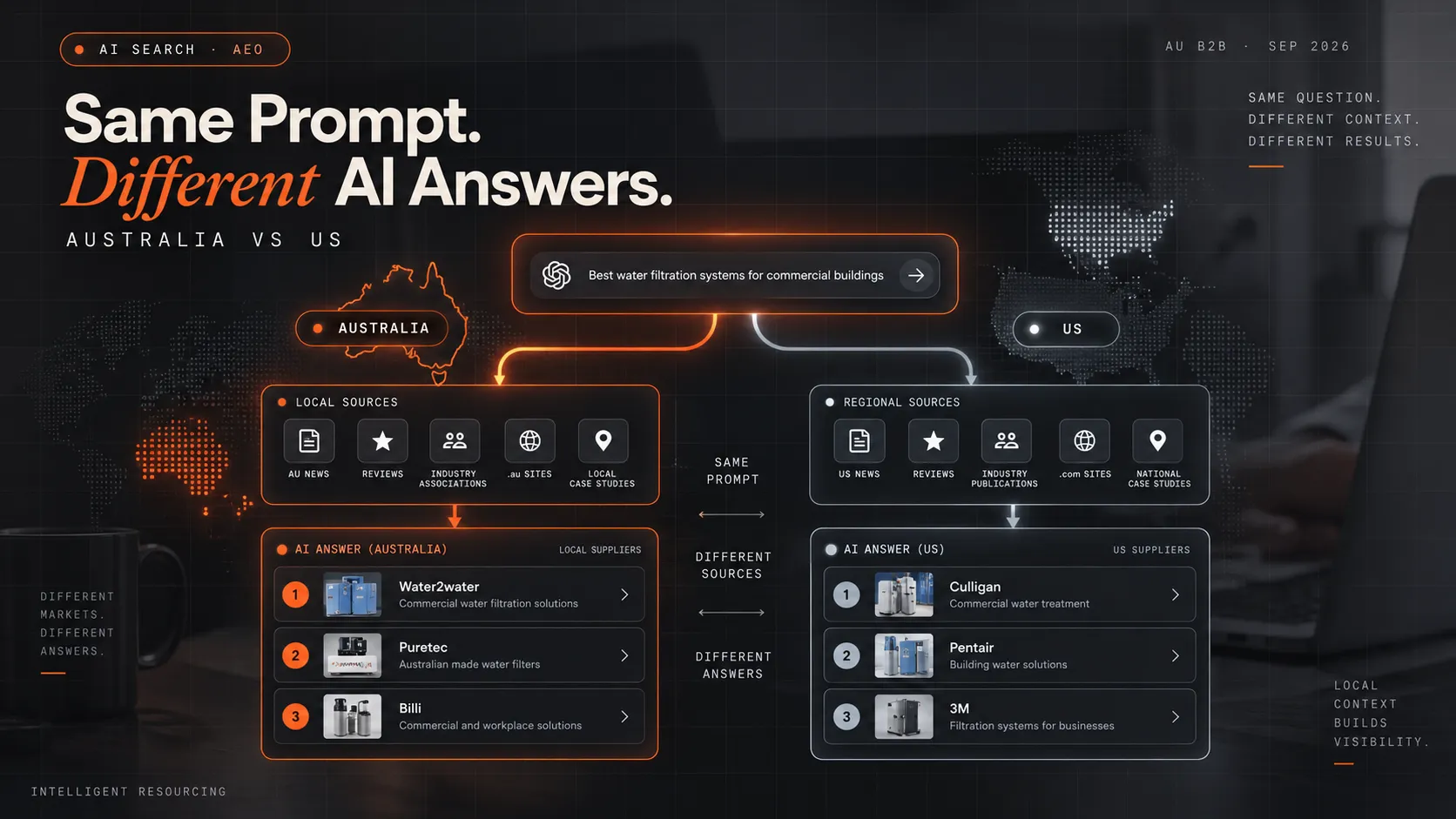
A search-enabled AI can turn the same visible prompt into a different retrieval process depending on the geographic context around the user. Location signals from an IP address or device can change which sources the AI retrieves, which changes the evidence it uses to build its answer, and which suppliers it names.
OpenAI’s ChatGPT Search documentation confirms that ChatGPT can rewrite a user’s question into more targeted web searches and uses approximate location derived from IP address to improve geographically relevant results.
Google Search Central confirms that search results can vary according to factors such as location, language and region, a principle that carries into AI search because AI systems retrieve and synthesise from those same results.
This matters because AI search adds another stage. The system does not simply retrieve pages. It uses those pages as evidence from which to construct a synthesised answer.
Different retrieval can therefore lead to:
- Different pages being found: Australian and US search contexts can expose different sources.
- Different evidence being available: A supplier may have much stronger supporting material in one market.
- Different entities being corroborated: Local directories, news articles and trade bodies may reinforce different businesses.
- Different suppliers being named: The final recommendation reflects the evidence the system was able to assemble.
The prompt remains the same, but the citation environment does not necessarily remain the same.
What Changes Between an Australian and US AI Session?
The most important difference is often not the model itself, but the pool of evidence the model can retrieve before answering. Several layers can contribute to that difference.
1. Location Signals Change What Counts as Relevant
Geography gives a retrieval system another clue about what information will be useful to the person asking the question.
If somebody asks for a supplier, adviser, software provider or professional service, location may affect whether a company is commercially relevant. ChatGPT Search documents the use of approximate geographic information for search. Google also states that location is used when it can improve the relevance of search results. Perplexity’s search documentation supports explicit geographic controls, including country and more granular location parameters.
None of those disclosures means every commercial question is automatically localised. They establish a more important point:
Location can be an input to retrieval.
Once geography enters the process, an Australian supplier question and a US supplier question are no longer guaranteed to create the same evidence set.
2. Local Domains and Regional Pages Can Enter the Citation Set
Pages that make Australian relevance explicit have a clearer chance of satisfying an Australian information need.
A .com.au domain is one obvious signal.
Google describes country-code top-level domains as strong indicators that a website targets a particular country. Geographic relevance can also be communicated through local addresses, phone numbers, language, regional URLs and links from other local websites.
That does not mean a .com.au domain receives an automatic AI ranking boost. An international .com business can still have strong Australian relevance if its Australian operation is clearly represented. What matters is whether retrieval systems can confidently identify:
- Where the business operates.
- Which market it serves.
- Which products are available locally.
- Which Australian customers it supports.
- Which regional pages represent the business.
For global companies, properly separated Australian market pages can be more informative than one generic international service page.
3. Australian News and Industry Sources Create Different Evidence
Local relevance is often established outside the supplier’s own website. An Australian buyer’s evidence environment can contain publications and organisations that rarely feature in a US retrieval. Depending on the industry, that can include:
- Australian business publications and news sites.
- National and state industry associations.
- Professional and accreditation bodies.
- Australian trade and supplier directories.
- Conference and event websites.
- Local partner and distributor pages.
These sources matter because AI systems need corroboration. A company can describe itself as a leading Australian supplier on its own website. An independent trade association membership, Australian customer case study or relevant industry article gives the retrieval system another source confirming the company’s connection to that market.
This is where the concept of a local citation set becomes useful. The goal is not simply to rank one page but to be represented across the collection of credible sources an AI system is likely to encounter when researching the category in Australia.
How Do Regional Review Platforms Change the Evidence Available to AI?
Reviews are another area where the Australian and US web ecosystems diverge. Australian consumers and B2B buyers encounter different review platforms, directories, and comparison sites than those that dominate US search. The sources that build a supplier’s credibility in one market do not automatically hold influence in the other.
An Australian consumer or business buyer may encounter review platforms, directories and comparison sites that are different from those dominating a US search. ProductReview is a straightforward example; it is an Australian platform focused on product and service experiences from Australian consumers.
The same principle applies in B2B sectors, where individual industries can have specialist directories, partner databases, accreditation lists or professional membership sites. BrightLocal’s 2026 AI directory research reinforces the broader point. Its 2026 study analysed 60,970 checks across 1,355 business locations in Australia, the UK and the US and found AI answers drawing from a wide collection of business websites, directories and specialist sources.
The lesson was not that every business should target one dominant directory. As BrightLocal Senior Content Marketing Manager Mike Hawkes put it:
“There isn’t one source you can optimize for and call it done.”
That is especially relevant when comparing countries. A company optimised for the sources that dominate its US category may still have gaps in the Australian citation ecosystem.
Why a Brand Can Be Strong Globally but Invisible in Australia
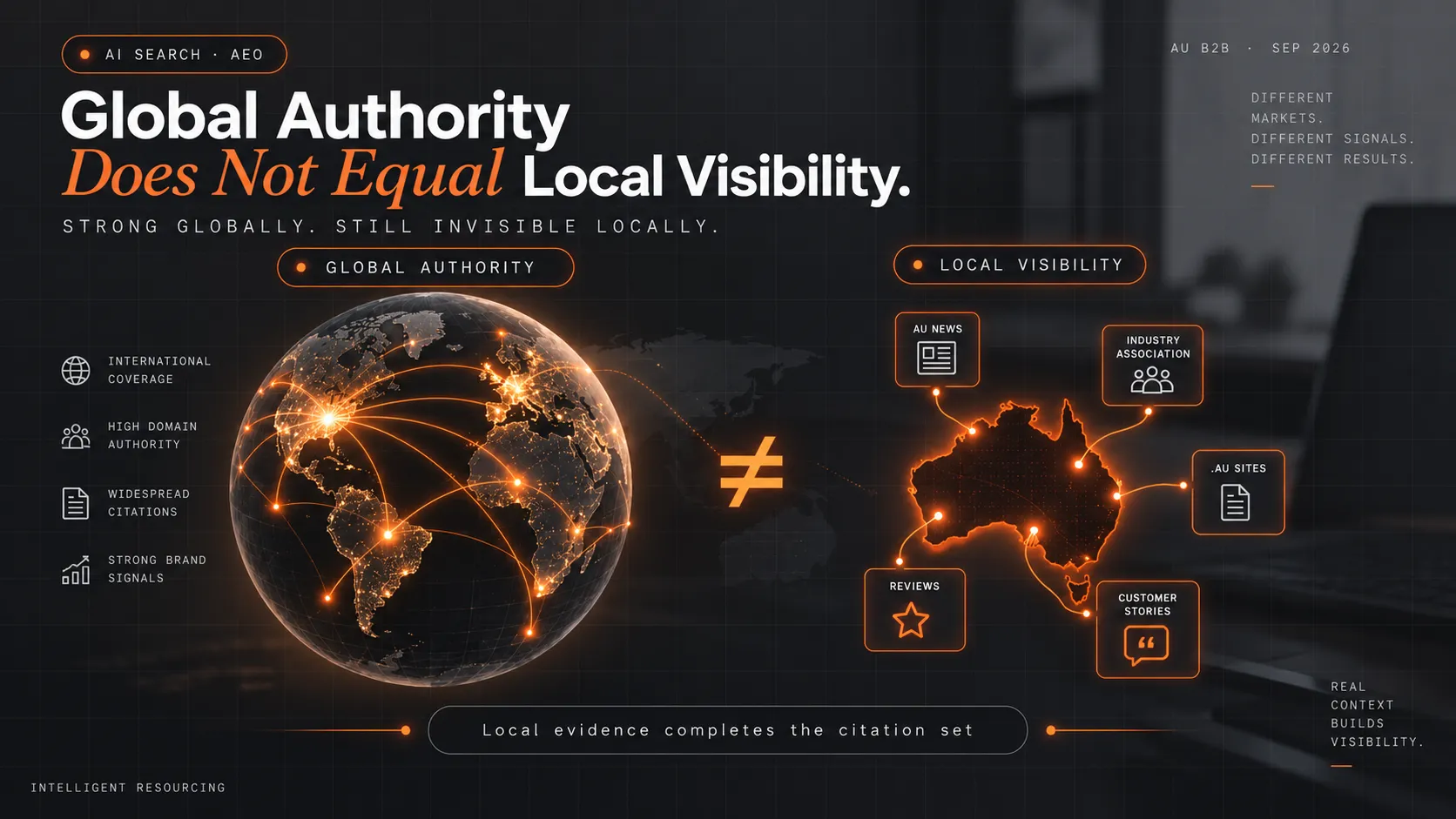
A brand can have strong global authority while lacking the Australian evidence needed to appear in a locally retrieved AI answer. International editorial coverage and global backlinks establish category credibility. They do not guarantee inclusion in the local citation set when an Australian buyer researches the same category using ChatGPT or Perplexity.
This is one of the easiest AI visibility problems to misdiagnose. Suppose a software vendor has:
- Strong international editorial coverage.
- Hundreds of global backlinks.
- Well-ranked category guides.
- Recognisable international customers.
- High-authority .com pages.
The brand may be strongly associated with its category. But competitors in Australia might have:
- Australian customer case studies.
- Australian service and pricing information.
- Mentions in local trade publications.
- Relevant association memberships.
- Australian directory profiles.
- Local reviews and partner references.
The international company has category authority. Its competitors have category authority plus local corroboration and that creates an evidence gap.
| Global citation footprint | Australian citation footprint |
| International publisher mentions | Australian publisher mentions |
| Global customer examples | Australian customer examples |
| Generic category pages | Australian market pages |
| International directories | Australian directories |
| Global reviews | Australian customer reviews |
| Broad service descriptions | Australian service coverage |
| Global partnerships | Australian associations and partners |
Global authority and local authority overlap, but they are not interchangeable. Ahrefs 2025 found that the top-ranking page receives 34.5% fewer clicks when an AI Overview appears above it.This raises the commercial cost of weak AI visibility because AI Overviews can also reduce organic click-through rates, making inclusion in the answer layer increasingly relevant.
This explains why a company can appear frequently when the category is discussed globally yet disappear when the same category is researched from its own target market.
The only reliable way to see whether that gap is persistent is to test a fixed set of buyer questions across markets rather than relying on isolated screenshots. For Australian brands, working with an Australian AI search agency can help formalise that process by tracking the same prompts across engines, recording which suppliers appear and comparing the citation sources behind each answer over time.
What Should an Australian Business Build to Enter the Local Citation Set?
Australian AI visibility improves when the business creates a clear first-party identity and surrounds it with credible Australian third-party evidence. This is not solved by inserting “Australia” into every heading. The business needs an evidence footprint.
Make the Australian Entity Unmistakable
Start with facts that should never require an AI system to guess. Your website should clearly explain your Australian operation. Depending on the business, this may include:
- Real Australian business locations.
- Accurate local contact details.
- States and regions genuinely served.
- Australian-specific products or services.
- Local delivery and support information.
- Australian customer and project examples.
- Consistent organisation and location schema. org provides a standard vocabulary for describing name, address, service area, and category information that is communicated to search and AI systems.
International businesses should also make regional relationships clear through dedicated Australian pages where appropriate. A retrieval system should not have to infer whether the company actually operates in Australia from a single mention in a footer.
Build Independent Australian Corroboration
Your website explains who you are. The wider Australian web helps verify it. Consider an Australian water treatment brand operating in Western Australia.
Water2Water’s public website does more than identify the company as a water filtration supplier. It connects the entity with specific Australian locations, including Perth and Karratha, describes its Western Australian service footprint and explains the types of water treatment products and services it provides.
That gives retrieval systems several concrete entity relationships:
Brand → water treatment
Brand → Australia
Brand → Western Australia
Brand → Perth and Karratha
Brand → relevant products and services
The next layer is corroboration. For another Australian business, that might come from:
- Relevant Australian trade bodies.
- Local distributor or partner websites.
- Industry-specific Australian directories.
- Regional news and editorial coverage.
- Australian conference or event participation.
- Local customer stories and testimonials.
- Credible sector-specific review platforms.
The objective is not to create artificial mentions, it is to ensure that legitimate third-party sources confirm the same entity facts the company communicates itself.
Publish Information That Australian Buyers Actually Need
Local content earns its place when Australia changes the answer, a weak localisation strategy takes a global article, changes the country name and republishes it. A useful Australian resource explains something genuinely specific to the market.
That could include:
- Australian regulatory requirements and standards.
- Local climatic or operating conditions.
- Regional delivery and servicing constraints.
- Australian pricing or purchasing conventions.
- Local units, terminology and compliance requirements.
- State-specific differences where they genuinely matter.
For example, “How industrial water treatment works” is a generic educational topic.”How to select industrial water treatment equipment for a remote Western Australian site” contains market-specific information gain.
That makes the content more useful to both the buyer and the retrieval system trying to answer that buyer’s question.
Why Is Checking One AI Answer Not Enough?
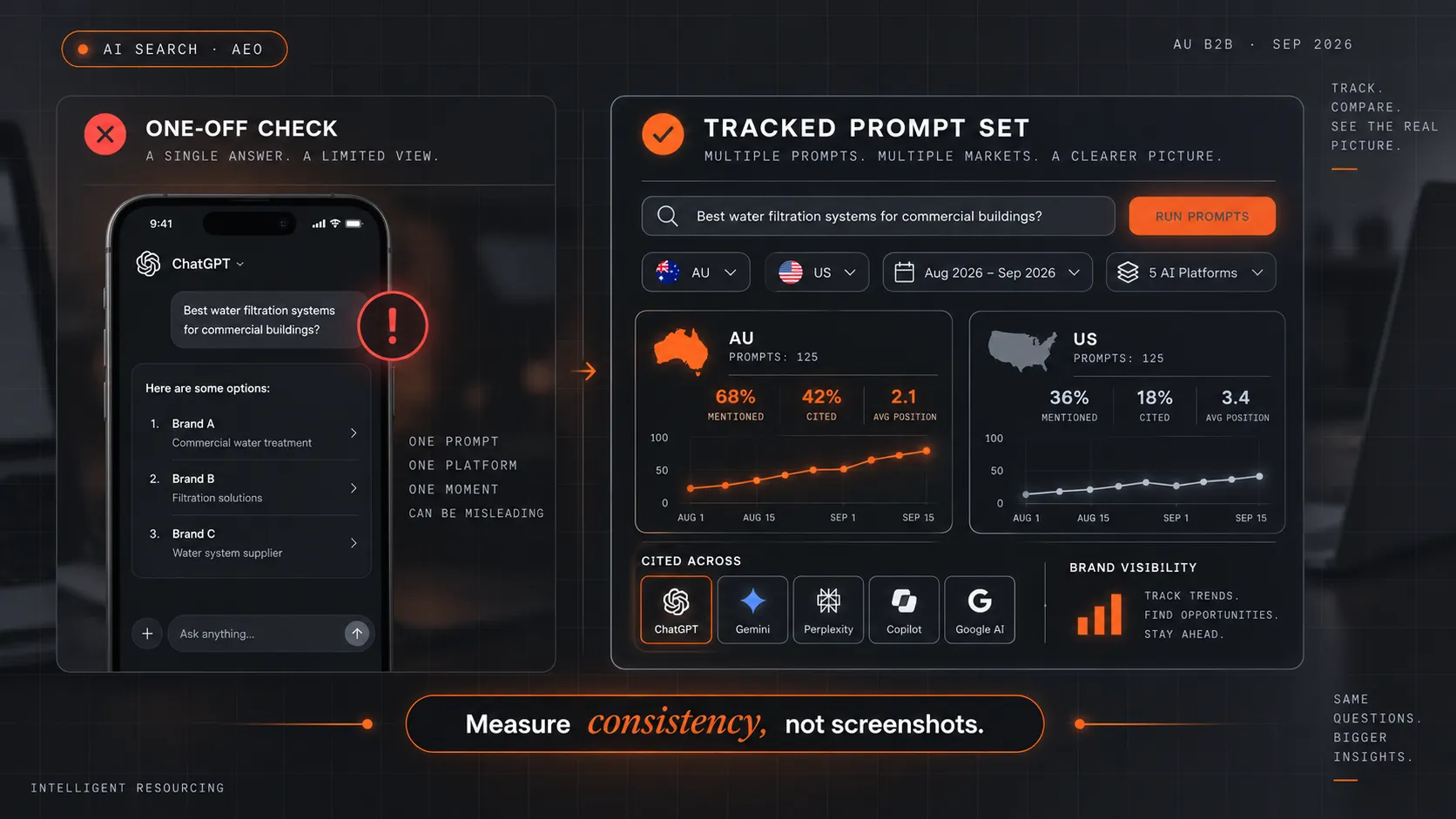
Cross-market AI visibility requires a tracked prompt set because a single answer cannot show whether a brand is consistently visible to Australian buyers.
A marketer opens ChatGPT, enters a commercial question, sees the company’s name and takes a screenshot. That proves one thing, the company appeared in that answer.
It does not establish:
- How often the brand appears.
- Whether Australian buyers see it.
- Whether US users see something different.
- Which sources caused the inclusion.
- Whether the result persists next week.
- Whether other AI platforms agree.
Generative answers vary, and different retrieval conditions can produce different evidence. Testing therefore requires a controlled set of buyer questions that remains stable over time.
A useful monitoring programme records at least:
| Field | What to capture |
| Prompt | Exact wording |
| AI platform | ChatGPT, Gemini, Perplexity or another engine |
| Market | Australia, US or another target country |
| Date | When the test occurred |
| Brand visibility | Whether the company was named |
| Mention position | Where the brand appeared in the answer |
| Citations | URLs and domains supporting the response |
| Local sources | Number and type of Australian sources |
| Repeat result | Whether the result persists across runs |
What Is the Simplest Way to Test Australian vs US AI Visibility?
The cleanest market test keeps the buyer question unchanged, varies the geographic condition and records the suppliers and citations returned across repeated runs.
Step 1: Choose 10 Buyer Prompts
Use genuine commercial questions, good prompts include:
- “Which companies provide [service]?”
- “What are the best [category] providers for [buyer type]?”
- “Who should I consider for [specific problem]?”
- “What are the main alternatives to [known supplier]?”
- “Which companies specialise in [specific use case]?”
Avoid including your own business name, you want to test whether the brand enters the answer naturally.
Step 2: Keep the Prompt Identical
Do not change the wording between countries.Comparing”Best cybersecurity consultancies” with “Best cybersecurity consultancies in Australia” does not isolate locale because the prompts themselves are different.Keep the wording fixed and change the market condition instead.
Step 3: Start With Clean Sessions
Reduce unnecessary session differences and use fresh conversations and record the conditions used for each test. Where a tool exposes region or location controls, document them. Where geographic control is imperfect, state that limitation rather than presenting the experiment as scientifically exact.
Step 4: Run Australian and US Conditions
Test both markets separately, for every prompt, create an Australian observation and a US observation. If the named suppliers differ, move to the citations, that is where the more valuable diagnosis begins.
Step 5: Record Every Named Supplier and Citation
Do not track mentions alone use columns such as:
| Prompt | Engine | Market | Brand named? | Mention position | Citations | Australian sources | Date |
| Best X provider | ChatGPT | Australia | Yes | 2 | A, B, C | 2 | Date |
| Best X provider | ChatGPT | US | No | N/A | D, E, F | 0 | Date |
The supplier list shows what changed and the citations can help explain why.
Step 6: Repeat the Runs
Repeat each prompt several times and, where possible, across more than one date. Then calculate a simple market-specific metric:
Local AI Share of Voice = Valid runs where the brand appears ÷ total valid prompt runs
Keep Australian and US results separate, a global average can hide the exact regional visibility gap the test is meant to uncover.
How Do You Diagnose the Difference Between Markets?
The pattern between markets often tells you which part of the evidence ecosystem deserves attention next.
| Test pattern | Possible explanation | What to investigate |
| Strong US, weak Australia | Global authority exceeds local corroboration | Australian citations and market content |
| Strong Australia, weak US | Entity has strong Australian relevance | Whether US visibility is commercially needed |
| Weak in both | Category authority is limited | Core entity and topic evidence |
| Brand named, few citations | Recognition exists but support is thin | Independent corroboration |
| Site cited, brand not named | Content is useful but entity association is weak | Brand-to-topic connections |
| Competitors constantly change | Citation set is unstable | More test runs and larger sample |
These are diagnostic clues, not secret ranking factors, AI companies do not publish every detail of their retrieval and ranking systems. The useful response is therefore to follow the evidence rather than invent an algorithm.