Only 12.5% of surveyed security professionals say their organisations can consistently trace AI agents’ actions from instruction to outcome. Experts warn that businesses need independent records, verifiable sources and stronger controls before trusting automated decisions.
20 November 2026 – As businesses adopt autonomous AI agents to process documents, analyse financial information and complete administrative tasks, a growing concern is emerging: how can organisations verify what an AI agent has actually done?
Unlike conventional software, AI agents can interpret instructions, extract information, use external tools and generate outputs with limited human intervention. However, their results may contain fabricated figures, incorrect citations or mistakes that are difficult to identify from the final response alone.
According to Salt Security’s October 2026 State of Agentic AI and API Security report, only 12.5% of surveyed security and technology professionals said their organisations could consistently trace an AI agent’s complete activity, from its initial instruction through connected tools and APIs to the final outcome.
The research, based on more than 380 professionals, also found that 49.8% had confirmed or suspected an AI agent taking an unintended or unauthorised action during the previous year.
For businesses using AI in finance, insurance, legal services and compliance, these findings raise questions about accountability and the reliability of automated work.
Why AI Agent Outputs Need Independent Verification
Dylan Grandmont, Vice President of Product and Engineering at AI automation company Kolena, argues that organisations should verify an agent’s work against information the agent cannot independently alter.
In document processing, that means returning to the original source material rather than accepting an AI-generated explanation as evidence.
A system might extract a revenue figure from a financial statement, for example, but the result should include a reference to the original document and the exact page where the figure appears.
Without that connection, an incorrect value can move through subsequent calculations, reports and business decisions without being detected.
Five Ways to Verify AI Agent Work
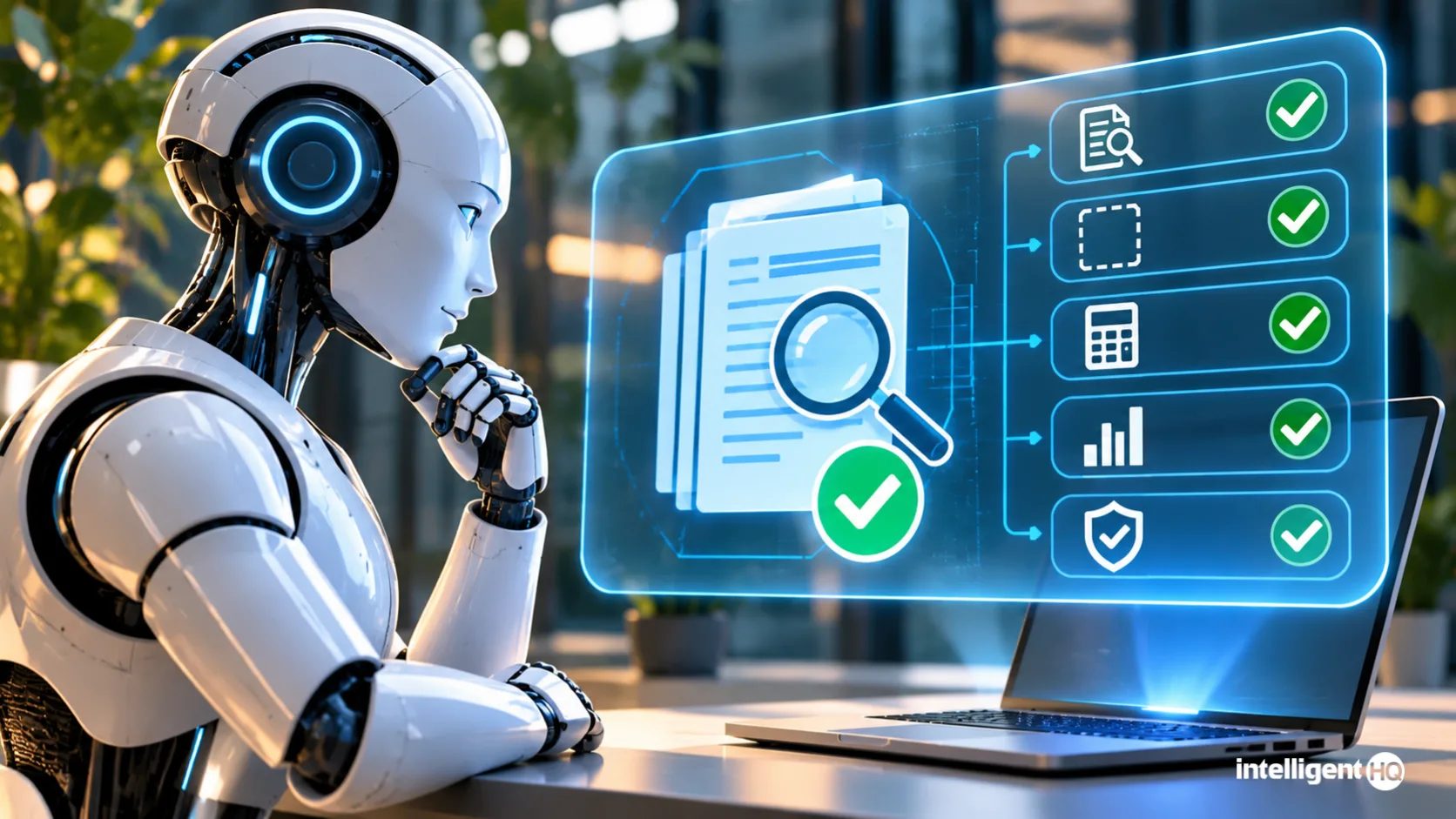
1. Require Source Documents and Page References
Every extracted figure or statement should be linked to its original document and page.
Reviewers must be able to open the source and confirm that the information supports the agent’s output.
A citation that points to the wrong document, an unrelated page or a passage that does not contain the reported information should be treated as a verification failure.
2. Allow Missing Information to Remain Missing
AI systems may generate plausible responses even when the requested information is absent.
Grandmont recommends allowing agents to return empty fields when the relevant data cannot be found.
For example, if a financial document does not disclose a particular expense, the agent should flag the missing information rather than estimate a figure without authorisation.
A document-processing system that never reports missing information may require closer examination.
3. Use Deterministic Code for Calculations
Calculations involving totals, percentages, financial ratios and date comparisons should be performed by software using verified input values.
Language models can help identify and extract information, but deterministic calculations allow reviewers to reproduce the results.
This separates document interpretation from arithmetic and reduces reliance on generated numerical answers.
4. Test Agents Against Known Answers
Before deployment, organisations should evaluate AI agents using historical documents with verified answers.
These tests should be repeated whenever the model, prompt or workflow changes.
Accuracy should also be assessed for individual data fields. A system achieving 95% overall accuracy could still make frequent mistakes on a specific field that carries serious financial or compliance consequences.
5. Maintain Audit Records Outside the AI Agent
Organisations should retain independent records of the documents processed, extracted results, source references, system actions and human approvals.
These records should be captured by infrastructure the agent cannot modify without authorisation.
If an auditor reviews a decision several months later, the organisation should be able to reconstruct which document was used, what the agent produced and how the output was approved.
Building Trust Through AI Governance
These recommendations reflect a broader shift in enterprise AI governance.
The US National Institute of Standards and Technology’s AI Risk Management Framework emphasises continuous evaluation, monitoring, documentation and accountability throughout the AI lifecycle.
For organisations deploying AI agents, these principles can be translated into practical controls, including document provenance, restricted permissions, independent audit logs and human approval for higher-risk decisions.
As AI systems become capable of completing more complex tasks, businesses need to distinguish between an agent providing a convincing answer and producing an answer that can be independently verified.
Automating a process may reduce manual work, but it does not remove an organisation’s responsibility for the accuracy, security and consequences of its decisions.
The ability to reproduce an agent’s actions and examine the evidence behind its outputs is becoming an important measure of enterprise AI reliability.
About Kolena
Kolena develops AI-powered tools for document processing, workflow automation and AI evaluation. Its technology supports organisations working with complex documents and structured data across industries including financial services, insurance and real estate.