Every year, we look ahead to see what new tech will change things. For 2026, the list of top 10 technology trends is pretty interesting. It’s not just about faster computers or newer phones anymore. We’re seeing big shifts in how we think about security, how we build things, and even how we power our world. This year, the focus is on technologies that are moving from just ideas to actual use, and it’s important to know what’s coming.
Key Takeaways
- Post-Quantum Cryptography is set to drive new ways of protecting data, especially as current methods might not be safe from future powerful computers.
- Neuromorphic Computing is expected to see commercial chips that can help with AI tasks, making them faster and more efficient.
- Physical AI, which combines robots with intelligence, is likely to make big steps forward, helping with tasks in factories and other workplaces.
- Multi-Agent Systems will see more companies using AI that works together in teams to handle complex jobs.
- Wireless EV Charging infrastructure is expected to grow, making it easier for electric cars to get power without plugging in.
1. Post-Quantum Cryptography
The digital world we live in relies heavily on cryptography to keep our information safe, from online banking to secure communications. However, a significant shift is on the horizon. The current methods of encryption, while robust today, could become vulnerable to the powerful computing capabilities of future quantum computers. This is where Post-Quantum Cryptography (PQC) comes into play.
Post-Quantum Cryptography refers to cryptographic algorithms that are thought to be secure against attacks from both classical and quantum computers. The development and standardization of these new cryptographic techniques are becoming increasingly important as we prepare for a future where quantum computing is a reality. It’s not about if quantum computers will break current encryption, but when.
Why is this a big deal for 2026?
- Standardization Efforts: Major standardization bodies are finalizing algorithms that will form the backbone of PQC. This means we’re moving from theoretical research to practical implementation.
- Hybrid Deployment Models: Many organizations will adopt a ‘hybrid’ approach, using both current and PQC algorithms simultaneously. This provides a safety net during the transition period.
- Increased Awareness and Planning: Businesses and governments are realizing the urgency and are beginning to plan for the migration of their systems to PQC-compliant solutions.
Think of it like upgrading your home security system. You wouldn’t wait for a break-in to install better locks; you’d do it proactively. PQC is that proactive upgrade for our digital infrastructure.
The transition to post-quantum cryptography is a complex undertaking that requires careful planning and execution. It involves not just updating software but also re-evaluating hardware and infrastructure to support new cryptographic standards. This shift is essential to maintain trust and security in our increasingly connected world.
2. Neuromorphic Computing
Neuromorphic computing is an exciting area that’s really changing how we think about artificial intelligence. Instead of using traditional computer chips that process information in a very linear way, neuromorphic chips are designed to mimic the structure and function of the human brain. This means they can process information much more like we do – in parallel, with interconnected "neurons" and "synapses."
This brain-inspired approach allows for significantly more efficient and faster processing of complex AI tasks. Think about tasks like pattern recognition, sensory processing, and even learning. Because these chips are built to work like our brains, they can handle these kinds of jobs with much less power and at higher speeds than conventional hardware.
Here’s a look at why this is becoming so important:
- Energy Efficiency: Traditional AI hardware can be very power-hungry. Neuromorphic systems promise to drastically cut down on energy consumption, which is a big deal for everything from mobile devices to large data centers.
- Speed and Responsiveness: The parallel processing capabilities mean these chips can react to information almost instantly, which is vital for real-time applications like autonomous vehicles or robotics.
- Learning and Adaptation: Mimicking neural networks allows these systems to learn and adapt from new data in a more natural way, similar to how humans learn.
We’re starting to see commercial chipsets emerge that are specifically designed to tackle these AI bottlenecks. This isn’t just theoretical anymore; it’s about building hardware that can actually keep up with the demands of advanced AI. It’s a big step forward for making AI more practical and widespread. For those looking to understand how to implement new technologies effectively, understanding agile methodologies can be quite beneficial, and certifications like the PMI-ACP can validate that expertise [f62d].
The shift towards neuromorphic computing represents a fundamental change in hardware design, moving away from brute-force computation towards a more biological, efficient, and intelligent processing paradigm. This evolution is key to unlocking the next generation of AI capabilities.
As these chips become more powerful and accessible, expect to see them integrated into a wider range of devices and applications, pushing the boundaries of what AI can achieve.
3. Physical AI
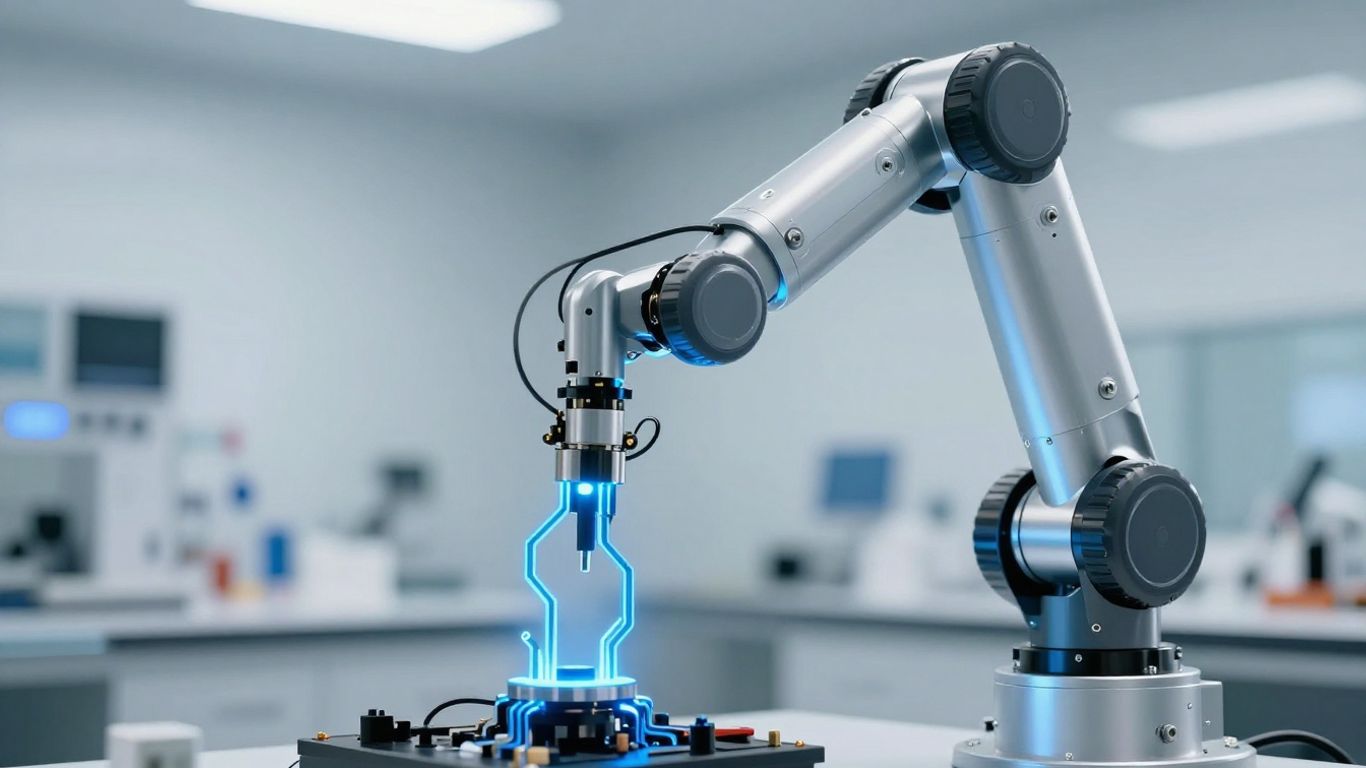
Physical AI is where the digital world of artificial intelligence meets the tangible world of robotics. Think of it as giving machines the ability to not just think, but to act and interact with their surroundings in intelligent ways. This isn’t just about robots on an assembly line anymore; it’s about creating systems that can perceive, reason, and physically perform tasks that were once exclusively human domains.
We’re seeing significant progress in areas like humanoid robots that can navigate complex environments, perform delicate operations, and even collaborate with people. This fusion of AI and robotics is opening doors in manufacturing, logistics, healthcare, and even in our homes. For instance, AI-powered robots can now handle tasks requiring fine motor skills, assist surgeons with precision, or manage inventory in warehouses with remarkable efficiency. The key driver is the ability of AI to provide these machines with adaptability and learning capabilities, allowing them to handle unpredictable situations.
Here are some key aspects of Physical AI’s growing influence:
- Enhanced Automation: Moving beyond repetitive tasks to complex, dynamic operations.
- Human-Robot Collaboration: Creating safer and more productive partnerships in workplaces.
- Improved Dexterity and Mobility: Robots are gaining the ability to perform intricate physical actions and move through varied terrains.
- Real-world Problem Solving: Applying AI’s intelligence to physical challenges, from disaster response to elder care.
The development in Physical AI is moving at a pace that suggests we’ll see more sophisticated applications emerge sooner than many anticipate. It’s about making AI useful in the physical spaces we inhabit, not just on our screens.
This trend is particularly important for addressing labor shortages and increasing operational resilience across various industries. As AI models become more sophisticated, their ability to control physical systems will only grow, leading to more capable and versatile robotic agents.
4. Multi-Agent Systems
Imagine a team of specialized digital workers, each with its own skills, all coordinating to get a job done. That’s the basic idea behind Multi-Agent Systems (MAS). Instead of one big, complex AI trying to handle everything, MAS breaks down tasks among several smaller, focused AI agents. These agents can communicate, negotiate, and work together autonomously to solve problems or manage operations.
Think about how a busy office works: you have people handling sales, others in customer support, and a separate team for IT. Each person has a specific role, but they all need to interact for the company to run smoothly. MAS applies this concept to artificial intelligence. One agent might be great at analyzing data, another at scheduling, and a third at communicating with users. Together, they can tackle much more intricate challenges than a single AI could.
The real power of Multi-Agent Systems lies in their ability to handle complex, dynamic environments where decisions need to be made quickly and efficiently.
Here’s how they’re starting to make a difference:
- Cybersecurity: Agents can monitor networks for suspicious activity, identify potential threats in real-time, and even coordinate defensive actions without human intervention.
- Supply Chain Management: MAS can optimize logistics by having agents manage inventory, track shipments, and adjust routes based on changing conditions, like traffic or weather.
- Customer Service: A system could use one agent to understand a customer’s initial query, another to find the relevant information, and a third to provide a helpful response, potentially escalating to a human agent if needed.
- Robotics and Automation: In factories or warehouses, multiple robots (each acting as an agent) can coordinate their movements and tasks to improve efficiency and safety.
The trend in 2026 is seeing enterprises invest in agents that are highly specialized for specific industries or business functions. This means we’re moving beyond general-purpose agents to ones that understand the nuances of a particular field, making them even more effective. It’s about building smarter, more collaborative AI teams for specific jobs.
This approach allows for greater flexibility and scalability. If a new task arises, you can potentially add a new agent with the required skills without overhauling the entire system. It’s a more modular and adaptable way to build intelligent systems for the future.
5. Wireless EV Charging
Imagine pulling into your garage or a parking spot and your electric vehicle (EV) just starts charging without you needing to plug anything in. That’s the promise of wireless EV charging, and it’s moving from a neat idea to a real possibility in 2026. This technology uses inductive charging, similar to how some smartphones charge, but on a much larger scale.
The big push for wireless charging is making EV ownership more convenient and accessible for everyone. No more fumbling with cables in the rain or worrying about damaged charging ports. It’s about removing a small, but significant, barrier to wider EV adoption.
Several factors are driving this trend:
- Advancements in charging pad technology: These pads are becoming more efficient and capable of delivering higher power, meaning faster charging times.
- Standardization efforts: As more companies work on wireless charging, common standards are emerging, which helps ensure different vehicles and charging systems can work together.
- Increased investment in infrastructure: We’re starting to see more public and private investment in installing wireless charging pads in places like parking lots, garages, and even on roads for dynamic charging (charging while driving).
While still not as widespread as plug-in charging, the infrastructure is growing. Expect to see more pilot programs and early rollouts in commercial fleets and public spaces. The goal is to make charging as simple as parking your car.
The convenience factor cannot be overstated. For many potential EV buyers, the act of plugging in is a minor hassle, but one that adds friction to the ownership experience. Wireless charging aims to eliminate this friction entirely, making the transition to electric vehicles feel more natural and less like a compromise.
Challenges remain, of course. Efficiency is still a bit lower than wired charging, and the initial cost of installation can be higher. However, as the technology matures and production scales up, these issues are expected to lessen. By 2026, wireless EV charging is set to become a much more visible and practical part of the electric vehicle landscape.
6. Counter-Drone Technology
The skies are getting a bit crowded, and not just with airplanes. Unmanned aerial vehicles, or drones, have become incredibly common, used for everything from taking cool aerial photos to delivering packages. But this widespread use also brings challenges, especially when drones are used for less-than-ideal purposes. Think about unauthorized surveillance, smuggling contraband into secure areas, or even more serious threats. This is where counter-drone technology comes into play.
The need for effective counter-drone systems is growing rapidly as the accessibility and capabilities of drones continue to expand. These systems are designed to detect, track, identify, and ultimately neutralize unauthorized or hostile drones. It’s a complex field because drones can be small, quiet, and fly at various altitudes, making them tricky targets. The technology aims to provide a robust defense against these aerial intrusions without causing collateral damage or disrupting legitimate air traffic.
Several approaches are being used to tackle this problem:
- Detection and Tracking: This often involves a combination of radar, radio frequency (RF) scanners, acoustic sensors, and electro-optical/infrared (EO/IR) cameras to spot drones.
- Identification: Once detected, systems try to determine if the drone is a threat. This can involve analyzing its flight path, communication signals, and comparing it against known drone signatures.
- Neutralization: This is the part where action is taken. Methods can include:
- Jamming: Disrupting the drone’s control signals or GPS.
- Spoofing: Taking control of the drone by feeding it false navigation data.
- Kinetic Methods: Using projectiles or nets to physically bring down the drone.
- Directed Energy: Employing lasers or high-powered microwaves to disable the drone’s electronics.
The development of counter-drone technology is a constant race. As drone technology advances, so too must the systems designed to counter them. This means continuous innovation in detection accuracy, speed of response, and the variety of neutralization methods available to adapt to new threats.
As we move further into 2026, expect to see more integrated and sophisticated counter-drone solutions. These will be vital for protecting critical infrastructure, public events, and sensitive locations from the misuse of drone technology.
7. Microfluidics
Microfluidics, a field that deals with the behavior, precise control, and manipulation of fluids that are constrained to a small scale (typically channels with dimensions of 1 to 100 micrometers), is gaining significant traction. While its roots are in areas like medical diagnostics and drug delivery, its potential applications are expanding rapidly, particularly in the tech sector. One of the most exciting emerging uses is as a next-generation cooling system for AI chips.
As artificial intelligence models become more complex and powerful, the heat generated by these processors becomes a major challenge. Traditional cooling methods are starting to struggle to keep pace. Microfluidic cooling systems offer a more efficient and targeted approach. They work by circulating a coolant through tiny channels directly within or very close to the heat-generating components. This allows for much more precise temperature management, preventing overheating and enabling chips to operate at higher performance levels for longer periods.
Here’s why microfluidics is becoming so important for advanced computing:
- Enhanced Heat Dissipation: The small scale allows for a very large surface area relative to the volume, which greatly improves heat transfer efficiency.
- Precise Temperature Control: Microfluidic systems can maintain very specific temperature gradients across a chip, which is vital for the stability and performance of sensitive electronic components.
- Compact Design: The miniaturized nature of microfluidic channels means cooling solutions can be integrated more tightly with the hardware, saving space.
- Reduced Coolant Volume: These systems require significantly less coolant compared to traditional methods, leading to potential weight and energy savings.
The ability to manage heat effectively is no longer just a secondary concern; it’s becoming a primary bottleneck for pushing the boundaries of computational power, especially in AI. Microfluidics presents a compelling solution to this growing problem.
Beyond cooling, microfluidics continues to be a key enabler in other areas. Its precision in handling small volumes of fluids makes it ideal for lab-on-a-chip devices, advanced chemical synthesis, and even novel display technologies. As research and development in these areas mature, we can expect to see more innovative products and solutions emerging from this fascinating field.
8. Multi-Cloud Models
Remember those big cloud outages that caused a stir in 2025? They really got people thinking. For 2026, the focus is shifting towards making things more resilient, and that’s where multi-cloud models come into play. Instead of relying on just one cloud provider, companies are spreading their digital assets across several. This isn’t just about having a backup plan; it’s a strategic move.
The main idea behind multi-cloud is to avoid putting all your eggs in one basket. This approach helps businesses dodge the risks associated with a single provider experiencing technical issues or even going offline. Plus, it allows organizations to pick and choose the best services from different cloud vendors, tailoring their setup for specific needs.
Here’s a quick look at why this is becoming so popular:
- Better Reliability: If one cloud goes down, others can often pick up the slack, keeping operations running.
- Cost Savings: Companies can shop around for the most competitive pricing for different services.
- Flexibility: You can use specialized tools or services from different providers that might be better suited for certain tasks.
- Avoiding Vendor Lock-in: It’s harder for one provider to dictate terms when you have options.
Managing multiple cloud environments can seem complicated at first. It requires careful planning and the right tools to keep everything organized and secure. However, the benefits in terms of stability and adaptability are making it a top priority for many businesses looking to stay competitive in the coming year.
9. Small Modular Reactors
Small Modular Reactors, or SMRs, are a newer approach to nuclear power generation. Think of them as smaller, factory-built versions of traditional large nuclear reactors. Because they’re built in a controlled factory setting, they can be produced more consistently and potentially at a lower cost. Plus, their smaller size means they can be deployed in more locations, even in areas that couldn’t support a full-sized plant.
Regulatory approvals are starting to open up new possibilities for SMRs to make a real impact on how we generate energy.
Here’s a quick look at why SMRs are gaining attention:
- Flexibility: They can be scaled up by adding more modules as energy needs grow.
- Safety: Advanced designs often incorporate passive safety features, meaning they rely on natural forces like gravity and convection to shut down safely.
- Efficiency: Factory production can lead to better quality control and reduced construction times compared to traditional builds.
The shift towards SMRs is driven by a need for cleaner, more reliable energy sources that can be deployed faster and more affordably than current large-scale nuclear projects. This makes them an attractive option for both established energy markets and developing regions looking to expand their power grids.
While still facing hurdles like public perception and final regulatory frameworks, SMRs represent a significant development in the quest for advanced nuclear energy solutions.
10. Open-Source Smart Buildings

The way we build and manage our living and working spaces is getting a major upgrade. Open-source smart buildings are becoming a bigger deal in 2026, and it’s all about making buildings more connected, efficient, and adaptable. Think of it as giving buildings a brain that can learn and improve over time, but with the added benefit of transparency and community involvement.
This trend is driven by the need for greater energy efficiency and better occupant experiences. Instead of proprietary systems that lock you into one vendor, open-source approaches allow different technologies and devices to talk to each other. This interoperability is key. It means a building’s heating, lighting, security, and even its energy usage can be managed through a unified platform, often built on open standards. This makes it easier to integrate new technologies as they emerge and avoids vendor lock-in, which can be a real headache and a drain on resources.
Here’s what makes open-source smart buildings stand out:
- Interoperability: Devices and systems from different manufacturers can work together without special adapters or complex workarounds.
- Flexibility: Building managers can customize and adapt the building’s systems to meet specific needs, rather than being limited by pre-set functions.
- Cost-Effectiveness: Open-source software often reduces licensing fees, and the ability to mix and match hardware can lead to significant savings.
- Innovation: A community of developers can contribute to improving the software, leading to faster updates and new features.
The shift towards open-source smart buildings is more than just a technological advancement; it represents a move towards more collaborative and sustainable urban development. By sharing code and standards, we can build smarter environments that are also more accessible and adaptable for everyone.
This approach is particularly important as we face growing energy demands and the need to reduce our environmental impact. Open-source platforms can help optimize energy consumption in real-time, responding to occupancy levels and external conditions. This not only saves money but also contributes to greener cities. As more companies and developers contribute to these open platforms, we can expect to see even more creative solutions for managing our built environment. It’s an exciting time for the future of smart building technology and how we interact with the spaces around us.
Conclusion
Looking ahead to 2026, it’s clear that technology is moving faster than ever. The trends we’ve explored—like post-quantum cryptography, neuromorphic computing, and physical AI—aren’t just buzzwords. They’re real changes that are starting to show up in everyday business and life. Companies will need to make choices about which new tools to use and how to use them safely. Some of these decisions might feel overwhelming, but that’s normal when things are changing so quickly. The important thing is to stay curious, keep learning, and be ready to try new approaches. No one has all the answers, but by paying attention to these trends and being open to change, organizations and individuals can find their way forward. The gap between those who adapt and those who don’t will only get wider. So, whether you’re a tech enthusiast or just trying to keep up, now is the time to get involved and see where these trends can take you.
Frequently Asked Questions
What is post-quantum cryptography and why is it important for 2026?
Post-quantum cryptography is like a new secret code that can protect our digital information from even the most powerful future computers. Right now, our online security relies on codes that today’s computers can break. But with new, super-powerful computers on the way, we need stronger codes. In 2026, many companies will start using these new codes together with the old ones to make sure our data stays safe from these future threats.
How will neuromorphic computing change things?
Neuromorphic computing is a new way of building computer chips that works more like a human brain. Our brains are great at learning and solving problems quickly. These new chips can help artificial intelligence (AI) learn faster and use less energy. By 2026, we’ll see these brain-like chips becoming available to help AI do more complex tasks more efficiently.
What is ‘Physical AI’ and what advancements can we expect?
Physical AI is when robots are given advanced AI brains, making them smart enough to do physical tasks. Think of robots that can walk, move things, and even help people. In the next few years, and especially by 2026, these robots will get much better at understanding and interacting with the real world, helping out in factories, warehouses, and even homes.
What are multi-agent systems and how will businesses use them?
Imagine having a team of AI helpers, where each one is good at a specific job. Multi-agent systems are like that – they are groups of AI agents that work together to solve big problems. Businesses will use these teams of AI agents in 2026 to handle complicated tasks, make smart decisions, and manage large operations more smoothly, like in customer service or managing supplies.
Why is wireless EV charging becoming a bigger trend?
Wireless EV charging means you can charge your electric car just by parking it over a special pad, without plugging anything in. This is becoming much easier and more common. In 2026, more charging stations will be built this way, making it super convenient for electric car owners to keep their cars powered up.
What is counter-drone technology and why is it needed?
Drones are becoming more popular, but sometimes they can be used for harmful purposes. Counter-drone technology is designed to detect and stop unwanted or dangerous drones. As more drones take to the skies, the need for these protective technologies will grow significantly by 2026 to keep areas safe from unauthorized drone activity.