It’s easy to miss things in the fast-paced world of technology. August 2019 had its share of interesting developments that might have flown under the radar. From finding new resources in unexpected places to making computers smarter and more creative, there was a lot going on. Let’s take a quick look at some of the technology current events august 2019 that were noteworthy.
Key Takeaways
- Researchers found that U.S. metal mines hold significant amounts of critical minerals that are currently unused. Recovering even a small part of these could lessen our reliance on foreign sources for important materials needed for clean energy and tech. The value of these recovered minerals might even be more than what the mines currently produce.
- A new carbon material has been developed that could make capturing carbon dioxide cheaper and more effective. The way nitrogen atoms are arranged in this material is key to how well it absorbs CO2, potentially leading to better and more affordable ways to store carbon.
- Scientists have demonstrated a prototype quantum battery. This device uses quantum physics to store energy and can charge up much faster than typical batteries, hinting at a future of rapid energy storage.
- AI is showing promise as a creative partner, helping in design processes. Also, AI-generated fake X-rays are now so realistic they can fool medical professionals, raising questions about its use in healthcare and creativity.
- There was a noticeable rise in significant cyberattacks, including espionage targeting phone companies. International efforts, like an Interpol operation, have helped disrupt global cybercrime groups.
Unlocking Earth’s Hidden Resources
Critical Minerals Found Abundantly in U.S. Mines
It turns out there’s a lot more valuable stuff hiding in plain sight within U.S. metal mines than we previously thought. Recent research has shown that many mines, while primarily extracting one type of metal, also contain significant amounts of other critical minerals. These aren’t just trace amounts; we’re talking about quantities that could make a real difference.
Potential to Reduce Import Dependence for Key Materials
This discovery is pretty big news, especially when you consider how much we rely on other countries for certain materials. Think about the minerals needed for things like electric car batteries, solar panels, and advanced electronics. If we can pull more of these out of our own mines, it could mean a lot less dependence on imports. This could lead to more stable supply chains and potentially lower costs for these high-demand items.
Economic Value Exceeding Primary Mine Products
What’s really interesting is that in some cases, the value of these ‘byproduct’ minerals could actually be more than the value of the main ore the mine was set up to extract. This changes the economics of mining quite a bit. It means that even mines focused on traditional metals could become much more profitable by simply processing their waste streams or tailings more effectively. It’s like finding a treasure chest within another treasure chest.
Here’s a look at some of the potential benefits:
- Reduced reliance on foreign sources: Bolstering domestic supply for strategic materials.
- Economic growth: Creating new revenue streams for mining operations.
- Environmental considerations: Potentially reducing the need for new mining sites by utilizing existing ones more fully.
The ability to recover these overlooked minerals from existing mine sites presents a significant opportunity. It’s a way to meet growing demand for advanced materials while also strengthening national resources. This approach could reshape how we think about mining and resource management for years to come.
Advancements in Carbon Capture Technology
New Carbon Material Enhances Capture Efficiency
Scientists have been working on new ways to pull carbon dioxide (CO2) out of the air and industrial emissions. One exciting development involves a novel carbon material that shows a lot of promise for making this process more efficient and less expensive. The key seems to be in how nitrogen atoms are arranged within the material’s structure. Researchers found that specific configurations of these nitrogen atoms are particularly good at grabbing CO2 molecules. This careful arrangement allows the material to absorb more CO2 and, importantly, release it with less energy needed, which is a big hurdle in current carbon capture methods.
Nitrogen Atom Arrangement Key to CO2 Absorption
The precise positioning of nitrogen atoms within a carbon-based material has emerged as a critical factor in its ability to capture carbon dioxide. Think of it like having the right kind of lock and key. When the nitrogen atoms are placed in just the right spots, they create binding sites that are perfectly shaped for CO2 molecules. This isn’t just a minor tweak; it significantly boosts how much CO2 the material can hold. Furthermore, the way these nitrogen atoms interact with the carbon structure influences how easily the captured CO2 can be released. This release step is often where a lot of energy is used, so making it easier means the whole capture process becomes more practical and cost-effective.
Lower Costs and Increased Effectiveness for Carbon Sequestration
These advancements in carbon capture materials point towards a future where removing CO2 from the atmosphere and industrial sources could become much more affordable and effective. The ability to fine-tune the material’s properties by controlling nitrogen atom placement means we can design better sorbents. This could lead to:
- Reduced energy requirements for both capturing CO2 and releasing it for storage or reuse.
- Higher capacity for CO2 absorption, meaning less material is needed to capture the same amount of gas.
- Improved durability of the capture materials, leading to longer lifespans and lower replacement costs.
The goal is to make carbon capture technology a more viable tool in the fight against climate change, moving it from a costly experimental phase to a widely applicable solution. By focusing on the molecular design of capture materials, researchers are paving the way for more economical and efficient ways to manage greenhouse gas emissions.
This progress is significant because effective carbon capture and sequestration (CCS) technologies are seen as a necessary part of strategies to limit global warming. Making these technologies cheaper and better performing could accelerate their adoption by industries and governments worldwide.
Innovations in Energy Storage
Remember when charging your phone felt like it took forever? Well, the world of energy storage is getting a serious upgrade, and it’s not just about making batteries last longer. We’re talking about fundamentally new ways to store and release power, moving beyond the usual chemical reactions.
Quantum Battery Prototype Demonstrates Rapid Charging
Scientists have recently shown off a working prototype of a quantum battery. This isn’t your typical lithium-ion tech. Instead, it uses the weird and wonderful rules of quantum physics to store energy. The big news here is its ability to absorb energy incredibly fast, in what’s being called a "super absorption" event. This could mean charging devices much, much quicker than anything we have today.
Harnessing Quantum Effects for Energy Storage Revolution
So, how does this quantum magic work? It’s all about manipulating quantum states. Instead of relying on chemical processes like traditional batteries, quantum batteries tap into quantum phenomena. This allows for a different kind of energy transfer – one that’s potentially much faster and more efficient. Think of it less like filling a bucket and more like a lightning-fast energy transfer.
Potential for Faster Charging Than Traditional Batteries
The implications are pretty exciting. If this technology can be scaled up, we might be looking at a future where devices charge in seconds, not hours. This could change everything from personal electronics to electric vehicles and even grid-scale energy storage. It’s still early days, but the progress is definitely something to keep an eye on.
AI’s Evolving Role in Creativity and Healthcare
AI as a Creative Collaborator in Design Processes
Artificial intelligence is stepping out of the purely analytical and into the artistic. In design, AI is no longer just a tool for optimizing existing ideas, but a partner in generating new ones. Think of it as a digital muse, capable of suggesting novel forms, color palettes, or even entire layouts that a human designer might not have considered. This collaboration can speed up the initial brainstorming phase significantly. AI algorithms can analyze vast datasets of existing designs, identify patterns, and then propose variations or entirely new concepts based on those learnings. This doesn’t replace the human designer’s intuition or aesthetic judgment, but rather augments it, allowing for more exploration in less time.
Deepfake X-rays Capable of Fooling Medical Professionals
This is a development that raises serious questions. Researchers have demonstrated that AI can create highly convincing "deepfake" medical images, including X-rays. These synthetic images are so realistic that they can potentially deceive even experienced medical professionals. The implications are significant, ranging from the potential for malicious actors to introduce fraudulent evidence into medical records to the need for new methods to verify the authenticity of diagnostic images. The ability to generate such realistic fakes highlights the growing sophistication of AI and the challenges it presents to trust and verification in critical fields like healthcare.
AI’s Potential to Enhance Human Creativity and Problem-Solving
Beyond design and healthcare diagnostics, AI is showing promise in broadening human capabilities. In creative fields, AI can act as a co-creator, helping artists, musicians, and writers explore new styles or overcome creative blocks. For problem-solving, AI can process complex data sets and identify correlations that might be missed by human analysis alone. This can lead to breakthroughs in scientific research, business strategy, and even everyday decision-making. The key is viewing AI not as a replacement for human intellect, but as a powerful assistant that can amplify our own abilities. It’s about working with AI to achieve outcomes that would be difficult or impossible otherwise.
Cybersecurity Threats and Responses
August 2019 saw a noticeable uptick in cybersecurity concerns, with a particular focus on large-scale attacks and the ongoing efforts to combat them. It’s becoming increasingly clear that the digital landscape is a constant battleground, and staying ahead requires a multi-faceted approach.
Increase in Nationally Significant Cyberattacks
We’re seeing more and more cyberattacks that have the potential to disrupt critical national infrastructure and services. These aren’t just isolated incidents; they’re often sophisticated operations that can have widespread consequences. The sheer scale and complexity of these attacks mean that governments and organizations alike are having to rethink their defenses.
Espionage Campaigns Targeting Telecommunications Providers
Telecommunications networks, the very backbone of our connected world, have become prime targets for espionage. State-sponsored actors are increasingly looking to exploit vulnerabilities within these systems to gain access to sensitive information and conduct surveillance. This puts a huge pressure on telecom companies to maintain robust security measures.
Interpol Operation Disrupts Global Cybercrime Syndicates
On a more positive note, international law enforcement agencies, like Interpol, have been making strides in taking down major cybercrime operations. A significant operation in August 2019 successfully disrupted several global syndicates, demonstrating the power of international cooperation in fighting digital crime. These efforts are vital in protecting individuals and businesses from financial and data theft.
The digital world presents unique challenges, where threats can emerge rapidly and spread globally. Addressing these requires not only technical solutions but also strong international collaboration and proactive security measures across all sectors.
Here’s a look at some key aspects of the evolving cybersecurity landscape:
- Sophistication of Attacks: Threats are becoming more advanced, often employing novel techniques to bypass traditional security systems.
- Targeting Critical Infrastructure: Attacks are increasingly aimed at sectors like energy, finance, and healthcare, where disruption can have severe societal impacts.
- International Cooperation: Global efforts are crucial for tracking and dismantling cybercriminal networks that operate across borders.
- Focus on Prevention: There’s a growing emphasis on ‘security by design,’ building security into systems from the outset rather than trying to patch it later.
Progress in Quantum Computing and Data Analysis

Quantum computing is a field that’s always buzzing with new ideas, and August 2019 was no exception. While we’re still a ways off from having quantum computers on our desks, the progress being made is pretty significant. One of the big challenges in quantum computing is something called decoherence, which is basically when the delicate quantum states of qubits get messed up by their surroundings. This loss of quantum information can happen really fast, making it hard to do complex calculations.
New Method for Faster Quantum Data Loss Measurement
Scientists have been working on ways to measure this data loss more effectively. In August 2019, there was a notable development in a new method that can track quantum information loss much, much faster than before. We’re talking over 100 times quicker! This means researchers can now observe what’s happening inside quantum systems in near real-time.
Tracking Quantum Information Loss in Real Time
Imagine trying to fix a car engine while it’s running at full speed – that’s kind of what it’s like trying to understand quantum data loss. This new technique allows scientists to see the problem as it happens.
Here’s a simplified look at why this is important:
- Detecting Errors: Quickly spotting when quantum information starts to fade.
- Improving Stability: Understanding the causes of loss helps in building more stable quantum hardware.
- Accelerating Development: Faster measurements mean quicker cycles for testing and improving quantum algorithms and hardware.
Towards More Stable and Reliable Quantum Computers
This ability to monitor quantum information loss in real time is a big step. It helps researchers figure out what’s going wrong and how to prevent it. Think of it like having a super-fast diagnostic tool for quantum computers. By understanding these issues better, we get closer to building quantum computers that are not only powerful but also dependable for complex data analysis tasks.
The ongoing quest for stable quantum systems involves understanding and mitigating the subtle ways quantum information can be lost. Advances in measurement speed are key to this effort.
Transforming Data Centers and Energy Efficiency
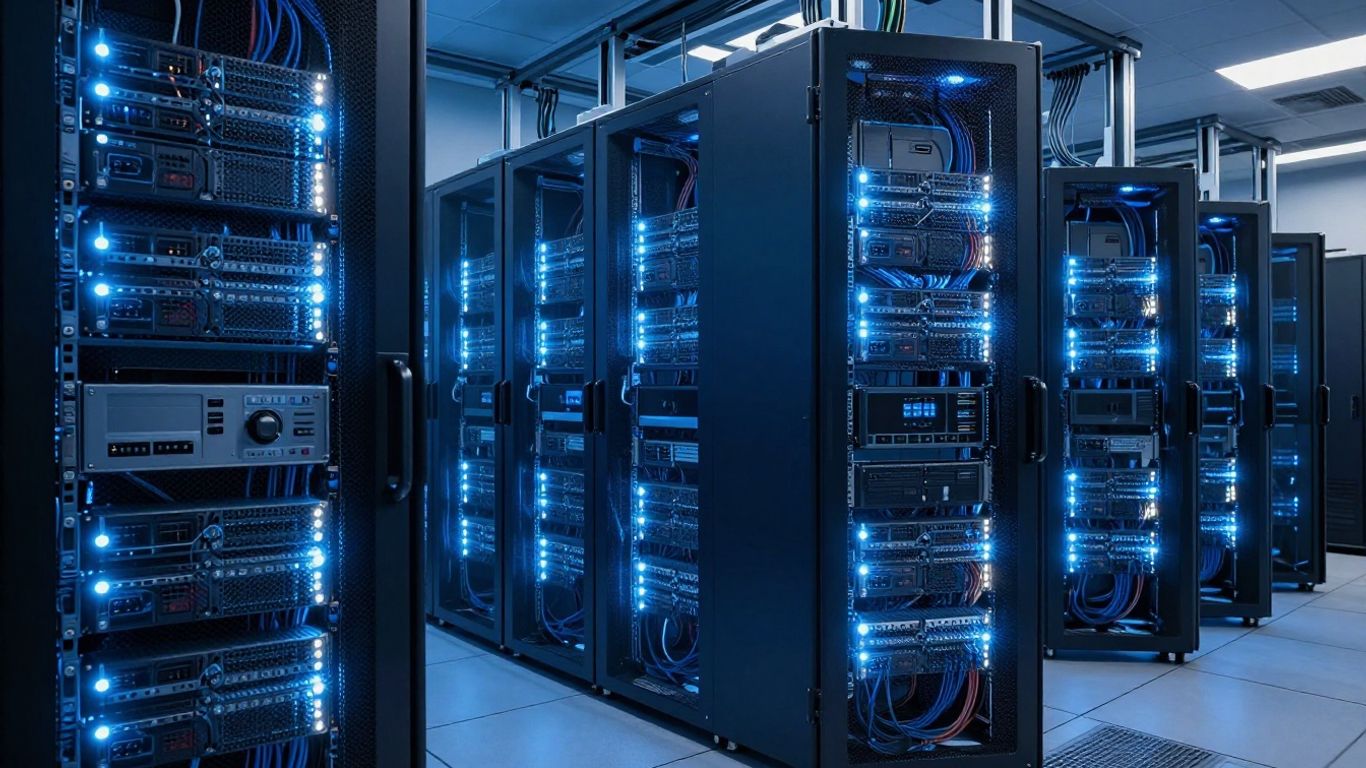
Data centers are the engines of our digital world, but they consume a lot of power. In August 2019, there was a lot of talk about making them run better and use less energy. It’s not just about bigger servers; it’s about smarter design.
Innovative Chip Design for Energy-Efficient Data Centers
Think about how much electricity your computer uses. Now imagine that multiplied by thousands, or even millions, for the servers in a data center. Researchers have been looking at new ways to design the chips that power these centers. One idea involves rethinking how power gets to the graphics processing units (GPUs), which are used for more than just graphics these days, especially with AI workloads. A new chip design aims to combine different components in a clever way to reduce wasted energy. This could mean less heat generated and lower electricity bills for these massive facilities.
Rethinking Power Conversion for GPUs
GPUs are power-hungry. Traditionally, converting electricity for them has had its limits. New approaches are exploring ways to make this conversion process much more efficient. This involves looking at the very components that handle the power flow. By using different materials or arranging circuits in novel ways, engineers are trying to get more performance out of the same amount of power, or even less.
Overcoming Limitations of Traditional Power Designs
Many existing data center power systems were designed for older technology. As computing demands grow, especially with the rise of AI and big data, these older designs are becoming bottlenecks. They can be inefficient, generate too much heat, and simply can’t keep up. The focus in 2019 was on developing next-generation power solutions that address these issues head-on. This includes:
- Exploring new materials for better conductivity and less heat.
- Developing integrated power management systems directly on the chips.
- Designing modular power units that can be scaled easily.
- Improving cooling systems that work hand-in-hand with power efficiency.
The push for more energy-efficient data centers isn’t just about saving money; it’s also about reducing the environmental impact of our increasingly digital lives. Finding ways to do more with less power is a key challenge for the future of computing.
Looking Back, Moving Forward
As we wrap up our look at August 2019’s tech news, it’s clear that the world of technology never really slows down. From advancements in materials science and energy storage to ongoing concerns about cybersecurity and the evolving role of AI, the landscape is constantly shifting. These developments, even those that might have flown under the radar at the time, often lay the groundwork for the innovations we see today and will continue to shape our future. Keeping an eye on these trends, big or small, helps us understand the direction technology is heading and how it might impact our lives.
Frequently Asked Questions
What kind of valuable materials are being found in U.S. mines that we might be missing?
Researchers have discovered that many U.S. metal mines contain large amounts of important minerals that are currently not being used. These are often leftovers from mining other materials. Getting even a small part of these unused minerals could help the U.S. rely less on other countries for materials needed for things like clean energy and advanced technology. In some cases, these leftover minerals could be worth more than the main products from the mines.
How is carbon capture technology improving?
Scientists are developing new ways to capture carbon dioxide, a gas that contributes to climate change. One new method uses a special carbon material where the arrangement of nitrogen atoms is key to grabbing CO2. This new approach could make capturing carbon cheaper and more effective, helping to store it away and reduce its impact on the environment.
Are there new ways to store energy that charge faster?
Yes, there’s exciting progress in energy storage! Researchers have created a test version of a ‘quantum battery.’ This new type of battery uses the weird rules of quantum physics to store energy. It can absorb energy very quickly, meaning it could potentially charge much faster than the batteries we use today in our phones and cars.
How is Artificial Intelligence (AI) being used in creative fields and healthcare?
AI is becoming a partner in creative work, helping designers come up with new ideas. In healthcare, AI is getting so good that it can create fake X-ray images that are hard for doctors to tell apart from real ones. This shows AI’s growing ability to help humans be more creative and solve complex problems, but also raises questions about its use.
What are the latest cybersecurity threats and how are they being handled?
There’s been a rise in major cyberattacks, with countries like Russia, China, Iran, and North Korea being identified as significant threats. Hackers are targeting important systems, like telecommunications companies, to steal information and spy. However, international efforts, like an operation by Interpol, are working to catch cybercriminals and stop their illegal activities around the world.
What advancements are being made in quantum computing?
Quantum computers are powerful but have a problem: the information they use can disappear unexpectedly. Scientists have developed a new, much faster way to measure this information loss. Being able to track these losses in real time is a crucial step toward building more stable and reliable quantum computers for the future.