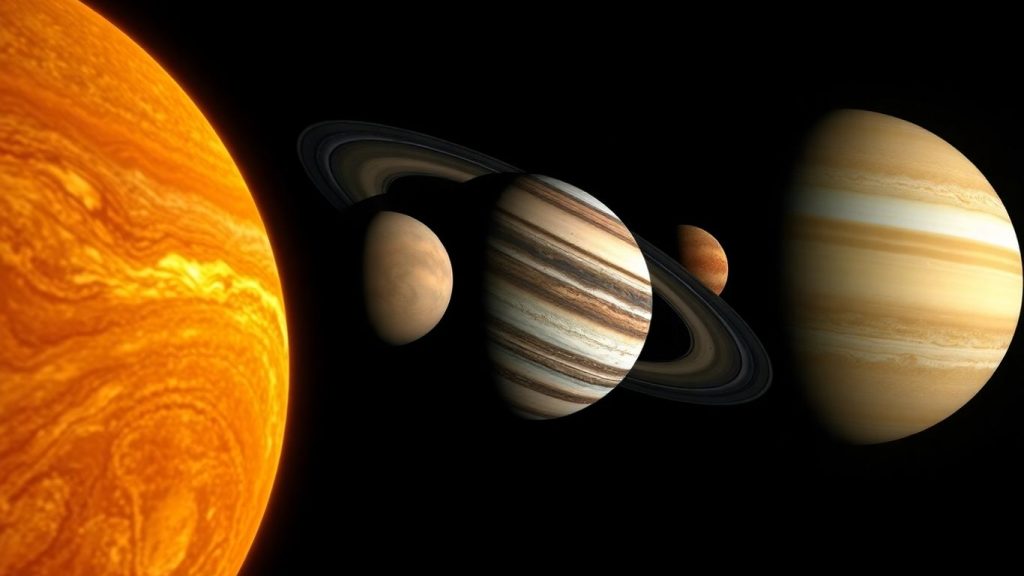
Right then, let’s talk about our cosmic neighbourhood. We’ve got these eight main planets spinning around the sun, each with its own quirks and characteristics. It’s pretty amazing when you stop and think about it all. We’re going to go through some of the most interesting planetary facts, from their size and where they sit in relation to us, to what they’re actually made of. It’s not just about pretty pictures; there’s a whole lot of science behind why things are the way they are out there.
Key Takeaways
- Our solar system has eight planets: Mercury, Venus, Earth, Mars, Jupiter, Saturn, Uranus, and Neptune. They’re grouped into the rocky inner planets and the gas/ice giants of the outer solar system.
- Planets are defined by orbiting the Sun, being round due to their own gravity, and having cleared their orbital path. This definition led to Pluto being reclassified as a dwarf planet.
- The planets vary hugely in size, from tiny Mercury to massive Jupiter, and their distance from the Sun dictates their orbital period and temperature.
- Each planet has a unique atmosphere (or lack thereof) and temperature range, with Venus being the hottest and Mercury experiencing extreme temperature swings.
- Beyond the eight planets, there are dwarf planets like Pluto and Ceres, and scientists are actively searching for exoplanets orbiting other stars.
Understanding Our Solar System’s Planets
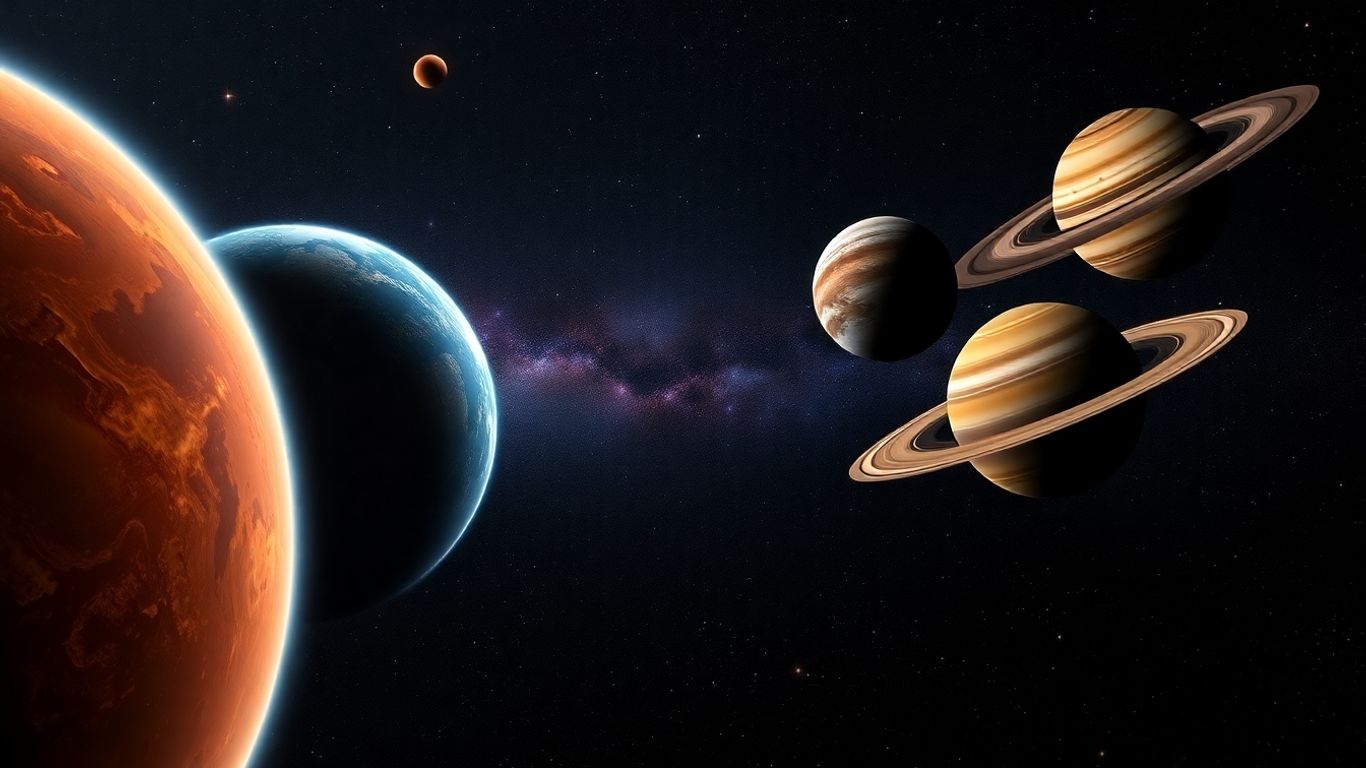
Our solar system is a vast and fascinating place, home to eight distinct planets that journey around our Sun. These celestial bodies aren’t all the same, though. They can be broadly categorised, giving us a clearer picture of their diverse nature. Understanding these categories helps us appreciate the unique characteristics of each world.
What Defines A Planet?
The term ‘planet’ itself has a rich history, originating from the ancient Greek word ‘planētēs’, meaning ‘wanderer’. In more recent times, the International Astronomical Union (IAU) established a formal definition in 2006. For a celestial body to be classified as a planet within our solar system, it must meet three specific criteria:
- It must orbit the Sun.
- It must have sufficient mass for its self-gravity to overcome rigid body forces so that it assumes a hydrostatic equilibrium (nearly round) shape.
- It must have cleared the neighbourhood around its orbit.
This definition, while precise, led to the reclassification of Pluto, highlighting how our understanding of the cosmos evolves.
The Eight Planets Of Our Solar System
We currently recognise eight planets in our solar system, each with its own unique identity and position relative to the Sun. They are, in order from the Sun:
- Mercury
- Venus
- Earth
- Mars
- Jupiter
- Saturn
- Uranus
- Neptune
These planets are not just names on a list; they represent a spectrum of sizes, compositions, and environments, from the scorching heat of Mercury to the distant chill of Neptune. The Sun’s gravitational pull is the invisible force that keeps all these worlds in their cosmic dance.
Terrestrial Versus Gas Giants
Planets in our solar system can be neatly divided into two primary groups based on their composition and structure: terrestrial planets and gas giants.
- Terrestrial Planets: These are the inner planets – Mercury, Venus, Earth, and Mars. They are characterised by their solid, rocky surfaces and are generally smaller and denser than the outer planets. Their proximity to the Sun means they receive more solar radiation.
- Gas Giants: These are the outer planets – Jupiter, Saturn, Uranus, and Neptune. They are immense worlds composed primarily of gases like hydrogen and helium, with no solid surface to stand on. Jupiter and Saturn are known as gas giants, while Uranus and Neptune are often referred to as ice giants due to a higher proportion of ‘ices’ like water, ammonia, and methane in their composition.
This fundamental division helps us understand the vastly different conditions and geological processes at play across our solar system. For instance, understanding planetary compatibility in relationships might seem unrelated, but open communication about finances, much like understanding planetary differences, is key to harmony [bbd1].
The Inner Planets: Rocky Worlds
The inner solar system is a fascinating region, home to four distinct worlds that share a common characteristic: they are primarily composed of rock and metal. These are Mercury, Venus, Earth, and Mars, often referred to as the terrestrial planets. Unlike their gaseous counterparts further out, these planets possess solid surfaces, though they are far from uniform. Their proximity to the Sun means they have experienced intense solar radiation and impacts throughout their history, shaping their varied landscapes.
Mercury: The Swift Messenger
Mercury, the closest planet to the Sun, is a world of extremes. It’s the smallest of the terrestrial planets and lacks any significant atmosphere, which means it cannot retain heat. Consequently, its surface temperature swings dramatically between scorching hot during the day and freezing cold at night. Its surface is heavily cratered, bearing witness to billions of years of asteroid and comet impacts. Mercury’s orbit is also the most eccentric of all the planets.
Venus: Earth’s Scorching Twin
Often called Earth’s twin due to its similar size and mass, Venus is a starkly different place. Its atmosphere is incredibly dense, composed mainly of carbon dioxide, which traps heat and creates a runaway greenhouse effect. This makes Venus the hottest planet in our solar system, with surface temperatures hot enough to melt lead. The thick clouds of sulfuric acid that shroud the planet also contribute to its extreme conditions, making direct observation of its surface incredibly challenging.
Earth: Our Habitable Home
Our home planet, Earth, is unique in the solar system for its abundance of liquid water on its surface and its life-sustaining atmosphere. A delicate balance of factors, including its distance from the Sun, its magnetic field, and its atmospheric composition, allows for a wide range of temperatures and conditions suitable for life as we know it. Earth’s surface is dynamic, with active geology, weather systems, and a vibrant biosphere.
Mars: The Red Planet’s Mysteries
Mars, the fourth planet from the Sun, is known for its reddish hue, a result of iron oxide on its surface. It is a cold, desert world with a thin atmosphere. While it currently lacks widespread liquid water on its surface, evidence suggests that Mars was once warmer and wetter, with rivers, lakes, and possibly even oceans. The search for past or present life on Mars is a major focus of current space exploration.
Here’s a quick comparison of the inner planets:
| Planet | Diameter (km) | Average Distance from Sun (million km) | Key Feature |
|---|---|---|---|
| Mercury | 4,879 | 57.9 | Extreme temperatures, cratered surface |
| Venus | 12,104 | 108.2 | Dense, hot atmosphere, sulfuric acid clouds |
| Earth | 12,742 | 149.6 | Liquid water, life, dynamic atmosphere |
| Mars | 6,779 | 227.9 | Red surface, thin atmosphere, evidence of past water |
The terrestrial planets represent a significant portion of our solar system’s mass, despite their smaller size compared to the gas giants. Their rocky composition and solid surfaces offer a stark contrast to the swirling atmospheres of the outer planets, providing distinct environments for scientific study.
The Outer Planets: Giants of Gas and Ice
Beyond the asteroid belt, our solar system enters a colder, more expansive region populated by the truly colossal planets. These are the gas giants and ice giants, worlds so immense they dwarf our own. Unlike the rocky inner planets, these giants lack a solid surface to stand on. Instead, they are vast spheres of swirling gases and liquids, with immense pressures building towards dense cores.
Jupiter: The King Of Planets
Jupiter, the fifth planet from the Sun, holds the title of the largest planet in our solar system. It’s a behemoth, primarily composed of hydrogen and helium, much like the Sun itself. Its most striking feature is the Great Red Spot, a colossal storm that has raged for centuries. Jupiter’s immense gravity influences the orbits of many smaller bodies in the solar system.
Saturn: The Ringed Jewel
Famous for its spectacular ring system, Saturn is the sixth planet from the Sun and the second-largest. While all the outer planets possess rings, Saturn’s are the most prominent and easily observed. These rings are not solid structures but are made up of countless particles of ice and rock, ranging in size from dust grains to large boulders. Saturn itself is also a gas giant, predominantly hydrogen and helium.
Uranus: The Tilted Ice Giant
Uranus, the seventh planet, is classified as an ice giant. This means that in addition to hydrogen and helium, it contains a significant amount of ‘ices’ – compounds like water, ammonia, and methane – in its interior. A unique characteristic of Uranus is its extreme axial tilt; it essentially orbits the Sun on its side, leading to very unusual seasonal patterns. This peculiar orientation is thought to be the result of a massive collision early in its history.
Neptune: The Distant Blue World
Neptune, the eighth and most distant planet, is also an ice giant, similar in composition to Uranus. Its striking blue colour is due to methane in its atmosphere, which absorbs red light and reflects blue. Neptune experiences the strongest winds in the solar system, with speeds that can exceed 2,000 kilometres per hour. Despite its distance, it has a dynamic atmosphere and a complex system of moons, the largest of which is Triton.
Size and Scale Of The Planets
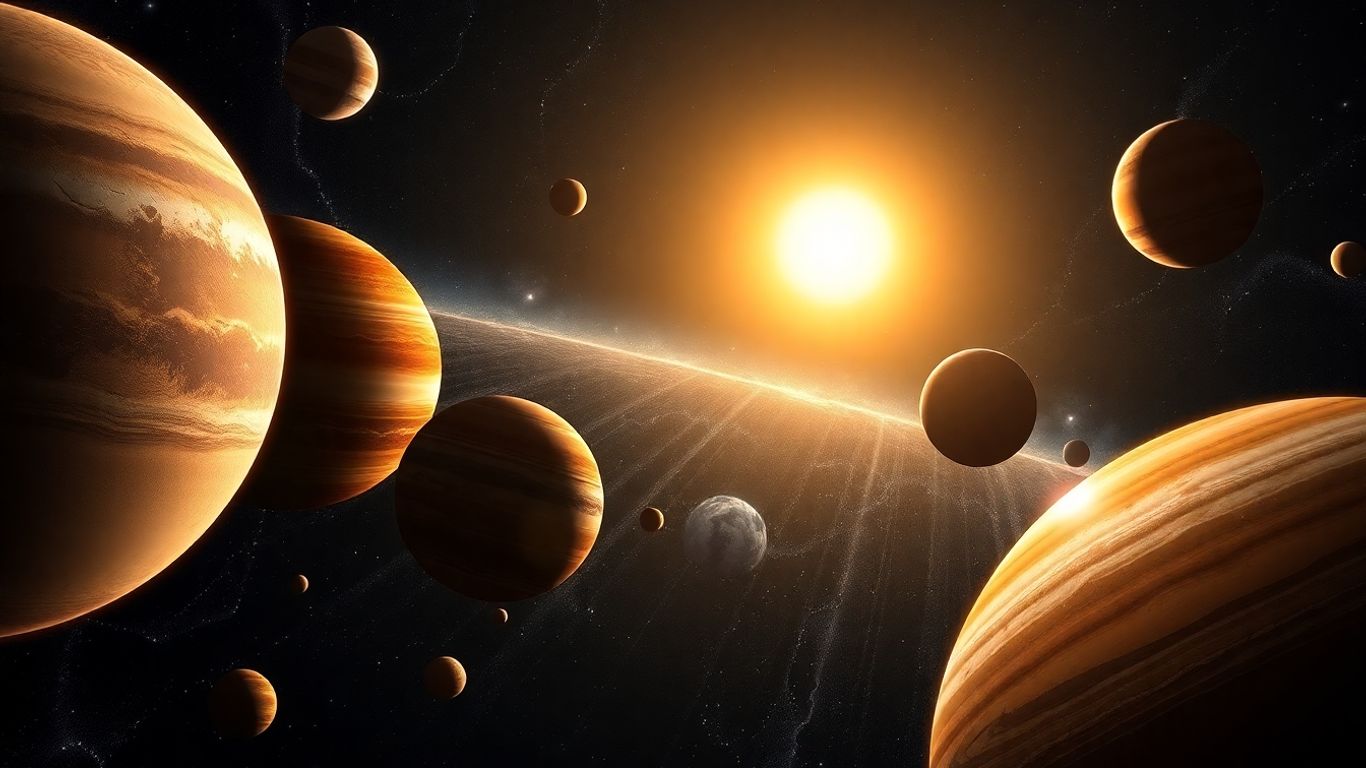
When we talk about the planets in our solar system, it’s easy to get lost in their individual characteristics. But taking a step back to consider their size and how they’re arranged gives us a real sense of the vastness we’re dealing with. It’s not just about how big they are, but also how far apart they are, painting a picture of our cosmic neighbourhood.
Comparing Planetary Diameters
The planets vary dramatically in size. Jupiter, the undisputed king, is so large that all the other planets in the solar system could fit inside it. Saturn comes in second, followed by the ice giants Uranus and Neptune. The rocky inner planets – Earth, Venus, Mars, and Mercury – are significantly smaller.
Here’s a look at their approximate diameters:
| Planet | Diameter (km) | Diameter (Earth = 1) |
|---|---|---|
| Mercury | 4,879 | 0.38 |
| Venus | 12,104 | 0.95 |
| Earth | 12,742 | 1.00 |
| Mars | 6,779 | 0.53 |
| Jupiter | 139,820 | 10.97 |
| Saturn | 116,460 | 9.13 |
| Uranus | 50,724 | 4.00 |
| Neptune | 49,244 | 3.87 |
Order From The Sun: A Cosmic Sequence
The arrangement of planets from the Sun is a fundamental aspect of our solar system’s structure. This order isn’t random; it reflects the conditions under which the planets formed billions of years ago. The inner planets are closer to the Sun’s warmth, while the outer planets reside in colder, more distant regions.
Here’s the sequence:
- Mercury
- Venus
- Earth
- Mars
- Jupiter
- Saturn
- Uranus
- Neptune
This orderly procession is a key feature, though the spacing between orbits isn’t uniform. For instance, the gap between Saturn and Jupiter is much larger than the gap between Earth and Mars. Understanding this arrangement helps us grasp the overall architecture of our solar system, and how it might compare to other planetary systems around distant stars.
Mass Distribution Within The Solar System
When we consider the mass of the solar system, the gas and ice giants dominate. Jupiter alone accounts for more than half of the total mass of all the planets combined. This immense gravitational influence shapes the orbits of other bodies and plays a significant role in the solar system’s dynamics. The terrestrial planets, despite their importance to us, are comparatively lightweight.
The vast majority of the solar system’s mass is concentrated in the Sun. The planets, in total, make up a tiny fraction of this overall mass, with the giant planets being the most substantial contributors among them.
This distribution of mass is a direct consequence of planetary formation, where lighter elements were pushed further out from the Sun, allowing gas giants to accumulate much more material.
Orbital Characteristics Of The Planets
When we look at our solar system, it’s easy to be captivated by the sheer size and appearance of the planets. But beneath the visual spectacle lies a complex dance governed by physics. The way each planet moves around the Sun, its orbit, is a defining characteristic, influencing everything from its year length to its temperature.
Revolution Around The Sun
All the planets in our solar system travel in paths around the Sun. This journey is called revolution. For the most part, these orbits lie on a relatively flat plane, much like a giant cosmic disc. The Sun sits at one focus of each planet’s orbital path, which is not a perfect circle but an ellipse. This means a planet’s distance from the Sun changes throughout its journey.
- Most planets orbit in the same direction the Sun spins, which is counter-clockwise when viewed from above Earth’s north pole.
- Some smaller objects, like certain comets, can have orbits tilted at much steeper angles to this main plane.
- While most moons orbit their planets in the same direction the planet spins, there are exceptions, like Neptune’s moon Triton.
Length Of A Planetary Year
The time it takes for a planet to complete one full orbit around the Sun is what we call its year. This duration is directly related to how far away the planet is from the Sun and how fast it’s moving. Closer planets, like Mercury, zip around much faster than those further out, like Neptune.
Here’s a look at how planetary years stack up:
| Planet | Orbital Period (Earth Days) |
|---|---|
| Mercury | 88 |
| Venus | 225 |
| Earth | 365.25 |
| Mars | 687 |
| Jupiter | 4,333 |
| Saturn | 10,759 |
| Uranus | 30,687 |
| Neptune | 60,190 |
As you can see, the outer planets have incredibly long years compared to us Earthlings. Imagine celebrating your birthday only once every few decades!
Orbital Velocities Explained
Planets don’t just drift around the Sun; they move at specific speeds. This speed, known as orbital velocity, is faster for planets closer to the Sun and slower for those farther away. This isn’t just about distance, though; it’s a delicate balance between the planet’s forward motion and the Sun’s gravitational pull. If a planet moved too slowly, it would be pulled into the Sun. If it moved too fast, it would fly off into space. It’s a cosmic equilibrium that keeps everything in its place. Understanding these orbital dynamics is key to grasping the structure of our solar system, much like understanding the Scrum framework helps manage complex projects.
The gravitational influence of other planets can cause tiny, long-term changes to a planet’s orbit. While these effects are usually minor on human timescales, over billions of years, they can lead to significant shifts in the solar system’s configuration.
Planetary Atmospheres And Temperatures
The conditions on the surfaces of planets are largely dictated by their atmospheres and their distance from the Sun. These factors combine to create a wide range of temperatures and environmental states across our solar system.
Venus: The Hottest Planet
Venus presents a stark example of atmospheric influence. Its atmosphere is incredibly dense, composed primarily of carbon dioxide. This creates a runaway greenhouse effect, trapping heat and making Venus the hottest planet in our solar system. Surface temperatures can soar to over 400°C (752°F), hot enough to melt lead. Unlike Earth, Venus lacks a significant magnetic field to shield it from the solar wind, suggesting that volcanic activity plays a role in replenishing its thick atmosphere.
Earth’s Protective Atmosphere
Our own planet, Earth, benefits from a unique atmospheric composition. With about 78% nitrogen and 21% oxygen, our atmosphere not only supports life but also provides crucial protection. A strong planetary magnetosphere deflects harmful solar radiation and charged particles from the Sun. This shielding is vital for maintaining surface liquid water and the conditions necessary for life as we know it.
Temperatures Across The Solar System
The temperature variations across the planets are dramatic. Mercury, the closest planet to the Sun, experiences extreme swings. Its surface can range from a frigid -170°C (-270°F) on the night side to a scorching 420°C (790°F) during the day. This is due to its very thin atmosphere, which cannot retain heat effectively. Further out, the gas and ice giants like Jupiter, Saturn, Uranus, and Neptune are significantly colder, with temperatures dropping dramatically as distance from the Sun increases.
| Planet | Average Surface Temperature (°C) | Notes |
|---|---|---|
| Mercury | ~167 | Extreme day/night variations |
| Venus | ~464 | Hottest planet due to greenhouse effect |
| Earth | ~15 | Habitable range |
| Mars | ~-65 | Thin atmosphere, cold |
| Jupiter | ~-110 (cloud tops) | Gas giant, temperature varies with depth |
| Saturn | ~-140 (cloud tops) | Gas giant, temperature varies with depth |
| Uranus | ~-195 (cloud tops) | Ice giant, very cold |
| Neptune | ~-200 (cloud tops) | Ice giant, furthest, very cold |
It is important to note that for the gas and ice giants, the temperatures listed are typically for their cloud tops, as they do not have solid surfaces in the same way terrestrial planets do. The internal temperatures of these planets are much higher.
The presence and composition of a planet’s atmosphere, combined with its orbital distance, are the primary drivers of its surface temperature. While the Sun provides the initial heat, atmospheric gases can trap this energy, leading to vastly different thermal environments from one world to another. Even a tenuous atmosphere can make a significant difference, as seen on Mercury, while a thick, carbon dioxide-rich atmosphere can turn a planet into an oven, as is the case with Venus.
Moons And Rings: Celestial Companions
Our solar system is a busy place, not just with planets, but with a whole host of smaller bodies tagging along. These are the moons and the spectacular ring systems that orbit some of the larger planets. They’re not just pretty to look at; they tell us a lot about how our solar system formed and evolved.
Saturn’s Extensive Moon System
Saturn is famous for its rings, but it also boasts an incredible collection of moons. With over 140 known moons, it’s a miniature solar system in itself. The largest, Titan, is particularly fascinating. It’s the only moon in our solar system with a substantial atmosphere, thicker than Earth’s, and it even has liquid methane lakes and rivers on its surface. Other notable moons include Enceladus, which has geysers erupting from its south pole, hinting at a subsurface ocean, and Mimas, with its giant Herschel crater that makes it look uncannily like the Death Star from Star Wars.
Moons of Other Giants
It’s not just Saturn that has a lot of moons. Jupiter is the king of planets in terms of size, and it also has a vast retinue of moons, with over 90 confirmed. The four largest, known as the Galilean moons (Io, Europa, Ganymede, and Callisto), were discovered by Galileo Galilei. Io is volcanically active, Europa might harbour a liquid water ocean beneath its icy crust, Ganymede is the largest moon in the solar system (even bigger than Mercury!), and Callisto is heavily cratered.
Uranus has a respectable collection of 27 known moons, with the five largest – Miranda, Ariel, Umbriel, Titania, and Oberon – being the most significant. Neptune, the farthest planet, has 16 known moons, the most prominent being Triton. Triton is unique because it orbits Neptune in a retrograde direction, meaning it goes against the planet’s rotation, suggesting it was likely captured from the Kuiper Belt.
Planetary Ring Systems
While Saturn’s rings are the most iconic, all the gas and ice giants in our solar system possess ring systems. Jupiter has a faint, dusty ring system, likely formed from impacts on its inner moons. Uranus has a set of narrow, dark rings, and Neptune also has a system of faint rings, some of which are incomplete, forming ‘arcs’. These rings are thought to be made up of countless small particles of ice and rock, ranging in size from dust grains to boulders. They are constantly being replenished by impacts on the moons within or near them, or by material escaping from those moons.
The formation of these moons and rings is closely tied to the formation of their parent planets. Some moons likely formed from the same disk of gas and dust that formed the planet, while others, like Triton, were probably captured later. The rings, on the other hand, are often thought to be remnants of moons that were torn apart by the planet’s gravity or material that never coalesced into a moon in the first place.
Beyond The Eight: Dwarf Planets
Our solar system is home to more than just the eight planets we typically learn about. There’s a whole category of celestial bodies known as dwarf planets. These are fascinating objects that, while not quite meeting the full definition of a planet, are significant in their own right. Think of them as smaller siblings to the major planets, each with its own unique story.
Pluto’s Reclassification
For a long time, Pluto was considered the ninth planet in our solar system. It held that title for decades after its discovery in 1930. However, as our understanding of the solar system grew and more objects similar to Pluto were found, particularly in the Kuiper Belt, scientists needed to refine what exactly constitutes a planet. In 2006, the International Astronomical Union (IAU) established a new definition. A key part of this definition is that a planet must have
Exploring Other Worlds: Exoplanets
Our understanding of planetary systems has expanded dramatically beyond our own Solar System. Scientists are now discovering planets orbiting distant stars, a field known as exoplanet research. These celestial bodies, or exoplanets, vary immensely in size, composition, and orbital characteristics, offering a glimpse into the sheer diversity of worlds that exist in the cosmos. The discovery of exoplanets has fundamentally changed our perspective on planetary formation and the potential for life elsewhere.
Planets Orbiting Distant Stars
The search for exoplanets began in earnest in the late 20th century, with the first confirmed discoveries made in the 1990s. Since then, thousands of exoplanets have been identified using various detection methods. The most common techniques include:
- Transit Photometry: Observing the slight dimming of a star as a planet passes in front of it.
- Radial Velocity: Detecting the wobble of a star caused by the gravitational pull of an orbiting planet.
- Direct Imaging: Though challenging, this method involves capturing actual images of exoplanets, often by blocking out the light of their host star.
These methods have revealed a wide array of planetary types, from gas giants larger than Jupiter to rocky worlds smaller than Earth. Many exoplanets have been found in systems with multiple planets, some of which bear a striking resemblance to our own Solar System, while others are vastly different.
The Search For Habitable Exoplanets
One of the most exciting frontiers in exoplanet research is the search for worlds that could potentially harbour life. This involves identifying planets within the habitable zone of their stars – the region where temperatures might allow liquid water to exist on the surface. Liquid water is considered a key ingredient for life as we know it. However, habitability is a complex concept that extends beyond just surface temperature. Factors such as atmospheric composition, the presence of a magnetic field to shield against stellar radiation, and geological activity all play a role. Scientists are particularly interested in exoplanets orbiting red dwarf stars, as these stars are the most common in our galaxy, and some have been found to host multiple terrestrial planets. The ongoing exploration of these distant systems is a testament to humanity’s enduring curiosity about our place in the universe.
The sheer number of stars in our galaxy suggests that there could be billions of planets, many of which might possess conditions suitable for life. While direct evidence of extraterrestrial life remains elusive, the continued discovery of exoplanets fuels the possibility that we are not alone.
Studying exoplanets is a testament to our growing capabilities in space exploration. While probes have visited all eight planets in our Solar System, the study of exoplanets relies on sophisticated ground-based telescopes and space observatories. These instruments allow us to gather data from light-years away, piecing together the characteristics of these alien worlds. The quest to find another Earth continues, pushing the boundaries of scientific inquiry and technological innovation. For those interested in the broader context of space exploration, understanding the history of planetary visits provides a fascinating backdrop to these new discoveries planetary visits.
Unique Planetary Features
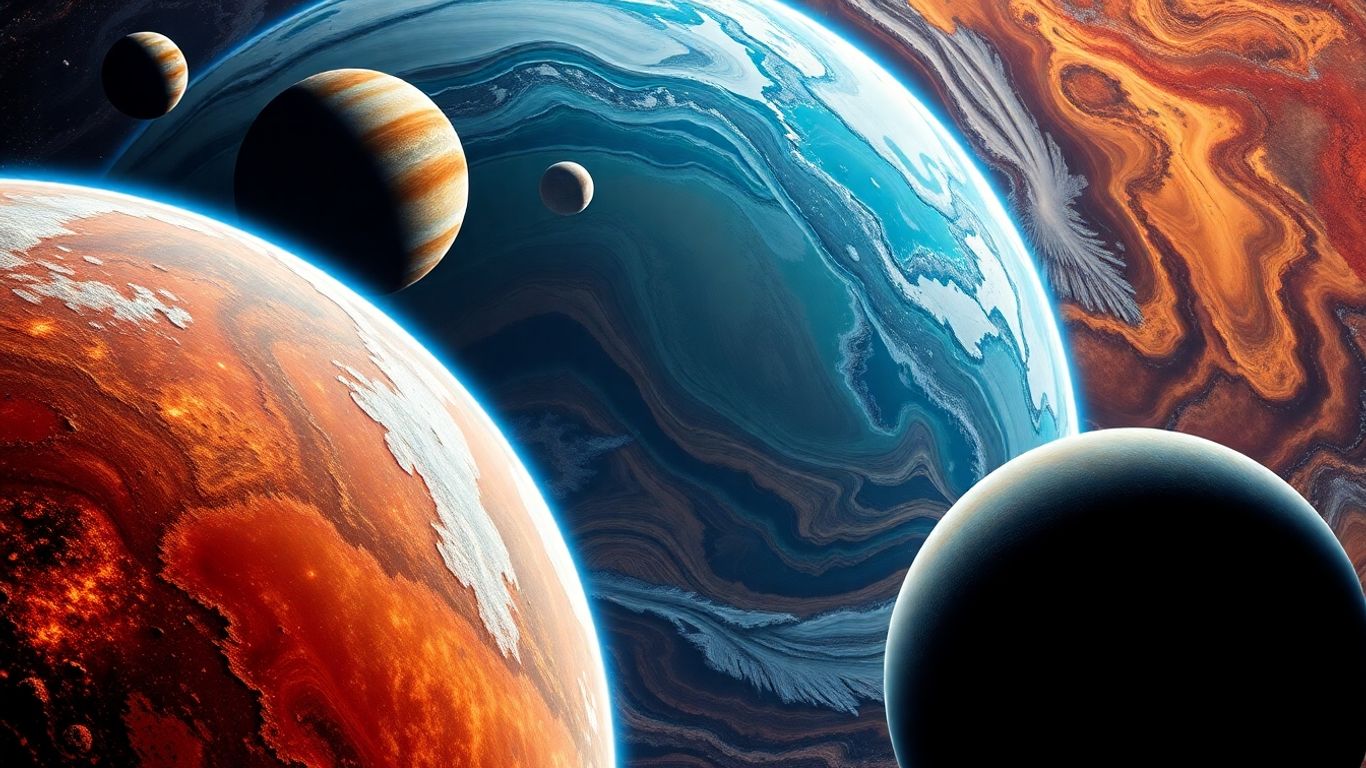
Our solar system is home to a diverse array of worlds, each with its own peculiar characteristics that set it apart. While we often focus on the grander aspects like size and composition, it’s the unique quirks that truly make these planets fascinating.
Mars’ Craters and Missions
Mars, often called the Red Planet, bears the scars of a violent past. Its surface is heavily cratered, a testament to countless asteroid and comet impacts over billions of years. These craters aren’t just geological features; they are time capsules, preserving evidence of the planet’s history. Missions like NASA’s Perseverance rover are actively exploring these ancient impact sites, searching for signs of past microbial life. The sheer number and variety of craters tell a story of a dynamic early solar system and Mars’s own geological evolution.
Mercury’s Artistic Naming Conventions
Mercury, the closest planet to our Sun, has a naming convention for its surface features that draws inspiration from the arts and humanities. Craters, mountains, and plains are named after famous authors, artists, musicians, and composers from Earth’s history. For instance, the large Rembrandt impact basin honours the Dutch master painter. This practice offers a unique cultural layer to our understanding of this small, rocky world, connecting celestial exploration with human creativity.
Uranus’ Solitary Spacecraft Visit
Unlike its neighbouring giant planets, Uranus has only been visited by a single spacecraft: Voyager 2. This probe performed a flyby in 1986, providing humanity with its first and, to date, only close-up look at the ice giant. The data gathered during this brief encounter revealed much about Uranus’s peculiar tilted axis, its complex ring system, and its numerous moons. The limited nature of this visit means that much about Uranus remains a mystery, making it a prime target for future exploration.
The vastness of space means that even within our own solar system, some worlds have been explored far more than others. This disparity in exploration highlights both the challenges and the ongoing quest to understand our cosmic neighbourhood.
The Habitable Zone
The habitable zone is the region around a star where conditions may allow the presence of liquid water on a planet’s surface. For our Solar System, this belt lies roughly between the orbits of Venus and Mars, with Earth sitting comfortably inside. The concept of a habitable zone is central to discussions about the likelihood of life beyond Earth. However, surface temperature alone doesn’t determine whether an environment can support life—atmosphere, protection from cosmic radiation, and the potential for subsurface water also matter.
Conditions For Liquid Water
Liquid water is often considered the baseline for life as we know it. Several factors must line up for a planet to maintain liquid water:
- The planet must be in the right distance from its star, so that it’s not too hot or too cold.
- The planet needs an atmospheric pressure that can keep water from immediately boiling or freezing.
- Chemical and geological activity might recycle and trap heat, influencing whether water remains liquid.
| Planet | Distance from Sun (AU) | Surface Liquid Water? |
|---|---|---|
| Venus | 0.72 | No |
| Earth | 1.00 | Yes |
| Mars | 1.52 | Not on surface |
Only one planet in our Solar System is confirmed to support surface liquid water—Earth. Mars may have subsurface reservoirs, while Venus is far too hot at the surface.
Shielding From Cosmic Rays
While distance from the Sun dictates general temperature, cosmic rays present a less obvious challenge. These high-energy interstellar particles can be dangerous to surface life and can strip away a planet’s atmosphere over time. Features that help reduce these effects include:
- A magnetic field strong enough to deflect charged particles (like Earth’s magnetosphere).
- A thick atmosphere that helps absorb or scatter arriving cosmic radiation.
- The bubbling heliosphere around the Sun, which also lessens the influx of interstellar particles.
Planets without significant magnetic fields, such as Mars and Venus, are more exposed to these rays, which further reduces their chances for habitability, at least on the surface.
Potential For Subsurface Habitability
Habitability isn’t only about the surface. In some cases, the best chances for life could be underground or beneath icy shells. Key points to consider:
- Moons like Europa (around Jupiter) and Enceladus (around Saturn) may have oceans beneath their icy surfaces, kept liquid by tidal forces and internal heat.
- Subsurface lakes and aquifers might persist on Mars, even if its surface is dry and cold.
- High-pressure, hot environments deep underground could host microbial life, protected from harsh space conditions.
These hidden worlds expand the idea of habitability far beyond the thin shell around the Sun where Earth orbits. As we look for life elsewhere, underground oceans and protected environments might be just as important as surface water.
Our Place in the Cosmos
So, there you have it – a quick look at the planets that share our solar system. From the scorching heat of Venus to the icy depths of Neptune, each world is unique. We’ve seen how they’re grouped, their vast differences in size, and their ordered dance around the Sun. It’s quite something to think about, isn’t it? All these celestial bodies, each with its own story, making up just a tiny part of the universe. It really puts things into perspective, and hopefully, it’s sparked a bit of curiosity about the vastness out there. There’s always more to learn, and the cosmos is always ready to surprise us.
Frequently Asked Questions
What exactly makes something a planet?
To be called a planet, a space object must orbit the Sun. It also needs to be big enough for its own gravity to pull it into a round shape. Finally, it must have cleared its orbital path of other large objects. This is why Pluto is now called a dwarf planet – it hasn’t cleared its neighbourhood. It’s a definition that scientists sometimes discuss and might change in the future.
How many planets are there in our solar system?
Our solar system is home to eight planets. These are, in order from the Sun: Mercury, Venus, Earth, Mars, Jupiter, Saturn, Uranus, and Neptune. For a long time, Pluto was considered the ninth planet, but it’s now classified as a dwarf planet.
What’s the difference between the inner and outer planets?
The planets closest to the Sun – Mercury, Venus, Earth, and Mars – are called the inner planets. They are also known as terrestrial planets because they have solid, rocky surfaces. The outer planets – Jupiter, Saturn, Uranus, and Neptune – are much larger and are mostly made of gases and icy materials. Jupiter and Saturn are called gas giants, while Uranus and Neptune are known as ice giants.
Which planet is the biggest and which is the smallest?
Jupiter is by far the largest planet in our solar system; it’s so massive that it contains more than double the mass of all the other planets combined! The smallest planet is Mercury, which is also the closest planet to the Sun.
Why is Venus the hottest planet if Mercury is closer to the Sun?
That’s a great question! While Mercury is closer to the Sun, Venus has a very thick atmosphere made mostly of carbon dioxide. This atmosphere traps heat like a blanket, creating a runaway greenhouse effect that makes Venus incredibly hot – even hotter than Mercury. It’s the hottest planet in our solar system.
Do all planets have moons?
Not all planets have moons. Mercury and Venus have no moons at all. Earth has one moon, which we call ‘the Moon’. Mars has two small moons, Phobos and Deimos. The giant outer planets, however, have many moons. Saturn is famous for its extensive moon system, and Jupiter also has a large collection of moons.
What are exoplanets?
Exoplanets are planets that orbit stars outside of our own solar system. Scientists are very interested in finding exoplanets, especially those that might be similar to Earth and could potentially support life. The search for these distant worlds is a major part of astronomy today.
What is the ‘habitable zone’?
The habitable zone, sometimes called the ‘Goldilocks zone’, is the region around a star where conditions might be just right for liquid water to exist on a planet’s surface. Liquid water is considered essential for life as we know it. Our own Earth is located within the Sun’s habitable zone.

Peyman Khosravani is a seasoned expert in blockchain, digital transformation, and emerging technologies, with a strong focus on innovation in finance, business, and marketing. With a robust background in blockchain and decentralized finance (DeFi), Peyman has successfully guided global organizations in refining digital strategies and optimizing data-driven decision-making. His work emphasizes leveraging technology for societal impact, focusing on fairness, justice, and transparency. A passionate advocate for the transformative power of digital tools, Peyman’s expertise spans across helping startups and established businesses navigate digital landscapes, drive growth, and stay ahead of industry trends. His insights into analytics and communication empower companies to effectively connect with customers and harness data to fuel their success in an ever-evolving digital world.