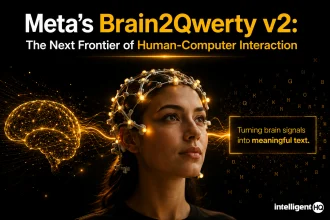
Brain2Qwerty v2 by Meta turns brain scans into typed sentences. Developed by Meta’s Fundamental AI Research (FAIR) team in collaboration with the Basque Center on Cognition, Brain and Language (BCBL), the system converts brain activity into text without requiring any surgical implants.
Although still a research project, Brain2Qwerty v2 has implications that go beyond healthcare and neuroscience. It provides insight into the future of human-computer interaction and raises important questions for businesses, technology leaders and policymakers.
What is Brain2Qwerty v2?
Brain2Qwerty v2 is a non-invasive brain-computer interface (BCI) that uses magnetoencephalography (MEG) to measure brain activity while a person types. Instead of reading signals from implanted electrodes, the system records brain activity externally using specialised sensors.
The AI analyses these signals and predicts what the person intends to type.
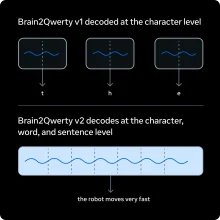
The latest version is a significant improvement over the original Brain2Qwerty. Instead of predicting individual letters alone, it combines character prediction with word recognition and language understanding to reconstruct complete sentences more accurately.
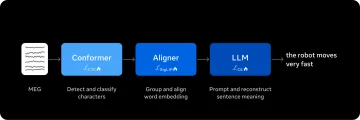
The system uses three AI components:
- An encoder that converts brain signals into character predictions.
- A semantic alignment model that links brain signals with language representations.
- A large language model that generates complete sentences using both the decoded signals and language context.
This combination allows the system to produce more accurate and coherent text.
Performance Shows Significant Progress
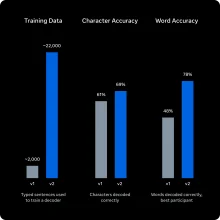
Brain2Qwerty v2 was trained using approximately 22,000 sentences collected from nine participants, each of whom spent around 10 hours inside an MEG scanner while typing.
The results demonstrate substantial progress for a non-invasive brain-computer interface:
- Average word accuracy reached 61%.
- The best participant achieved 78% word accuracy.
- More than half of the decoded sentences for the best participant contained one word error or fewer.
Meta also reported that performance continues to improve as additional training data is added. This suggests that future improvements may come through larger datasets and better AI models rather than relying solely on new hardware.
Why This Matters
Most high-performing brain-computer interfaces today rely on surgically implanted electrodes. While these systems can achieve high accuracy, surgery limits their wider adoption.
Brain2Qwerty v2 demonstrates that non-invasive approaches are becoming increasingly capable.
Although the current system is not ready for commercial use, it shows that AI can compensate for noisier external brain signals through better machine learning and language models.
This could reduce one of the biggest barriers to making brain-computer interfaces more widely available in the future.
Healthcare Is the First Major Opportunity
The most immediate application is assistive communication.
People living with conditions such as ALS, paralysis, stroke or other neurological disorders often lose the ability to speak or type.
A non-invasive brain-to-text system could provide a new way for these individuals to communicate without requiring surgery.
If future versions become smaller, faster and more accurate, they could become valuable tools in hospitals, rehabilitation centres and long-term care environments.
For healthcare organisations, this represents an important area where AI could improve patient outcomes while reducing clinical risks associated with implanted devices.
Why Business Leaders Should Pay Attention
Brain2Qwerty v2 is not simply another AI research project.
It points to a possible long-term shift in how people interact with computers.
Every major technology platform has changed the way businesses operate—from personal computers and smartphones to cloud computing and generative AI.
Brain-computer interfaces could eventually become another interface layer.
While widespread enterprise use remains years away, organisations should begin monitoring developments because future applications could include:
- Faster human-computer interaction
- Improved accessibility technologies
- Hands-free workplace systems
- New communication tools
- Enhanced collaboration technologies
For organisations investing in digital transformation, Brain2Qwerty highlights how AI is expanding beyond automation towards entirely new methods of interaction.
AI Is Becoming Better at Understanding Human Intent
One of the most significant aspects of Brain2Qwerty v2 is the role of large language models.
Rather than simply decoding brain signals, the language model interprets incomplete information and generates meaningful sentences using context.
This reflects a broader trend across AI.
Modern AI systems are increasingly acting as translators between different types of information, including speech, images, video, code and now brain activity.
This capability will become increasingly valuable as organisations adopt AI across more business functions.
Current Limitations
Despite its progress, Brain2Qwerty v2 is still an experimental research system.
Several challenges remain:
- MEG scanners are expensive and only available in specialised research facilities.
- The equipment is large and not portable.
- The study involved healthy volunteers under controlled laboratory conditions.
- Accuracy is not yet sufficient for everyday communication.
Significant improvements in both hardware and software will be required before this technology becomes practical outside research environments.
Privacy and Governance Will Become Critical
Brain-computer interfaces introduce new questions about data privacy and governance.
Brain activity is among the most sensitive forms of personal data.
As these technologies develop, organisations and regulators will need clear policies covering:
- Ownership of neural data
- User consent
- Data security
- Responsible AI development
- Regulatory compliance
Businesses developing or adopting future brain-computer technologies will need to address these issues from the beginning.
Meta’s Open Research Approach
Meta has also chosen to release the training code for Brain2Qwerty v1 and v2, while research collaborators have made datasets available to the scientific community.
This open research approach allows universities, startups and other organisations to validate and extend the work.
For business leaders, it demonstrates how collaborative AI research can accelerate innovation across an emerging technology field.
Looking Ahead
Brain2Qwerty v2 is not a consumer product, nor is it likely to become one in the immediate future.
However, it represents meaningful progress in non-invasive brain-computer interfaces and demonstrates how advances in AI are improving the interpretation of complex human signals.
For C-suite executives, technology leaders and innovation teams, the announcement is less about today’s product and more about tomorrow’s opportunities.
As AI continues to improve its ability to understand human intent, organisations should monitor developments in brain-computer interfaces alongside advances in generative AI, robotics and intelligent automation.
The technology is still in its early stages, but it offers a practical example of how AI may expand beyond today’s digital interfaces and create new ways for people to communicate, work and interact with technology in the years ahead.







![7 Best AI Development Companies for Data AI Solutions: Comprehensive Overview [2026]](https://www.intelligenthq.com/wp-content/uploads/2026/10/7-Best-AI-Development-Companies-for-Data-AI-Solutions-Comprehensive-Overview-2026-330x220.webp)