A factory can have robotic production lines, automated inspection, smart machines, and a warehouse full of connected equipment, and still lose hours every week because materials are not where they need to be.
This is one of the less visible problems in industrial automation.
Manufacturers have spent years automating individual tasks. Production lines have become faster, robots have become more capable, and warehouse systems have become increasingly intelligent. Yet the movement between these systems often remains dependent on manual coordination, disconnected software, or fixed transportation routes.
The result is an automation paradox: the factory floor becomes highly automated, while the flow of materials around it remains fragmented.
That is changing the way manufacturers should think about factory automation solutions.
The next stage is not simply automating more machines. It is connecting production, warehousing, transportation, scheduling, and operational data so that the entire material flow can respond to what is happening inside the factory.
The Factory Automation Problem Is No Longer Just on the Production Line
Traditional automation was designed around individual processes.
A robot could assemble a component. A conveyor could move a finished product. An automated storage system could retrieve inventory. An AGV could transport materials along a predefined route.
Each system could perform its assigned task efficiently.
The difficulty appears when production conditions change.
A production order is moved forward. A material requirement suddenly increases. A delivery is delayed. A vehicle becomes unavailable. A warehouse location changes. A production line stops temporarily for maintenance.
In a highly interconnected factory, these events should trigger adjustments across the operation.
In a fragmented factory, they often trigger phone calls, manual instructions, spreadsheet updates, or emergency intervention.
This distinction matters because manufacturing efficiency increasingly depends on synchronization rather than isolated machine performance.
A production line that can assemble products faster than the internal logistics system can supply materials has not actually increased factory capacity. It has simply moved the bottleneck somewhere else.
Why Automation Islands Create Hidden Costs
The most common mistake in automation projects is to evaluate each system independently.
A manufacturer may ask:
- How fast is the robot?
- How many pallets can the warehouse system handle?
- How many vehicles are required?
- How much labor can the system replace?
- How quickly can the production line operate?
These are useful questions, but they do not reveal whether the factory is operating as one system.
The more important question is:
Can these systems coordinate when production requirements change?
Consider a simple material flow.
Raw materials arrive at the warehouse. The warehouse records their availability. Production requests the materials. A vehicle is assigned to collect them. The materials are delivered to the correct production area. Empty containers are removed. Finished products are transported to another location.
If every step depends on a separate system, the factory can become a collection of automation islands.
The warehouse knows what inventory is available.
The production system knows what needs to be manufactured.
The fleet system knows where vehicles are.
But none of them necessarily has a complete picture of what should happen next.
This is where the next generation of factory automation is beginning to look different.
From Task Automation to Flow Automation
The goal of modern automation should not be to automate the largest possible number of individual tasks.
It should be to automate the flow between tasks.
That requires several layers to work together.
| Automation Layer | Traditional Approach | More Connected Approach |
| Production | Fixed production schedules | Production signals connected to material demand |
| Warehouse | Inventory storage and retrieval | Inventory linked to production requirements |
| Transportation | Predefined vehicle routes | Dynamic task assignment and dispatch |
| Scheduling | Rule-based planning | AI-assisted predictive scheduling |
| Data | Separate system records | Shared operational visibility |
| Exceptions | Manual intervention | Real-time detection and human oversight |
The difference may appear subtle, but it changes the economics of automation.
A faster robot does not necessarily create a faster factory.
A better result comes when the robot, warehouse, vehicle fleet, production system, and scheduling layer understand how their actions affect one another.
Where AI Changes Factory Automation
This is where artificial intelligence becomes more interesting than automation alone.
Traditional automation is very good at repeating a known process.
AI becomes valuable when the environment is less predictable.
Suppose a production schedule changes unexpectedly.
A conventional system may continue executing the original sequence until an operator intervenes.
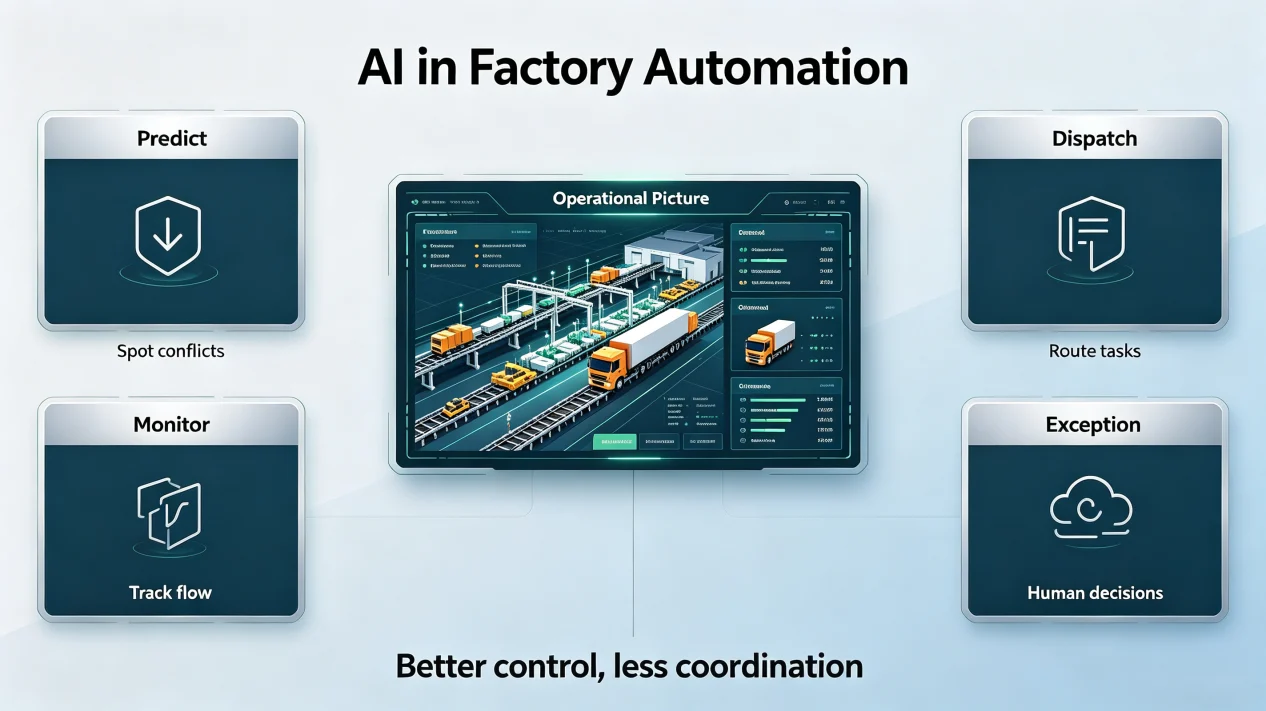
An intelligent system can potentially detect the change, evaluate available inventory and vehicles, identify the affected material movements, and recommend or initiate a new sequence.
The objective is not to remove humans from the process.
It is to give operators a better operational picture and reduce the amount of manual coordination required to keep the factory moving.
AI can support factory operations in several ways:
Predictive Scheduling
Production demand, inventory levels, vehicle availability, and historical operating patterns can be analyzed together to identify potential conflicts before they become disruptions.
Dynamic Dispatching
Instead of assigning vehicles according to fixed routes alone, dispatching systems can prioritize tasks based on production requirements, distance, availability, and changing operational conditions.
Real-Time Monitoring
Connected equipment can provide continuous information about material movements, vehicle locations, inventory status, and production activity.
Exception Management
Not every situation should be automated. When something falls outside expected conditions, the system should be able to identify the exception and bring human operators into the decision process.
This creates a more practical model of intelligent automation: machines handle predictable execution while people retain control over complex decisions and unusual situations.
The Warehouse-to-Line Connection Is a Critical Test
One of the clearest ways to evaluate a factory’s automation maturity is to examine what happens between the warehouse and the production line.
This area is often overlooked.
A manufacturer may have an advanced warehouse management system and highly automated production equipment, yet materials can still wait for manual instructions before reaching the line.
That creates several problems.
First, production becomes dependent on the reliability of internal transportation.
Second, inventory visibility does not necessarily mean material availability at the point of use.
Third, production planners may have limited visibility into the logistics conditions that affect their schedules.
And finally, expensive production equipment can remain idle because the supporting material flow cannot keep pace.
For manufacturers considering factory automation solutions, this is an important evaluation point.
Automation should be measured not only by how quickly an individual machine performs its task, but also by how reliably materials move through the entire production environment.
What Manufacturers Should Evaluate Before Investing
Automation projects can become expensive when companies begin with equipment instead of workflow.
Before choosing robots, autonomous vehicles, warehouse systems, or software platforms, manufacturers should first map the actual flow of materials.
Five questions are particularly useful.
Where does material wait?
Waiting time often reveals bottlenecks that machine-level performance metrics hide.
Where does information stop?
If production, warehouse, fleet, and inventory systems cannot share operational information, automation may remain fragmented.
What happens when conditions change?
A system that performs well under ideal conditions may struggle with production changes, blocked routes, urgent orders, or equipment downtime.
How are exceptions handled?
A factory cannot assume that every operational scenario can be predicted. Human intervention remains important, particularly for safety-critical or unusual events.
Can the system scale beyond one production area?
An automation solution that works in one isolated zone may become difficult to manage when expanded across multiple warehouses, workshops, yards, or facilities.
These questions shift the discussion from “Which machine should we buy?” to “Which operational problem are we trying to solve?”
That is a much better starting point for an automation investment.
Why Flexibility Matters More as Factories Become More Complex
Factories are not static environments.
Product mixes change. Production volumes fluctuate. New lines are introduced. Warehouse layouts evolve. Supply chains become more geographically distributed.
This makes rigid automation increasingly difficult to scale.
Fixed routes and predefined rules can work extremely well when processes remain stable. But when a factory needs to respond to frequent changes, the ability to perceive conditions and adjust becomes more important.
This is one reason autonomous mobile robots, AI-assisted dispatching, digital twins, and connected operational systems are becoming increasingly relevant to industrial automation.
The objective is not simply greater autonomy.
It is operational adaptability.
A factory that can adjust its material flow without rebuilding its entire automation architecture has a significant advantage when production requirements change.
The Shift From Automation to Intelligent Autonomy
The broader direction of industrial automation is therefore becoming clear.
The first generation focused on replacing repetitive manual tasks.
The next generation focused on connecting machines and systems.
The emerging model combines automation with AI-driven decision-making, real-time operational data, and autonomous execution.
Westwell’s approach to smart factory automation illustrates this shift by connecting warehouse operations, production-line delivery, autonomous transportation, and intelligent scheduling rather than treating each function as an isolated automation project. Its Smart Factory solution uses AI, digital twins, and cloud-based dispatching to support predictive scheduling and real-time monitoring, while autonomous vehicles and automated handling connect warehouse activity with production demand.
Its recent work on industrial logistics also highlights a practical challenge: traditional factory automation can become constrained by fixed routes, fragmented data, and limited coordination between warehouse and production systems. The proposed direction is to combine intelligent software with autonomous equipment so that the physical flow can adapt to operational changes.
This is an important distinction.
The value of automation is no longer determined only by how many machines a factory operates.
It is increasingly determined by how intelligently those machines, systems, and people work together.
What the Future of Factory Automation May Look Like
The factory of the future will not necessarily be the one with the largest number of robots.
It may be the one where every part of the operation has enough visibility to understand what is happening around it.
Production systems will generate demand signals.
Warehouse systems will understand material availability.
Autonomous vehicles will respond to changing priorities.
AI systems will identify conflicts and recommend better decisions.
Human operators will manage exceptions rather than manually coordinate every routine movement.
And energy consumption can increasingly become part of the same operational equation, allowing manufacturers to consider productivity and sustainability together.
This represents a fundamental change in the role of factory automation solutions.
Automation is moving from a collection of machines performing predefined tasks toward an intelligent operating environment capable of sensing conditions, coordinating resources, and adapting to change.
For manufacturers evaluating their next automation investment, that may be the most important question of all:
Are you automating individual tasks—or building a factory that can intelligently coordinate the entire flow?
The answer could determine whether the next automation project simply adds another machine or creates a genuinely smarter operation.
Frequently Asked Questions
What are factory automation solutions?
Factory automation solutions combine technologies such as robotics, automated material handling, software, sensors, fleet management, and production systems to automate or coordinate manufacturing processes. Modern approaches increasingly connect production with warehouse and internal logistics operations.
Why is AI important in factory automation?
AI can help factories interpret operational data, identify potential bottlenecks, support predictive scheduling, optimize resource allocation, and respond to changing conditions. Its value is particularly relevant when factory processes are too dynamic for fixed rules alone.
What is the biggest challenge when implementing factory automation?
One of the biggest challenges is integrating previously independent systems. Production, warehouse, transportation, inventory, and scheduling systems may operate separately, creating information gaps that limit the benefits of automation.
Does factory automation eliminate the need for human workers?
Not necessarily. Effective automation can shift human roles away from repetitive physical coordination toward supervision, exception handling, process control, and higher-value decision-making. Human oversight remains important when conditions fall outside predefined operating parameters.
How should manufacturers evaluate an automation project?
Manufacturers should look beyond equipment specifications and evaluate material-flow bottlenecks, system integration, scheduling flexibility, exception handling, scalability, safety, and measurable operational outcomes. The strongest projects begin with the workflow rather than with a specific machine.
Website:www.en.westwell-lab.com
Westwell:https://en.westwell-lab.com/about
Email: hello@westwell-lab.com