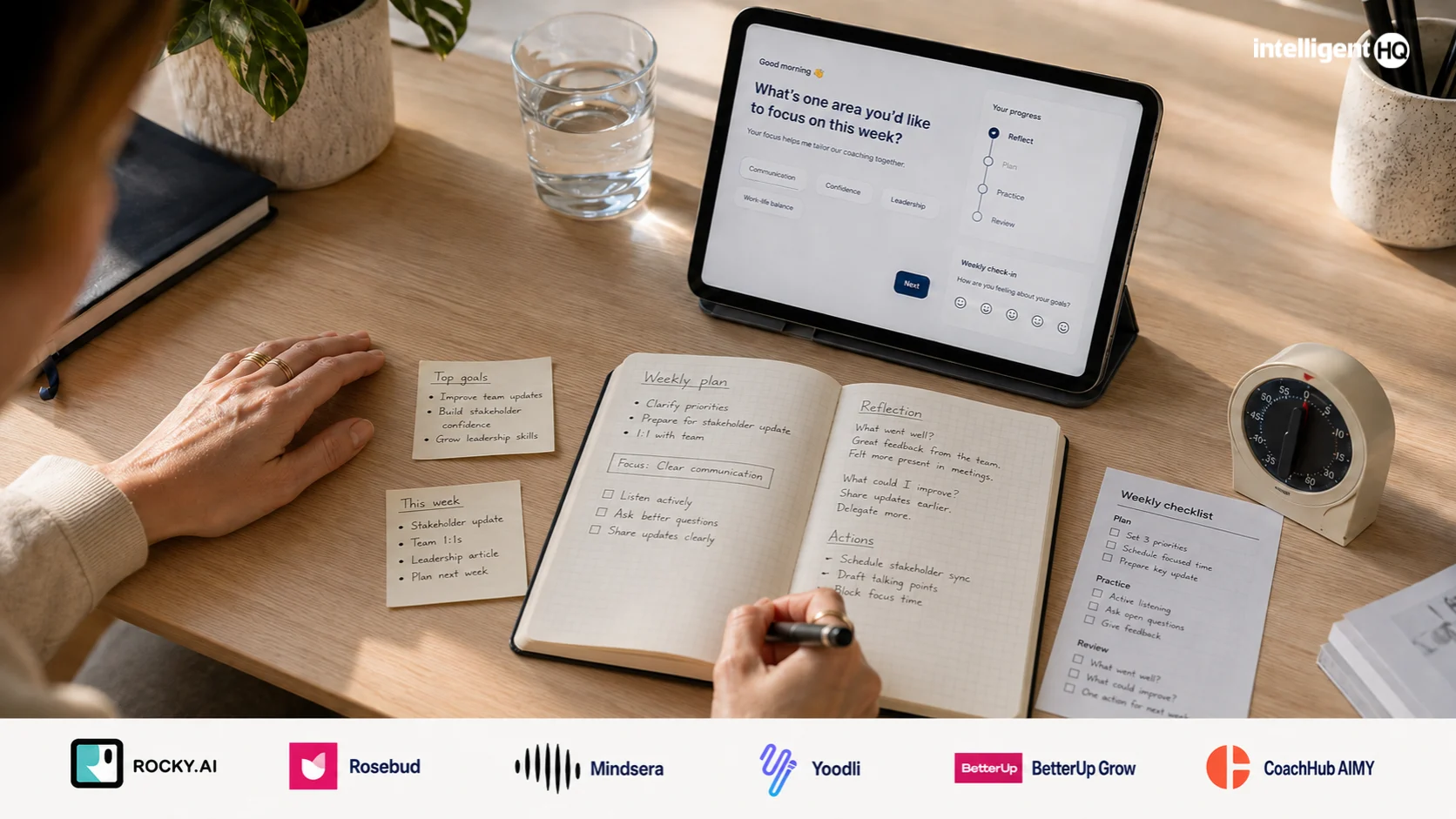
AI coaching apps can help users clarify goals, examine their decisions and maintain momentum between moments of motivation. The strongest platforms do more than generate encouraging responses: they ask structured questions, remember relevant context, turn reflection into action and review whether commitments were completed.
However, an AI coach is not automatically a qualified human coach, therapist or trusted adviser. Its value depends on the quality of its coaching process, its treatment of personal data and the user’s willingness to act outside the app.
This guide compares six AI coaching tools for personal development, reflective thinking, workplace growth and communication practice.
Key takeaways
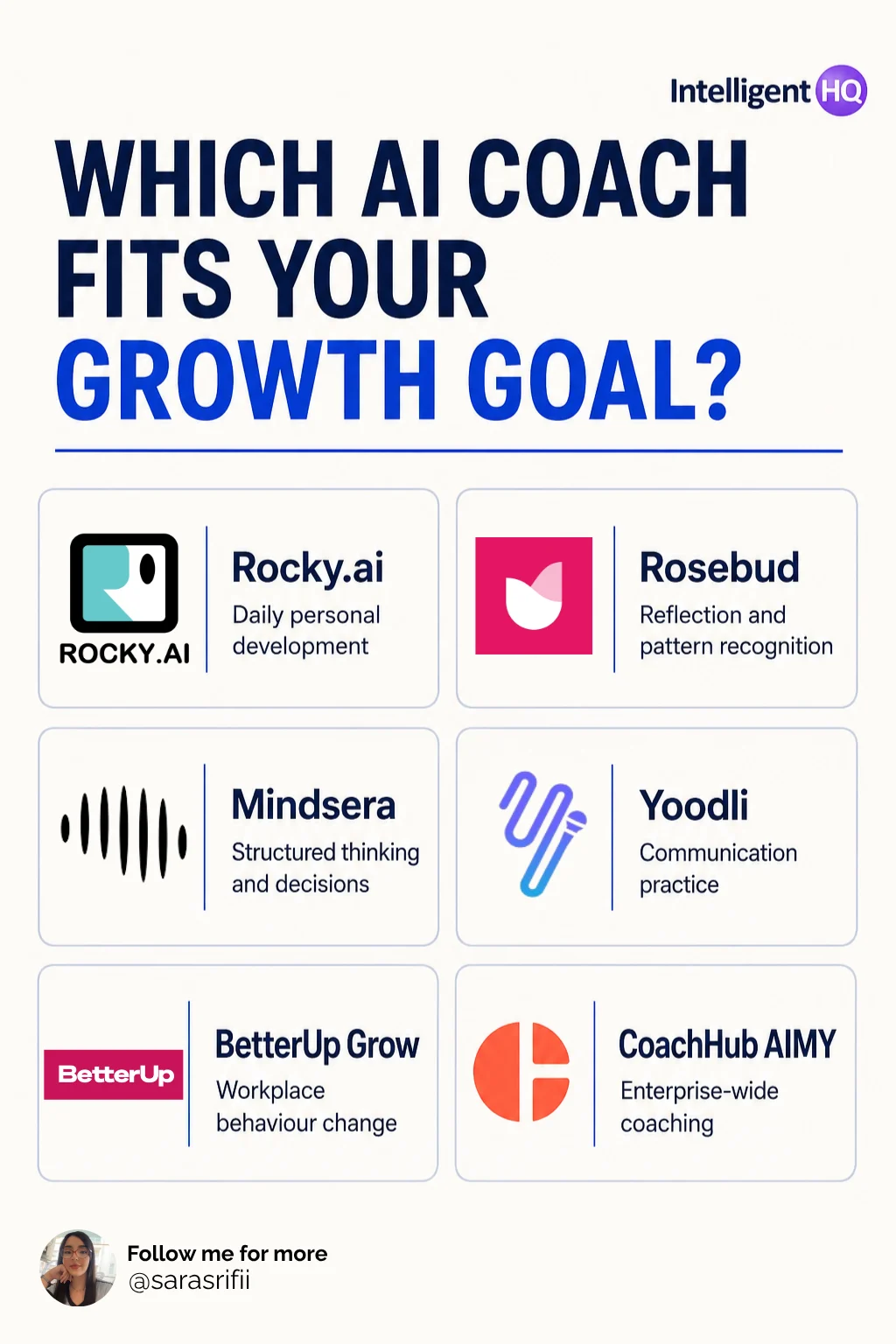
- Rocky.ai is the strongest general-purpose option for short, structured coaching conversations.
- Rosebud is best suited to reflective journaling and recognising patterns over time.
- Mindsera offers structured frameworks for decisions, assumptions and complex thinking.
- Yoodli is a specialist AI coach for communication practice and role-play.
- BetterUp Grow and CoachHub AIMY bring AI coaching into employer-led development programmes.
- AI coaching works best when it produces a measurable action—not simply a satisfying conversation.
- Sensitive personal, medical, legal or career-critical decisions still require appropriate human judgement.
What is an AI coaching app?
An AI coaching app uses artificial intelligence to guide a user through goal-setting, reflection, skills practice or accountability.
This differs from a conventional productivity app. A task manager records what needs to be done; a coaching app should help the user understand what is preventing progress, select an appropriate next action and review the outcome.
A credible coaching process normally includes four stages:
- Planning: defining a goal, constraint or decision.
- Reflection: examining assumptions, behaviour and obstacles.
- Action: agreeing on a specific step outside the app.
- Accountability: returning to review the evidence and adjust the plan.
Readers primarily looking for task organisation should instead compare IntelligentHQ’s best productivity apps for personal growth. The tools below focus more directly on questioning, reflection and behavioural development.
Best AI coaching apps compared
| AI coaching app | Best for | Main coaching method | Important limitation |
|---|---|---|---|
| Rocky.ai | Everyday personal development | Short guided conversations, goals and nudges | Advice quality depends on honest, specific input |
| Rosebud | Reflective journaling | Entries, follow-up prompts and pattern reports | Not a substitute for therapy |
| Mindsera | Structured thinking | Journaling analysis and guided frameworks | Can become reflection-heavy without action |
| Yoodli | Communication skills | Recorded speaking and interactive role-play | Focused on communication rather than whole-life coaching |
| BetterUp Grow | Workplace development | Goals, role-play and contextual guidance | Primarily an enterprise product |
| CoachHub AIMY | Scaled employee coaching | Goals, assessments, nudges and practice | Usually accessed through an organisation |
1. Rocky.ai: Best for daily personal-development coaching
Rocky.ai is one of the clearest examples of a purpose-built AI coach rather than a general chatbot.
Its approach centres on short guided conversations that encourage users to examine situations, challenge assumptions and select practical next steps. The platform combines coaching questions with goals, a diary, progress insights, reminders and learning resources.
The five-minute conversation format makes Rocky particularly suitable for people who want regular coaching without maintaining a long journal. It can be used for leadership development, decision-making, confidence, habits and personal accountability.
Its principal advantage is structure. Instead of asking the AI an isolated question, the user can connect conversations to continuing goals.
Best for: entrepreneurs, professionals and students who want brief, consistent coaching check-ins.
Watch for: an AI-generated question may sound insightful without identifying the real cause of a problem. Review important conclusions independently.
2. Rosebud: Best for reflection and pattern recognition
Rosebud combines AI-assisted journaling, goal development and emotional reflection.
The app can refer to previous entries, identify recurring subjects and provide weekly reports about patterns and progress. Users can write or record voice entries, making it useful for people who think more clearly through conversation than formal planning.
Rosebud is strongest when the user wants to understand why the same obstacle keeps returning. Its longitudinal memory can reveal connections that are difficult to notice across separate diary entries.
That reflective strength also creates a boundary. Personal journals may contain information about health, relationships, employment and identity. Users should review privacy, retention, export and deletion controls before recording sensitive material.
Best for: guided journaling, personal reflection and identifying recurring patterns.
Watch for: Rosebud should not be treated as a therapist, diagnostic system or crisis service, regardless of how human its responses may feel.
3. Mindsera: Best for clearer thinking and decisions
Mindsera positions the journal as an active thinking environment rather than a passive record.
Its AI can summarise an entry, identify assumptions and emotional patterns, and respond with structured observations. The platform also provides guided frameworks for subjects such as first-principles thinking, energy, overthinking and decision-making.
This makes Mindsera particularly relevant to founders, professionals and creative workers facing complex choices. The user can place an unstructured concern into a framework and separate facts, interpretations, risks and possible actions.
The main risk is sophisticated procrastination: continuing to analyse a decision without testing it. Each session should therefore end with an observable next step and a review date.
Best for: decision journals, structured reflection and challenging assumptions.
Watch for: insight is not evidence. Test the resulting conclusion in the real world.
4. Yoodli: Best for communication practice
Yoodli is a specialist AI communication coach built around interactive role-play.
Users can practise presentations, interviews, workplace conversations and pitches against simulated participants. The system can ask follow-up questions and provide feedback on content, delivery and progress over time.
Unlike text-only coaching, Yoodli allows users to rehearse the behaviour itself. This is valuable because communication ability improves through repeated performance, feedback and adjustment—not merely by reading advice.
Individuals can use it for interview and public-speaking practice, while organisations can create customised scenarios and evaluation criteria.
Best for: presentations, interviews, difficult conversations and speaking practice.
Watch for: simulated feedback cannot fully reproduce the politics, emotion or unpredictability of a real audience.
For broader professional development, IntelligentHQ’s guide to AI skills platforms for essential soft skills provides additional context.
5. BetterUp Grow: Best for workplace behaviour change
BetterUp Grow is designed for organisational coaching rather than unrestricted personal conversation.
It supports goal-setting, performance conversations and role-play, with guidance adapted to a person’s role and the employer’s leadership frameworks. Organisations can also examine usage and behavioural signals at an aggregated level.
A notable feature is its connection to BetterUp’s wider human-coaching system. The company states that the product can identify situations requiring deeper support and direct a user towards a human coach.
BetterUp Grow is therefore most relevant when an employer wants scalable development that remains connected to organisational priorities and professional coaching.
Best for: leadership development and employer-sponsored behavioural change.
Watch for: employees should understand exactly what information managers receive and what remains confidential.
6. CoachHub AIMY: Best for enterprise-wide access
CoachHub AIMY provides always-available AI coaching for employees who may not otherwise receive individual professional coaching.
The platform supports short- and long-term goals, self-assessments, progress tracking, reminders and video role-play. It can also be configured around an organisation’s values, competencies and development objectives.
CoachHub says individual coaching conversations are not shared with HR teams; programme administrators instead receive aggregated and anonymised insights. Organisations should still evaluate how anonymity operates in small teams and what data is retained.
AIMY is not primarily a consumer app. Its value lies in making structured development available across a large workforce while preserving access to CoachHub’s human-coaching services.
Best for: companies scaling leadership, communication and career-development support.
Watch for: organisational alignment should not turn coaching into performance surveillance.
The IntelligentHQ coaching-value test
An app can produce polished language without providing meaningful coaching. Before choosing one, apply these five questions:
1. Does it clarify the real goal?
A useful coach should distinguish between a vague ambition—such as “become more confident”—and a result that can be observed.
2. Does it ask before advising?
Immediate advice may solve the wrong problem. Strong coaching begins by investigating context, constraints and assumptions.
3. Does every session create an action?
A reflection should conclude with a specific behaviour, owner and deadline.
4. Does it review evidence?
Accountability requires more than reminders. The app should ask what happened, what was learned and what needs to change.
5. Does it recognise its limits?
A responsible tool should not present itself as a therapist, doctor, lawyer or infallible authority. It should make escalation to qualified human support possible where appropriate.
How to use an AI coach effectively
Begin with one goal for a six-week period. Define the desired outcome, the reason it matters and the evidence that would demonstrate progress.
Use the app for brief check-ins rather than unrestricted conversation. A practical rhythm is:
- Monday: define the week’s most important action.
- Midweek: identify the obstacle and adjust the approach.
- Friday: record the result, evidence and lesson.
- End of month: review patterns and decide whether the goal remains relevant.
If distraction prevents execution, combine coaching with one of IntelligentHQ’s best focus apps for protecting deep work.
The essential principle is simple: the conversation happens inside the app, but personal development must happen outside it.
Privacy and safety considerations
AI coaching may involve unusually sensitive information. Before adopting a platform, examine:
- Whether conversations are used to train AI models.
- How long entries and recordings are retained.
- Whether memory can be viewed, corrected or deleted.
- Whether data can be exported.
- What employers or programme administrators can see.
- Whether the product provides a route to human support.
- Which security and privacy standards are independently documented.
Avoid entering confidential employer information, trade secrets, medical records or details about another person without permission.
Final verdict
There is no single best AI coach for every form of personal development.
Rocky.ai provides the most direct everyday coaching experience. Rosebud and Mindsera are stronger for reflective writing and pattern recognition, while Yoodli is the better choice when the skill must be practised aloud. BetterUp Grow and CoachHub AIMY are more suitable for organisations extending development support across a workforce.
The right choice depends on the behavioural gap. Choose the tool that helps turn a clearly defined goal into action, evidence and review—not the one that merely produces the most convincing conversation.
FAQs
Can AI coaching apps replace a human coach?
No. They can provide regular prompts, reflection and practice, but they lack the full judgement, responsibility and relational understanding of a qualified human coach.
Are AI coaching apps suitable for mental-health treatment?
They may support journaling or general wellbeing, but they should not be used as a replacement for qualified mental-health care or emergency support.
What is the difference between an AI coach and a chatbot?
A chatbot mainly responds to prompts. A purpose-built AI coach maintains a development process involving goals, questions, actions, review and accountability.
Which AI coach is best for personal goals?
Rocky.ai is a strong general-purpose option. Rosebud is more appropriate for journal-led reflection, while Mindsera suits structured thinking and decisions.
Which app is best for professional communication?
Yoodli is the most specialised option in this selection because it combines role-play with feedback on spoken performance.
Sources
- Rocky.ai: AI coaching and personal-development platform
- Rosebud: AI journaling for personal growth
- Mindsera: AI journal and structured reflection
- Yoodli: AI role-play and communication coaching
- BetterUp Grow: AI coaching for workplace development
- CoachHub AIMY: Enterprise AI coach
- International Coaching Federation: AI Coaching Framework and Standards
- UK Information Commissioner’s Office: Guidance on AI and data protection