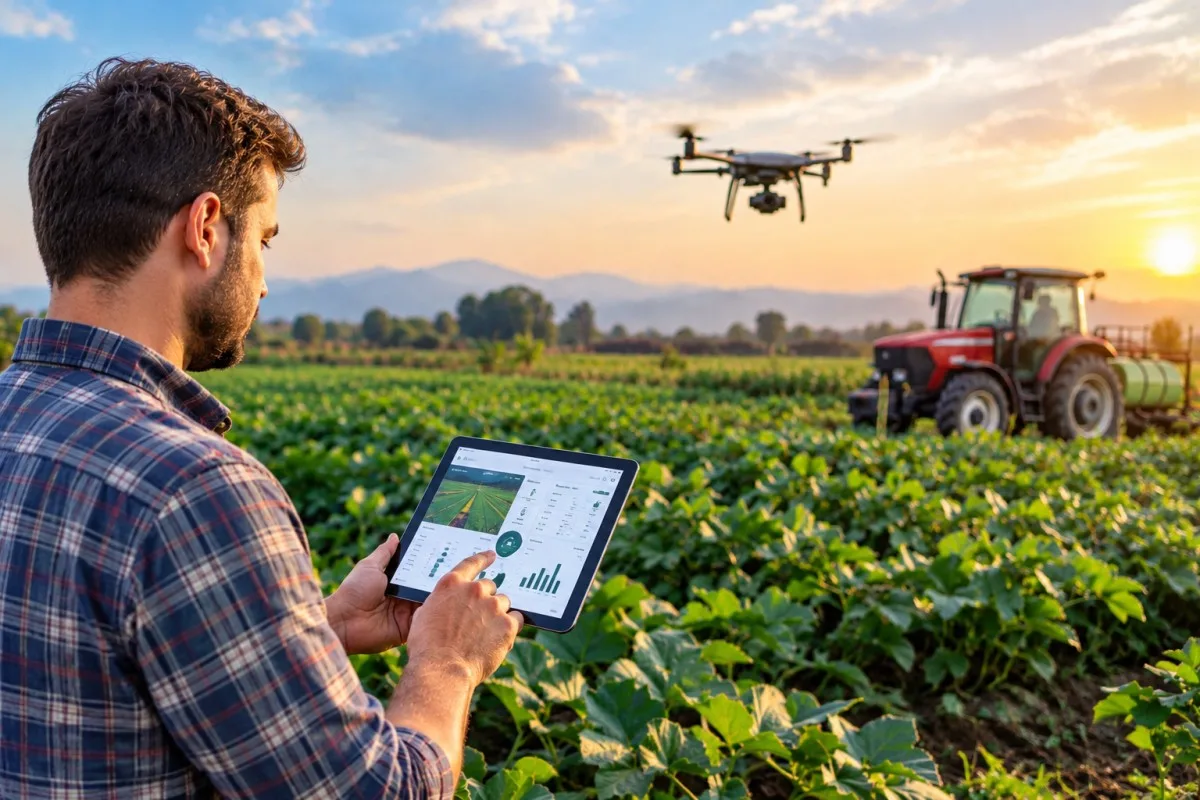
Agriculture is becoming more data-driven as farmers look for ways to manage unpredictable weather, rising input costs, water shortages, and crop diseases. Artificial intelligence (AI) is helping address these challenges by turning information from sensors, satellite images, weather forecasts, and farm records into practical recommendations.
The US Department of Agriculture’s 2025 technology report shows that precision agriculture is gaining ground, although adoption varies by farm size and technology. In 2023, 52% of midsize farms and 70% of large crop-producing farms used tractor or equipment guidance systems. These systems are not all AI-powered, but they demonstrate how digital technology is becoming part of modern farming.
Agriculture AI takes this shift further. It helps farmers identify crop problems earlier, estimate yields, manage resources, and make decisions using data rather than relying only on observation or experience.
What Is Agriculture AI?
Agriculture AI refers to the use of artificial intelligence and machine learning to analyze agricultural data, predict outcomes, and support farming decisions. It can process information from soil sensors, drones, satellites, weather stations, machinery, and historical crop records.
For example, an AI system can analyze images of crop leaves to identify signs of disease. Another system can combine rainfall forecasts, soil moisture readings, and crop requirements to recommend when a field needs irrigation.
AI can also support farm management beyond crop production. Agricultural businesses can use it to forecast demand, monitor livestock, track equipment performance, and improve supply chain planning.
However, AI does not replace agricultural knowledge. It provides additional insights that farmers and agronomists can use alongside their experience, field observations, and local conditions.
How Does AI in Agriculture Work?
An agriculture AI system typically follows a simple process: collect data, analyze patterns, generate predictions, and help users decide what to do next.
First, the system gathers information from sources such as weather APIs, satellite imagery, field sensors, farm equipment, and agricultural databases. It then processes the information to identify patterns or detect changes.
A machine learning model might estimate crop yield from historical harvest data, rainfall, soil conditions, and temperature. A computer vision model might examine a photograph to identify a possible pest infestation.
The system then presents its findings through a dashboard, mobile application, alert, or recommendation.
For instance, a farmer might receive a warning that a particular field shows signs of water stress. The farmer can inspect the area and decide whether irrigation is necessary.
The quality of these recommendations depends on the accuracy of the input data, the model’s training, and the conditions in which it operates.
Key Applications of Agriculture AI
AI-Powered Crop Monitoring and Disease Detection
Crop diseases and pest infestations can spread quickly if farmers do not identify them early. AI-powered image analysis can help detect visible symptoms by examining photographs captured by smartphones, drones, or field cameras.
These systems can flag possible diseases, identify affected areas, and help farmers prioritize inspections. Some solutions also analyze satellite imagery to identify changes in crop health across larger fields.
Early detection can help farmers respond sooner and avoid unnecessary treatment across an entire farm. Still, image-based predictions should be treated as decision support. Similar symptoms can have different causes, so field inspection or expert confirmation may be necessary.
Precision Farming and Smart Irrigation
Precision farming uses data to manage individual parts of a field according to their needs. AI can support this approach by analyzing soil moisture, weather forecasts, crop growth, and irrigation history.
A smart irrigation system can estimate when crops need water and help schedule irrigation accordingly. This reduces dependence on fixed schedules that waste water during rainy periods or fail to provide enough moisture during dry conditions.
AI can also support variable-rate fertilizer application, helping farmers adjust input levels based on soil conditions and crop requirements.
The result is more targeted resource management. However, recommendations need to reflect local soil types, crop varieties, equipment capabilities, and field conditions.
Crop Yield Prediction and Weather Forecasting
Estimating crop yield helps farmers plan harvesting, storage, labor, transportation, and sales. AI models can analyze historical yields, planting dates, weather patterns, soil characteristics, and satellite observations to estimate potential production.
Weather data adds another layer. AI can help interpret rainfall patterns, temperature changes, and other environmental indicators to support decisions about planting, irrigation, and harvesting.
These predictions are estimates, not guarantees. Extreme weather, unexpected pests, and changes in field conditions can affect the final result. Farmers should use predictions alongside local forecasts and regular field assessments.
Smart Pest and Weed Management
AI can help identify weeds and pests through images and sensor data. When connected to suitable agricultural machinery, the system can help target specific areas rather than treating an entire field uniformly.
For example, a camera-based system distinguishes weeds from crops and guides precision spraying equipment toward affected spots. This can reduce unnecessary chemical use when the system is accurate and properly calibrated.
Farmers still need to consider local regulations, chemical instructions, crop safety, and the possibility of incorrect detection. The goal is to make pest management more targeted, not to automate every treatment without supervision.
Livestock Monitoring and Farm Automation
Agriculture AI also supports livestock management. Sensors and cameras can help monitor animal movement, feeding behavior, activity, and environmental conditions.
Changes in behavior indicate a potential health issue, allowing farm workers to investigate earlier. AI can also support automated feeding, dairy monitoring, and equipment maintenance.
These systems can reduce manual monitoring, but alerts need to be interpreted carefully. A change in activity does not always mean an animal is ill, so veterinary expertise remains important.
Benefits of Agriculture AI for Farmers and Agribusinesses
The main benefit of Agriculture AI is its ability to turn large amounts of farm data into more useful decisions.
AI can help farmers detect crop problems earlier, manage irrigation more carefully, and target fertilizer or pesticide use. It can also support yield planning, reduce some repetitive tasks, and improve visibility across farm operations.
For agribusinesses, AI can help forecast demand, manage inventory, coordinate transportation, and reduce uncertainty in agricultural supply chains.
These benefits depend on the use case. A small farm can gain the most from a simple crop-monitoring tool, while a large agricultural enterprise may need a connected platform that combines field data, equipment, logistics, and business systems.
Challenges of Implementing Agriculture AI
AI adoption comes with practical challenges. Reliable recommendations require good-quality data, but some farms lack consistent sensor coverage, historical records, or stable internet access.
Equipment, software, integration, and maintenance can also create high costs. Smaller farms need affordable mobile tools or shared services rather than expensive, farm-wide systems.
Model accuracy is another concern. A disease detection model trained on one crop variety or climate performs poorly in another environment. Systems need testing with relevant local data.
Farmers must also understand how their data is collected, stored, and shared. Clear permissions and security controls help protect sensitive operational and commercial information.
That is why successful adoption requires more than selecting an AI model. It also needs practical training, reliable support, and a clear plan for how the technology fits into everyday farming.
How to Build an AI App for Agriculture
Agricultural businesses that want to develop their own solution should start with a specific problem. Trying to build an AI application that handles every farming task at once can make the project expensive and difficult to manage.
A crop disease detection app needs image uploads, a trained computer vision model, crop-specific guidance, user accounts, and a way to flag uncertain results for expert review.
A smart irrigation app needs weather data, soil sensors, crop information, and a recommendation engine. A farm management platform needs dashboards, inventory tracking, equipment data, and reporting.
The development process usually includes:
- Define the use case: Identify the farming problem and the users who need to solve it.
- Collect suitable data: Gather reliable field images, sensor readings, weather data, or historical records.
- Select the AI approach: Choose computer vision, predictive analytics, machine learning, or a combination based on the task.
- Develop the application: Build the mobile or web interface, backend services, data integrations, and model connections.
- Test in real conditions: Evaluate performance across relevant crops, locations, devices, and weather conditions.
- Monitor and improve: Track model accuracy, user feedback, and system performance as conditions change.
The Future of Agriculture AI
Agriculture AI is moving toward more connected and practical farming systems. AI models are increasingly being combined with drones, robotics, satellite imagery, Internet of Things (IoT) sensors, and farm management platforms.
These combinations can help farmers monitor fields, automate selected tasks, and respond more quickly to changing conditions. More accessible mobile tools also bring useful AI capabilities to farms that cannot invest in large technology systems.
At the same time, progress will depend on reliable data, affordability, local relevance, and farmer trust. A sophisticated model has limited value if it produces recommendations that are difficult to understand or apply.
Conclusion
Agriculture AI gives farmers and agribusinesses new ways to monitor crops, predict yields, manage resources, and plan operations. Its value comes from using data to support better decisions, not from replacing agricultural expertise.
The best starting point is a clearly defined problem, reliable data, and a solution that fits the farm’s actual needs. With careful testing and ongoing improvement, AI can become a practical part of more efficient and informed agricultural management.