What if every student could learn at their own speed, get instant results and feedback, and never feel left behind in a classroom?
This is how AI in education is transforming learning systems worldwide.
In fact, two-thirds of higher education institutions are already using or developing AI guidance frameworks. This clearly shows just how quickly AI is becoming a part of mainstream education.
But this shift is about rethinking how learning works altogether rather than just about implementing various tools.
So, what does education look like in an AI-driven world? And more importantly, what does it mean for students, teachers, and institutions?
Continue reading to find out.
What “AI in Education” Means in 2026
When people hear “AI in education,” they imagine chatbots that answer homework questions or provide textbook summaries. But in 2026, it’s far more layered than that.
AI has slowly moved from merely being a support tool to becoming a core part of learning systems.
Today’s AI-powered education includes systems that:
- Set dynamic levels depending on the performance of students
- Make recommendations according to the learning needs of each student
- Give feedback immediately rather than after assessments
- Create questions, notes, and answers automatically
It’s like having a continuously adapting learning environment using AI, instead of a one-size-fits-all classroom.
For example, when a student struggles with fractions, the system does more than assign additional worksheets. It analyzes the underlying cause of the difficulty, whether related to conceptual understanding, processing speed, or retention, and adapts the learning experience accordingly.
That’s a fundamental shift that reshapes learning journeys.
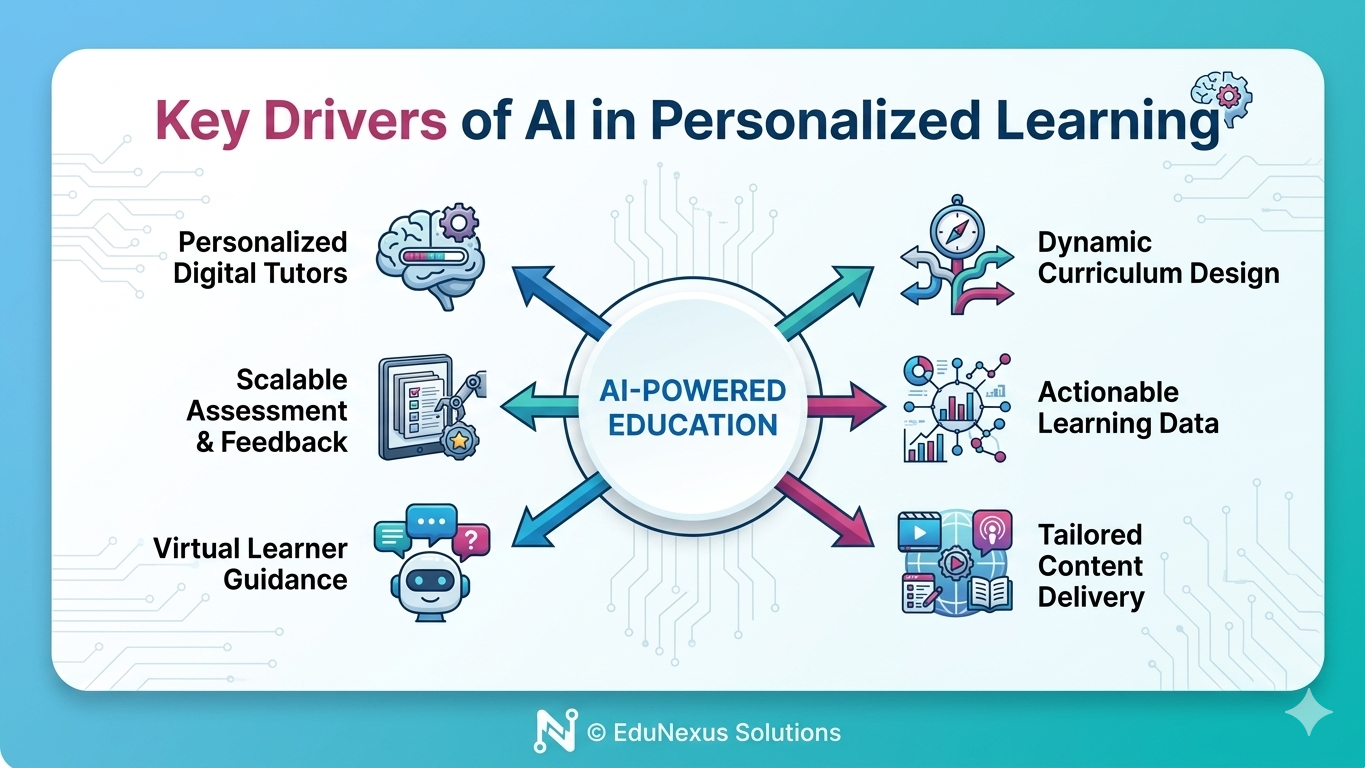
The Key Drivers Behind AI Adoption in Education
So, why is this transformation happening now, and not five years ago?
There are a few clear forces pushing AI into education at scale.
1. The demand for personalization has reached a breaking point
Traditional classrooms were never designed to handle individual learning speeds effectively. With 30+ students and one teacher, personalization was always limited. AI changes that equation completely.
2. Teacher workload is becoming unsustainable
Grading, lesson planning, and administrative work add up fast. AI tools are stepping in to handle repetitive tasks and give teachers more time to focus on teaching.
3. Hybrid and digital learning are now the norm
Post-pandemic learning didn’t revert; it evolved. Schools and institutions now operate across physical and digital environments, and this makes AI a natural fit.
4. Data is finally used meaningfully
Education has always generated data related to scores, attendance, assessments, but AI turns that data into insights. The result is educators can make better decisions in real time.
The shift isn’t just happening at the institutional level. It’s also happening at the student level.
Take early learning as an example.
All-in-one online reading classes improve comprehension, fluency, and grades. This is a structured research-based curriculum and 1:1 personalized lessons with full alignment with US state standards.
Programs like this show that learning is increasingly becoming more structured, data-driven, personalized, and outcome-based.
And once students experience that level of personalization, expectations change. They don’t want to go back.
How AI Is Transforming the Learning Experience
Now, let’s see what this looks like in practice because the impact of AI shows up in real ways inside the learning experience.
1. Learning becomes adaptive
Instead of studying from a fixed syllabus, students can follow dynamic paths based on their preferences and learning speed.
Consider, for example, if someone is good at understanding a concept quickly, they move ahead. If they struggle, the system slows down and explains the concept again.
This ensures that the pressure to “keep up with the class” is reduced. Due to this, students focus on learning instead of mugging up things. With AI, the class adapts to you.
2. Feedback becomes immediate and actionable
Remember waiting days or weeks for the results?
AI reduces that delay.
Students can get instant feedback. They also get explanations that help them understand why something is right or wrong. This shortens the learning loop.
3. Engagement improves because learning feels relevant
When the content matches a student’s knowledge level and pace, they feel more engaged, and the frustration drops. Therefore, the engagement of each student increases.
AI can also have interactive elements, quizzes, simulations, and conversational explanations. This makes learning less passive.
4. Language and accessibility barriers are reduced
AI-driven translation and speech tools are making education more accessible in many languages.
A student in one part of the world can access the same quality of content as someone else. This way, AI reduces education barriers.
5. Learning extends beyond the classroom
What if learning didn’t stop when a class ended?
AI systems are like continuous learning companions. Students can ask questions anytime, revisit concepts, and practice at their own pace. This happens outside formal education settings.
But this transformation is also reshaping what it means to be a teacher.
Instead of being the primary source of information, educators are becoming facilitators, mentors, and critical thinkers who guide students through AI-enhanced learning environments.
And that shift might be one of the most important changes of all.
Ready to Transform Your Learning System?
AI in education is removing the major factors that have always limited learning.
We’re moving from rigid standardized systems to personalized experiences. The delayed feedback system is transformed with real-time insights. Also, students can go through adaptive learning journeys instead of static ones.
The takeaway is: Thoughtful implementation of technology improves education.
The real transformation happens when institutions, educators, and platforms choose to use AI to make education more meaningful and effective.
So, the question isn’t whether AI will shape education. It already is. The real question is are you ready for it?
If you want to find out more such insights and practical tips centered around AI implementation, you should check out intelligentHQ and see how cutting-edge technologies can transform the future.
About Author:
Prateek Arora is a content marketing specialist at thestartupinc.com, where he dives into B2B and SaaS topics that transform website visitors into paying customers.
With a passion for exploring innovative marketing strategies, Prateek enjoys researching and crafting content that resonates with target audiences.
In his free time, he loves driving around the city and hanging out with friends, finding inspiration in the vibrant urban landscape.

Linkedin: https://www.linkedin.com/in/prateek-arora-8b8650239/