Modern business requires far more than simply upgrading existing software. Over the years, application modernization services have mainly focused on refactoring, rehosting, or rewriting legacy systems.
However, the next wave of enterprise application modernization is more strategic.
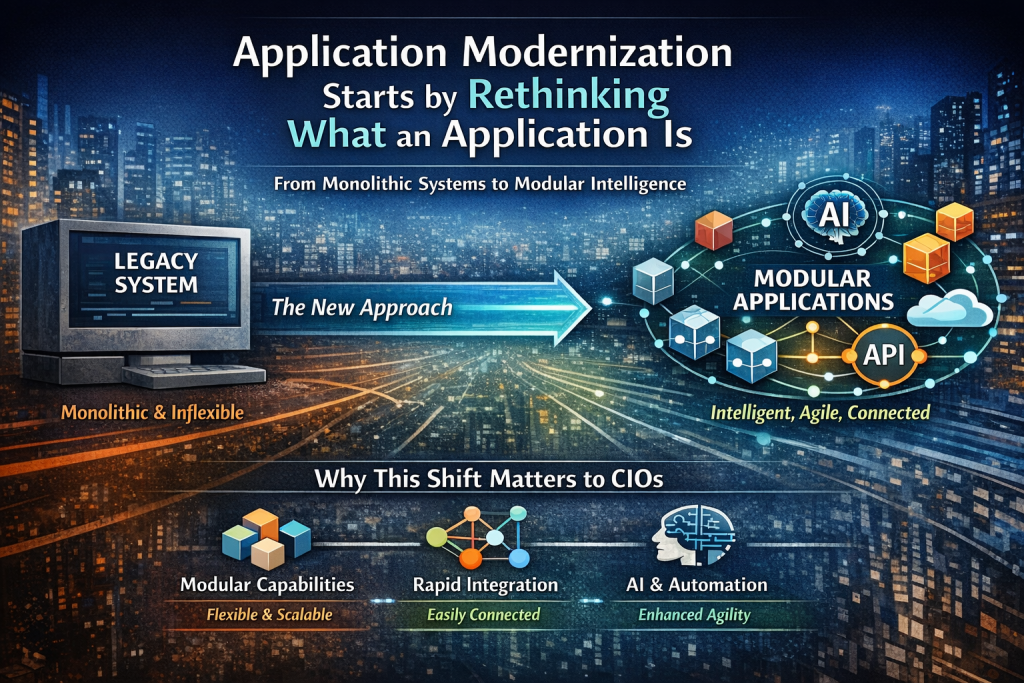
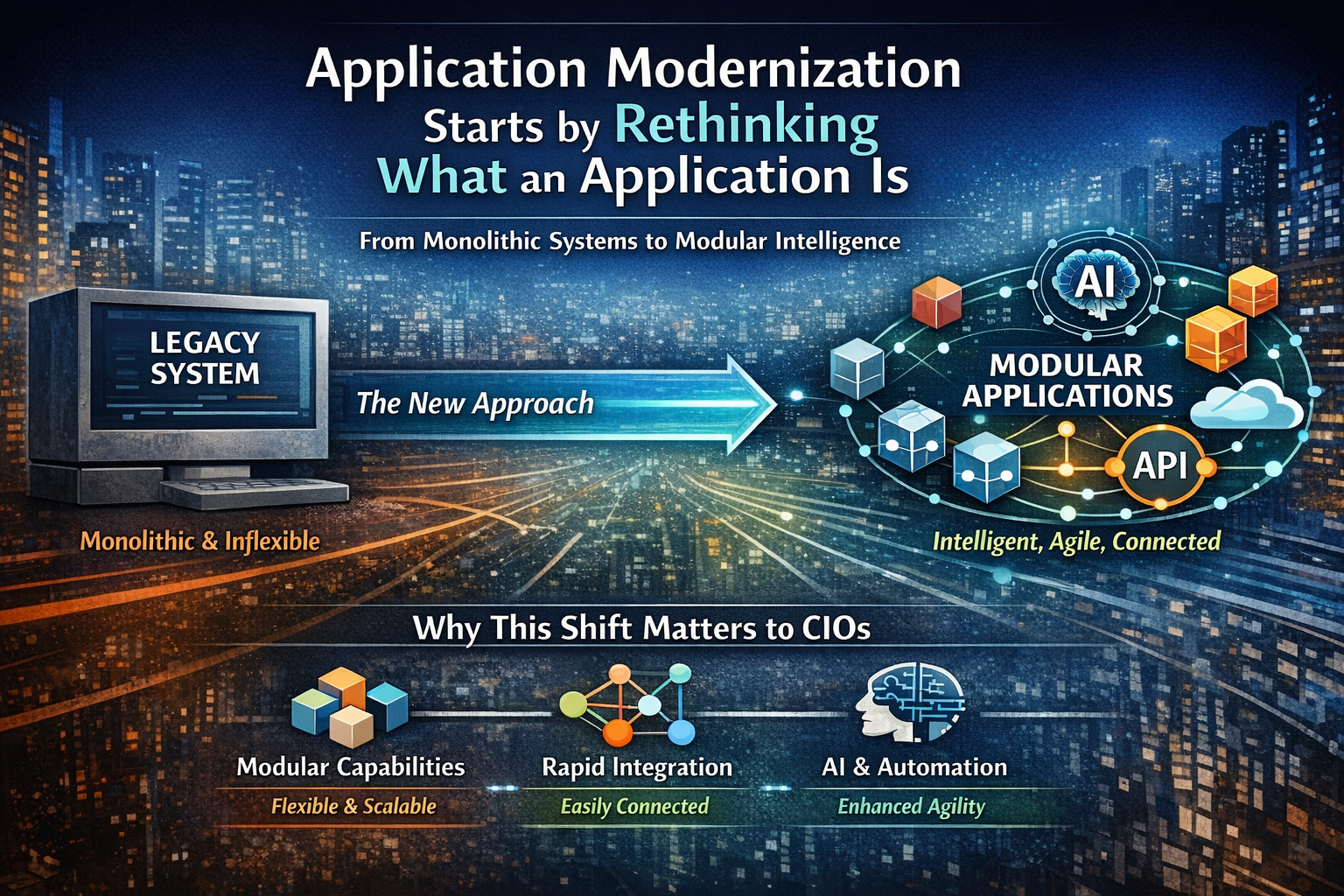
Nowadays, executives need to consider, from scratch, what an application truly is. Rather than a monolithic block of code and user interface, modern applications are being recognized as a set of intelligent, modular features. These are facilitated by services, APIs, event streams, and increasingly AI agents that collaborate to deliver business value.
Why This Shift Matters to CIOs
Legacy applications are dependable yet inflexible, and they often do not readily accept change. Changing the face of the old system, such as migrating to the cloud or rewriting the code merely makes the system more cost-efficient, but does not really increase business agility in a lasting way. CIOs are now under pressure to reinvent the unit of delivery once again. Instead of focusing on whole applications, they have to start seeing them as sets of capabilities that can be independently developed, scaled differently, and easily connected to other areas of the business.
What Modern Application Really Means
Traditionally, enterprise applications consisted of bundled code, internal business logic, and a fixed user interface. These silos made software harder to change and scale over time. They often required extensive rewrite or refactoring work to support even minor business updates.
In modern solutions, an application is no longer a single unit of delivery. Instead, it is:
- Composable services delivered via APIs and microservices
- Event-driven components that react to business conditions in real time
- Intelligent layers where AI agents support decision-making or automate tasks
This shift allows functionality to evolve without overhauling the entire system. Enterprise application modernization services now emphasize breaking down legacy systems into independently deployable units that can be upgraded, scaled, or replaced as business needs change.
Practical Elements of Modern Applications
Present-day applications contain various moving parts. Most application modernization services focus on the following:
Composable Architecture and Event-Driven Models
Modern systems move away from monolithic code toward lightweight services that communicate through APIs and events. This makes it easier to integrate with other systems, deploy updates quickly, and drive new capabilities without disruptive rewrites. Composable patterns also support independent scaling and continuous delivery.
AI Agents in Development and Modernization
There is no doubt that AI-driven agents are rapidly becoming one of the leading features of enterprise application modernization services. They can analyze legacy code, help with refactoring, provide suggestions for improvement, and contribute to test and deployment automation. For instance, agentic AI systems can deeply scan the entire codebase and refactor it to a newer standard more quickly than the manual methods, freeing developers to concentrate on more valuable tasks.
According to Gartner, over the next couple of years, about 40 percent of enterprise applications may embed task-specific AI agents, gradually bringing autonomous features directly into business systems. Actually, these agents are capable of assisting users and performing complex, full-cycle tasks.
AI in Enterprise Workflow Orchestration
Well-equipped AI agents can be the key to smoothly running workflow management in a very easy way. They can initiate actions when certain business events occur, transfer data between systems, or submit requests for human intervention for tasks beyond their capabilities. Such orchestration not only increases automation in enterprise processes but also gives teams the power to create value at an unprecedented rate.
Strategic Benefits of Rethinking Applications
Changing the focus of application modernization from monolithic systems to capabilities is more than just an architectural choice. It has a direct impact on how rapidly a business can operate, how securely it can scale, and with what assurance it can innovate. When applications are decomposed into modular, intelligent capabilities, the impact is visible across technology, operations, and strategy.
Greater Agility at the Capability Level
Changes in traditional systems have to go through big release cycles, even for the smallest changes. For example, a slight change in pricing logic or compliance rules may require full regression testing across the entire application.
Capability-based enterprise application modernization allows each component to develop independently. Payment service, underwriting rule engine, or customer onboarding workflow, any of these can be updated without the need to redeploy the entire system, thus reducing the coordination overhead and shortening release timelines.
The value of agility can be identified in the results of the work. Business teams can react to regulatory changes, market shifts, or competitive pressure without waiting for quarterly or biannual system upgrades.
Faster, Safer Innovation
Trying out something new in monolithic environments is risky. It means that a part of a new feature can unintentionally interfere with unrelated parts of the system. This risk slows down the pace of experimentation.
Composable application modernization solutions cut down that barrier. The modular services and AI-enabled components enable teams to test new capabilities in isolation. If an experiment goes wrong, then the rollback can be limited to that specific service only, instead of the whole platform.
This structure supports:
- Incremental feature releases
- Pilot deployments for specific customer segments
- Controlled integration of AI agents into workflows
Innovation becomes continuous instead of episodic. Organizations move from large transformation programs to steady, iterative improvement.
Improved Developer Productivity and Focus
Legacy systems often consume developer time with maintenance work. Teams spend hours navigating tightly coupled codebases, managing dependencies, and fixing regression issues.
Modern software modernization services introduce modular architectures and AI-assisted development practices. Developers can focus on business logic and value creation instead of boilerplate fixes and repetitive tasks.
AI tools assist with:
- Code analysis and refactoring
- Automated testing and validation
- Documentation generation
- Identifying performance bottlenecks
This does not remove human oversight. It shifts developer effort toward higher-value design and problem-solving. Over time, productivity gains compound across teams.
Stronger Resilience and Operational Stability
In a monolithic application, a failure in one module can impact the entire system. Recovery can be complex and time-consuming.
Capability-based enterprise application modernization isolates failures. If one service experiences an issue, other services can continue functioning. Teams can scale high-demand capabilities independently without over-provisioning the entire system.
This leads to:
- Improved system uptime
- Faster incident resolution
- Targeted scaling during peak demand
Resilience becomes built into the architecture rather than managed through reactive firefighting.
Scalable Governance and Control
As enterprises adopt AI-driven and automated systems, governance becomes critical. Modular capability design makes governance more precise.
Each service can have:
- Defined access controls
- Independent monitoring
- Dedicated compliance checks
- Clear audit trails
Instead of applying broad, system-wide controls, leaders can enforce policies at the capability level. This increases transparency and reduces compliance risk.
For CIOs working with an application modernization company, this governance model provides confidence that innovation does not outpace oversight.
Better Alignment Between IT and Business Strategy
When applications are structured as capabilities, they map more directly to business outcomes. A claims processing capability, a pricing engine, or a recommendation service can be measured in terms of business impact.
This clarity improves decision-making. Investments in modernization are tied to specific value streams rather than abstract infrastructure upgrades.
Enterprise application modernization then becomes a strategic lever. It supports revenue growth, customer experience improvement, and operational efficiency in a visible way.
Long-Term Adaptability
Markets evolve. Regulations change. New technologies emerge. Monolithic systems struggle to keep up because change requires large-scale redesign.
Capability-driven architectures are inherently adaptable. New services can be introduced alongside existing ones. Legacy components can be retired gradually rather than replaced in a single disruptive event.
This staged evolution reduces transformation risk and protects prior investments.
Closing Perspective
Application modernization today is much more than just upgrading technology. It is essentially about changing the way business capabilities are delivered and developed. Leading-edge enterprises and application modernization companies enable organizations to transition from fixed software stacks to adaptable, smart systems that facilitate growth and change.
Today, the focus of the modernization services and solutions should be on modular design, AI augmentation, flexible integration, and well-established governance. Those leaders who embrace this approach will develop systems that are not only current but also future-ready. Enterprise application modernization is a strategic path to business capabilities that grow with the business and help the delivery of value at a faster pace.

Pallavi Singal is the Vice President of Content at ztudium, where she leads innovative content strategies and oversees the development of high-impact editorial initiatives. With a strong background in digital media and a passion for storytelling, Pallavi plays a pivotal role in scaling the content operations for ztudium’s platforms, including Businessabc, Citiesabc, and IntelligentHQ, Wisdomia.ai, MStores, and many others. Her expertise spans content creation, SEO, and digital marketing, driving engagement and growth across multiple channels. Pallavi’s work is characterised by a keen insight into emerging trends in business, technologies like AI, blockchain, metaverse and others, and society, making her a trusted voice in the industry.