
Blockchain in healthcare has evolved rapidly from initial hype to cautious experimentation. While early pilots show promise in data sharing, supply chain transparency, and clinical research, adoption faces technical, regulatory, and business-model challenges, signalling a transition toward realistic, commercial deployment.

In its 2019 forecasts for the global healthcare industry, consulting firm Frost & Sullivan predicts the commercial implementation of blockchain projects. According to the report, blockchain, as well as artificial intelligence, two technologies that have enjoyed an important aura in recent years, will have to convince of their potential beyond the hype.
Blockchain’s first applications in healthcare appeared in 2015, when one could still count on the fingers of the hand the companies that were interested in this field. In just 4 years, we have reached nearly 200 startups, not counting traditional healthcare companies that are developing their own internal projects. The rapid evolution of technology and the emergence of tools facilitating its use have accelerated the transition from what was first thought as an incomprehensible subject to a key theme of corporate strategy.
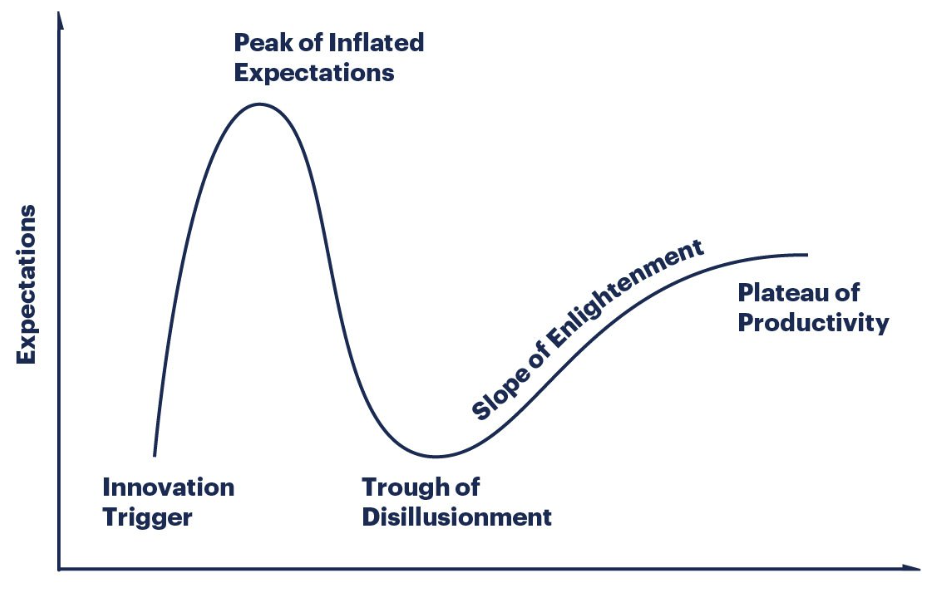
Nevertheless, despite its importance being well understood, blockchain struggles to convince of the necessity of its implementation in healthcare. Thus, with the same velocity as we reached the hype phase, we are now moving towards a phase of bashing and mistrust. The media announce the anticipated end of a technology they qualify as “oversold” and “disappointing”. However, this comes with no surprise to the blockchain community that was expecting to reach the much predictable “Trough of Disillusionment” of the famous Gartner hype cycle.
Blockchain’s Role in Healthcare
So, can blockchain cross the threshold and move towards commercial deployment by the end of 2019?
Beyond large-scale deployment, what early adopters and investors expect is proof of a return on investment. The number of projects with a viable product and market feedback having been particularly low in 2018, many questions remain unanswered. Moreover, according to a recent Forbes article, only 5% to 10% of pilot-phase applications in traditional healthcare companies will go into production in 2019.
A particularly small proportion, which suggests a cautious approach on behalf of healthcare organizations. Indeed, they still poorly understand and anticipate blockchain’s potential business models and the other stakeholders response.
Simultaneously, blockchain startups in the healthcare industry will continue to rise by strengthening their positions on the market and creating new innovative services. Remains the question of the future of startups who have completed an ICO, with more or less difficulty, during a particularly challenging year for the field.
Will they succeed in reaching new milestones, convincing end-users and commercialising adapted products?
Competition promises to be stiff, especially as disparities between regions of the world are growing. Indeed, countries like China, with little communication and a lot of investment, already offer solutions ready to be deployed on a large market.
So in a two-tier ecosystem divided between blockchain’s fervent supporters and its virulent detractors, it may be necessary to take a moment to look back at the reasons that drove the health sector to take an interest in this technology in the first place.
The craze for blockchain in the health sector stems from two observations.
First, it appears clear that the number of major medical and therapeutic innovations is decreasing. Numerous studies agree that the next breakthroughs in healthcare will be on highly specialized mechanisms or rare pathologies with more discrete repercussions on the general population.
At the same time, health innovation is moving to the digital world with more and more tools and services dedicated to healthcare professionals, industry stakeholders or patients. In addition, the rise of value-based care is leading to a data rush with the aim of better anticipating and preventing patient outcomes and thus optimizing patient care. This new health model is highly dependent on institutions’ ability to invest in digital tools to capture, process and analyze data.
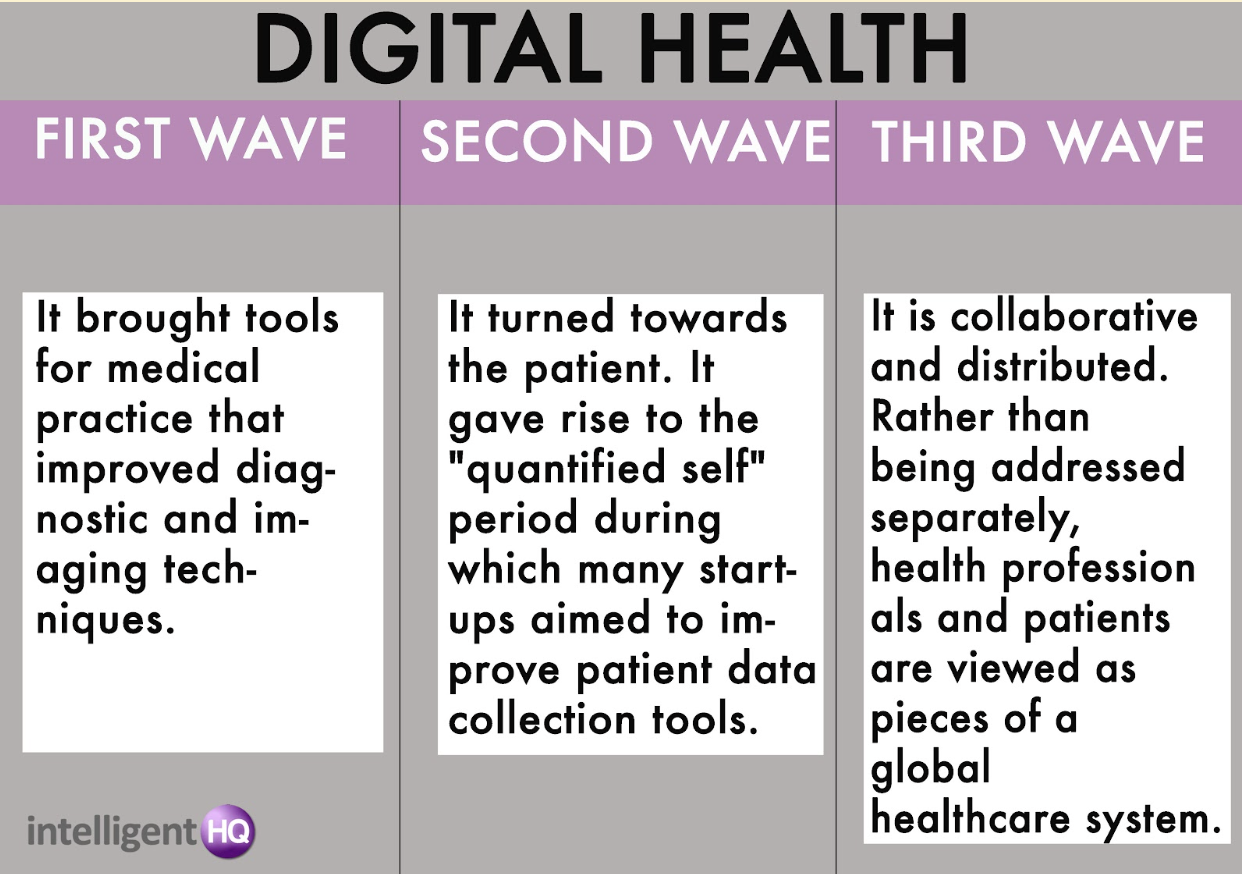
Second, it is possible to distinguish 3 waves in the emergence of digital health. The first wave brought tools for medical practice that improved diagnostic and imaging techniques. At the same time, the first EHR systems, whose interest seemed obvious to all, received a mixed reception due to their complexity of use and their time-consuming nature.
This first wave, resolutely turned towards health professionals, was followed by a second wave turned towards the patient. It gave rise to the “quantified self” period during which many startups aimed to improve patient data collection tools.
Finally, comes the third wave of digital innovation in health: it is collaborative and distributed. Rather than being addressed separately, health professionals and patients are viewed as pieces of a global healthcare system. Innovation is no longer aimed at one target or the other, but rather at the ecosystem as a whole, in which everyone plays a specific role. In it in this system turned towards decentralization that blockchain first emerged.
Blockchain initially seduced by a simple promise: make value transfer over the Internet reliable. Like a notary or a bank, blockchain authenticates information, creating a trust environment between stakeholders with divergent interests. Healthcare organizations quickly sketched out the first use cases: sharing of medical data by moving away from existing silos, transparency of supply chains or even the fight against data manipulation in clinical research.
However, like any emerging technology, blockchain quickly ran into technical or regulatory challenges that slowed its adoption. This has created a gap between the ever-increasing hype and the slower development speed of solutions facing many obstacles. This gap thus gives rise, at this moment, to a period of disillusionment, or rather correction, in order to align, in the future, the enthusiasm and the reality of the field.
2017 was the year in which many consortia, working groups and think tanks were set up to explore blockchain use cases. In 2018, the healthcare industry started experimenting and launched the first pilots. Finally, in 2019, we expect the first commercial successes, based on more mature and constructive exchanges between the different stakeholders of the ecosystem. Nevertheless, patience is required. Blockchain has only just celebrated its 4th birthday in healthcare.

Dinis Guarda is an author, academic, influencer, serial entrepreneur, and leader in 4IR, AI, Fintech, digital transformation, and Blockchain. Dinis has created various companies such as Ztudium tech platform; founder of global digital platform directory businessabc.net; digital transformation platform to empower, guide and index cities citiesabc.com and fashion technology platform fashionabc.org. He is also the publisher of intelligenthq.com, hedgethink.com and tradersdna.com. He has been working with the likes of UN / UNITAR, UNESCO, European Space Agency, Davos WEF, Philips, Saxo Bank, Mastercard, Barclays, and governments all over the world.
With over two decades of experience in international business, C-level positions, and digital transformation, Dinis has worked with new tech, cryptocurrencies, driven ICOs, regulation, compliance, and legal international processes, and has created a bank, and been involved in the inception of some of the top 100 digital currencies.
He creates and helps build ventures focused on global growth, 360 digital strategies, sustainable innovation, Blockchain, Fintech, AI and new emerging business models such as ICOs / tokenomics.
Dinis is the founder/CEO of ztudium that manages blocksdna / lifesdna. These products and platforms offer multiple AI P2P, fintech, blockchain, search engine and PaaS solutions in consumer wellness healthcare and life style with a global team of experts and universities.
He is the founder of coinsdna a new swiss regulated, Swiss based, institutional grade token and cryptocurrencies blockchain exchange. He is founder of DragonBloc a blockchain, AI, Fintech fund and co-founder of Freedomee project.
Dinis is the author of various books. He has published different books such “4IR AI Blockchain Fintech IoT Reinventing a Nation”, “How Businesses and Governments can Prosper with Fintech, Blockchain and AI?”, also the bigger case study and book (400 pages) “Blockchain, AI and Crypto Economics – The Next Tsunami?” last the “Tokenomics and ICOs – How to be good at the new digital world of finance / Crypto” was launched in 2018.
Some of the companies Dinis created or has been involved have reached over 1 USD billions in valuation. Dinis has advised and was responsible for some top financial organisations, 100 cryptocurrencies worldwide and Fortune 500 companies.
Dinis is involved as a strategist, board member and advisor with the payments, lifestyle, blockchain reward community app Glance technologies, for whom he built the blockchain messaging / payment / loyalty software Blockimpact, the seminal Hyperloop Transportations project, Kora, and blockchain cybersecurity Privus.
He is listed in various global fintech, blockchain, AI, social media industry top lists as an influencer in position top 10/20 within 100 rankings: such as Top People In Blockchain | Cointelegraph https://top.cointelegraph.com/ and https://cryptoweekly.co/100/ .
Between 2014 and 2015 he was involved in creating a fabbanking.com a digital bank between Asia and Africa as Chief Commercial Officer and Marketing Officer responsible for all legal, tech and business development. Between 2009 and 2010 he was the founder of one of the world first fintech, social trading platforms tradingfloor.com for Saxo Bank.
He is a shareholder of the fintech social money transfer app Moneymailme and math edutech gamification children’s app Gozoa.
He has been a lecturer at Copenhagen Business School, Groupe INSEEC/Monaco University and other leading world universities.