
More than 75% of internet users prefer content in their native language, yet most organisations still rely on slow, fragmented translation workflows. As global content volumes explode and the AI translation market grows at over 20% annually, the AI-powered translator like SmartCat is no longer a support tool, it’s becoming essential infrastructure for scaling, speed, and consistent global communication.
Global content is growing at an unprecedented pace. More than 75% of internet users now prefer to consume content in their native language, and companies that localise content properly can see up to 40% higher conversion rates compared to those that do not.
At the same time, organisations are producing more content than ever before, across websites, videos, training platforms, apps, and internal systems, creating pressure that traditional translation models can no longer handle efficiently.
AI-powered translators are no longer simply an added benefit to businesses but a fundamental operational requirement of doing business globally. The Global AI Translation Market is expected to grow by over 20% per year owing to the demands for faster delivery, lower costs, and to provide continuity of communications in a consistent manner across all borders.
Businesses are no longer debating whether or not they should utilise AI tools for localisation, but are now more concerned about how quickly they can implement AI into their overall system.
AI-powered Translators have crossed a line that defines their importance to international teams. What previously could be classified as a ‘nice to have’ feature is now considered infrastructure necessary for companies that operate internationally. Today, AI-powered translators can support over 100 languages, translate content in various file formats, have the capability to work collaboratively with human experts and also have the ability to continuously learn and adapt based on the unique characteristics of an organisation’s brand.
Platforms such as Smartcat demonstrate how this necessity for advanced technologies has created new ways of managing the localisation of a company’s content. Rather than being a laborious manual process, it is now an ever-present scalable process that allows businesses to continue to grow while decreasing the impact of localisation delays on their growth.
From Manual Translation to Always-On Global Content
For many years, multilingual content workflows were slow and fragmented. Translating content meant long email chains with agencies, multiple disconnected tools, and timelines that stretched into weeks. Every new language added friction. Every update meant starting again.
Today, that model no longer works.
A modern AI-powered translator can translate content into hundreds of languages in minutes, turning localisation into an always-on capability rather than a bottleneck. Global organisations now expect to launch campaigns, training programmes, and product updates in multiple languages at the same time, not one market after another.
AI translation dramatically reduces turnaround times while maintaining quality, particularly when paired with human review. Smartcat extends this further by offering AI agents that plug directly into existing workflows. Teams can upload content, select language pairs, and receive ready-to-use translations without leaving their core tools. The AI-powered translator becomes embedded in daily operations rather than sitting on the sidelines.
Why an AI-Powered Translator Is Now Essential
Within Smartcat, intelligent AI agents select the most suitable neural engine for each language pair and refine their output with every project. Over time, translation accuracy moves closer to human quality while costs remain predictable.
The AI-powered translator has become essential because it solves three problems at once: speed, scale, and consistency.
- Speed: AI-powered translators can process thousands of words in seconds. Product pages, internal communications, support documentation, and marketing assets can be translated almost instantly. This removes delays that once slowed global launches and internal alignment.
- Scale: Smartcat supports more than 280 languages and over 50 file formats. A single AI-powered translator can handle documents, websites, videos, images, and software from one central platform. This level of scale is impossible to achieve efficiently with manual-only workflows.
- Consistency: By learning from glossaries, translation memories, and user edits, an AI-powered translator maintains tone, terminology, and brand voice across markets. Instead of fragmented translations from different vendors or teams, organisations gain a unified linguistic identity.
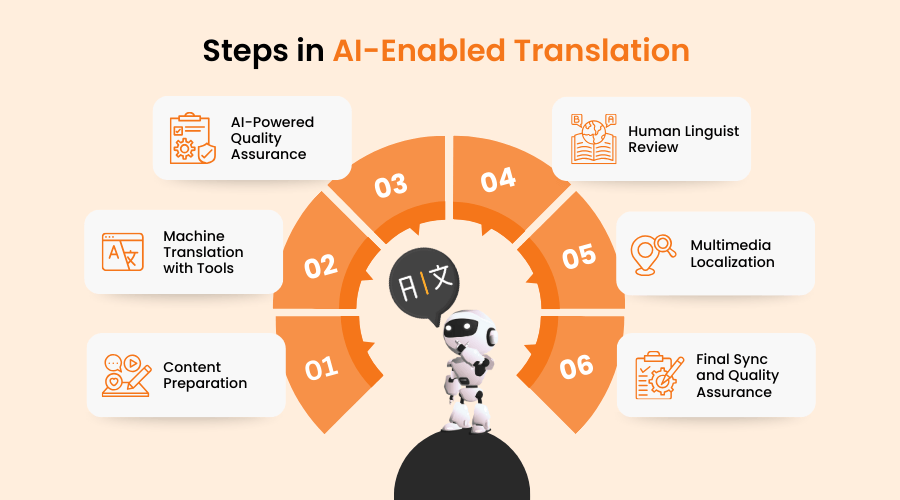
How Smartcat’s AI-Powered Translator Works
Smartcat is not a single machine translation button. It is a full AI translation platform built around expert-enabled AI agents. Each AI-powered translator on the platform is designed to perform a specific role while learning continuously from human feedback.
Adaptive AI Translation Engine
Smartcat’s AI translation software automatically chooses the most effective algorithm for each language pair. Instead of relying on one generic model, the AI-powered translator adapts based on language complexity, domain, and context.
As users review and edit content, the system learns. Translation memories, glossaries, and institutional knowledge are incorporated into future projects, ensuring that each translation is more accurate and more aligned than the last.
When combined with neural networks and professional post-editing, translation accuracy can reach very high levels, even for complex or technical content.
A Library of Specialised AI Agents
Rather than using a one-size-fits-all approach, Smartcat offers a library of specialised AI agents. Each agent acts as a focused AI-powered translator for a specific content type.
Document Translation agents handle multi-format documents with precision while preserving layout. Media Translation agents manage video, audio, and image translation, including subtitles, dubbing, and in-image text replacement.
Website and Software Localisation agents translate live sites and applications while maintaining SEO structure, user experience, and product copy consistency.
This modular approach allows organisations to deploy the right AI-powered translator for each task without changing platforms.
Human-in-the-Loop Workflows
Smartcat is built around collaboration between AI and humans. The platform integrates review and feedback directly into the workflow, ensuring that human expertise remains central.
More than 500,000 professional linguists and subject-matter experts are available through the Smartcat Marketplace. These experts can review, refine, and approve AI-generated translations directly in the platform.
This hybrid model ensures that every AI-powered translator delivers speed without sacrificing quality, especially for regulated, technical, or brand-sensitive content.
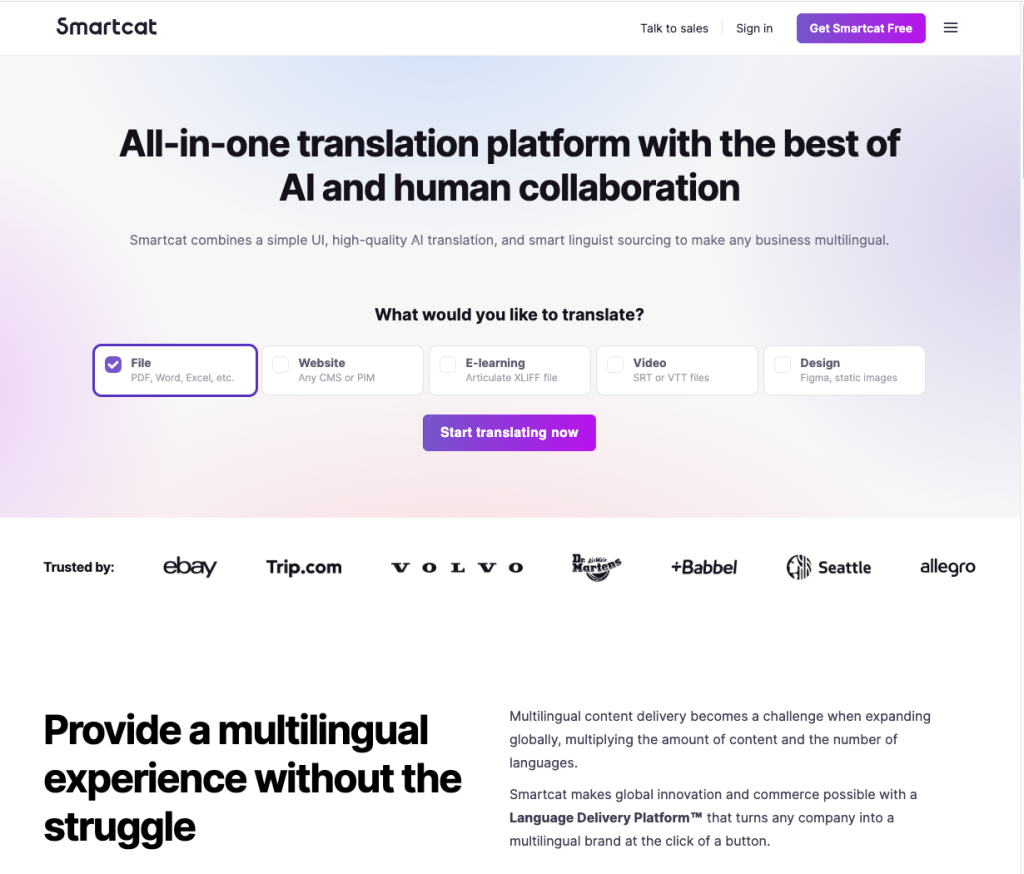
A Single AI-Powered Translator for Every Format
Modern organisations rarely work with just Word documents. They manage SCORM files, MP4 videos, slide decks, help centres, applications, and landing pages. An AI-powered translator that handles all formats is no longer a luxury; it is essential.
Documents and Files
Smartcat supports over 50 file formats, including PDFs, DOCX, JPG, MP4, MOV, and SCORM packages. The AI-powered translator preserves layouts while updating text, eliminating hours of manual reformatting and desktop publishing.
Media and Visual Content
Video Translation agents generate subtitles and AI-driven dubbing in more than 280 languages, making training, marketing, and product videos globally accessible.
Image Translation agents detect and replace text within images while maintaining the original design.
Websites, Software, and Courses
Website Translation agents localise entire sites while maintaining SEO integrity and user experience.
Software Localisation agents allow product teams to develop and translate in parallel, removing localisation as a release bottleneck.
Course Creator and Content Generator agents enable teams to build and localise learning content and multilingual assets in minutes.
Business Impact: Cost, Quality, and Growth
The reason the AI-powered translator is becoming essential is simple: it changes the economics of global content.
Lower Translation Costs
AI translation reduces manual effort by automating repetitive work. Human expertise is reserved for high-impact content rather than routine tasks. By reusing translation memories and institutional knowledge, organisations see meaningful cost savings.
Smartcat customers report improved translation spend efficiency and noticeable reductions in expenses through AI-driven reuse and automation.
Faster Time to Market
When every campaign, feature, and policy needs to be multilingual, speed becomes a competitive advantage. An AI-powered translator allows teams to publish in multiple languages almost simultaneously instead of rolling out market by market.
Smartcat’s integrations with CMS platforms and content systems further reduce delays by keeping workflows connected.
Consistent, On-Brand Quality
Without a unified AI-powered translator, terminology and tone can drift across regions and teams. Smartcat’s AI agents apply shared glossaries, style guides, and translation memories across all projects.
By learning continuously from existing content libraries—blogs, product documentation, and eLearning materials—each translation becomes more aligned with brand voice and messaging.
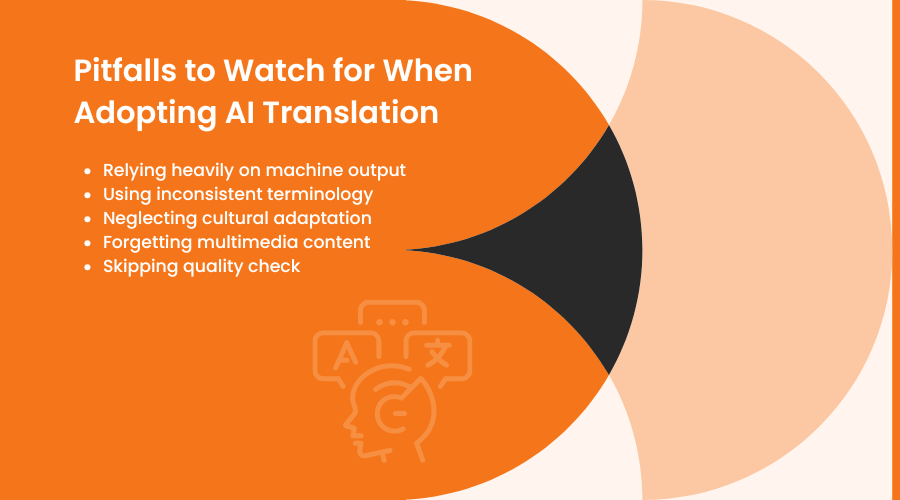
Human + AI: The New Translation Standard
Another reason the AI-powered translator is now essential is that it does not replace humans. It elevates them.
AI handles high-volume, repetitive tasks. Humans focus on nuance, clarity, and strategic messaging. Hybrid AI–human workflows consistently outperform AI-only or human-only approaches in both speed and quality.
Smartcat embeds this collaboration directly into the platform. The AI-powered translator delivers the first draft, while editors refine and approve content in the same environment. Their feedback feeds back into the system, making future translations smarter and more context-aware.
Security, Governance, and Compliance
For enterprise teams, translation is also about trust. A modern AI-powered translator must meet strict security and governance requirements.
Enterprise-grade platforms use encryption, access controls, and recognised compliance frameworks to protect sensitive content. Smartcat is SOC 2 compliant and applies end-to-end encryption for data in transit and at rest.
This makes the AI-powered translator suitable for legal documents, HR policies, internal training, and regulated content that cannot be handled by consumer-grade tools.
Collaboration Across the Organisation
The real value of an AI-powered translator emerges when multiple departments share one platform.
Marketing and Sales teams can translate campaigns and landing pages into hundreds of languages.
Learning and Development teams can roll out multilingual training without external delays. Product teams can ship globally by localising UX and support content alongside development.
Localisation managers gain a central view of quality, spend, and performance.
Smartcat’s AI agents support this collaboration by ensuring every team works from the same translation memories and glossaries. Every AI-powered translator output becomes more informed, consistent, and valuable.
Why Now Is the Time to Adopt
Given the pace of globalisation and the explosion of content formats, manual-only translation is no longer sustainable. Organisations that succeed will treat their AI-powered translator as core infrastructure, not a side tool.
With Smartcat, teams can start with a free trial, upload content across formats, and let AI agents handle first drafts and multi-language output. Human review can be added where needed without slowing delivery.
In a world where content must cross borders instantly, the AI-powered translator is no longer optional. It is the backbone of modern global communication—automating the heavy lifting, amplifying human expertise, and ensuring every message sounds exactly like your brand, in every language.

Pallavi Singal is the Vice President of Content at ztudium, where she leads innovative content strategies and oversees the development of high-impact editorial initiatives. With a strong background in digital media and a passion for storytelling, Pallavi plays a pivotal role in scaling the content operations for ztudium’s platforms, including Businessabc, Citiesabc, and IntelligentHQ, Wisdomia.ai, MStores, and many others. Her expertise spans content creation, SEO, and digital marketing, driving engagement and growth across multiple channels. Pallavi’s work is characterised by a keen insight into emerging trends in business, technologies like AI, blockchain, metaverse and others, and society, making her a trusted voice in the industry.










