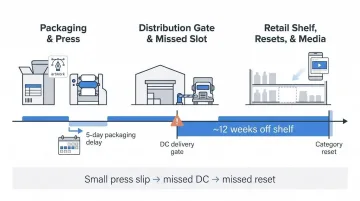
When packaging slips by even five days, the truck misses its slot and your product’s on-shelf date evaporates. Media spend still fires, shelves stay empty, and margin burns.
Gartner reports that 45 percent of product launches arrive at least a month late. Five lost factory days can snowball into twelve empty weeks on shelf.
This piece traces that ticking clock and shows how to keep it on time.
Creative and governance swirl
The press run seldom wrecks the schedule; email does.
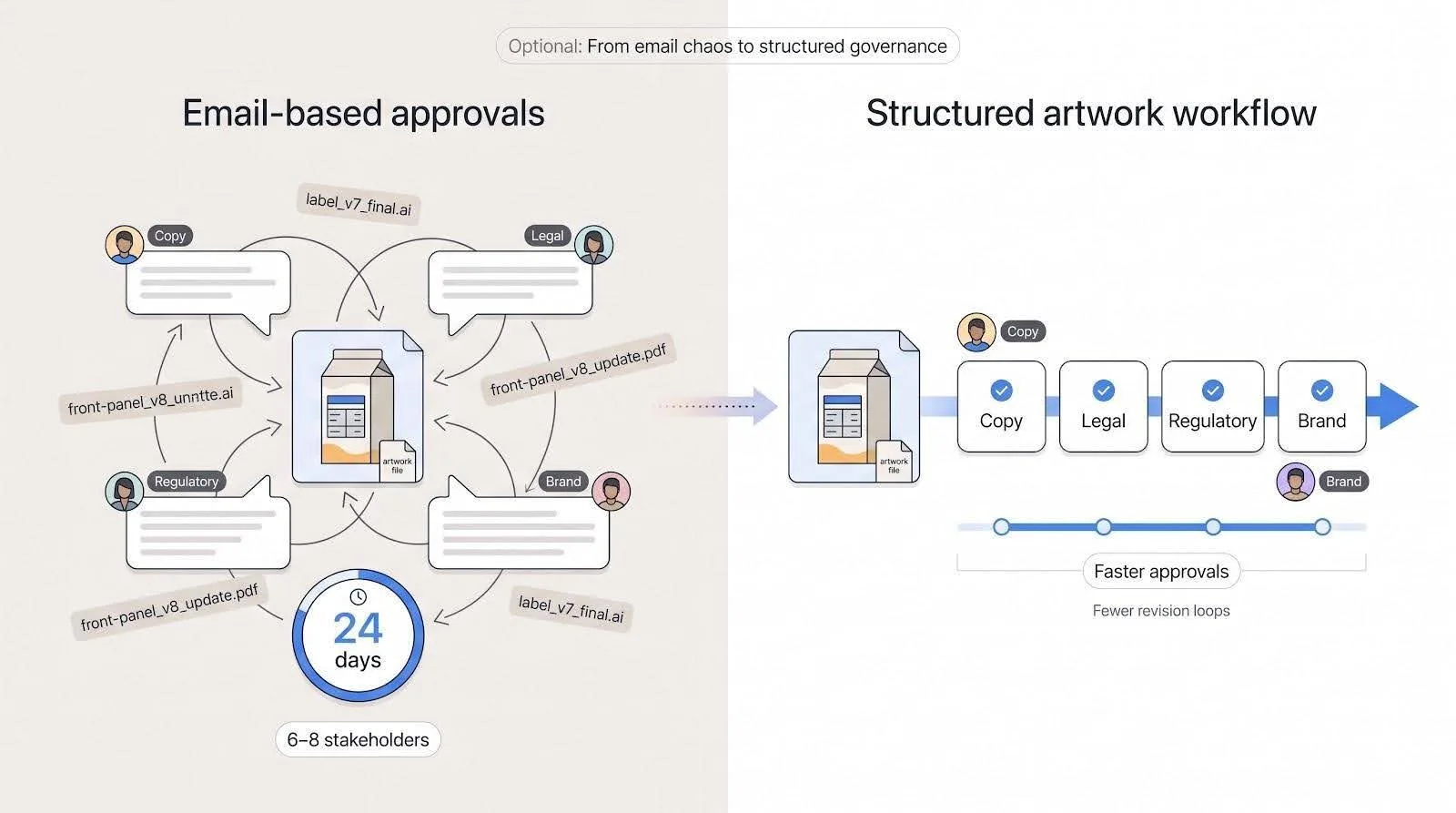
Packaging artwork pinballs among copy, legal, regulatory, and brand. Each tweak restarts the proof. Cway’s 2026 benchmark puts the average artwork-approval cycle at 24 calendar days with 6.8 stakeholders, and each extra revision round adds about 2.3 days. Run it over email and the average stretches to about 32 days, against 18 for a structured workflow.
Zenpack says its plug-and-play dieline frameworks reduce new product launch timelines “from months to days,” and it backs that with guaranteed launch deadlines: a backwards-planned critical path with lock dates for structural design, colour-material-finish approvals, factory tooling, and transit drop validation, plus a Golden Sample sign-off before mass production.
For brand teams, that discipline removes days of email ping-pong and protects the reserved press slot, a template worth copying even if you still print elsewhere.
This isn’t incompetence; it’s governance by committee. When claims, artwork, and compliance spin in circles, packaging drifts to the end of the timeline, right where risk peaks.
Engineering and compatibility chaos
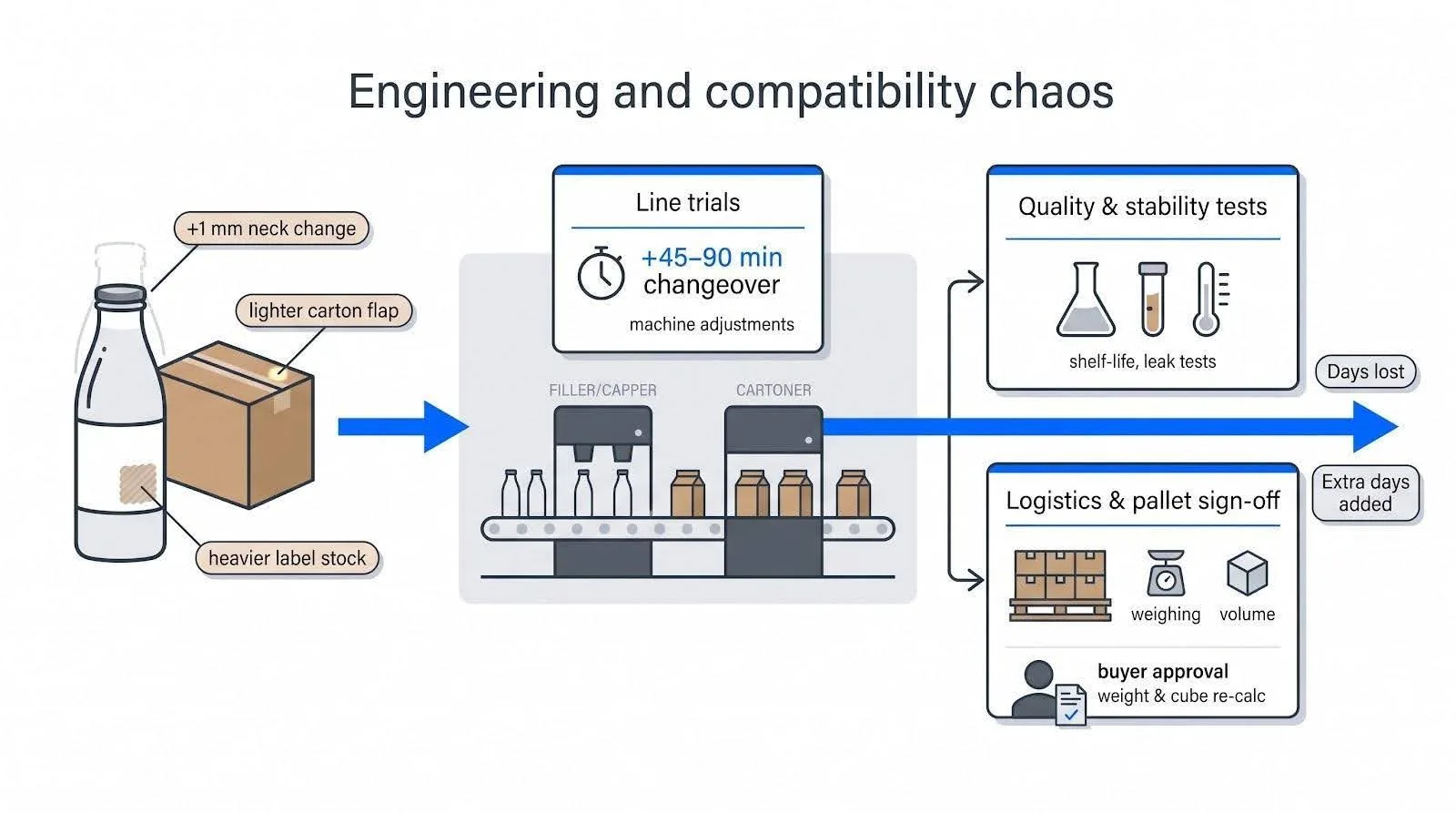
Packaging isn’t wallpaper; it belongs to the machine. A 1 mm neck tweak can require a new cap-torque spec, and a lighter carton flap can fail a drop test the retailer already approved.
Each adjustment kicks off a chain reaction:
- Line trials. Without a standardised procedure, one format change can add 45–90 minutes of change-over time on an FMCG line, according to iFactory’s SMED checklist.
- Quality and stability. New components need fresh shelf-life or leak tests.
- Logistics math. Heavier label stock shifts pallet weight and cube, so the buyer must sign again.
Every extra sign-off steals days you can’t spare. A tweak that saves pennies can shove the launch past a fixed retail gate, and that gate rarely opens again until the next reset.
Materials and capacity pinch
The pandemic crunch has eased for standard substrates, but pockets of pain remain. Specialty paper label liners and high-barrier films still carry longer lead times than commodity grades, and custom or printed packaging typically needs 8–12 weeks, so a late tweak can move the next open window past your target.
Why? Specialty lines run fewer shifts and fill quickly. Add a trade-show surge or holiday push, and that next slot may sit one or two retail resets, roughly 8 to 16 weeks, beyond your date.
Your printer can crank out a plain white B-flute shipper over a weekend, but no one can produce custom foil board or a compostable zipper overnight. That last-minute change to embossing or barrier film isn’t a bet on price; it’s a bet on time, and time keeps the house edge.
Regulation and retailer setup tripwires
Lawmakers and retailers keep their own clocks, and they never reset.
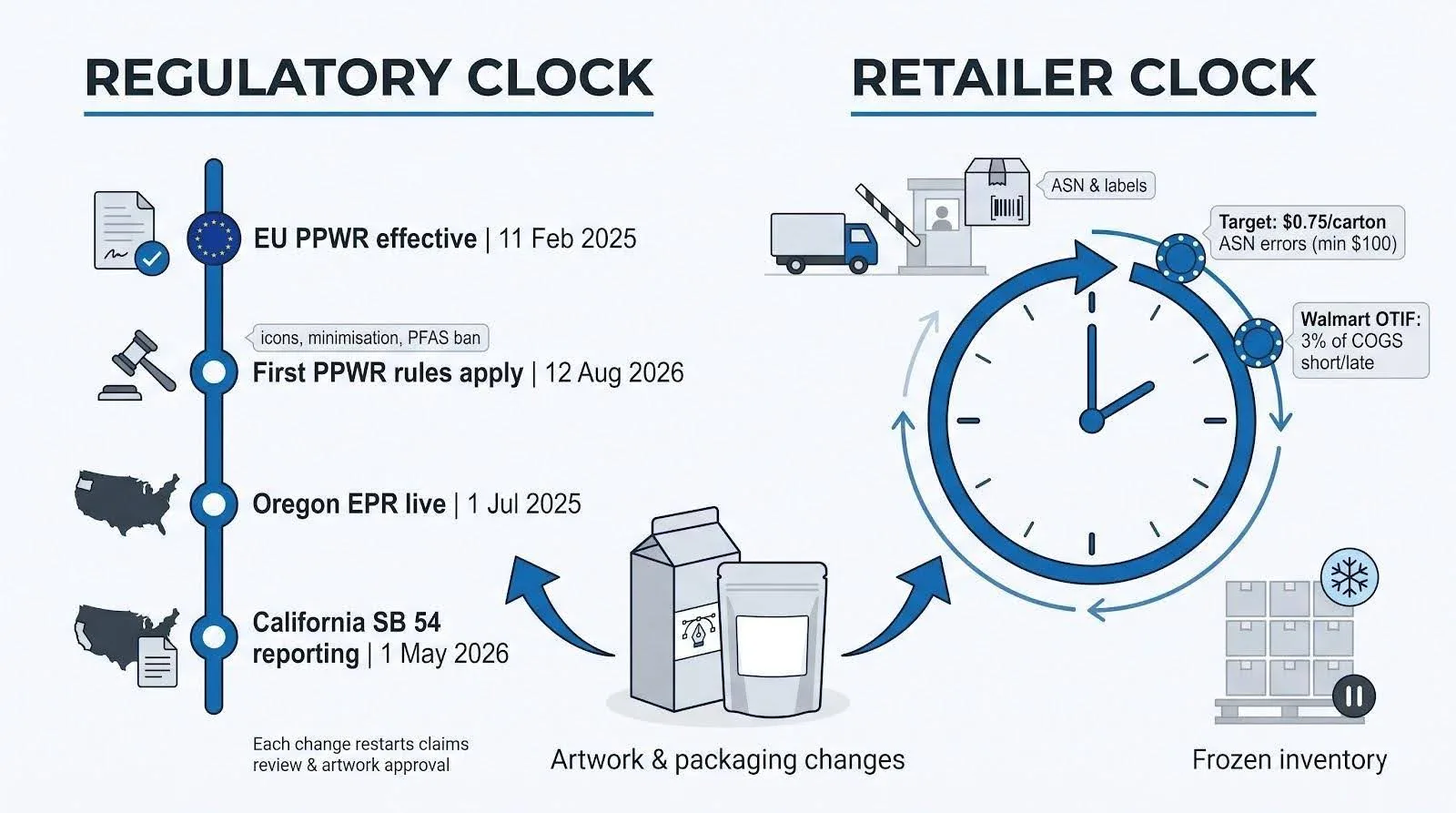
Regulatory clock
- European Union. The Packaging and Packaging Waste Regulation entered into force on 11 February 2025, and its obligations, from recyclability and minimisation requirements to PFAS limits in food-contact packaging, apply from 12 August 2026.
- United States. Oregon’s packaging extended-producer-responsibility programme began charging producer fees on 1 July 2025. California approved its permanent SB 54 regulations on 1 May 2026, so its reporting fields are now fixed.
Each new symbol or substrate change restarts claims review and artwork approval, time you may not have.
Retailer clock
One transposed GTIN or missing case-label count stops the truck at the guard shack. According to a vendor-compliance guide from the logistics firm Warp, Target lists a USD 0.75 per-carton penalty for ASN errors (USD 100 minimum) and Walmart’s OTIF program withholds 3 percent of COGS on short or late units. Fixes often require relabeling in a third-party warehouse while the on-time, in-full clock keeps ticking.
What actually happens once the clock runs out
Miss the packaging gate, and the dominoes fall, each with its own price tag.
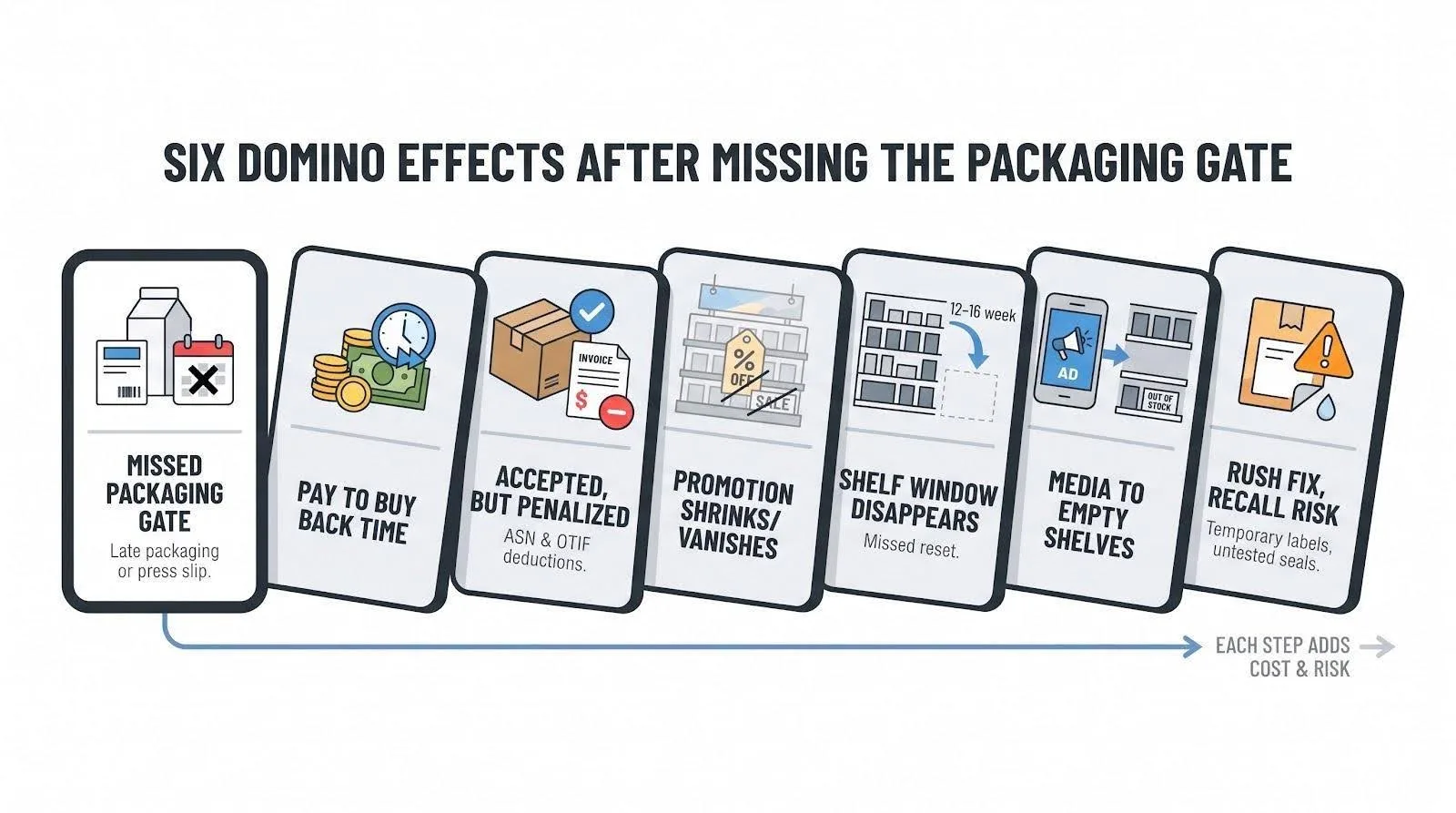
You pay to buy back time
The reflex move is to throw money at the clock.
- Weekend press run. Overtime on a narrow-web press adds a rush premium on top of the normal run rate.
- Ocean to air. Spot air freight runs at a multiple of the per-kilogram ocean rate; one 2026 shipping-cost guide from Suaid Global put mid-2026 air at USD 2.50 to USD 8.50 per kilogram, roughly four to eight times ocean.
- Hot-shot trucking. Same-day “hot shots” bill a multiple of a scheduled truck-load rate.
You often pay anyway because the alternative is worse: miss the gate, lose the on-shelf date, strand the media plan, and erode buyer trust. The real equation is margin saved tomorrow versus dollars burned tonight, and many teams calculate it only when wires are flying at midnight.
Set aside a rush budget if possible. If not, know the break-even: expedite costs make sense only when incremental gross profit plus preserved retail media exceed the bill.
The promotion gets cancelled or shortened
Retail promotions run on strict choreography: banners print, circulars lock, endcaps ship assembled, all on the belief that inventory waits backstage.
A rule written in ink: Utah’s Department of Alcoholic Beverage Services (DABS) requires, in its 2026 Vendor Partnership Manual, that inventory for a one-month “SPA” price promotion land in its warehouse by the 15th of the previous month. Miss the date and the SPA may be cancelled, with repeat offenders losing future slots.
Big-box retailers follow the same logic: arrive late and they pull endcaps, strip TPR tags, or slide a rival’s pallet into the space. The marketing dollars you already committed now advertise a deal no shopper can find.
The shelf window disappears
Planogram resets move like tides. Arrive days late and the fixture plan is already printed, peg hooks labelled, and the space awarded to the runner-up. Best case, you debut in half the stores or in a test bay behind a seasonal display. Worst case, you wait for the next review, often a full quarter, while the story you pitched last spring goes stale and competitors leapfrog your claims.
The media launches into an availability gap
Ads keep perfect time, but inventory does not.
The campaign fires. Retail media drives clicks to empty shelves, influencers unbox a product no one can buy, and paid social targets ZIP codes where the DC still waits for labels. ShoppingIQ’s 2025 audit of 500 global brands found that 5–12 percent of retail-media budgets are wasted on ads for out-of-stock products.
Analytics crater: conversion drops, CPA spikes, and performance marketers tweak audiences in a fog, unaware the problem is physical, not creative. You can pause placements, but that burns reserved inventory and strains partner relationships. Worse, shoppers learn the item is missing and ignore future messages even after stock arrives.
The rush fix becomes a recall risk
Cornered by the calendar, you may reach for shortcuts: slap a temporary label on a stock jar, skip a validation round, promise to “swap in the real package” after launch.
It feels heroic; lines keep running, trucks keep rolling, and the shelf date looks safe, until new fires spark:
- Label adhesive fails in the cold chain.
- Barcode prints too small for scanners, forcing manual intervention.
- Foil seal delaminates and leaks concentrate down the shipper.
Any one of these issues can trigger a formal recall. In July 2025, Mondelēz recalled four carton sizes of RITZ Peanut Butter Cracker Sandwiches over a film-packaging error, pulling nationwide inventory and prompting customer notices.
Quality teams say it plainly: shortcuts turn a schedule problem into a safety problem. Buyers forgive late more easily than unsafe.
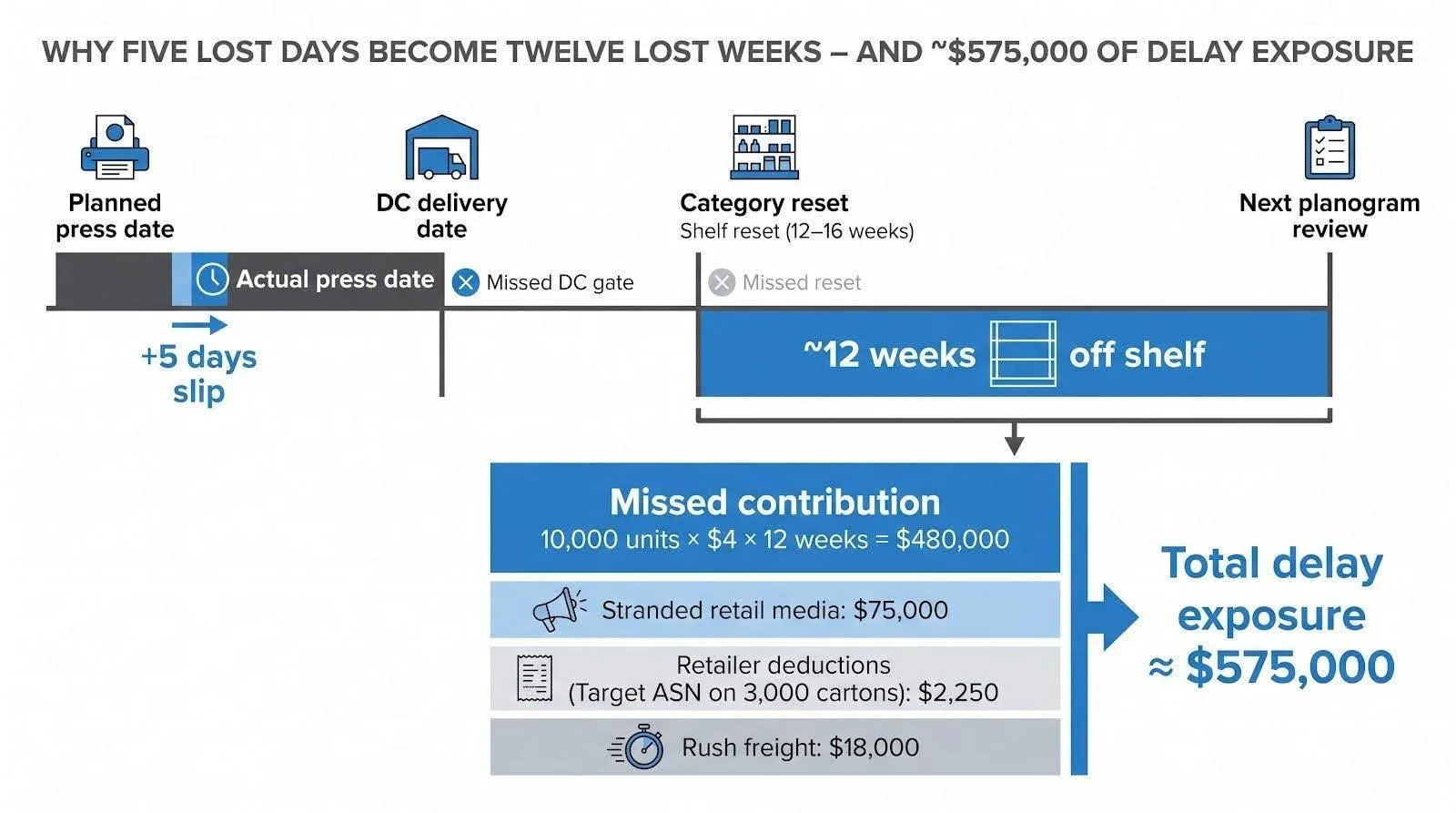
Why five lost days become twelve lost weeks
Time in retail moves in steps, not slopes.
On the plant floor, a five-day press slip feels small. On the commercial calendar it can break three hard gates in a row:
- Miss the DC date → truck misses the reset.
- Miss the reset → item waits for the next planogram review.
- Next review = 12–16 weeks for many grocery and mass-channel categories, based on published retailer reset calendars.
Those lost days don’t add; they multiply every time they cross a fixed gate.
The stakes are real: research cited in an OpInc analysis shows that a product forecast to reach peak sales of USD 100 million can lose USD 17 million in lifetime revenue if the launch slips by two months.
Finance sizes the damage like this:
Delay exposure = (units × contribution margin × weeks off-shelf)
+ stranded media spend
+ retailer deductions
+ expedite or rework cost
+ holding or markdown loss
Sample math:
- 10,000 units × USD 4 margin × 12 weeks = USD 480,000 missed contribution.
- Stranded retail media = USD 75,000.
- Target ASN deductions on 3,000 cartons = USD 2,250.
- Rush freight already spent = USD 18,000.
Total delay exposure lands around USD 575,000, all because the press slipped by five days.
Packaging timing isn’t an operations chore; it is the fuse on the entire launch P&L.
Conclusion
Packaging deadlines may look like small milestones, but each missed date compounds across regulatory, retailer, and marketing calendars. Protect the schedule, or plan for the true cost that five days can trigger: margin lost, media stranded, and trust eroded.