Researchers widely agree on one key point: IQ does not peak at a single age. Instead, different cognitive abilities reach their highest levels at different stages of life. Some abilities peak early, such as processing speed, while others—like vocabulary and reasoning built from experience—continue improving well into later adulthood.
1. Fluid and Crystallized Intelligence Peak at Different Times
Modern psychology divides intelligence into two major areas:
- Fluid intelligence, which refers to mental speed, abstract reasoning, and the ability to solve new problems.
- Crystallized intelligence, which represents accumulated knowledge, vocabulary, and skills gained from experience.
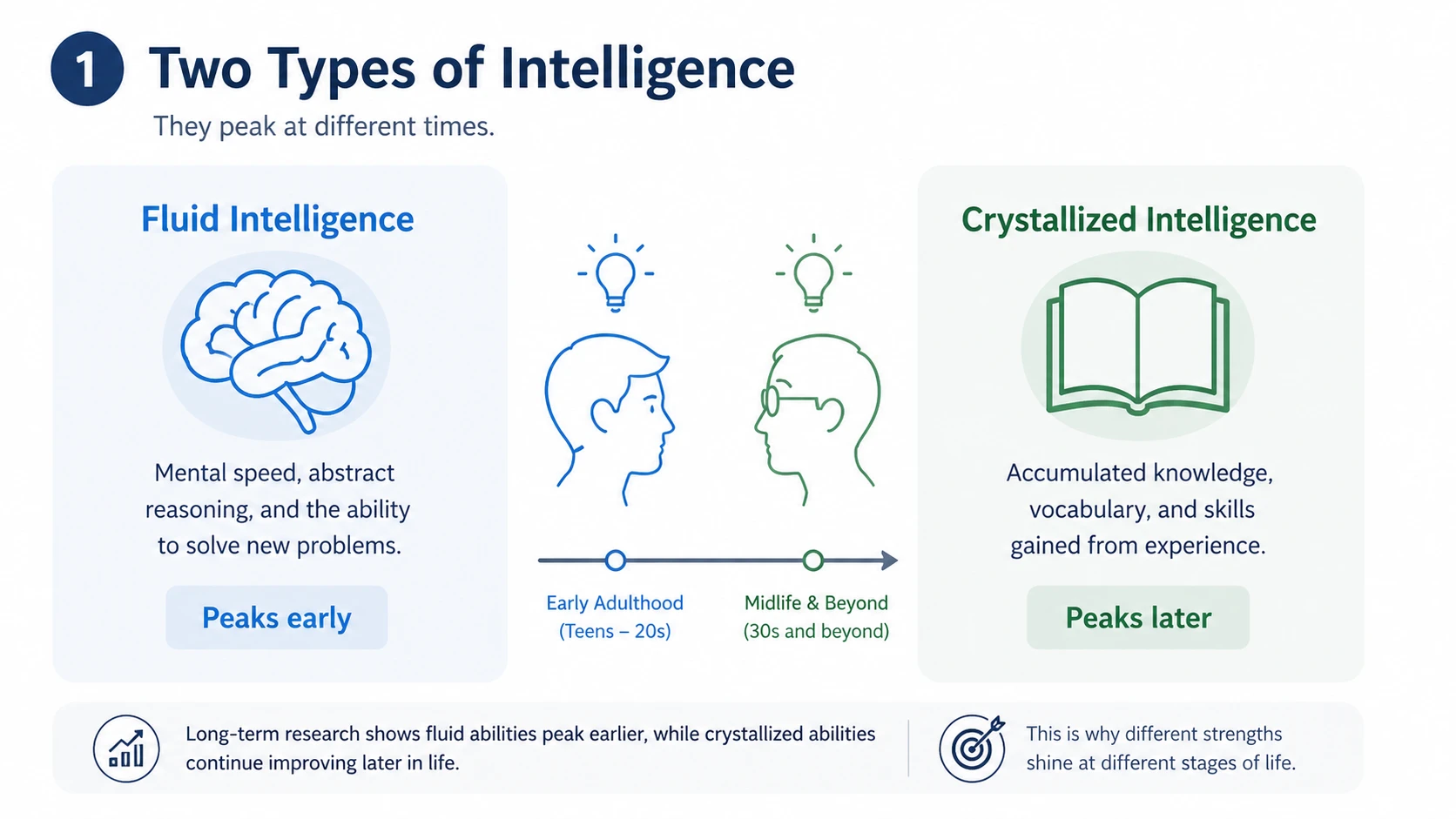
Long-term data shows that fluid abilities typically peak earlier in life, while crystallized abilities peak later. This distinction helps explain why younger adults tend to excel at rapid problem-solving, whereas middle-aged and older adults often outperform younger people in tasks involving knowledge and verbal reasoning.
This pattern is illustrated in the age breakdown of cognitive performance presented in the “Average IQ by Age analysis” by WorldIQTest.com, which shows that different components of IQ reach their high points during different decades of life.
2. Research Findings on When Different Skills Peak
Processing Speed Peaks First
A major study highlighted by the Association for Psychological Science found that processing speed—the fastest and most energy-intensive mental skill—peaks around the late teens to early 20s. The article “Cognitive Skills Peak at Different Ages Across Adulthood” emphasizes that tasks requiring quick reactions and fast mental calculations tend to decline gradually after these early years.
Working Memory Peaks in Young Adulthood
Short-term working memory typically strengthens through the early 20s and stays relatively stable into the 30s. As noted in the cognitive science overview “At What Age Is Your Brain the Sharpest?” by Verywell Mind, working memory often begins to decline in the mid-30s or early 40s, though lifestyle and cognitive engagement can slow this process significantly (source: Verywell Mind).
Verbal and Knowledge-Based Skills Peak Later
In contrast, vocabulary, general knowledge, and verbal reasoning often continue improving into the 40s, 50s, or even 60s. This aligns with findings from Harvard Health Publishing, which explains that while some brain functions slow with age, others—such as pattern recognition and the ability to integrate information—actually strengthen with decades of accumulated experience (source: Harvard Health Publishing, “How Memory and Thinking Ability Change With Age”).
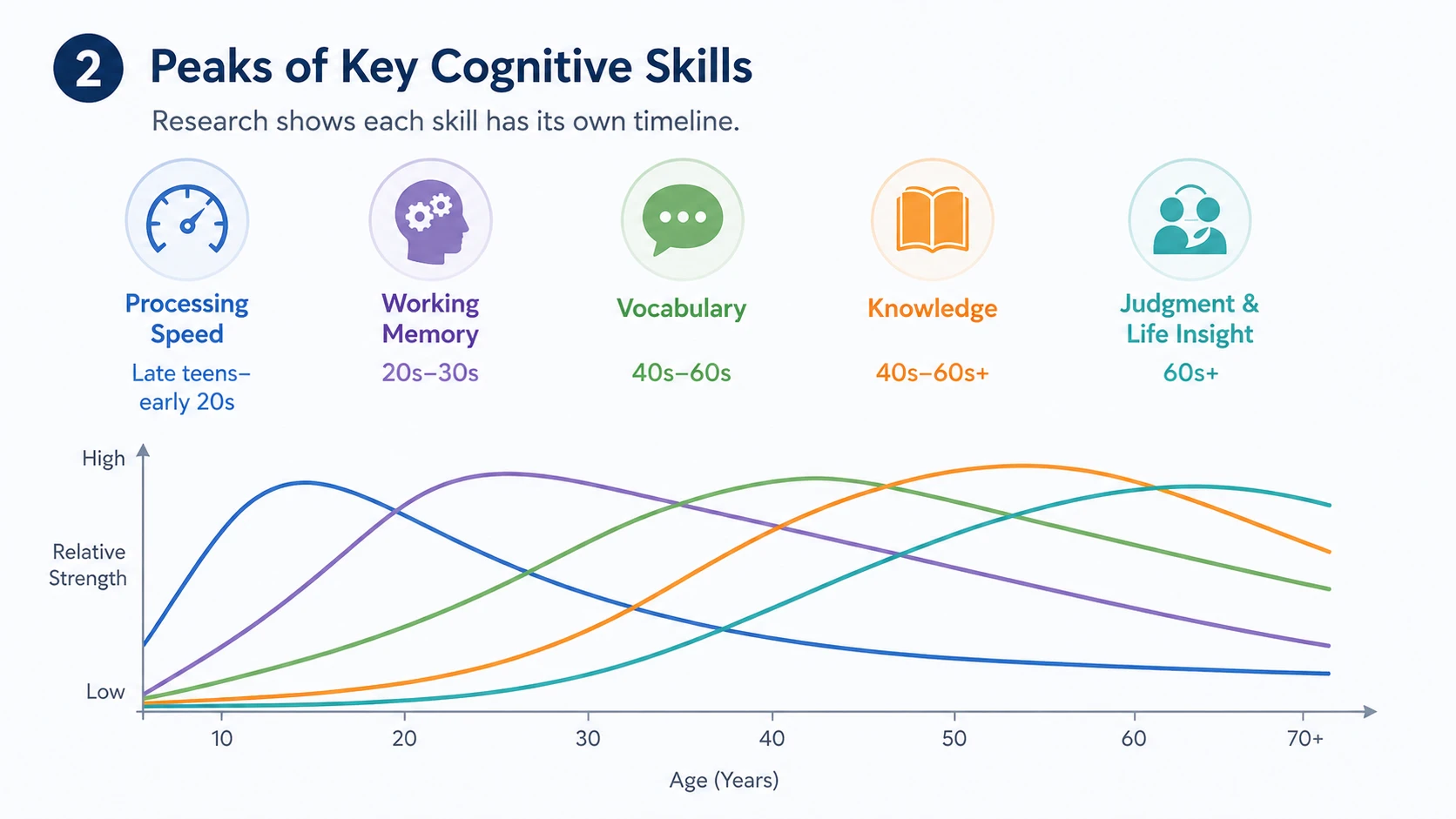
3. A Simple Breakdown of Cognitive Peaks by Age
These averages vary widely among individuals. Genetics play a role, but so do sleep, education, physical activity, emotional well-being, and daily intellectual habits.
- During the late teens through the 20s, people tend to demonstrate their fastest processing speed and strongest fluid reasoning abilities. These years are often considered the peak for mental quickness and rapid problem-solving.
- In the 20s and 30s, working memory is typically at its strongest. This period is ideal for learning new complex skills, absorbing large amounts of information, and handling demanding cognitive tasks that require holding and manipulating data in the mind.
- From the 40s into the 60s, vocabulary, general knowledge, and verbal reasoning tend to reach their highest levels. Experience, long-term learning, and accumulated understanding contribute to significant strengths in language, communication, and expert-level judgment.
- By the 60s and beyond, many individuals show notable strengths in emotional insight, life-pattern recognition, and big-picture thinking. While certain mental processes may slow, older adults often excel at decision-making informed by decades of experience.
4. Why There Is No Single “IQ Peak”
An IQ score is a composite of many sub-skills. Because each sub-skill ages differently, IQ cannot meaningfully be said to peak at one age.
For example:
- A 20-year-old may have top-tier processing speed
- A 45-year-old may have the strongest vocabulary of their life
- A 65-year-old may show exceptional judgment and pattern recognition from experience
As research consistently shows across multiple sources, intelligence is not a simple curve—it is a collection of curves, each with its own trajectory.
5. What This Means for Learners and Educators
For students, adults, and lifelong learners, this research offers an encouraging conclusion:
Every stage of life has cognitive strengths.
- Young adults excel at rapid learning and novel problem-solving.
- Midlife adults excel at complex reasoning and accumulated expertise.
- Older adults excel at big-picture thinking and emotional understanding.
No matter your age, there are meaningful cognitive abilities at their peak.