Is your enterprise email platform costing you customers? With 70% of users unsubscribing from irrelevant emails, the stakes have never been higher. Here are the top 5 platforms of 2025, revealing who leads in AI-powered personalisation, deliverability, and pure ROI.
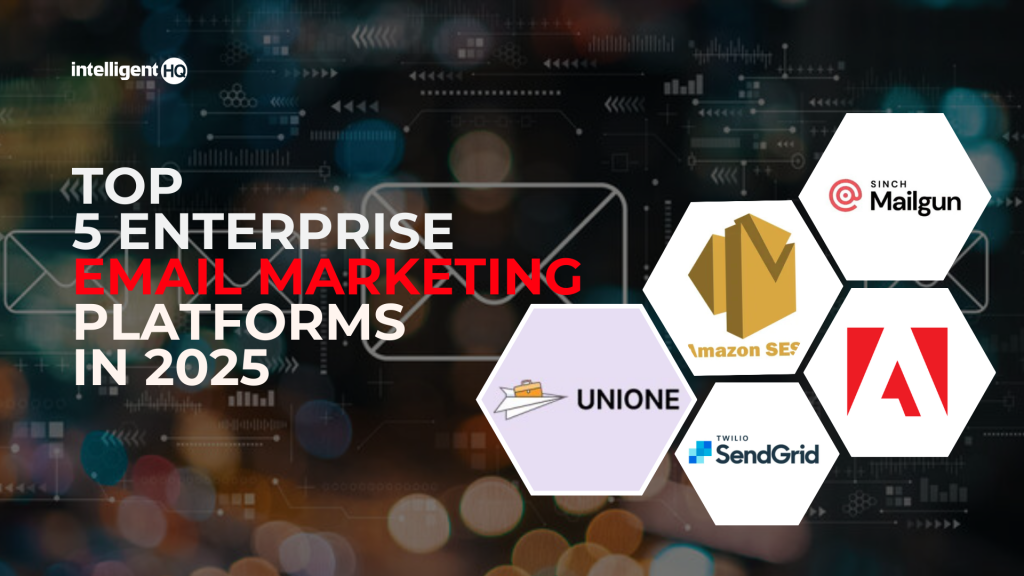
Email isn’t just a tool; it’s the foundation for countless customer relationships. Whether you’re managing transactional emails, customer marketing campaigns, or system alerts, a robust enterprise email platform can make or break your business communication.
But with so many options on the market, it’s easy to feel lost in the sea of promises of lightning-fast delivery, rock-solid security, and unbeatable analytics.
According to Statista, over 306 billion emails are sent daily worldwide, with transactional emails accounting for about 15% of this total. In the context of e-commerce alone, 42% of brands say email is their most profitable channel. But with great volume comes great responsibility.
A poorly timed email can cost companies both reputation and revenue, as 42% of email users will delete an email if it takes longer than 3 seconds to load. Additionally, 70% of consumers state that they would unsubscribe from an email list after receiving too many irrelevant messages.
This is why choosing the right enterprise email marketing platform can make or break your marketing campaigns, especially when balancing transaction-heavy and marketing-focused emails. Understanding which platform performs under high loads, offers reliable deliverability, and remains cost-effective at scale is more crucial than ever.
The Platform Showdown
Below, we step through each contender. Think of it as speed-dating with substance.
1. UniOne
Who it’s for: Email for startups, SMBs, and growing companies needing reliable email marketing platform with minimal friction.
Overview: UniOne strikes a perfect balance between ease of use and powerful functionality. It handles both small-scale marketing campaigns and high-volume transactional sends with equal finesse. With an AI-powered drag-and-drop email designer and more than 300 templates, marketers can quickly create campaigns without needing to code. On the developer side, UniOne’s REST API supports up to 60 million emails per hour, making it ideal for both marketers and engineers.
Key Features:
- Deliverability: UniOne touts an impressive 99.88% inbox placement rate, which our testing confirmed.
- Pricing: Pricing starts at $6 per month for up to 10,000 emails, with volume discounts dropping to as low as $0.30 per 1,000 emails for larger campaigns (over three million emails).
- Ease of Integration: Setting up SPF, DKIM, and DMARC took less than an hour, and they offer affordable dedicated IP options.
- Best For: Startups and growing businesses that need solid performance without the complexity of more enterprise-focused tools.
Pros:
- Easy integration and intuitive interface
- Budget-friendly, especially for high-volume senders
- High deliverability rate
Cons:
- Limited advanced features compared to enterprise-heavy solutions
2. Twilio SendGrid
Who it’s for: Engineering-heavy teams and businesses prioritising code and infrastructure flexibility.
Overview: Twilio SendGrid is the go-to platform for engineers who need to integrate email into their systems quickly and efficiently. With SDKs in eight languages, Terraform modules, and Postman collections, SendGrid makes it easy for developers to get started. It features adaptive MTA (Mail Transfer Agent) rerouting to help emails bypass slow ISPs, which can be a lifesaver during high-traffic events.
Key Features:
- Developer Tools: Excellent documentation, APIs, and integration options.
- Pricing: The first 50,000 emails are about $20, but the real cost breaks come when you scale to a million-plus emails per month.
- Marketing Features: While SendGrid offers a basic “Campaigns” add-on for email journeys, more advanced features like real-time segment recomputation and deeper branching are limited.
- Best For: Developer-first teams that want a seamless infrastructure integration with minimal hassle.
Pros:
- Ideal for developers with a focus on infrastructure and scaling
- Strong API capabilities and reliability
- Excellent deliverability
Cons:
- Limited marketing features compared to competitors like Adobe Campaign
- Pricing becomes more competitive only at very high volumes
3. Amazon SES
Who it’s for: Businesses that are deeply embedded in the AWS ecosystem and need a super low-cost solution.
Overview: Amazon SES (Simple Email Service) is like the bare-bones model of email marketing platforms. While it offers unbeatable pricing (about $0.10 per 1,000 emails outside of AWS, and even free within the same region), the platform doesn’t come with pre-built tools like a template editor or audience manager. You’ll have to integrate third-party services or custom-built solutions to handle those tasks. This makes it great for AWS users who already have the infrastructure in place but less ideal for businesses that want a fully featured platform out of the box.
Key Features:
- Pricing: Starting at $0.10 per thousand emails; incredibly cost-effective for high-volume senders.
- Customisation: Requires third-party tools for features like template creation and list management.
- Integration: Seamless if you’re already using AWS services like EC2 or S3.
- Best For: Teams already embedded in the AWS ecosystem that need a low-cost, scalable solution.
Pros:
- Extremely low cost per email
- Seamless integration with other AWS services
- Scalable to massive volumes
Cons:
- No built-in tools for email marketing platform (you need to build or buy extras)
- Can be complex to manage without technical expertise
4. Mailgun by Sinch
Who it’s for: Regulated industries or businesses where deliverability is critical.
Overview: Mailgun’s focus is on operational excellence and deliverability. For companies in fintech, healthcare, or political campaigns, where email deliverability impacts the bottom line, Mailgun provides a managed deliverability service. You’ll get access to a dedicated deliverability expert who’ll audit DNS, IP warming, and list hygiene to ensure emails reach the inbox.
Key Features:
- Deliverability Focus: Managed deliverability service and spam trap monitoring.
- Pricing: Starting at a few dozen dollars for 50,000 emails plus a dedicated IP.
- Operational Excellence: Mailgun offers features like AMP support and MJML templates.
- Best For: Businesses in regulated industries or those with high-stakes email campaigns.
Pros:
- High level of support for deliverability
- Customised deliverability audits and management
- Advanced email features like AMP support
Cons:
- Mid-market pricing; not the cheapest option
- Less user-friendly for non-technical teams
5. Adobe Campaign
Who it’s for: Large brands with an existing Adobe ecosystem and a need for deep, cross-channel marketing automation.
Overview: Adobe Campaign is not just an email platform, it’s an omnichannel engine that connects email, SMS, push notifications, and more. It’s a part of Adobe’s larger suite of products, which means it integrates seamlessly with tools like Adobe Analytics and Experience Manager. However, it comes with a hefty price tag and long deployment times. If your business already uses Adobe products, Campaign is a powerful way to consolidate your marketing technology stack.
Key Features:
- Omnichannel Integration: Easily transition between email, SMS, push notifications, and more.
- Pricing: Expect six-figure annual investments for licensing, MTA, and consultants.
- Customisation: Advanced segmentation, real-time analytics, and deep customer insights.
- Best For: Large, omnichannel-focused enterprises with deep pockets.
Pros:
- Comprehensive platform for large enterprises
- Excellent cross-channel integration
- Deep analytics and segmentation capabilities
Cons:
- Expensive with long setup times
- Requires dedicated internal resources and training
Comparative insights: Why it is matter
So, which platform should you choose? Here are a few insights that can help you decide:
- Budget-sensitive startups or mid-market businesses: Look at UniOne or Amazon SES. UniOne offers a balance of features and pricing, while SES offers rock-bottom pricing at the cost of extra setup work.
- Engineering-first teams: Twilio SendGrid and Amazon SES are your go-to choices, with SendGrid excelling in infrastructure and SES in sheer cost efficiency.
- Highly regulated industries: Mailgun is ideal if you’re focused on deliverability and security, with their dedicated team and advanced monitoring tools.
- Large enterprises: If you’re already using Adobe’s suite of products, Adobe Campaign will integrate seamlessly into your larger marketing operations.
Final thoughts
Choosing the right enterprise email marketing platform is all about understanding your priorities. Whether it’s cost, speed, security, or features, there’s a solution out there that aligns with your needs.
By considering factors like integration, deliverability, and support, you’ll be able to make a decision that sets you up for success, even during peak email seasons. Remember, the key is to find a platform that doesn’t just meet your needs today but can grow with you tomorrow.

Founder Dinis Guarda
IntelligentHQ Your New Business Network.
IntelligentHQ is a Business network and an expert source for finance, capital markets and intelligence for thousands of global business professionals, startups, and companies.
We exist at the point of intersection between technology, social media, finance and innovation.
IntelligentHQ leverages innovation and scale of social digital technology, analytics, news, and distribution to create an unparalleled, full digital medium and social business networks spectrum.
IntelligentHQ is working hard, to become a trusted, and indispensable source of business news and analytics, within financial services and its associated supply chains and ecosystems