One of the most overworked professions is being a K-12 educator. NCES data shows that public school teachers had a student-teacher ratio of 15.4 in 2021, which extends far beyond just instruction.
Five years ago, teachers were already spending 58.6 hours per week on school-related activities, a chunk of which was spent on administrative and assessment-related work.
One thing that is working for teachers is the significant development of technology over the last few years, particularly in terms of artificial intelligence. There are now AI tools for various instruction-related tasks that can help cut down teachers’ workload and the time and effort required.
Automating grading is a great way to help make things easier for teachers. Grading essays, assignments, and evaluative tasks tends to take up a large portion of their time. They can use dedicated AI tools to grade assessments, ensuring efficiency and effective feedback.

Here are the top AI graders that can help transform K-12 education, reducing the time teachers spend on instruction and leaving more time to innovate instruction.
Essay Grader AI
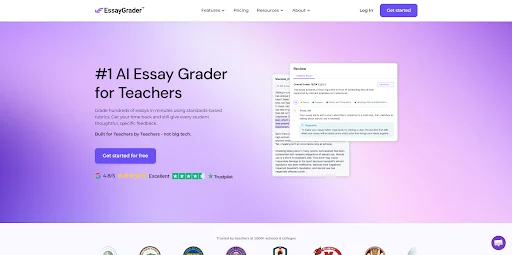 Unlike fixed-response MCQs and subjective short-answer questions, grading essays takes a lot of time, especially if you are grading a whole class of them with 40 students. This is where a tool like Essay Grader AI can come in handy.
The grading tool was designed to assess long-form written assessments, and that too in large batches. The teacher can upload their own rubric or make use of the library of 800+ standards aligned rubrics available within the platform to assess large batches of work.
The feedback is structured and doesn’t just tell what is wrong with the work, but also gives curriculum-aligned suggestions for improvement.
Evaluating essays often takes up to 10 hours each week for teachers, so if a grading tool can take care of that, all they have to do is go through the feedback to ensure everything is accurate.
This also gives the teacher a quick and concise summary of the essay, so that they can make a more accurate judgment of whether the feedback makes sense.
The feedback includes a detailed analysis of the essay’s purpose, structure, content, development, organization, and grammar. The tool also includes an analytics dashboard where you can track submissions, progress, and performance insights.
Brisk Teaching
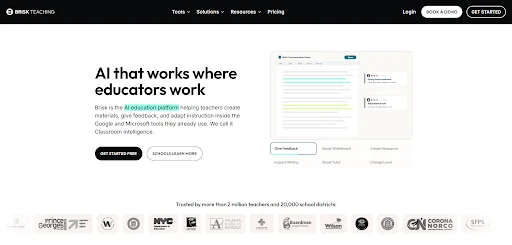
Brisk Teaching makes educator aiding tools more accessible for teachers. This browser-based system gives access to multiple tools that can be used directly into Google Classroom, Docs, and Slides. It is also works with some Canvas workflows.
Instead of dealing a whole separate application, teacher can simply be on the LMS or page they are on, and still have access to the tools they need. This means that the evaluation feedbacks can come quick.
You can upload or choose your preferred rubric, and it will give you feedback based on that. It’s speciality is the “Glow and Grow” feedback, which tells you what the student did right and what they need to improve.
Gradescope
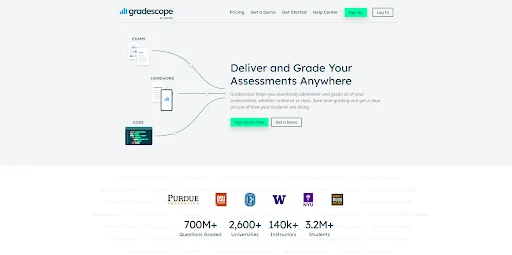 Turnitin’s Gradescope can be used alongside the LMS platform, and is particularly effective for exams.
The good thing about the tool is that its more versatile, and can assess math and code, alongside other subjects. It works particularly well for short-answer work, and can even review handwritten responses, which need to be scanned and uploaded.
The AI-driven tool allows teachers to use one grading response as the benchmark, and apply the same rubrics to the remainder papers. This saves a lot of time since the teacher doesn’t have to do repetitive checking.
If the question types are supported by the tool, it can do AI-assisted answer grouping. You can also set a rubric which can be used for grading and can also be updated as needed. Other than Turnitin, the tool can also be integrated to other LMS like Canvas and Blackboard.
Although this isn’t the best for essays, as is is not good with work that may require unique responses for each paper, but it does support batch uploads.
GPTZero AI Grader
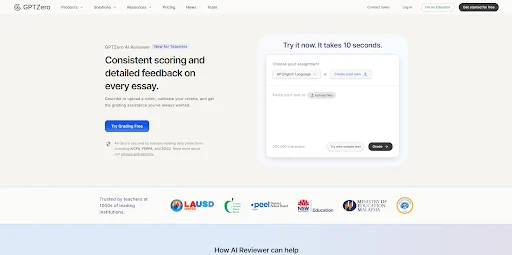 One thing that is crucial for essays in particular is integrity. No matter how good an essay is, if a large portion of it is AI-generated, the scoring would be redundant. This is why GPTZero’s AI Grader is particularly relevant for evaluating long-form written-work.
While it is a rubric-based grading platform, it also has GPTZero’s high-quality AI detection and plagiarism checker built in. You also get citation review and sentence-level feedback breakdown.
The tool allows teachers to upload or build rubrics, which it uses to draft scores and feedback based on the specified criterias. The feedback and analysis is quite detailed, and you can get document-level, sentence-level, and even word-level breakdown.
So, while it is an essay checking allrounder, if you want a more dedicated grader, this may not be enough.
This is good for teachers who want fast feedback, and tend to get deeply
CoGrader
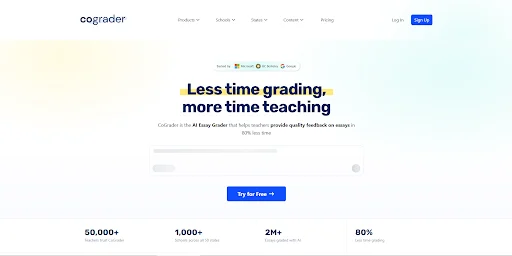
If assessment is focused on essays type scripts, CoGrader can give you feedback that is not generic. Another rubric-based scoring and feedback system, this gives you detailed comments before presenting the work for the teacher’s review.
The work will have to be reviewed by the user, because that’s how it has been built. Teachers can upload essays directly from LMS like Google Classroom or Canvas, and then can grade the work according to AP, IB, State, or custom rubrics.
One specific feature for assessment is that it can generate criteria-specific feedback. This means that things like claim, evidence, convention and organization can each be a criteria, basing on which the grading may take place. No feedback can be released unless reviewed by the teacher.
The tool also has class analytics and inbuilt AI detection, which means that teachers won’t need to go to another platform for a comprehensive assessment.
involved with the process. So, that the grading is efficient, without missing the personal teaching voice, perspective and remarks.
Final Thoughts
A good AI grader is a technology that can transform K-12 education, by reducing the teacher’s workload and leaving them more time to get more innovative and personal with instruction.
Choosing the right grader will closely depend on what your requirement is. If you want to get indepth feedback for your student’s essays, Essay Grader AI will be more suitable. If you want a quick feedback to guide your own personal remarks, the Brisk Teaching can be the right one.
And if don’t want a separate place for detecting AI, plagiarism and claims, you can opt for GPTZero’s AI Grader.