Raja Ampat is not a destination that rewards hurry. Its islands look close on a map, scattered like green stones across a bright blue sea, but the real value of the journey comes from slowing down enough to understand the water between them. For experienced divers, curious travellers, and hospitality leaders studying high-value tourism, the strongest liveaboard experiences are not built around how many sites can be visited. They are built around timing, judgment, guest care, and respect for a place that still feels rare.
A good liveaboard in Raja Ampat is less a means of transport and more a floating field base. It gives guests access to remote reefs, quiet anchorages, early-morning light, and dive planning that can shift with current, tide, visibility, and guests’ abilities. This is why liveaboard diving in Raja Ampat attracts travellers who want more than beautiful photographs. They want depth, comfort, safety, and a sense that each day has been carefully shaped rather than simply scheduled.
For guests comparing routes, vessels, and destination logic, NeptuneLiveAboards.com Indonesia liveaboard and scuba diving is relevant because the best operators understand both sides of the journey: the emotional pull of Indonesia’s reefs and the operational discipline required to host people well at sea.
- The best itinerary is not always the longest one.
- The best vessel is not always the largest one.
- The best dive day is often the one where the crew knows when to wait.
Why Raja Ampat Changes the Meaning of Luxury
Luxury in Raja Ampat is not mainly about polished surfaces or oversized cabins. Those things matter, of course, especially for guests spending several nights at sea. But the true luxury is proximity. Waking up beside limestone islands before other boats arrive. Dropping into water where reef fish move like the weather. Finishing a night dive and looking up at a sky with almost no artificial light. These are experiences that cannot be manufactured by design alone.
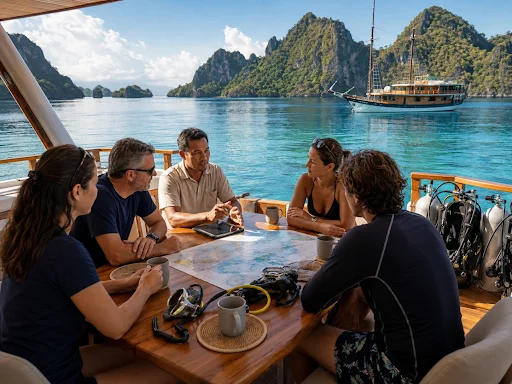
A strong Raja Ampat diving liveaboard understands that comfort and restraint must work together. Guests need good beds, reliable meals, clean equipment spaces, shaded decks, and staff who anticipate needs without crowding the experience. At the same time, the boat should never feel like it is trying to dominate the destination. Raja Ampat should remain the main character.
The Business Case for Going Slowly
From a hospitality perspective, slower travel often leads to greater satisfaction. Guests remember the feeling of being looked after. They remember a cruise director who changed the dive order because the current was wrong. They remember a chef who adapted lunch after a cold, long dive. They remember a guide who kept a nervous diver calm at a cleaning station rather than pushing the group forward.
This matters commercially because premium liveaboard clients are not only buying access. They are buying confidence. They want to feel that the operator knows when to say yes, when to say no, and when to adjust the plan. In remote regions, good judgment is part of the product.
- Safe planning builds trust.
- Honest briefings reduce anxiety.
- Flexible itineraries create better memories.
- Well-trained crews turn distance into comfort.
Raja Ampat Is Not One Experience
Many travellers speak about Raja Ampat as if it were a single dive destination. In practice, it is a collection of moods. Dampier Strait can feel energetic and fish-rich. Misool often feels cinematic, with soft coral walls, caves, lagoons, and reefscapes that seem almost designed for silence. Wayag, when included, evokes a different emotion: wide horizons and island views that remind guests how far they have travelled.
This is where liveaboard diving in Indonesia becomes more complex than a standard resort stay. A resort can be excellent, but it is tied to one base. A liveaboard can follow seasonal patterns, weather windows, and remote-site access. The vessel becomes a moving hospitality platform, one that must balance adventure with rest. Too many dives can exhaust guests. Too much movement can reduce the pleasure of being somewhere extraordinary.
What Intelligent Travellers Should Look For
The most informed guests do not simply ask how many dives are included. They ask better questions. How are dive groups divided? Are guides familiar with current sensitive sites? Is there oxygen on board, and is the crew trained properly? How does the operator manage waste? How are local communities respected? What happens if the weather changes the route?
These questions are not negative. They are signs of mature travel. Raja Ampat deserves guests who understand that access comes with responsibility.
- Ask about the guide to guest ratios.
- Ask how the boat handles reef safe anchoring.
- Ask whether the itineraries are fixed or tide-aware.
- Ask how beginner and advanced divers are separated.
- Ask what conservation practices are used on board.
The Human Side of a Liveaboard
A liveaboard crew has a different role from a hotel team. They are hosts, safety support, logistics staff, weather watchers, cultural interpreters, and sometimes quiet counsellors for guests who are tired, seasick, or nervous. On a well-run liveaboard journey in Indonesia, the best service is often invisible. Tanks are ready. Towels appear dry. Coffee is served before sunrise. Dive briefings are clear. Cabins are refreshed while guests are on deck. Problems are solved before they become stories.
The strongest crews also know how to read people. Some guests want every marine species named. Others want space. Some want detailed dive profiles. Others simply need reassurance before entering current. This emotional intelligence separates a good trip from a great one.
Food, Rest, and Rhythm Matter More Than Guests Expect
Many first-time liveaboard guests focus heavily on diving and underestimate life between dives. Yet the spaces between dives often define the journey. A warm meal after a demanding current dive can change the mood of the whole group. A shaded deck with enough room to read, nap, or speak quietly can make a boat feel generous. A predictable daily rhythm helps guests relax into the remoteness.
Raja Ampat asks for energy. The operator’s job is to help guests spend that energy wisely. Four dives a day may sound impressive, but three excellent dives with proper rest may create a better overall experience. This is especially true for mixed groups, couples, photographers, and guests who have travelled far to be there.
Sustainability Is Now Part of Hospitality Quality
In fragile marine environments, sustainability should not be treated as a decorative message in a brochure. It is part of operational quality. Guests notice whether briefings include reef etiquette. They notice if plastic use is careless. They notice whether guides control the behaviour of the group around coral, mantas, and cleaning stations. They notice if the crew respects local waters or treats them as a stage set for tourism.
A responsible liveaboard does not need to lecture guests. It simply builds better habits into the journey. Clear rules, patient guiding, good mooring choices, careful waste systems, and respect for local communities create a better guest experience as well as a better environmental outcome.
- Do not touch coral.
- Control buoyancy before entering sensitive sites.
- Keep a distance from mantas and sharks.
- Follow the guide’s current plan.
- Treat remote villages and local waters with respect.
Why Raja Ampat Rewards the Prepared Guest
The best liveaboard guests arrive with curiosity rather than a checklist. They understand that nature does not perform on command. Visibility can change. Currents can strengthen. A better option may replace a planned site. This is not a failure of service. In a remote marine environment, it often serves as proof that the operator is paying attention.
For intelligent travellers, especially those reading about tourism, leadership, and sustainable business, Raja Ampat offers a useful lesson: premium travel is no longer only about possession or status. It is about access handled with care. A well-managed liveaboard turns that idea into a daily practice.
The Real Value of a Raja Ampat Liveaboard
The strongest Raja Ampat journeys leave guests with more than a logbook full of dive sites. They leave them with a sharper sense of place. They show why timing matters, why crew culture matters, why restraint can be more luxurious than excess, and why Indonesia remains one of the world’s most compelling marine destinations.
A liveaboard is not the only way to experience Raja Ampat, but for the right traveller, it may be the most complete. It allows the sea to set the pace. It gives each island a little more space to breathe. And when it is operated with intelligence, humility, and care, it turns a diving holiday into something much harder to copy: a journey that feels earned.