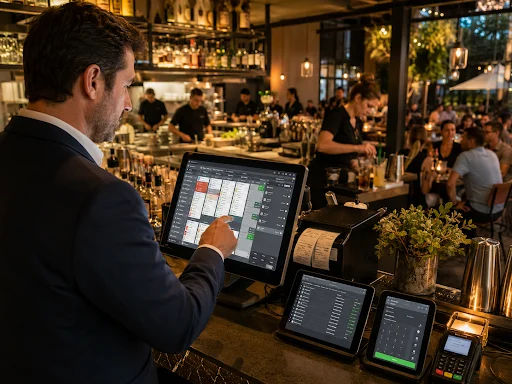
Restaurant owners often judge their point of sale by the moments when pressure is highest. Friday night service, a full terrace, three delivery tablets buzzing, a bartender calling for a void, a kitchen printer refusing to cooperate. In those moments, the POS is not an office tool. It is the nervous system of the business, translating orders, payments, stock movement, staff decisions, and guest habits into something the team can act on without hesitation.
The mistake many operators make is treating POS selection as a hardware purchase. Screens, terminals, cash drawers, receipt printers, and payment devices matter, but they are not the real decision. The real decision is whether the system helps the restaurant remember what actually happened during service. A strong restaurant POS software setup does more than process payments. It gives owners a clearer view of table behaviour, menu performance, staff patterns, stock pressure, and the small operational leaks that rarely appear in the bank account until the end of the month.
For owners comparing digital tools with daily service realities, TableView.com for bar and restaurant POS systems is relevant because the best POS decisions should be based on how restaurants and bars actually operate, not on generic retail logic.
Why Restaurant POS Decisions Are Really Management Decisions
A restaurant is a chain of tiny decisions. Which tables turn fastest? Which dishes slow down the pass? Which staff members upsell naturally? Which promotions drive margin, and which only create noise? Which items look profitable on paper but become expensive once waste, prep time, and refunds are included?
This is why restaurant POS systems should be viewed as management infrastructure. They sit at the intersection of guest experience and business control. When the system is poorly matched to the operation, the damage is quiet. Orders get retyped. Discounts are applied without consistency. Managers spend hours reconciling reports. Stock counts drift away from reality. Staff invent workarounds, and those workarounds become the real operating system.
A capable POS should help owners answer practical questions:
- What sold well today, and what actually made money?
- Which payment, delivery, and table channels are creating friction?
- Where are staff losing time during service?
- Which menu items should be promoted, removed, resized, or repriced?
- Are voids, discounts, and refunds normal, or do they show a pattern?
These questions are not technical. They are commercial. A POS that cannot answer them clearly is only doing part of the job.
The Bar Problem: Speed, Control, and Trust
Bars place different demands on technology. A dining room may tolerate a few seconds of extra navigation at the terminal. A busy bar cannot. When ten people are waiting, the bartender needs speed, accuracy, and confidence. Open tabs, split payments, happy hour rules, modifiers, service charges, and staff permissions must work without slowing the rhythm of service.
This is where bar POS system software needs to be judged differently from general restaurant software. A bar environment is fast, repetitive, and exposed to more cash handling, voids, high-volume orders, and stock sensitivity. One incorrect pour size, one unrecorded comp, or one badly managed open tab can look small in isolation. Repeated every night, it becomes a margin problem.
What Good Bar POS Software Should Protect
The strongest bar systems protect the business without making the bartender feel watched or restricted. That balance matters. Staff need freedom to serve quickly, but owners need traceability.
Important features include:
- Fast product search and clear category layout
- Open tab management with reliable payment capture
- Staff permissions for discounts, voids, and refunds
- Integration with card payments to reduce manual errors
- End-of-shift reporting that is easy to reconcile
- Stock visibility for high-value spirits, wines, and cocktail ingredients
A good POS system for a restaurant setup should respect both sides of the business. The bar needs speed. The restaurant needs order accuracy. Management needs reporting that brings both worlds into one readable picture.
The Quiet Value of Better Data
Data is often discussed as if it belongs only to large chains. That is not true. Independent restaurants need clean data even more because a single poor decision can quickly affect cash flow. The difference is that owners do not need endless dashboards. They need useful, plain information that supports action.
For example, a report showing total sales is helpful, but limited. A better report shows which items sold, when, with which modifiers, through which channels, and at what gross margin. A simple sales increase may hide poor profitability if the growth came from discounted items, delivery commissions, or labour-heavy dishes.
The Reports Owners Actually Use
The most useful POS reports are not the longest ones. They are the reports owners return to every week because they explain something real.
Valuable reports often include:
- Sales by item, category, server, and time period
- Void and refund tracking by a staff member
- Payment reconciliation by method and terminal
- Menu performance by margin, not only revenue
- Table turn time and average spend per guest
- Delivery, takeaway, and dine-in comparison
- Stock movement connected to actual sales
When these reports are clear, the owner can make sharper decisions without relying only on instinct. Instinct still matters in hospitality, but it becomes stronger when supported by evidence.
POS Software Should Reduce Mental Load
Restaurant work already carries enough pressure. Owners move between guest complaints, supplier calls, staff schedules, cash flow concerns, and unexpected repairs. A POS should reduce mental load, not add another layer of administration.
Poor systems force managers to remember too much. They remember which report to export, which terminal had an error, which waiter forgot to close a table, which delivery order needs manual adjustment, and which promotion was entered differently across shifts. That is not technology support. That is hidden labour.
Better systems make the correct action easier than the wrong one. Menus are structured logically. Staff access is controlled. Reports are readable. End-of-day closing is consistent. Stock changes can be checked. Payments match orders. When the system supports routine, managers can spend more time on hospitality and less time cleaning up after software.
Integration Matters, But Only When It Solves Real Problems
Restaurant technology has become crowded. Booking platforms, delivery apps, loyalty tools, accounting software, QR ordering, kitchen display systems, stock control, staff scheduling, and payment providers all compete for attention. Integration is valuable, but only when it removes duplicate work or improves decision-making.
Owners should be cautious about buying features simply because they sound modern. The better question is: will this reduce errors, save management time, improve guest flow, or protect margin?
A POS connected to accounting can reduce reconciliation work. A POS connected to inventory can highlight waste and theft. A POS connected to reservations can support better table planning. A POS connected to loyalty can help identify regular guests and their preferences. But each connection must have a purpose. Otherwise, complexity grows faster than value.
A Practical Checklist Before Choosing a POS
Before changing systems, restaurant owners should map how the business actually works. This prevents buying software based on a demo that looks good but fails during real service.
Key questions include:
- How many order points are active during peak hours?
- Does the business rely more on table service, counter service, delivery, or bar sales?
- Are menus simple, seasonal, or modifier-heavy?
- Who is allowed to discount, refund, void, or reopen bills?
- How are tips, service charges, and split payments handled?
- What reports does the owner need every day, every week, and every month?
- Which existing tools must connect with the POS?
The best POS choice is rarely the one with the longest feature list. It is the one that matches the restaurant’s service model with the least friction.
The Future POS Will Feel Less Visible, Not More
Restaurant owners do not need more screens for the sake of screens. They need systems that disappear into the work, quietly recording, guiding, and protecting the operation. The guest should notice better timing, fewer mistakes, faster payment, and more confident staff. They do not need to notice the software.
That is the real test of a mature POS system. It supports the business without stealing attention from the dining room. It gives managers control without turning service into bureaucracy. It helps owners understand the truth of their operation, not just the total at the end of the night.
For restaurant and bar operators, POS selection is no longer a back-office IT task. It is a strategic decision about memory, discipline, and service quality. The right system helps the business remember what happened, learn from it, and serve better tomorrow.