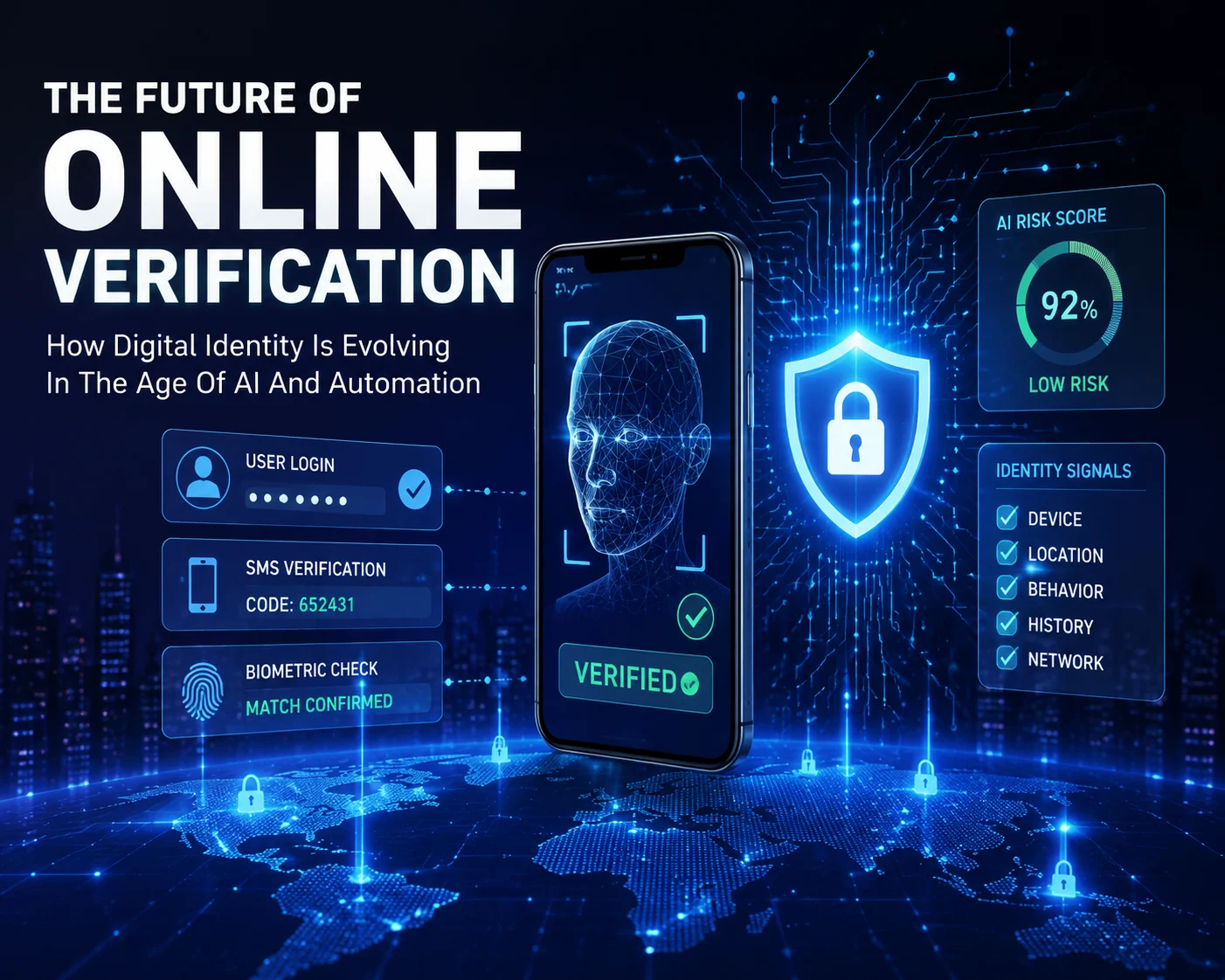
Online verification sits at the core of digital life. Every login, payment, and signup depends on it. It decides who gets access and who does not.
Older systems were simple. A password, an email code, or an SMS message was enough. That model worked when the internet was smaller and slower.
Now the scale has changed. Platforms handle millions of users. Bots and fraud tools also scale faster. Static verification can no longer carry the full load.
AI and automation reshape this space. They turn identity into something active, not fixed. Verification now runs in real time and reacts to behavior, not just input.
Identity is no longer a single moment. It is a continuous process.
Traditional Verification Systems And Their Limits
Traditional online verification was built for a slower internet. It focused on simple trust checks. A user proves identity once, then repeats that proof many times.
The most common method is SMS-based verification. A platform sends a one-time code to a phone number. The user enters the code. Access is granted.
This model worked when account creation was low and fraud was limited. But digital scale changed the environment.
Today, users create accounts across dozens of platforms. Apps, fintech services, marketplaces, and AI tools all require verification. This creates pressure on SMS systems.
Phone-based verification also has structural limits. A phone number is tied to a single identity. But users now operate across multiple contexts. Work, testing, privacy, and temporary access all require separation.
This gap has created demand for flexible number solutions. Temporary and virtual numbers now support use cases where permanent identity is not needed.
One example of this shift is the use of services like smsfast free temp number, which reflects a broader category of tools that provide short-term access to SMS verification without exposing a primary personal number. These tools fit into workflows where speed and separation matter more than long-term identity binding.
At the same time, traditional SMS verification shows another weakness. It depends on telecom infrastructure. That makes it slower than modern API-driven systems. It also makes it harder to scale globally in real time.
As automation increases, companies need verification systems that respond instantly, integrate with software pipelines, and adapt to risk in real time.
This is where the old model begins to break.
How AI And Automation Redefine Identity Verification
AI changes verification from a fixed step into a continuous process. Instead of asking “Who are you?”, systems now ask “Does this behavior match a real user?”
Automation runs this process at scale. It evaluates thousands of signals in milliseconds. No human review is needed for most cases.
Modern verification systems now combine multiple layers. Each layer adds context and reduces fraud risk without slowing the user down.
Core Signals Used In AI Verification
Below are the main data points AI systems analyze today:
- Device fingerprinting, including browser type, operating system, and hardware signals
- IP behavior patterns and geographic consistency
- Typing speed and interaction rhythm on forms
- Login frequency and session timing
- Past account behavior and transaction history
- Network reputation and known fraud indicators
- Real time anomaly detection during session activity
Each signal alone is weak. Combined, they form a behavioral profile.
Why This Model Replaces Static Checks
Static verification assumes identity never changes. AI assumes the opposite. It treats identity as dynamic.
This approach reduces reliance on single points of failure like passwords or SMS codes. Instead, systems build a probability score of trust.
If risk is low, access is seamless. If risk increases, the system requests extra checks.
The result is a smoother experience for legitimate users and stronger resistance against automated attacks.
The Rise Of Continuous Identity And Risk-Based Access
Modern systems no longer treat login as a single gate. They treat it as a continuous flow. A user enters, but verification never fully stops.
Instead of a fixed pass or fail moment, platforms now use risk-based access. The system adjusts security levels in real time based on behavior.
This model reduces friction for trusted users. At the same time, it increases scrutiny when something looks unusual.
Identity becomes a moving score. Not a document. Not a code. A live pattern.
How Risk-Based Verification Works In Practice
When a user logs in, the system does not only check credentials. It evaluates context:
- Is this device familiar
- Is the location consistent
- Does the behavior match past sessions
- Is the request timing normal
- Are there signs of automation or bots
If everything aligns, access stays smooth. If not, the system escalates checks or blocks activity.
Verification Layers Comparison
| Verification Layer | What It Checks | Strength | Weakness |
| Passwords | Knowledge of secret string | Simple and fast | Easy to steal or reuse |
| SMS Verification | Access to phone number | Widely supported | SIM swap and interception risk |
| Email Codes | Access to inbox | Easy integration | Email compromise risk |
| Device Fingerprinting | Hardware and browser signals | Hard to fake | Privacy concerns |
| Behavioral Analysis | User interaction patterns | Strong fraud detection | Needs data history |
| AI Risk Scoring | Combined trust model | Adaptive and scalable | Complex to tune |
This layered structure shows a clear shift. No single method is enough anymore. Security now depends on combination, not isolation.
The goal is not only to block fraud. The goal is to reduce friction while maintaining trust at scale.
Identity As A Living System
Online verification no longer behaves like a gate. It behaves like a system that watches movement over time. Static checks still exist, but they no longer carry full trust on their own.
AI and automation push identity toward constant evaluation. Every action adds a small signal. Every signal updates the trust picture. The result is a model that reacts instead of waiting.
In this environment, verification tools evolve into infrastructure. SMS codes, device checks, behavioral models, and risk scoring all work together. Each layer covers the limits of the others.
This shift also changes how users interact with platforms. Login becomes lighter when trust is high. It becomes heavier only when risk appears. The system adapts instead of blocking by default.
At the same time, flexibility grows in parallel with security. Temporary access models, modular identity layers, and API-driven verification systems support different user needs. Some require long-term identity binding. Others only need short-term access without permanent exposure.
The future of online verification is not a single method. It is a connected network of signals. It learns, adjusts, and responds in real time.
Identity online is no longer a static credential. It is a living pattern shaped by behavior, context, and time.