The conversation in the boardroom has evolved. It’s no longer whether or not to invest in generative AI. It’s how quickly, how profoundly, and how courageously to do so. It’s not the organizations with a chatbot on their website that are outperforming the competition.
It’s the ones who are not just quietly redefining the very architecture of work but replacing sequential human workflows with interconnected, self-directing systems that learn, decide, and act in real time.
It’s not an upgrade. It’s a category change. And it’s one that, for executives of financial services organizations, retailers of consumer loans, and other customer-centric businesses, is growing increasingly urgent.
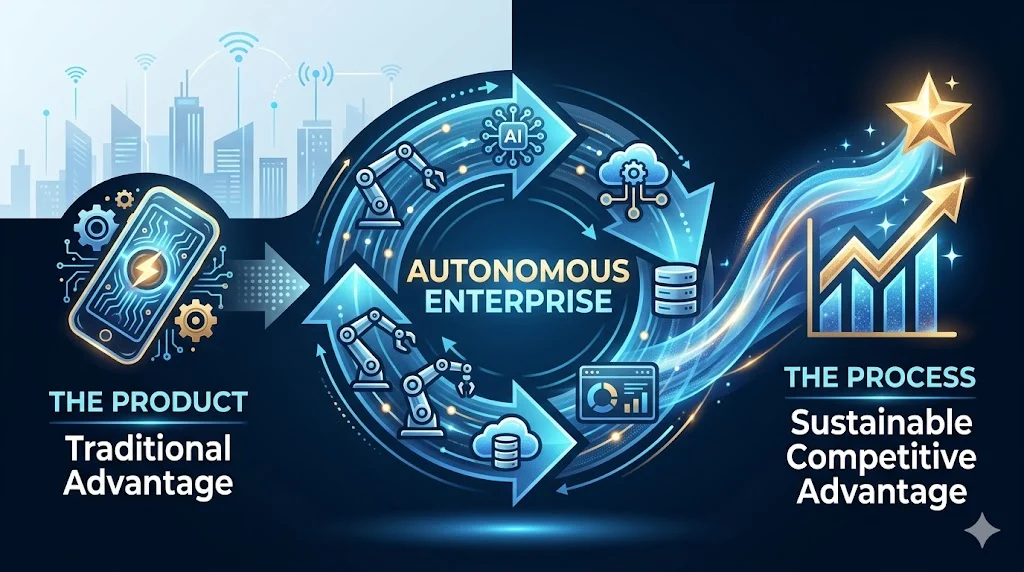
From Automation to Autonomy: A Distinction That Matters
There is a word that keeps appearing in strategy decks, vendor pitches, and analyst reports: agentic. It is worth pausing on what it actually means, because the distinction between automation and agency is exactly where enterprise value is being created or destroyed.
Automation is executing a defined instruction. An agent is acting in pursuit of a defined objective. The distinction is a subtle one. The operational impact is a very big one.
A typical automated workflow in a bank, for example, might route a loan application to a credit analyst after a defined threshold is met. An agentic system, by contrast, can consume the loan application, retrieve data from a bureau, cross-check income verification sources, identify inconsistencies, calculate risk scenarios, generate a draft decision memo, and escalate only those cases to a human reviewer without a queue, a ticket, or a delay.
The same workflow that used to take days now takes minutes. The time of the analyst is now focused on the 8% of cases that actually require human judgment.
This is what is meant by Agentic AI in Lending. Not a smarter interface to a legacy system. Not a copilot for credit analysts. A fundamentally different decision architecture with intelligent agents doing the mundane with precision, speed, and auditability – and humans owning the consequential.
The Customer Experience Imperative
Just as internal operations represent one frontier of Agentic deployment, so too is the customer-facing level where brand equity is made or broken. And here, the rules differ. Customers do not judge us by our internal operational metrics. They judge us by how it felt to do business with us at 11 p.m. on a Sunday, over a mobile device, when something went wrong.
Why Legacy Service Models Are No Longer Fit for Purpose
The service model of the last two decades, multi-level support queues, Interactive Voice Response trees, and offshore call centers with scripted responses, was designed for a world where the only constraint was the cost of human attention. And while that constraint remains in place, another constraint has emerged alongside it: customer tolerance for friction is gone.
The customer of today has same-day delivery, instant loan pre-qualification, and real-time fraud protection. They do not understand why it takes three transfers and a callback window to resolve a billing inquiry. They do not accept it. They defect.
The equation changes with the use of AI Agents for Customer Service. A good customer service agent does more than just answer the question. It has context for the conversation, access to the customer’s history, the ability to detect the emotional tone of the conversation, and the ability to initiate actions or pass the conversation off with a human with complete context. It’s not deflecting the customer; it’s improving the customer experience.
The Personalization Dividend
The secondary benefit of the use of AI Agents for Customer Service is personalization at scale. Traditional customer service operations are forced to pick between depth and breadth. Do you want to be good at ten use cases or good at one hundred use cases? Agentic systems allow the same depth of knowledge and context to be applied to every interaction, simultaneously.
For financial institutions, the benefit is direct retention. A customer calls to ask why their mortgage rate has changed, and the agentic system provides a clear and personal explanation in under two minutes. They are not going to churn. A customer calls and has to navigate three menus before finally being connected with someone who has no idea what their account looks like. They are.
What Leaders Get Wrong About Agentic AI Implementation?
While the value proposition is strong, many enterprise implementations of Agentic AI fail to deliver. Not because of shortcomings in the technology, which is not the case, but shortcomings in the organizational approach to it.
1. Treating It as an IT Project
Agentic AI implementations fail when they are handed over to a technology group with a specification sheet and a project plan. Agentic AI implementations succeed when the Chief Operations Officer, the Chief Risk Officer, and the Chief Customer Officer are in a room together, discussing what success looks like before a line of code is written. Technology is an enabler. Strategy is a leadership issue.
2. Optimizing for Cost Before Experience
While the business case for Agentic AI is typically built on hard-hitting ROI calculations centered on headcount reduction, this is not necessarily a mistake. Headcount reduction is a legitimate and important aspect of efficiency.
However, when organizations prioritize headcount reduction and end up deploying agents in a way that is annoying to their customers and creates compliance problems, they are getting it wrong. Experience quality first, then efficiency. They are not in conflict; one is a necessary precursor to the other.
3. Ignoring the Governance Layer
An agent is an agent only if it can make decisions, and it can make wrong decisions. Regulated domains, financial services, healthcare, insurance – they are all at risk here. The governance structure of agentic systems is just as important as the operational structure. Who audits decisions made by the agent? What happens in edge cases? What happens if an agent is acting on stale data? These are leadership questions.
The Competitive Clock Is Running
In most industries, the window of opportunity for first-mover advantage in agentic deployment is 18 to 36 months. After that, it is table stakes. The leaders who move now will have something invaluable: two to three years of production data, refined logic, and muscle memory that late movers cannot skip over.
The analogy to mobile banking is instructive.
The financial institutions that moved mobile banking products in 2011 and 2012 were not just winning the competition of early adopters. They were creating the data infrastructure, customer behavior, and engineering capability that would define their competitive position over the next decade. Financial institutions that moved mobile banking products in 2016 were trying to catch up to a race they would never win.
Agentic AI is an inflection point of this kind. The technical barriers to agentic AI are now lower than they were even 18 months ago. The barriers of organization culture, governance, and alignment are where the heavy lifting is. And it is not a task to be accomplished quickly.
A Framework for Leaders: The Three Questions That Matter
Before investing in the next proof of concept or approving the next vendor evaluation, executives should challenge their agentic AI strategy with these three basic questions:
First: What part of our value chain has the most decision latency for our customers or our organization? This is where agentic AI will deliver the quickest and most significant return on investment.
Second: Do we have the data infrastructure to support decision-making at the agent level? An agent is only as good as the data it has available to make decisions. If your data is disorganized and has no unified infrastructure, then that is the prerequisite.
Third: Have we precisely defined the boundary between humans and agents? Not as a policy statement, but as an operational definition. What decisions are left to humans? What are the triggers for escalation? What makes the reasoning behind the agent transparent? These are the definitions that separate scaling deployments from stalled deployments.
Conclusion: The Architecture of the Autonomous Enterprise
The autonomous enterprise isn’t a place to arrive at; it’s an operating model. One in which human judgment is reserved for what only humans should decide, and intelligent agents handle the rest with the speed, consistency, and accountability that no traditional process can match.
The leaders who will look back on these days with pride are not those who will wait for the technology to further mature, the regulatory environment to become clearer, or the competitive environment to necessitate their actions. They’re the ones who saw the inflection point while the advantage was still available and responded in kind.
The question isn’t whether your organization will be changed by agentic AI. It’s whether you’ll be the one doing the changing.