Struggling with project chaos? Nearly half of all projects fail. A Project Management Office (PMO) is your solution. How a high-performing PMO boosts success rates, aligns projects with business goals, and delivers real ROI. Stop managing projects in the dark and start driving your strategy forward.

Projects are how modern organisations move strategy into action but the numbers show just how hard that is to do well. From launching a new product to rolling out digital transformation, projects are the vehicles that drive progress. But here’s the thing, projects can easily go off track. Budgets spiral, deadlines slip, and stakeholders lose confidence. That’s where the Project Management Office (PMO) steps in. Understanding the PMO meaning, and how it can transform strategy into action, is critical for modern organisations.
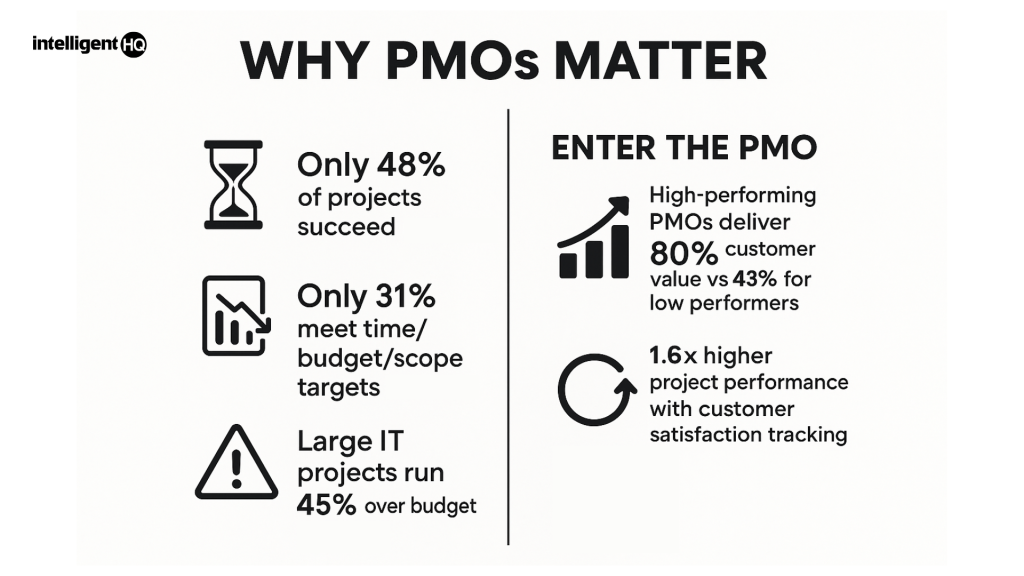
Look across the market and you’ll see why governance matters. A recent PMI analysis found only 48% of projects are rated successful, with 12% outright failures and the remainder somewhere in the messy middle, “mixed” outcomes.
Meanwhile, the Standish CHAOS data continues to flag delivery risk in tech: just 31% of projects succeed on the classic time/budget/scope triangle, 50% are challenged, and 19% fail. And those big digital bets? McKinsey’s long-running benchmark still lands hard: large IT projects run 45% over budget, 7% over time, and deliver 56% less value than planned.
This is where understanding PMO meaning becomes powerful. PMI reports that high-performing PMOs are far better at delivering customer value ( 80% vs 43% for low performers), and organisations that actively measure customer satisfaction are 1.6× more likely to achieve high project performance.
In short, if strategy is the “why”, the PMO meaning is the “how”, turning ambition into outcomes with standards, visibility, and smarter decisions.
What Is a PMO, Really?
So what’s the PMO meaning? It is a Project Management Office (PMO) is a dedicated team or department that sets standards for how projects should be run. It offers tools, templates, processes, and governance frameworks that give structure to projects.
But beyond templates and checklists, a PMO meaning is about strategy. It ensures that projects are not isolated activities but part of a bigger business plan. A PMO makes sure the work being done today supports the organisation’s ambitions for tomorrow.
According to the Project Management Institute (PMI), the PMO meaning is a management structure that standardises project-related governance and facilitates the sharing of resources, methodologies, and techniques. In other words, it’s the guardian of project discipline.
Why PMOs exist
Let’s be honest, projects don’t always go as planned. Without some form of oversight, organisations can end up with:
- Duplicate efforts – different teams solving the same problem in different ways.
- Scope creep – projects expanding endlessly without delivering results.
- Poor alignment – projects that look good on paper but have little to do with company goals.
- Resource waste – talent, time, and money spread thin or used inefficiently.
The different types of PMO
Not all PMOs look alike. Depending on their authority and scope, they can take different shapes.
1. Supportive PMO
This is the “consultant” style PMO. It offers templates, training, and best practices, but it doesn’t enforce compliance. It’s flexible and supportive, giving guidance when asked. The downside? If nobody listens, its value is limited.
2. Controlling PMO
This PMO meaning goes a step further by enforcing compliance. It makes sure projects use standard methods, frameworks, and reporting structures. It’s like a watchdog, ensuring visibility and consistency. The challenge? Teams sometimes push back, seeing it as bureaucracy.
3. Directive PMO
The directive PMO takes full control. It directly manages projects, assigns project managers, and ensures uniformity. It’s powerful and consistent, but also resource-intensive.
4. Based on organisational level
- Individual PMO – focused on a single project.
- Departmental PMO – supports multiple projects within a business unit.
- Corporate PMO – oversees projects across the whole organisation, aligning them with corporate strategy.
Who makes up a PMO team?
A PMO meaning isn’t just one person with a spreadsheet. It’s a collective of roles, each bringing something essential to the table.
- PMO Director – sets the vision, ensures alignment with strategy, and oversees everything.
- Project and Programme Managers – lead individual projects, handling planning, budgets, and execution.
- Support Team – schedulers, planners, and controllers who provide operational support.
- PMO Analysts/Coordinators – manage data, reporting, and knowledge-sharing.
- Change Control Analysts – help navigate shifts in scope or stakeholder expectations.
The roles and responsibilities of a PMO
So, what does a PMO actually do on a day-to-day basis? Here’s a breakdown:
- Governance – setting up frameworks, processes, and policies.
- Portfolio management – deciding which projects get greenlit based on strategy and ROI.
- Resource allocation – ensuring the right people are in the right place at the right time.
- Reporting – giving stakeholders real-time visibility of progress and risks.
- Training and mentoring – helping project managers build their skills.
- Standardisation – ensuring consistency across all projects.
- Risk and issue management – spotting problems early and helping teams adapt.
A project manager focuses on delivering one project. The PMO meaning ensures that all projects combined are steering the organisation towards its goals.
Why PMOs matter for modern business strategy
In the past, PMOs were sometimes dismissed as bureaucratic overhead. But in today’s world, where speed, adaptability, and innovation are critical, they play a strategic role.
Here’s how:
- They align projects with strategy: Every project should support the business vision. A PMO ensures that project selection and execution are guided by strategy, not just departmental interests.
- They improve efficiency: By standardising processes and sharing resources, PMOs reduce duplication and waste. This boosts productivity across the board.
- They enable better decision-making: With centralised data and reporting, executives can see which projects are thriving, which are struggling, and where to invest next.
- They strengthen risk management: By tracking risks across the project portfolio, the PMO helps businesses avoid surprises.
- They drive continuous improvement: PMOs capture lessons learned and best practices, making sure each new project starts smarter than the last.
The business benefits of a PMO
Let’s dig deeper into the tangible benefits a PMO meaning can bring:
- Projects delivered on time and within budget – fewer overruns.
- Higher success rates – PMI studies show organisations with PMOs see more projects succeed.
- Resource optimisation – skills matched to needs, reducing burnout and underuse.
- Better communication – stakeholders kept informed and engaged.
- Cost savings – fewer wasted hours and resources.
- Increased confidence – clients, boards, and investors trust organisations with strong governance.
How to set up a successful PMO
Establishing a PMO isn’t just about buying software and hiring a director. It requires a thoughtful approach.
Step 1: Define the vision
What will the PMO achieve? Is it about project delivery, innovation, compliance, or all three? Get buy-in from stakeholders early.
Step 2: Build the structure
Decide whether you need a supportive, controlling, or directive PMO. Choose whether it should sit at a departmental or enterprise level.
Step 3: Plan the implementation
Treat the PMO itself as a project. Define scope, objectives, governance, and success measures.
Step 4: Recruit the right people
Mix strategic thinkers with detail-focused planners. Diversity of skills is key.
Step 5: Pilot and evolve
Start small with a pilot, gather feedback, and refine. PMOs grow in maturity over time—don’t try to reach perfection immediately.
Future Trends: Where Are PMOs Heading?
Business doesn’t stand still, and neither do PMOs. Here are some trends shaping their future:
- Hybrid methodologies – blending Agile, Waterfall, and other approaches for flexibility.
- AI and automation – using predictive analytics for risk spotting, resourcing, and scheduling.
- Real-time business intelligence – dashboards replacing static reports.
- Continuous innovation – PMOs driving experimentation, not just governance.
- Holistic resource management – balancing global workforces, freelancers, and permanent staff.
Final thoughts
The PMO has moved far beyond being a back-office support function. It’s now a strategic powerhouse that helps organisations navigate complexity, align projects with goals, and deliver results efficiently.
Whether you’re a small start-up scaling up or a multinational managing hundreds of projects, the PMO offers clarity, control, and confidence. In a world where change is constant, having a strong PMO meaning isn’t just about managing projects, it’s about driving business strategy forward.
So, the next time someone asks, “Do we really need a PMO?”, the answer is clear. If you want consistent success, sustainable growth, and strategic alignment, the PMO isn’t optional. It’s essential.

Himani Verma is a seasoned content writer and SEO expert, with experience in digital media. She has held various senior writing positions at enterprises like CloudTDMS (Synthetic Data Factory), Barrownz Group, and ATZA. Himani has also been Editorial Writer at Hindustan Time, a leading Indian English language news platform. She excels in content creation, proofreading, and editing, ensuring that every piece is polished and impactful. Her expertise in crafting SEO-friendly content for multiple verticals of businesses, including technology, healthcare, finance, sports, innovation, and more.