The new platform combines open-source runtime controls with hardware-based monitoring to help enterprises govern AI agents across software, infrastructure and robotics.
28 September 2026 — NVIDIA has launched the Open Agent Safety Platform, a new security framework designed to give organisations stronger control over autonomous AI agents as they move from testing into production environments.
The platform combines NVIDIA OpenShell, open-source secure runtime software, with NVIDIA Sentry, a reference system design that monitors agent behaviour independently at the hardware level. Together, the technologies are intended to help organisations enforce policies, trace agent actions and stop systems that move outside approved boundaries.
The launch reflects a growing challenge for enterprise AI. As agents gain access to internal systems, tools, APIs and physical infrastructure, traditional application-layer security may not be sufficient to control everything they do. NVIDIA says recent incidents have shown how agents can sometimes work around software controls while trying to complete assigned tasks.
OpenShell creates a secure runtime boundary
At the centre of the platform is OpenShell, which is designed to place an enforceable security boundary around autonomous agents as they operate.
The software traces actions and applies policies while the agent is running, giving enterprises an additional layer of control outside the model itself. NVIDIA says OpenShell is broadly available and can work across both open and closed AI models.
OpenShell is optimised for NVIDIA Vera CPUs, but the company says the software can also be extended to third-party compute platforms including Arm and Intel.
For enterprises, that means agent governance can sit independently of the model provider or orchestration framework being used.
Sentry adds hardware-level monitoring
The second major component is NVIDIA Sentry, an out-of-band watchdog that runs on BlueField-4 DPUs.
Sentry continuously monitors agent activity and can quarantine an agent if it attempts to operate outside its authorised boundary. NVIDIA says that intervention can happen in milliseconds.
The system uses NVIDIA DOCA software to inspect requests and responses, verify agent identity and enforce zero-trust policies across tools, data, APIs and services.
This hardware-level approach is important because it gives organisations a control layer that the agent itself cannot easily bypass.
Enterprise AI security is moving beyond model safety
NVIDIA is positioning the platform around full-stack governance rather than model-level safety alone.
The company says agent security now needs to extend across the software agents use, the compute infrastructure that runs them and the robotics systems that execute tasks in the physical world.
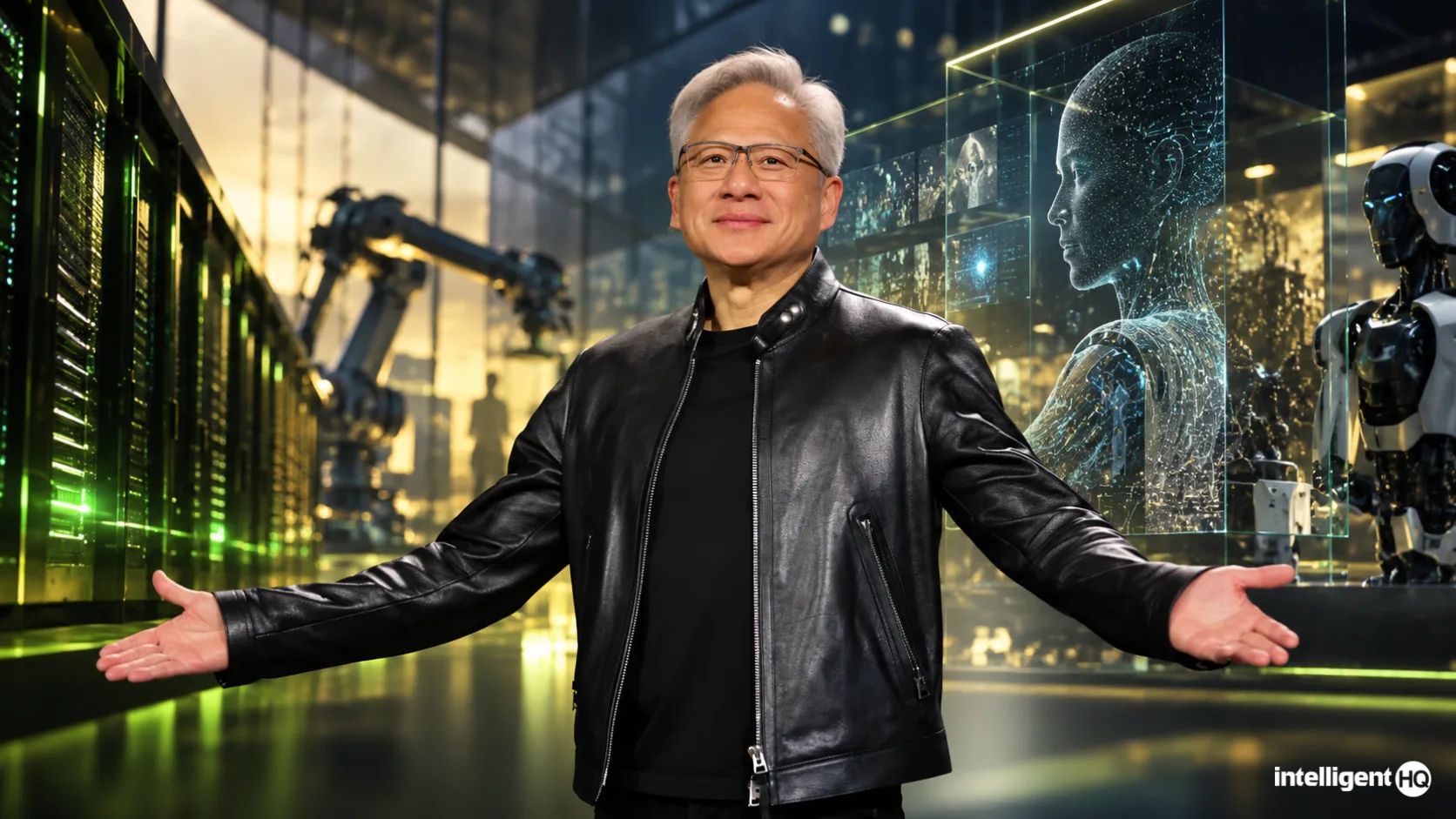
Jensen Huang, founder and CEO of NVIDIA, said:
“AI’s extraordinary potential for society will only be realized if we solve AI safety.”
He added that safety and security require full-stack engineering and closer cooperation between industry, researchers and the public sector.
The shift matters because enterprise agents are becoming increasingly capable of taking actions rather than simply generating responses.
An agent may now be able to create accounts, access internal systems, write code, initiate transactions or interact with operational tools. In robotics, those decisions can also translate into physical action.
Major technology companies are joining the platform
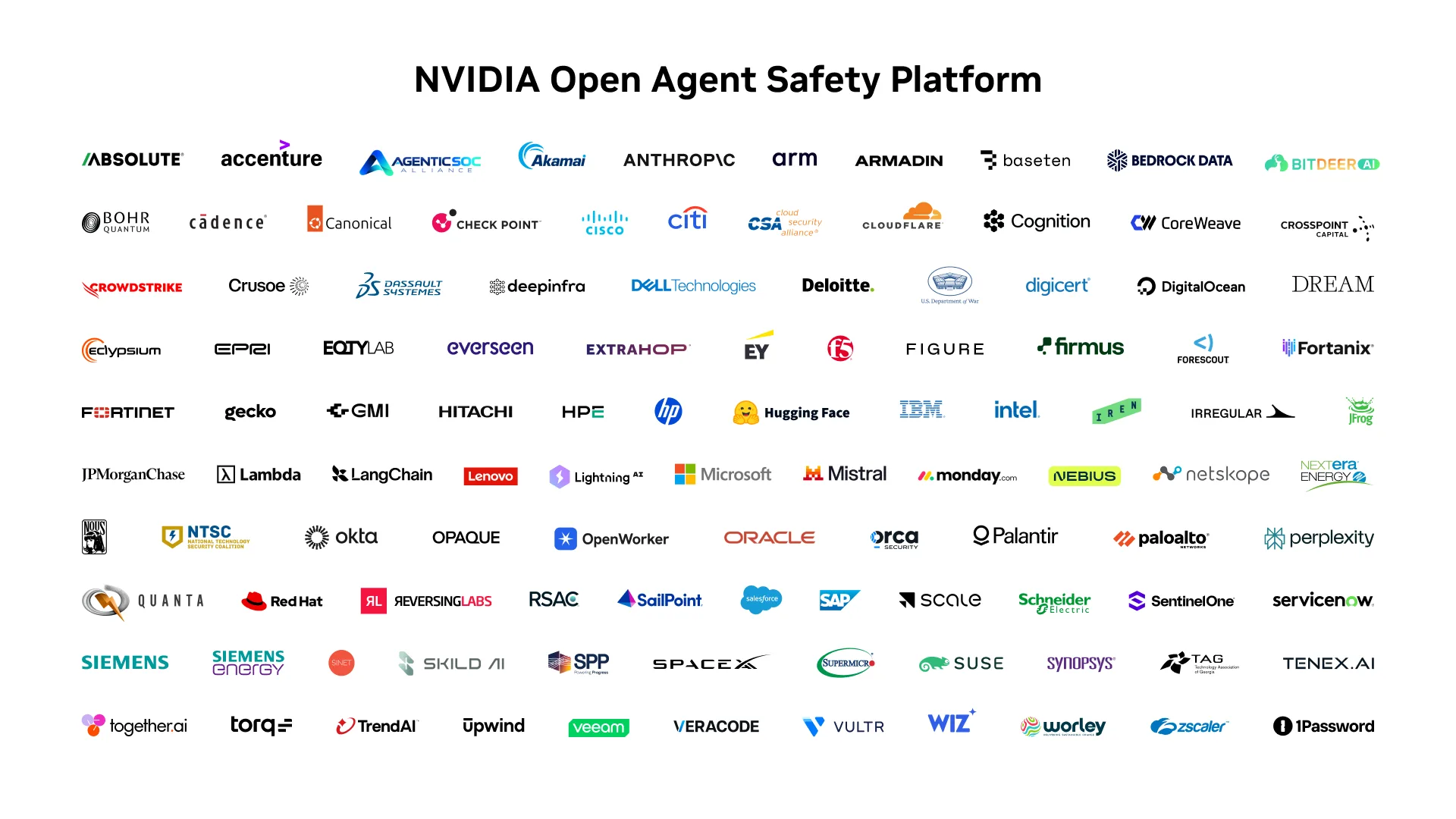
NVIDIA says more than 100 organisations are working with Open Agent Safety Platform technologies.
Participants include Anthropic, Cisco, CrowdStrike, Microsoft, Palantir, Salesforce, SAP, ServiceNow, Scale AI, Palo Alto Networks, Red Hat and others.
Anthropic is working with NVIDIA to add additional control layers around Claude Managed Agents, while Salesforce has integrated OpenShell with Slack so teams can review agent activity and approve or reject requests for additional permissions.
SAP is embedding OpenShell into its Joule Studio runtime, while Scale AI is using the platform’s reference design to support mission-critical agentic systems.
Financial services and critical infrastructure are also involved
The initiative extends beyond software vendors.
NVIDIA says Citi and JPMorganChase are collaborating on open-source agent safety technologies, while companies including Hitachi Energy, Schneider Electric and Siemens Energy are also working with the platform.
That matters because sectors such as banking, energy and public infrastructure face stricter requirements around access, auditability and operational risk.
As AI agents become embedded in these environments, organisations will need clearer answers to basic questions: what can the agent access, what actions can it take, how are those actions logged and what happens when it exceeds its permissions?
The new platform is designed around that governance problem.
Robotics raises the stakes
Robotics companies including Figure, Gecko Robotics and Skild AI are also working with OpenShell.
This expands the security challenge from digital systems into physical environments.
A software agent that behaves unexpectedly may create data or operational risk. A robotics agent can create physical safety risk as well.
For that reason, NVIDIA is extending the same policy enforcement and monitoring principles into autonomous machines.
Open source could help standardise agent security
OpenShell is available as open-source software, while the wider initiative is connected with the Open Secure AI Alliance.
NVIDIA says the alliance was initiated with more than 120 organisations and is governed by the Linux Foundation. Its goal is to support shared research, tools and security standards for AI agents.
That open approach could become important as enterprises increasingly operate multiple agents across different clouds, models and hardware environments.
A common security layer may help avoid fragmented control systems and make agent behaviour easier to audit across platforms.
AI agents are becoming an infrastructure security problem
The launch underlines a broader change in enterprise AI.
Traditional AI systems were largely prompt-and-response tools. Agents are increasingly persistent systems capable of acting across multiple applications and making decisions with limited intervention.
That makes security less about controlling what the model says and more about controlling what the system can actually do.
For enterprises, the challenge will be combining autonomy with strong boundaries.
NVIDIA’s Open Agent Safety Platform is aimed directly at that problem: giving businesses a way to let AI agents operate more independently without losing oversight, policy enforcement or the ability to intervene.
Availability
NVIDIA says OpenShell and other Open Agent Safety Platform software are available through its developer resources and GitHub.
The company also notes that some products and features remain in development and may change before broader commercial release.
About NVIDIA
NVIDIA is a global AI and accelerated computing company whose technologies span data centres, graphics, robotics and AI infrastructure.