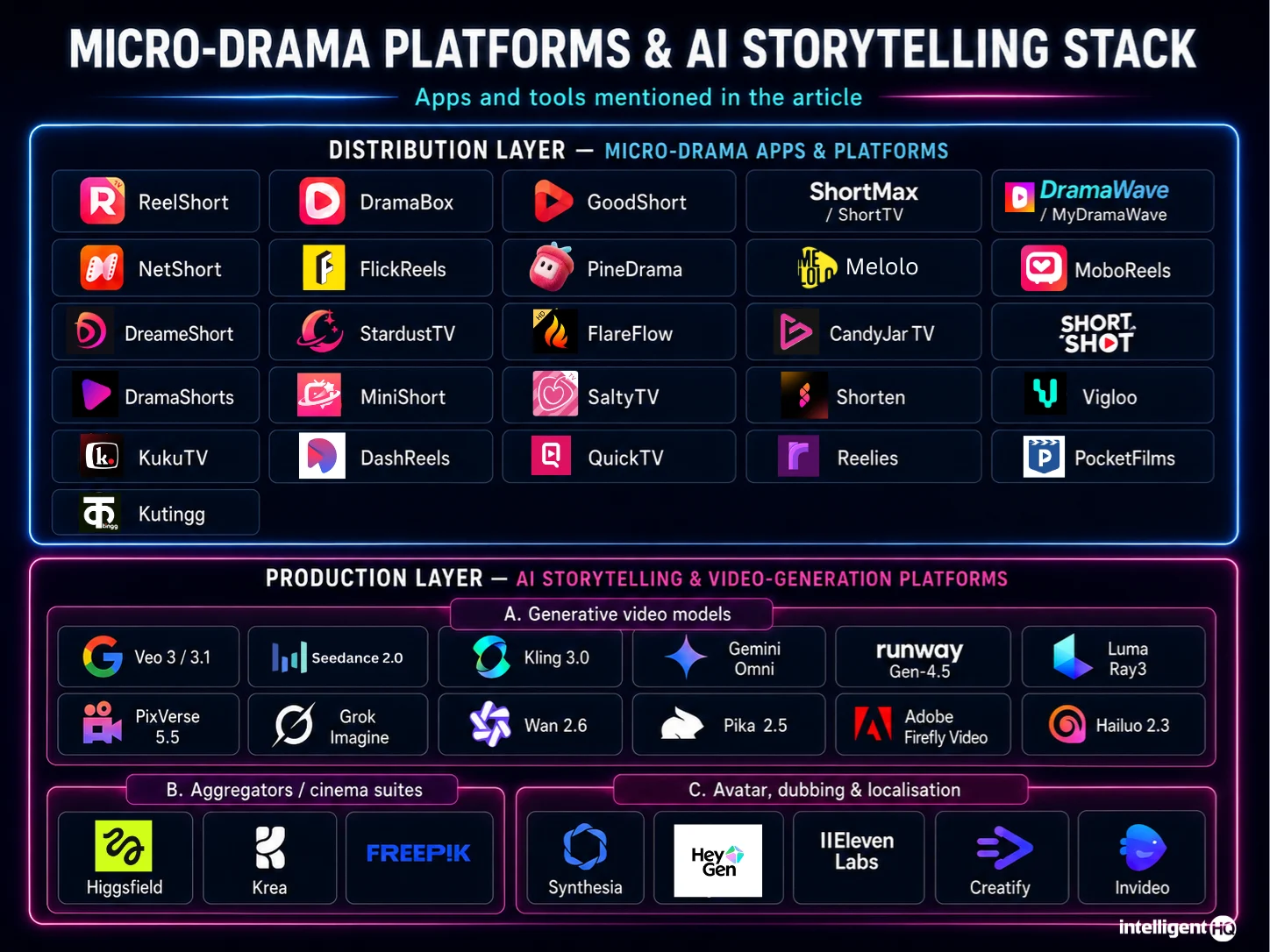
Micro-drama — the 60–90-second, vertical, cliffhanger-driven serial format that has become a multi-billion-dollar global category — sits at the intersection of two fast-moving ecosystems.
On the consumption side, more than 830 million people now watch micro-dramas globally, and Sensor Tower’s Short Drama IQ tracker alone follows 717 distinct apps as of mid-2026 — a figure that still excludes China’s domestic mini-program and platform-native ecosystem entirely.
On the tooling side, the generative-video market feeding those apps is compounding at 20–36% a year depending on scope (narrower “pure generation” estimates put it at roughly $847M–$946M in 2026; broader definitions including AI editing and avatars reach $3.67B), while individual platforms have already crossed startling absolute usage thresholds: Kling AI reports serving 60 million+ creators and generating over 600 million videos, Google’s Veo 3 logged more than 70 million videos in the two months after its 2025 launch, and monthly active users across AI video platforms collectively surpassed 124 million in January 2026.
This brief maps both, side by side:
- The distribution layer — the vertical-video apps (ReelShort, DramaBox, GoodShort, KukuTV, and many more) competing worldwide for the same fifteen minutes of a commuter’s attention.
- The production layer — the AI storytelling and video-generation platforms (Veo, Kling, Seedance, Runway, Higgsfield, Synthesia, HeyGen, and others) that studios are now using to write, cast, shoot, and dub those dramas without a soundstage.
The distribution layer — Micro-drama apps and platforms
More than 830 million people now watch micro-dramas worldwide, spread across a fragmented but consolidating field of apps.
The table below profiles the most significant platforms by business model, content focus and what makes each one distinct, drawn from platform trackers, app-store data and industry press as of mid-2026.
| Platform | Origin / Publisher | Monetisation | Genre Focus | Notable Data Point |
| ReelShort | Crazy Maple Studio | Coin unlocks + ad-rewards | Billionaire romance, werewolf/vampire, revenge | Breakout title The Double Life of My Billionaire Husband passed 500M+ views |
| DramaBox | StoryMatrix Pte Ltd | Coins + VIP subscription ($17.99–19.99/wk) | CEO romance, urban revenge, family drama | Top-10 grossing entertainment app on major app stores; $323M revenue, $10M net profit (2024) |
| GoodShort | — | Coins + subscription | Romance, thriller, historical, fantasy | Positions on “cinematic quality” and A-list crew |
| ShortMax / ShortTV | — | Coins | Billionaire, mafia, werewolf, revenge | High-volume catalog, fast content refresh |
| DramaWave / MyDramaWave | SKYWORK AI Pte Ltd | Coins + VIP ($19.99/wk) | Family drama, mafia, vampire romance | 50M+ Play Store installs across 18 languages; on-screen “danmu” comments |
| NetShort | — | Coins | Werewolf/CEO romance, martial arts, time-travel | Markets “unrepeatable originals” |
| FlickReels | — | Coins | Midlife/silver-haired romance (differentiator), mafia | 100+ title drop with 1/3 senior-protagonist stories |
| PineDrama | ByteDance / TikTok | Ad-free, no paywall (at launch) | Romance, fantasy, CEO | Quiet TikTok-parent entrant, testing a no-coin model |
| Melolo | — | Ads-for-coins | Romance, revenge, fantasy | Personalized recommendation engine |
| MoboReels | — | Free-to-sign-in + coins | Romance, fantasy, time-travel, C-drama | 1,800+ series tracked; multi-language subtitles |
| DreameShort | — | Coins | Forbidden love, secret heiress, supernatural | — |
| StardustTV | — | 10 free episodes, then 59 coins/ep | Palace drama, thriller, literary adaptation | 1,300+ series in English catalog |
| FlareFlow | Singapore–LA | Coins | Boardroom drama, urban romance, family conflict | Top 5 Google Play / Top 9 App Store within 3 months of April 2024 launch; 10M+ downloads across 177 countries |
| CandyJar TV | — | Coins/ads | CEO/boardroom, fantasy romance | Also adapts best-selling novels |
| Short Shot | — | Coins (10 free eps) | CEO, forbidden, werewolf romance | AI-driven recommendation engine |
| DramaShorts | — | Subscription (1080p, ad-free tier) | Billionaire, arranged marriage, martial arts | 10+ new exclusives monthly |
| MiniShort | — | Ad-unlock (2 eps/ad) | Romance, werewolf, boardroom | Smaller catalog, daily-binge focus |
| SaltyTV | — | Coins/subscription | Romance, thriller, reality-style drama | — |
| Shorten | — | Subscription ($14.99/wk, $149.99/yr) | Billionaire, double-life, Turkish drama | Supports 9 subtitle languages; 2K/4K streaming tiers |
| Vigloo | SpoonLabs, backed by Krafton | Subscription/coins | K-drama romance, comedy, thriller | Produced the first fully AI-generated 22-episode English series (see Part B) |
| KukuTV | KukuFM | Flat subscription (not coin-based) | Action, romance, mythology | Built on an existing audio-storytelling audience; 2-minute episodes, 50+ episode series across multiple regional languages |
| DashReels | Dashverse | Coins/subscription | Romance, thriller, webtoon-inspired | First platform to host fully AI-generated microdramas; multi-million users within months of launch |
| QuickTV | ShareChat | Ads/subscription | Hyperlocal, regional-language drama | Leverages an existing social-network user base to reach smaller cities and towns |
| Reelies | Independent | Coins/subscription | Romance, drama | Blends professional scripts with influencer-led casts for a social, creator-economy feel |
| PocketFilms | Independent | Low-cost daily pass | Crime, thriller, comedy, drama, horror | Deliberately avoids the “billionaire romance” trope in favour of genre variety; long-running short-film heritage |
| Kutingg | Independent | Freemium (1080p even on free tier) | Youth drama, thriller, romance | Emerging platform with a low-friction, coin-light model |
Sources: platform surveys, app-store audits, catalog trackers, and company disclosures, compiled across markets.
Reading the table: Note the near-total convergence on genre. Billionaire/CEO romance, werewolf and vampire fantasy, revenge, and secret-identity arcs recur across almost every platform worldwide — evidence that this is folk-tale architecture (Cinderella, Monte Cristo, the returning king) retooled for a coin economy, not a new genre being invented from scratch. Where platforms do differentiate, it’s usually through pricing model or a narrow content niche (silver-haired romance, hyperlocal-language storytelling, trope-avoidance) rather than a fundamentally different format. It’s also worth noting Seekho, a non-fiction cousin of the format: it borrows the identical vertical, swipeable, cliffhanger-driven UI and applies it to skills content instead of drama, a sign of how far the underlying interaction pattern has spread beyond storytelling itself.
Business model comparison
Micro-drama apps monetise through some blend of three levers: coins (pay-per-episode), subscriptions (flat-rate VIP access), and rewarded ads (watch-to-unlock). The mix says a lot about a platform’s target market.
| Model | How It Works | Typical Apps | Best For |
| Coin unlock | Free first 8–15 episodes, then ~10–60 coins/episode, coins bought in $0.99–$50 bundles | ReelShort, DramaBox, ShortMax, Shorten | Whales / binge-payers willing to spend $10–20 to finish one series |
| Flat subscription | Weekly/monthly/annual pass, unlimited viewing | Kuku TV (₹99–399), Shorten ($14.99/wk), DramaShorts | Budget-conscious, heavy-usage regional audiences |
| Ad-rewarded / hybrid | Watch an ad to unlock 1–6 episodes per day; VIP tier removes ads | Melolo, MiniShort, DramaBox (hybrid) | Casual users, markets with low willingness-to-pay |
| Ad-free, no paywall | Fully free at launch, monetised elsewhere (parent-platform data/ads) | PineDrama (TikTok/ByteDance) | Market-share land-grab by a platform that doesn’t need direct revenue yet |
The broader direction of travel across the category is toward advertising as the dominant revenue line — in China’s market, projections have advertising reaching roughly 56% of micro-drama revenue by 2030, versus about 39% subscription and 5% commerce — a sign that even coin-heavy apps elsewhere may eventually follow PineDrama’s ad-subsidised playbook rather than the other way around.
The production layer — AI Storytelling and video-generation platforms
This is the toolkit studios like Vigloo, Dashverse, and Shortical are assembling to write, cast, shoot, dub and localise vertical drama at a fraction of conventional cost — Dashverse’s 42-episode series Raftaar, for example, was produced for roughly 85–90% less than a conventionally-shot comparable, and in a fraction of the time.
The tools split into three functional categories that studios typically combine rather than choose between.
| Category | What It Does | Representative Tools | Micro-Drama Use Case |
| Generative video models | Text/image-to-video generation of raw footage | Veo 3, Seedance 2, Kling 3.0, Runway Gen-4.5, Luma Ray3, PixVerse, Grok Imagine, Wan 2.6, Pika 2.5 | Generating B-roll, establishing shots, action beats, fantasy/supernatural sequences impossible to shoot practically |
| Multi-model aggregators / cinema suites | One subscription, many underlying models, plus directing tools (camera, character consistency) | Higgsfield, Krea, Freepik | Full-episode “virtual production” — shot planning, consistent characters across 22–42 episodes |
| Avatar / presenter & localisation tools | Script-to-talking-head video, voice cloning, dubbing, translation | Synthesia, HeyGen, ElevenLabs, Creatify, Invideo | Turning a 6-month dubbing pipeline into a 48-hour one; AI-hybrid performers |
The cinematic generative models
These are the raw engines that generate footage from a prompt. Independent hands-on testing (Synthesia, Magic Hour, March–June 2026) converges on Veo 3, Seedance 2 and Kling 3.0 as the current top tier for realism and physics, with each having a distinct trade-off.
| Tool | Best For | Max Resolution | Max Clip Length | Native Audio | Entry Price |
| Veo 3 / 3.1 (Google) | Cinematic realism, tightly synced audio | 4K | ~8 sec | Yes — strongest in category | $19.99/mo (Flow, via AI Pro) |
| Seedance 2.0 (ByteDance) | Camera choreography, physics, budget audio-video | 720p | ~15 sec | Yes | ~$9.60/mo (Dreamina) |
| Kling 3.0 (Kuaishou) | Controllable, production-ready realism | 4K | ~15 sec (up to 2 min in some modes) | Yes (2.6) | $6.99–$10/mo |
| Gemini Omni | Automatic multi-shot filmmaking, conversational re-editing | 4K (Ultra tier) | ~10 sec | Yes | $19.99/mo |
| Runway Gen-4.5 | Character consistency, directed editing (Aleph) | 720p+ | ~10–16 sec | No (separate audio tools) | $12/mo |
| Luma Ray3 | Aesthetic/atmospheric visuals; chains up to 5-minute sequences | 4K | ~5–10 sec per clip | No | $9.99/mo |
| PixVerse 5.5 | Fast, social-ready short clips | 1080p | ~5–6 sec | Yes (noisier) | $10/mo |
| Grok Imagine | Stylised, imaginative, fantasy-forward mood | 720p | ~15 sec | Yes | $10/mo |
| Wan 2.6 | Reliable, least content-restricted, cheap workhorse | 1080p | ~5–15 sec | Yes (rough) | $49/mo (or free local run) |
| Pika 2.5 | Viral effects (Pikaffects/Pikaswaps/Pikascenes) | 480p free / 1080p paid | ~5–10 sec | No | $8/mo |
| Adobe Firefly Video | Adobe-ecosystem integration, concept stills | 1080p | ~5 sec | No | $9.99/mo |
| Hailuo 2.3 | — (currently lagging the field) | 1080p | ~6–10 sec | No | $14.99/mo |
Compiled from Synthesia’s and Magic Hour’s independently tested 2026 benchmarks; figures approximate and change frequently as vendors update models.
Why this matters for micro-drama specifically: the format’s defining constraint — one reversal per 60–90 second episode, rarely more than two faces in frame — maps almost perfectly onto what today’s models can already do reliably. A single AI-generated clip (5–15 seconds) plus a handful of dialogue/reaction shots covers most of an episode, which is precisely why AI-native studios like Vigloo can produce 22 episodes in eight weeks with a crew of under ten.
The Aggregators — One subscription, many models
Rather than committing to a single frontier model, most working studios now access several through an aggregator that adds direction and consistency tools on top.
| Aggregator | Positioning | Standout Feature | Pricing | Watch-outs |
| Higgsfield | Full “virtual production studio”; 25M+ users, $1.3B+ valuation, Series A ($80M, Jan 2026) | Cinema Studio 4.0: real camera-body/lens/aperture simulation, up to 3 stacked camera movements, 70+ director presets; Soul ID for character consistency across shots; Marketing Studio (9 ad formats from one product photo) | $15–$84/mo (credit-based; premium models cost 40–70 credits each) | Credit economics can be punishing at scale (community reports of $1,000+ for full brand workflows); a February 2026 Forbes investigation flagged deepfake and content-moderation concerns |
| Krea | Automation-first, node-based workflows | Repeatable pipelines across image/video/3D/motion | Competitive but less generous free tier than Higgsfield | Best suited to technically fluent teams |
| Freepik | Originally stock media, now a full AI creative workspace | Unlimited AI image generation + node workflows | Subscription bundles video + image | Newer to video specifically |
Higgsfield in particular has become the de facto “one-stop shop” cited across 2026 trade coverage for exactly the kind of episodic, character-consistent, multi-shot production micro-drama demands — its Soul ID system exists specifically to solve the “does the lead actress look the same in episode 14 as episode 1” problem that plagues naive prompt-by-prompt generation.
Avatar, localisation and “Work” tools
A second cluster of tools isn’t about generating cinematic footage at all — it’s about scripts, presenters, dubbing and scale. This is the layer responsible for one of the format’s biggest shifts: localisation has moved from a six-month, six-figure process to a 48-hour, four-figure one.
| Tool | Category | Best For | Key Numbers |
| Synthesia | Enterprise avatar video | Training/corporate, but increasingly narrative dubbing pipelines | 240+ avatars, 160+ languages, used by 90%+ of Fortune 100; from ~$30/mo |
| HeyGen | Avatar + multilingual dubbing | Fast script-to-talking-head; localisation at scale | 700+ presenters, 175+ languages with lip-matched dubbing; from $29/mo |
| ElevenLabs | Voice cloning / narration | Emotional voice performance, audiobook-style narration | Rated among the strongest for “hyper-real” voice cloning |
| Creatify | UGC-style ad generation | Turning a single product photo into a full ad in minutes | Template-driven, integrates directly with Meta/TikTok ad accounts |
| Invideo | One-prompt marketing video | Full video (script + visuals + voiceover) from a brief | 1080p, but generation can take up to an hour |
The broader “AI Storytelling” category
A wider tier of tools markets itself directly at writers and narrative creators rather than video producers — long-form fiction assistants (Sudowrite, NovelAI), collaborative-worldbuilding apps (Summon Worlds, Friends & Fables), and general LLMs used for scripting and dialogue polish (including Claude, Gemini, and GPT-class models). These matter upstream of the video-generation stack: before any footage is generated, someone (increasingly, a human-AI pairing) still has to write the sixty-second reversal that makes the cliffhanger work. Industry commentary — Angela Yu of StoReel’s line that “everybody’s taste” is what will actually be competitive once generation is free — applies directly here: the writing layer, not the rendering layer, is where the remaining human bottleneck sits.
A methodological note: marketing surveys of this specific sub-category (AI storytelling apps aimed at hobbyist writers) are thin, self-promotional, and often published by vendors ranking themselves first — treat comparative “ratings” in this space with more skepticism than the video-generation benchmarks above, which come from named, hands-on testers.
Where the two layers meet
Putting Parts A and B together, three production patterns have emerged among micro-drama studios in 2026:
| Pattern | Description | Example |
| AI-assisted | Human cast and shoot; AI used for localisation, marketing variants, and post | The dominant model across most ReelShort/DramaBox/GoodShort-style catalogs today |
| AI-hybrid | Human writers/directors; synthetic performers and environments generated via Kling/Seedance/Higgsfield-class tools | Shortical’s Bound by Fire — audience response reportedly on par with live-action titles |
| AI-native | Entire pipeline — script, visuals, voice performance — is generative | Vigloo’s Bloodbound Luna (22 episodes, <10 people, 8 weeks); Dashverse’s Raftaar (42 episodes, ~85–90% cost reduction); DashReels, an early platform hosting fully AI-generated microdramas |
The market chart above is the economic backdrop against which all of this tooling investment makes sense: revenue outside China is growing at roughly 28.4% CAGR against China’s 11.5%, meaning the next wave of platform and tooling competition will increasingly be fought across the US, Japan, Korea, South and Southeast Asia, and Latin America alike — markets where AI-native production cost advantages matter most, since none of them have China’s decade-long head start in conventional micro-drama crew and studio capacity.
Key takeaways
- Platform consolidation is genre consolidation. Nearly every major micro-drama app — ReelShort, DramaBox, GoodShort, ShortMax, NetShort, DramaShorts, Shorten, KukuTV, DashReels — competes on the same handful of tropes (billionaire romance, werewolf/vampire fantasy, revenge, secret heirs) worldwide. Differentiation increasingly comes from monetisation model and niche audience (FlickReels’ “silver-haired romance,” PocketFilms’ trope-avoidance, KukuTV’s flat-subscription pricing) rather than genre invention.
- AI-native production is emerging in parallel, everywhere. The world’s first fully AI-generated commercial micro-drama slates have appeared on platforms in South Korea (Vigloo) and South Asia (Dashverse/DashReels) within months of each other — not as one region copying another, but as independent studios arriving at the same production logic once the underlying models became capable enough.
- No single AI video model wins everything. Studios combine tools by task: Kling or Seedance for cinematic realism, Runway for character consistency, Higgsfield for full “virtual production” direction, Synthesia/HeyGen for dubbing and localisation at scale. The aggregator layer (Higgsfield, Krea, Freepik) exists precisely because this fragmentation is now the normal way of working.
- The bottleneck has moved, not disappeared. As generation itself becomes commoditised and cheap, the scarce resource shifts to story architecture, taste, and character-consistency engineering (Soul ID, Runway’s reference system) — the tools that automate camera and cast are proliferating fast, but “the Michelin approach will fail” remains the operating logic: portfolio velocity beats prestige polish.
Sources
- Mbrella Films, Top 22 Microdrama (Short Drama) Apps Platforms, September 2025 (updated 2026). https://mbrellafilms.com/insights/best-microdrama-short-drama-platforms/
- Square Infosoft, Microdrama Apps: Top Short Drama Platforms 2025, December 2025 (updated June 2026). https://www.squareinfosoft.com/best-microdrama-apps-2025/
- Social Media Dissect, India’s Microdrama Revolution: The 4 Companies Leading the Way, September 2025. https://www.socialmediadissect.com/indias-microdrama-revolution-the-4-companies-leading-the-way/
- MicroDrama Radar, platform catalog and tracker. https://www.microdramaradar.com/en/platforms
- AnimateAI, Top 10 Best AI Storytelling Platforms for Creators in 2026 USA, February 2026. https://animateai.pro/blog/top-10-best-ai-storytelling-platforms-for-creators-in-2026-usa/
- Synthesia, The 18 Best AI Video Generators in 2026 (Tried & Tested), June 2026. https://www.synthesia.io/post/best-ai-video-generators
- Magic Hour, 10 Best AI Video Generators in 2026, updated June 2026. https://magichour.ai/blog/best-ai-video-generators
- Higgsfield, product pages and third-party 2026 reviews (gstory.ai, browsing.ai, mcstarters.com, fluxnote.io, beginnersinai.org). https://higgsfield.ai/generate/all
- Wikipedia, Microdrama, background and China market history.
Figures and pricing change quickly in this category; all data reflects publicly available information as of August 2026.