Most PIM evaluations start with a comparison table, and by the time that table is filled in, every shortlisted product carries roughly the same checkmarks. The matrix eliminates the obviously unsuitable vendors and then stops being useful, because every serious vendor spent the last three years building the same capabilities. What did not converge is how each system behaves when the incoming data is a mess, and in retail it usually is: one supplier file holds an article number, a name and a price, another calls the same attribute something else, specifications arrive as a PDF, and half the category values match nothing in your taxonomy.
Run the evaluation on your own data instead. Take the messiest supplier file you have, hand it to each vendor, and follow one product from import through mapping, validation, enrichment and approval to a published record. Count the steps that need a person, a support ticket, or a developer. That count is the real difference between platforms.
This guide breaks that test into five criteria: where your product data comes from and what condition it arrives in, which model of AI enrichment your catalog actually needs, deployment and ownership, what the total cost includes, and whether the system is ready for the channels your product data now has to reach. The examples come from catalog migrations run at HootCore, which builds PIM software for retailers and distributors, where the same handful of problems appears regardless of which platform a company came from.
What PIM Software Actually Does (and What It Does Not)
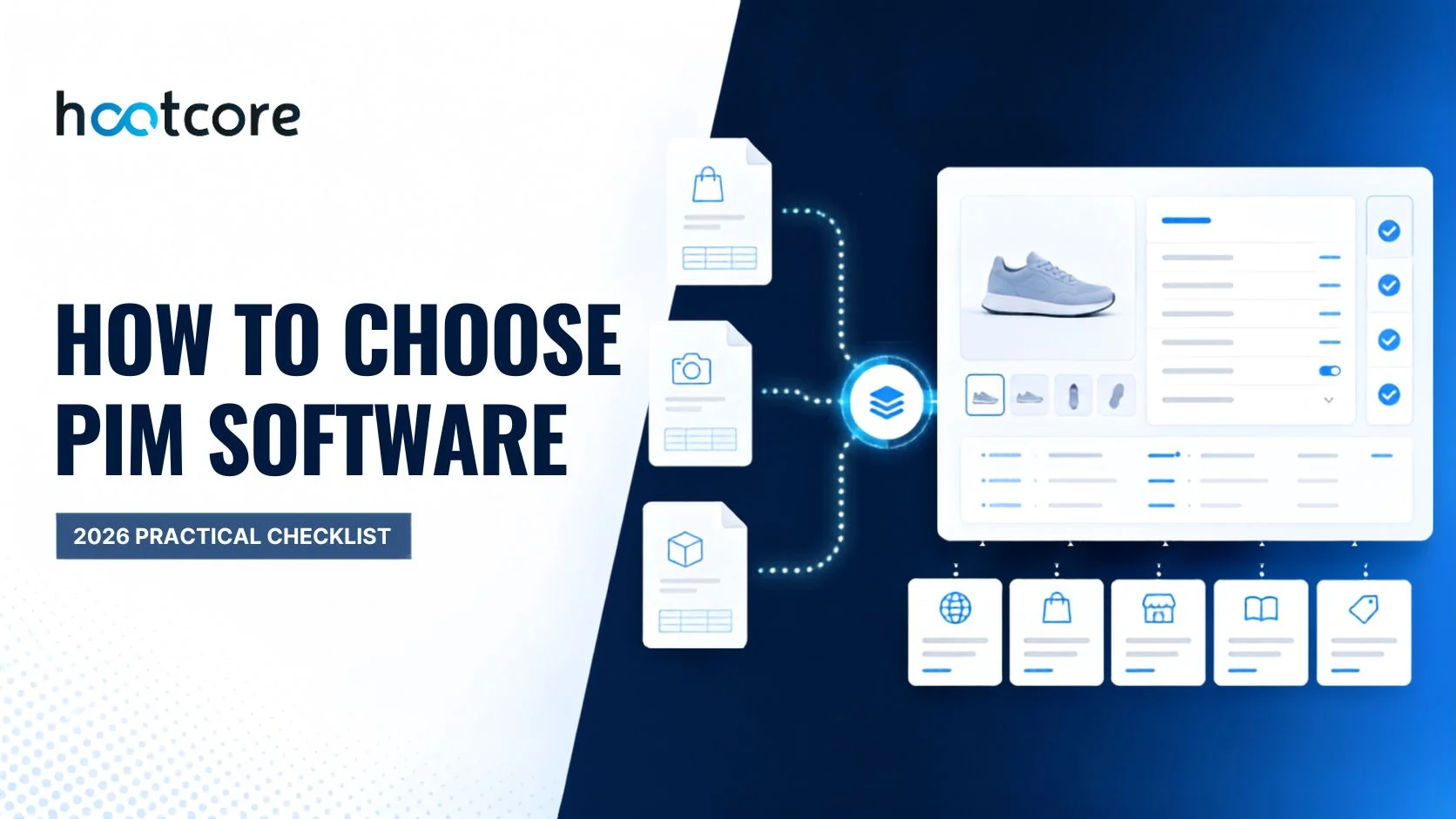
PIM software sits between the systems that create product information and the channels that consume it. Its job is to hold an approved product record and control how that record is prepared for each destination: a marketplace may demand a fixed category structure and mandatory specifications, whereas your own site uses longer descriptions, richer media and localized content.
Other parts of the record stay where they are. Prices and inventory come from the ERP, original media files can remain in a DAM, and order processing belongs to an OMS or commerce platform. Every field needs one clear owner, or systems will overwrite each other.
What a PIM does not do is clean the data you load into it. A system that receives an article number and a price returns a record with an article number and a price, unless something enriches it first. It will not decide your taxonomy, and it will not resolve which of two suppliers is right about a specification; it will show you that they disagree.
Five Criteria That Separate PIM Vendors
1. Where Your Product Data Comes From, and What Condition It Arrives In
Catalog volume dominates PIM conversations and says almost nothing about difficulty. A retailer receiving 500,000 products through one stable feed has an easier problem than a distributor collecting 40,000 from 300 manufacturers.
Map every source that contributes to a product record. For each one, write down the format and delivery method, the update pattern, the identifiers available, the gaps that recur, and who fixes the source when something breaks. Companies set out to buy attribute storage and discover that their real problem is matching the same product across six supplier files, or pulling specifications out of PDFs before a record can be completed at all.
Then bring the messiest of those files to the vendor demo. Any system will import a spreadsheet that already follows its structure, so a prepared demo catalog proves very little.
Take a common attribute such as screen size. One supplier calls it Screen Size, another Display Diagonal, a third just Diagonal. Values arrive as 15.6, as 15,6 inches, as 396 mm. Ask the vendor to show how those columns and values become one attribute with one unit.
Then run the same import a second time, with the changes that happen in production:
- rename one supplier column
- add a value that does not exist in the dictionary
- submit a barcode that already belongs to a product in the catalog
- remove a required attribute from several rows
- change a parent product while leaving its variants in the file
The second run shows whether mappings can be saved and reused, whether the platform distinguishes new records from updates, and how it treats probable duplicates.
Watch what happens to failed rows. Catalog managers need to see which product was rejected, which value caused it, and what to do next. A technical log written for integration engineers pushes exception handling back into spreadsheets and support tickets, which is where it was before you bought anything.
Ask about recovery in the same session. If a bad mapping rewrites 40,000 records, find out whether that update can be reviewed and reversed without restoring a database backup.
2. Three Models of AI Enrichment and Which One You Need
AI enrichment now appears in every PIM comparison, and the label covers three different jobs.
Content generation works from information already in the product record and produces titles, descriptions, bullet points, translations, and SEO fields.
Document extraction finds specifications inside supplier PDFs, images, spreadsheets, or unstructured text and assigns them to the right attributes.
Source-based enrichment searches approved external sources when the submitted record does not contain enough information.
Which one you need depends on where the missing data sits. A content generator helps a team that has complete technical data and no channel-ready copy, and does nothing for a supplier file holding a product name and a price. Document extraction works when the information exists somewhere in the materials you received. Source-based enrichment applies when it exists nowhere in your possession.
The third model carries a risk the first two do not. Product data circulates: one retailer enters a figure incorrectly, three others copy it, and to any retrieval system four matching pages look like independent confirmation.
Coverage tells you how many fields were filled. It says nothing about which of them are true. The HootCore AI product data enrichment service attaches a confidence score and the source page or document to every enriched value, and leaves a field empty when nothing verifies it, so the catalog team reviews a gap instead of inheriting an unsupported number.
3. Deployment, Architecture and Ownership
Start with where the system runs: cloud, your own infrastructure, or a hybrid. For European retailers, this is frequently the deciding criterion rather than a technical footnote, since data residency, security review, and internal compliance can rule out an otherwise suitable platform. If on-premises deployment matters to you, ask for resource, monitoring, logging, and backup requirements during evaluation, and for the difference in price against the cloud edition.
Product scope is the next decision. Some retailers connect separate PIM, CMS, and OMS products; others prefer fewer systems. HootCore licenses PIM, CMS, and OMS separately, which lets a retailer start with one module and add the others later. Enrichment also runs as a standalone API service for teams that keep their existing catalog system.
Then name an owner for each of the following:
- infrastructure, backups, and security updates
- platform releases and compatibility testing
- supplier mappings and catalog configuration
- API monitoring and failed transfers
- connector updates when an ERP or channel changes
- documentation, training, and user support
Custom development deserves particular scrutiny. Confirm which parts of the proposed workflow use standard configuration, which require code, and whether those changes survive future releases. Where an implementation partner is involved, the contract should state who owns the code and documentation and who is able to maintain it later.
4. What the Total Cost Actually Includes
The license quote is the clearest number in any PIM proposal and the smallest part of the bill. A useful comparison separates five groups.
- Platform pricing: subscription, users, SKUs, channels, locales, environments, storage, API volume.
- Implementation: discovery, catalog modeling, configuration, migration, testing, training.
- Data and integrations: source cleanup, supplier mappings, ERP connections, channel connectors, custom development.
- Ongoing work: hosting, support, monitoring, upgrades, documentation, internal administration.
- Expansion: additional markets, new suppliers, higher AI usage, larger catalogs, capabilities gated to another plan.
Build the estimate around the catalog you expect to run in three years, then repeat it with more suppliers, channels, and products. Pricing thresholds that look irrelevant during a pilot become the main line item once the system spreads across business units or markets.
One item deserves a direct question: how implementation is priced. An hourly rate with no ceiling transfers all the estimating risk to you, and it is the single most common reason a deal that passed budget approval falls apart later.
Implementation assumptions belong in the estimate too. If you are expected to clean source files, define the taxonomy, prepare mappings, or build integrations, those tasks consume budget and staff time whether or not they appear on the software invoice.
5. Whether the System Is Ready for Channels That Did Not Exist Two Years Ago
Product data used to end its journey on your own product page. It now leaves through structured feeds submitted directly to AI shopping assistants, where required fields decide whether a product enters the index at all and completeness decides whether it gets recommended.
The practical implication for PIM selection is narrow but real. Ask how the system exports to a feed specification you do not control today, how quickly a new required field can be added across a category, and how completeness is measured per channel rather than globally. A platform that treats channel requirements as a fixed list will need development work every time one of those specifications changes, and they are changing frequently.
Gartner has predicted that organizations will abandon 60% of AI projects unsupported by AI-ready data through 2026, and in the survey behind that forecast, 63% of organizations either lacked the data management practices AI requires or were unsure whether they had them. The constraint is rarely the model. It is what the model is given to work with.
Questions to Ask at the PIM Demo
Bring one of your own supplier files and follow its data from import to an approved, published record.
Import and mapping
- Can catalog managers create and update mappings without developers?
- Can mappings be saved and reused for later imports?
- What happens when a supplier renames, adds, or removes a column?
- How does the system standardize attribute names, units, and category values?
- How are products from different suppliers matched by SKU, barcode, or manufacturer code?
Validation and enrichment
- Where do users see incomplete, rejected, or conflicting records?
- Can an incorrect bulk update be reviewed and reversed?
- Can users see the source of each AI-enriched value, and a confidence score?
- What does the system do when it cannot verify a value?
Deployment and integrations
- Can the platform run in our own infrastructure, and how does that change the price?
- Which parts of the proposed workflow require custom development?
- Who owns customizations, and how are they tested during upgrades?
- Who monitors integrations after launch?
Cost and exit
- Is implementation quoted as a fixed scope or an open hourly rate?
- Which pricing limits apply to users, SKUs, channels, storage, APIs, and AI usage?
- Can product records, taxonomy, relationships, assets, and history be exported in usable formats?
Conclusion: How to Choose the Right PIM System
A feature matrix narrows a long list. It cannot show how much work the chosen system will leave with your catalog team, and that is the number the business will feel every week.
Give every shortlisted vendor the same starting material: your supplier files, your identifiers, your product relationships, your missing fields, your channel requirements. The platform that handles them with the fewest interventions is the one that will cost you the least after launch, whatever the license comparison says.
And if a vendor cannot show you the screen where their system declined to fill a field, along with the sources it checked before declining, the coverage percentage in their deck is not telling you anything.