Like many other types of cases, personal injury cases often come with a lot more than just accident reports and medical bills. There are years of treatment records, photos, expert opinions, insurance correspondence, details… all of which should be kept nicely organized.
It’s 2026, and there are many modern technologies available that help with this. Law firms turn to them when they want to manage cases more accurately and respond faster when new evidence appears.
If you’re on the lookout for these innovations, keep reading.

Cloud-Based Case Management Keeps Every Detail in One Place
It’s well-known that strong case management depends on good organization. Personal injury claims usually involve medical records, insurance correspondence, police reports, witness statements, expert opinions, and more.
When all these documents are located in different systems, it takes more time to find important information and respond to new developments.
But no one should be this inefficient when there are cloud-based case management platforms. They keep everything together in the same, secure place, so it’s easy to find case files, upload documents, assign tasks, follow deadlines, communicate, and more.
This means there’s no endless, messy paperwork anymore and everyone is up to date.
Here’s a simple example of how these platforms help in practice. Someone has been injured in a car accident and needs legal help in Newburgh. There are countless papers involved — police and medical reports, witness statements, etc.
When this person chooses their personal injury lawyer Newburgh who uses secure cloud-based case management, they’ll have every single document properly organized and safely stored in one place. They won’t have to wait for files to be shared between different parties.
AI-Powered Document and Medical Record Review Saves Time
Now that all case files are placed in one system, it becomes easier to review them. And this is another field full of modern advancements, mainly powered by AI.
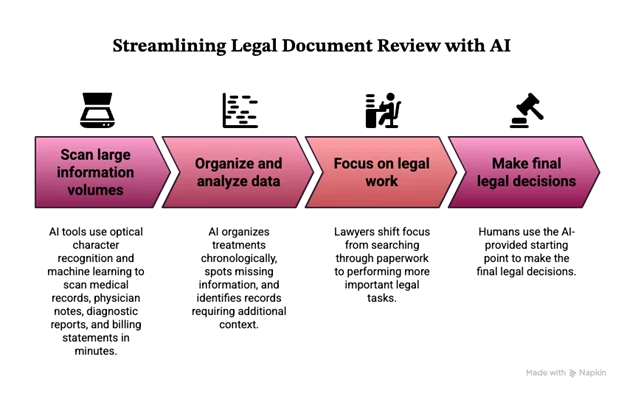
AI tools can help legal teams work with and through large volumes of information without spending hours sorting documents by hand.
Most modern tools use optical character recognition (OCR) and machine learning to scan medical records, physician notes, diagnostic reports, and billing statements in a matter of minutes.
Then, they can organize treatments chronologically, spot what’s missing, and find which records need more context. Lawyers, rather than being stuck with searching through paperwork, can focus on more important work.
Not only has the legal industry embraced AI, but it expects it to play an even bigger role in the years ahead. Thomson Reuters’ Future of Professionals Report notes that 80% of respondents believe AI will have a high or transformational impact on their work within the next five years.
The impact is already here and visible through faster document review, better organization, and more informed case preparation.
Important: AI isn’t replacing humans any time soon; they still make the final legal decisions with a better starting point.
Digital Evidence Provides a More Complete View of an Accident
As mentioned previously, personal injury cases often bring more than photographs and witness statements. That means there’s a lot to verify.
Digital evidence gives lawyers additional ways to verify what happened before, during, and after an accident.
Every case is a unique story, but evidence can include vehicle telematics that record speed, braking, or steering inputs before a collision. For evidence about heart rate and mobility changes after an injury, smartwatches are another source.
In more complex cases, drones and 3D imaging can capture accident scenes from lots of different angles.
Regardless of what the sources are, when they all point to the same story, they create a stronger foundation for a claim. They help verify timelines, support medical records, and fill in details that traditional evidence sometimes doesn’t.
Of course, every piece of digital evidence still needs to be collected, preserved, and reviewed before it becomes part of a legal claim.
Predictive Analytics Supports Better Legal Decisions
The more information a legal team has, the easier it is to evaluate a case from different angles. As the final touch, predictive analytics then compares current claims with larger sets of historical legal data.
These platforms can review factors such as injury severity, medical expenses, liability, settlement history, and court outcomes to estimate a reasonable case value.
They can also point out patterns that help legal professionals assess any potential risks before recommending whether to negotiate or prepare for trial.
And while no tool is perfect and can’t predict the exact outcome of a case, these useful insights can give legal teams another source of information.
In the end, technology helps and improves much of the work, but it works best when paired with legal experience. Every personal injury claim has its own facts, and no algorithm can account for every circumstance, witness, or piece of evidence. Humans are still there to check the details, advise their clients, and make the best decisions for the case.