Google has introduced Gemini 4 Carbon, its latest frontier artificial intelligence model, designed to strengthen cybersecurity defence, software engineering and complex autonomous workflows. Announced on 28 October 2026, the model represents a significant development in the use of AI to identify software vulnerabilities, validate security threats and generate corrective code before weaknesses can be exploited by malicious actors.
Developed by Google DeepMind, Gemini 4 Carbon builds on the capabilities of Gemini 4 Argon, with improvements across cybersecurity benchmarks and long-duration engineering tasks. Google reports that the new model achieves 88.2% on SEC-bench Pro for vulnerability discovery, 54.8% on ExploitGym for vulnerability exploitation and 71.0% on CWE-bench for software patching. These results, measured in controlled evaluations, suggest that increasingly capable AI systems could help security teams address vulnerabilities at a scale difficult to achieve through manual processes alone.
The announcement comes as organisations worldwide integrate AI agents into software development, cloud infrastructure, financial services and critical business operations. While AI can accelerate security analysis and vulnerability remediation, its growing ability to discover and exploit weaknesses also introduces serious dual-use concerns. The development of Gemini 4 Carbon therefore highlights an important question for enterprises: can AI-powered security systems become sufficiently capable, reliable and controlled to defend increasingly complex digital environments?
Gemini 4 Carbon Sets New Cybersecurity Performance Benchmarks
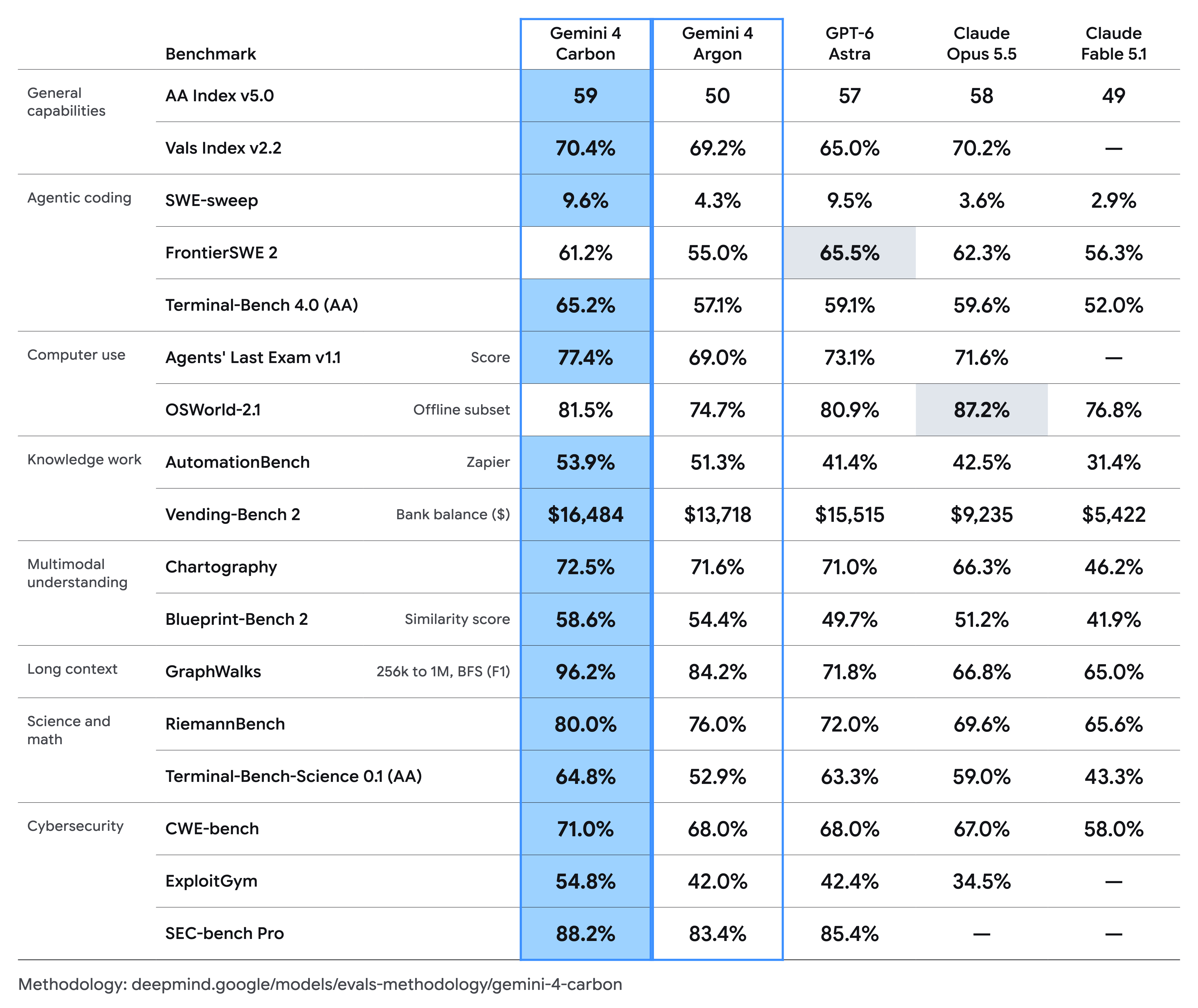
One of the most significant developments in Gemini 4 Carbon is its ability to perform multiple stages of the cybersecurity lifecycle, including identifying vulnerabilities, assessing exploitability and producing working software patches. Traditionally, these activities have required different security tools, specialist expertise and substantial human review. An AI system capable of supporting all three activities could help organisations reduce the time between discovering a vulnerability and implementing an effective security fix.
According to Google’s published results, Carbon achieved 88.2% on SEC-bench Pro, a benchmark designed to assess vulnerability discovery in software. It also recorded 54.8% on ExploitGym, which evaluates exploitation capabilities, and 71.0% on CWE-bench, which assesses the ability to repair software weaknesses. Google reports that Carbon more than doubled the success rate of its predecessor, Gemini 4 Argon, in generating secure code during internal evaluations.
The improvements extend to complex coding environments. Google’s Chrome team reported that Carbon performed more than ten times better than an unnamed competing frontier model at generating high-quality software patches in its evaluation. The company also describes the model as capable of working through multi-step engineering problems over extended periods, including identifying the underlying causes of difficult software bugs across large codebases.
These results are promising, although benchmark performance does not guarantee identical outcomes in production environments. Enterprise systems involve legacy applications, interconnected dependencies, operational restrictions and unpredictable security conditions. Organisations deploying AI for cybersecurity will still need independent validation, reliable testing environments and human oversight before allowing automated systems to modify critical infrastructure.
Why AI-Powered Cybersecurity Is Becoming a Business Priority
Cybersecurity has become a central business concern as organisations grow increasingly dependent on cloud platforms, digital transactions, interconnected applications and AI-enabled workflows. Every additional software integration or autonomous agent can create potential security vulnerabilities, increasing the difficulty of monitoring complex enterprise environments.
Traditional security operations often depend on identifying known threats, reviewing alerts and deploying patches through established incident-response processes. However, the volume of software vulnerabilities and the speed at which attackers can exploit them create significant operational pressure. AI-assisted security systems offer the possibility of continuously analysing code, identifying weaknesses and supporting remediation without relying exclusively on manual investigation.
For businesses, the value of advanced cybersecurity AI extends beyond detecting malicious activity. Systems capable of identifying vulnerabilities earlier in the software development process could reduce remediation costs, improve operational resilience and help prevent business disruption. Financial institutions, healthcare providers, technology companies and public-sector organisations could benefit from faster vulnerability analysis, particularly where sensitive information and essential services are involved.
Nevertheless, effective deployment will depend on integration with existing security controls. An AI model that identifies vulnerabilities must also provide sufficiently accurate findings, understandable explanations and reliable evidence for security teams to act on. False positives, incomplete patches and incorrectly prioritised vulnerabilities could otherwise create additional work or introduce new risks.
Google Prioritises Cyber Defenders Before Wider Public Access
Unlike conventional AI product launches, Gemini 4 Carbon is initially being made available to a limited group of cybersecurity defenders rather than the general public. Google is distributing early access through its Fairwind Program, which gives selected organisations an opportunity to evaluate advanced cybersecurity capabilities while the company continues refining its safety measures. Google has also confirmed its participation in a voluntary US government process for pre-release model testing.
This phased deployment reflects the dual-use nature of advanced cybersecurity AI. A model capable of discovering security weaknesses and validating exploits can support legitimate vulnerability research, but similar capabilities could potentially be misused to identify and exploit weaknesses in systems without authorisation. Restricting initial access allows Google to gather feedback from trusted defenders while evaluating safeguards against misuse.
Google has also reported improvements in the model’s resistance to prompt injection, a technique in which malicious instructions attempt to manipulate an AI system through untrusted content. In the company’s evaluations, Carbon recorded a 0% attack success rate on the tested Gray Swan indirect prompt-injection benchmark, compared with 0.7% for Argon. Although these findings are encouraging, they do not establish immunity against every possible attack or security scenario.
From AI Assistants to Autonomous Cybersecurity Agents
Gemini 4 Carbon also represents a development in long-horizon AI reasoning, where models can work through complex tasks requiring multiple steps and sustained execution. Google reports that its internal teams have used Carbon to investigate difficult engineering problems over periods lasting several days, including tracing software defects and developing fixes across extensive codebases.
This capability could contribute to the development of autonomous cybersecurity agents that continuously inspect applications, prioritise security weaknesses and recommend corrective action. Instead of functioning only as assistants that respond to individual requests, these systems could increasingly support ongoing security operations under defined human supervision.
The economic implications are substantial. Organisations may eventually be able to reduce the manual effort involved in vulnerability management while enabling cybersecurity professionals to concentrate on strategic risk assessment, incident investigation and complex security decisions. However, autonomous agents also require clearly defined permissions, audit trails and mechanisms for preventing unintended actions.
What Gemini 4 Carbon Means for the Future of Enterprise Security
Google plans to expand Gemini 4 Carbon’s availability to developers, businesses and consumers, although it has not announced a specific timetable for general access. Its introductory API pricing is set at $2 per million input tokens and $10 per million output tokens, rising to $4 and $20 respectively after the introductory period.
The announcement demonstrates how competition among frontier AI developers is increasingly extending into specialised enterprise capabilities, including cybersecurity, software engineering and autonomous operational systems. For organisations evaluating these technologies, performance improvements must be considered alongside reliability, governance, deployment costs and measurable security outcomes.
Gemini 4 Carbon offers an early indication of how AI might reshape vulnerability detection and software remediation, but its long-term impact will depend on real-world performance and responsible adoption. As AI systems become more capable of identifying, validating and repairing security weaknesses, enterprises will need to reconsider how digital security is organised, monitored and governed.
The central challenge is no longer simply whether artificial intelligence can support cybersecurity teams. It is how organisations can safely integrate increasingly autonomous security capabilities into essential business systems while maintaining meaningful human control.
Sources and references
These are the verified sources used for the article, with primary sources prioritised.
1. Google — Introducing Gemini 4 Carbon (28 October 2026)
Official announcement covering benchmark performance, capabilities, safeguards, deployment and pricing. Read Google’s official announcement
2. Reuters — Google Launches Gemini 4 Carbon AI Model With Cybersecurity Focus (28 October 2026)
Independent reporting on the launch and its competitive and commercial implications. Read Reuters coverage
3. The Hacker News — Google’s Gemini 4 Carbon Leads Benchmarks for Finding, Exploiting, and Patching Vulnerabilities (29 October 2026)
Technical coverage of the model’s cybersecurity benchmarks and reported performance. Read The Hacker News analysis
4. SecurityWeek — Google Says Gemini 4 Carbon Leads in Finding, Exploiting and Fixing Vulnerabilities (29 October 2026)
Cybersecurity industry coverage of Carbon’s restricted rollout and vulnerability detection claims. Read SecurityWeek coverage
5. Google — Developing Gemini 4 Argon Responsibly and Safely (13 October 2026)
Background on Google’s cybersecurity safeguards, controlled access and prior model evaluations. Read Google’s safety report