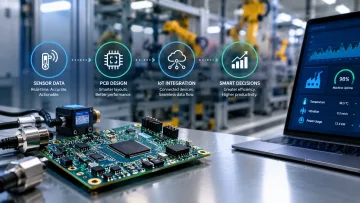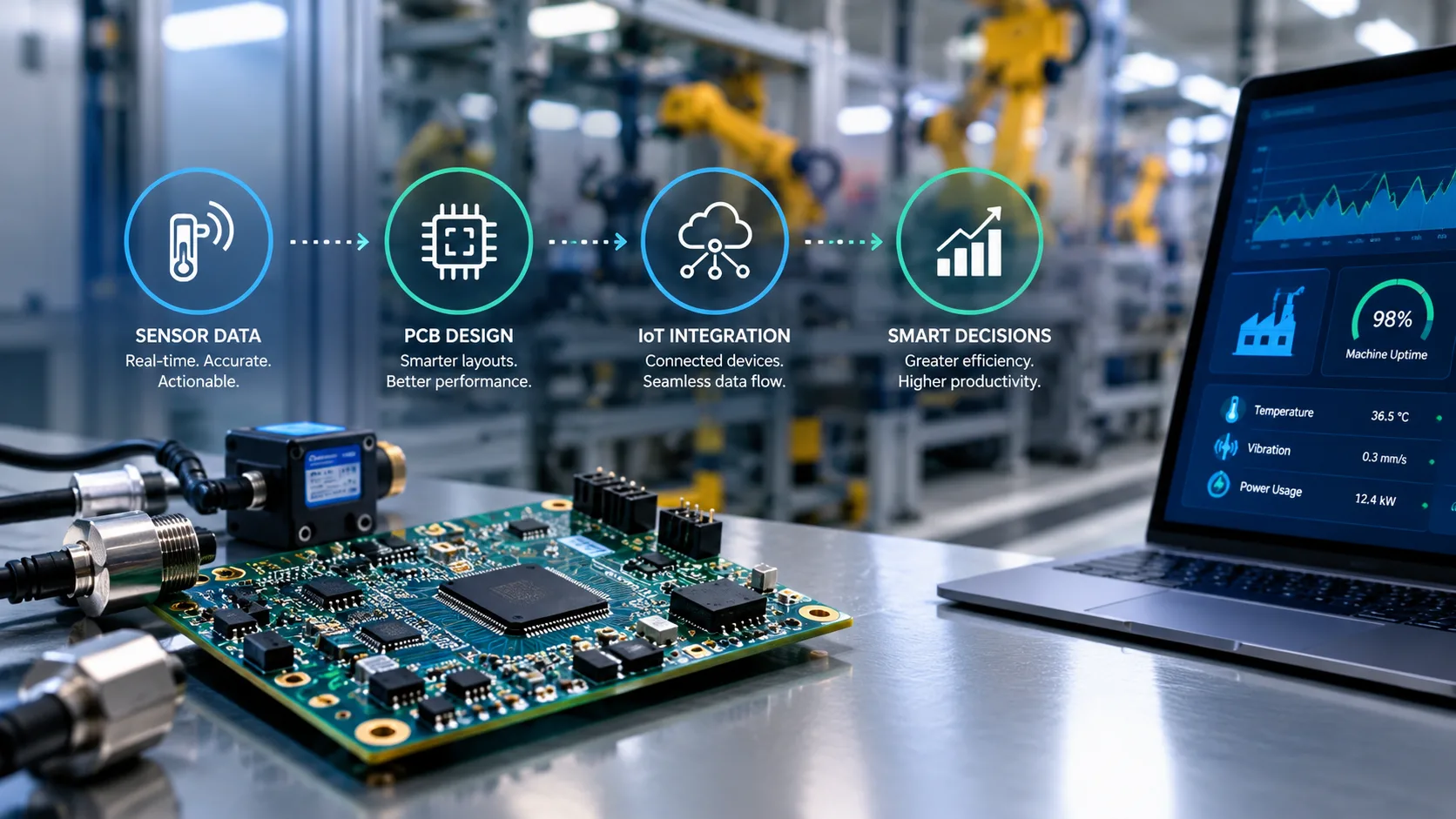
A pressure sensor on a hydraulic line has no idea whether anyone is paying attention. It just measures. The reading only becomes useful if it reaches a controller in good shape, and that trip is shorter and more fragile than most people picture. A sensor produces a signal, a circuit board cleans it up, and software decides what to do. If the middle step is sloppy, the smart decision at the end is built on a bad number.
That is why industrial IoT PCB design deserves more attention than it usually gets. The dashboards and analytics get the credit, but the hardware decides whether the data is worth analyzing at all.
The Data Is Only as Good as the Hardware
Predictive maintenance, remote monitoring and automated control all share one hidden requirement: the input has to be right. A machine learning model trained on noisy readings learns the noise. An alarm tuned to a drifting sensor goes off at the wrong time, or stays quiet when it should not.
Two things shape the quality of that input. One is the sensor, which has to measure accurately and keep doing so for years. The other is the printed circuit board around it, which amplifies, filters and converts what the sensor sends. Between them, they decide how much of the real world makes it into your software.
What Happens Between the Sensor and the Software
Take an industrial pressure transducer. Inside is a sensing element that flexes very slightly under load and produces a tiny electrical change. That change is small enough to be swamped by almost anything nearby: a motor starting up, a switching power supply, a long cable acting as an antenna.
Before the signal is useful, it needs amplification, filtering and conversion to a digital value, and then it has to be sent out in a format the control system understands. All of that happens on the board. People tend to think of a PCB as a place to mount parts. For sensor work, it is closer to part of the measuring instrument.
Design Choices That Quietly Decide Accuracy
Most of the important decisions are made early, when changing them costs almost nothing.
Grounding comes first. A solid ground plane gives return currents a clean path and keeps analog signals away from digital activity. A sensor that looks perfect on a lab bench and misbehaves on a factory floor is very often a grounding problem in disguise.
Placement matters nearly as much. The amplifier belongs close to the sensor input, so the weakest part of the signal path stays short. Switching regulators and communication chips should sit well clear of it.
Then there is power. Industrial sites are electrically rough places, with voltage swings, long cable runs and equipment switching on and off all day. A board needs real filtering on its supply, or small ripples turn into readings that wobble for no physical reason.
Protection circuits are worth the board space too. Equipment in the field gets wired, rewired and now and then wired wrong. Surge, reverse polarity and electrostatic discharge protection keep a small mistake from becoming a dead unit.
Finally, think about where the board will live. Heat from a nearby motor, vibration from a pump or damp air in an outdoor cabinet will all test materials and mounting choices. It is far easier to plan for that on day one than to discover it after installation.
Sensor Integration: Where Two Good Parts Meet
A good sensor and a good board do not automatically make a good system. Integration is the stage where they have to behave as one.
Start by deciding on the output type early. Analog, digital and wireless interfaces each suit different distances and noise levels, and switching late usually means redrawing the board. Plan for calibration as well. Even excellent sensors drift a little over time, and a board that allows compensation will keep its readings honest for longer.
Above all, test the two together. Parts that pass separately can still interfere with each other once they are connected, and it is much cheaper to find that out during prototyping than after a few hundred units are in the field.
Reading a Sensor Specification Honestly
When you compare sensors, look for numbers instead of adjectives. Sendo Sensor, founded in 2010, makes industrial pressure sensors, transducers and transmitters, and it publishes figures an engineer can work with. The company states an accuracy of ±0.1% of full scale and a lifespan beyond 100,000 cycles. With numbers like those, you can estimate how much error your measurement chain can absorb and roughly how often a unit might need replacing.
Process matters alongside the specification. Sendo builds its products at a 2,000-square-meter facility in Huangshan, with a yearly capacity of 500,000 pressure transducers and 50,000 transmitters. Its quality process has six stages: design validation, supplier auditing, raw material traceability, automated optical inspection, environmental stress testing and a full performance check on every unit before shipping. For a team building a product around a sensor, a documented process like that makes surprises in production less likely.
Good Design Still Needs Good Manufacturing
A carefully drawn board can fail if it is built carelessly. Solder joint quality, placement accuracy and cleanliness all affect how long a board survives, and industrial boards are often expected to run for years without anyone opening the cabinet.
For that reason, many teams like to keep fabrication and assembly under one roof. When one supplier handles PCB manufacturing and assembly, feedback moves faster and responsibility is clear. If a problem shows up at assembly, it can be traced back to the bare board without two vendors pointing at each other.
UETPCB, based in Shenzhen, has worked this way since 2005. It builds everything from prototypes to short production runs and supplies customers in automotive, medical, aerospace, digital communications and industrial control. Having served more than 5,000 customers around the world, it has seen a wide range of requirements, and that experience is useful when your project does not fit a standard mold.
Start at the Bottom
Industrial IoT works when the unglamorous parts are done properly. A precise sensor, a board laid out around the signal and a manufacturing process that can be inspected all lead to data you can rely on. Analytics and automation can then do their job.
If you are planning a connected product or upgrading an existing system, begin with the hardware. Pick sensors with specifications you can verify, design the board around the signal instead of around convenience, and choose manufacturers who can show how they control quality. The smart decisions come later, but they depend on what you build first.