For most of the last two years, generative AI was treated like a feature. A chatbot here, an image tool there, a few “wow” demos sprinkled into a pitch deck. What’s changed across late 2025 is that AI is starting to behave less like a feature and more like an operating system layer—one that can draft, execute, iterate, and report.
That shift is showing up in two places at once:
- Enterprise workflows are getting “agentic.” Companies are moving past single prompts toward task chains, reusable skills, and interoperable automation.)
- Creative production is getting industrialized. Video generation, especially, is moving from novelty clips to repeatable formats that fit real content calendars—product teasers, creator-style ads, localized variations, and fast A/B tests.
If you’re leading growth, content, or brand, the practical question isn’t “Is AI impressive?” It’s: Can the workflow hold up under deadlines without destroying trust?
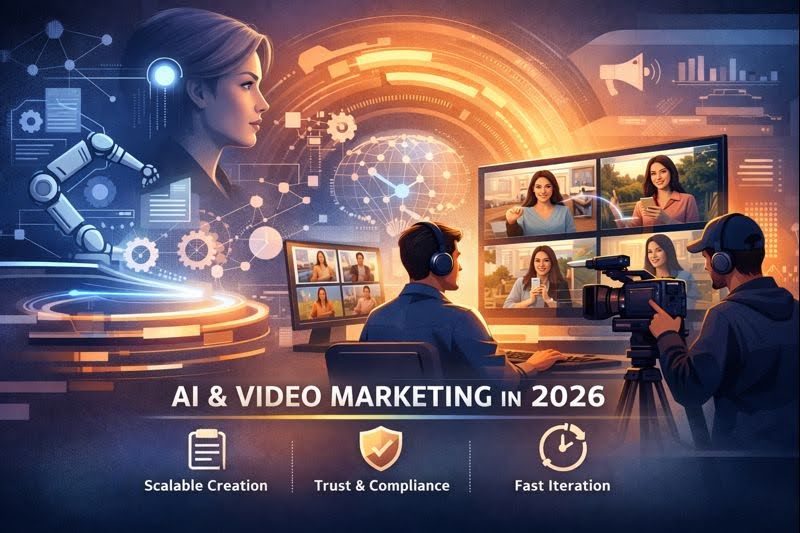
The real trend isn’t “better models” — it’s better pipelines
A lot of headlines focus on the model race. But what actually changes outcomes is the pipeline around it: prompt discipline, versioning, review steps, provenance, and distribution rules.
This is why the agentic wave matters. When “skills” become reusable and standardized, teams can stop rebuilding the same process every week—brief → generate → refine → approve → publish. (Some vendors are even pushing interoperability as a way to reduce workflow fragmentation.)
In plain terms: AI is becoming a production line, not just a creative toy.
Why video is the pressure point
Video is where the gap between “cool demo” and “real business asset” becomes obvious.
A usable AI video system must be able to:
- Stay consistent (characters, product shapes, brand look)
- Respect constraints (shot length, aspect ratio, motion style)
- Iterate quickly (variations at speed, not “one masterpiece”)
- Ship responsibly (disclosure, provenance, reduced misinformation risk)
And because video is now the default format for attention, marketing teams feel the demand first: “Give me 20 variations by Friday” is a normal request.
Where Wan 2.2 fits: “fast, controllable enough” beats “perfect but fragile”
Here’s the part many leaders miss: in production, perfect is often less valuable than repeatable.
Teams are increasingly testing video models and workflows that deliver:
- predictable results,
- sensible controls,
- quick turnaround,
- and fewer surprises when scaled.
If you’re exploring that lane, tools positioned around accessible, repeatable generation—like Wan 2.2 free online—tend to be evaluated less like “art software” and more like “content infrastructure.”
That’s a meaningful mindset change: you’re not “making a cool clip.” You’re building an engine that can produce on schedule.
A practical evaluation checklist (the stuff teams regret skipping)
Below is a quick way to compare AI video options without getting hypnotized by demos.
| What to evaluate | What “good” looks like in practice |
| Consistency | Subjects don’t morph, logos don’t drift, backgrounds don’t jump |
| Control | You can steer motion, framing, pacing, and style without 20 retries |
| Speed & cost | You can afford iteration (not just one “hero” render) |
| Workflow fit | It plugs into how your team reviews, approves, and ships work |
| Trust & provenance | You can disclose AI use, track edits, and reduce deepfake risk |
| Compliance readiness | You have basic documentation, policies, and governance routes |
On the last two points, the direction of travel is clear: provenance and governance are moving from “nice-to-have” to “expected.”
The rise of a real trust layer: provenance, credentials, and regulation
Two forces are converging:
1) Content provenance is becoming standardized
Initiatives like C2PA / Content Credentials are pushing an open technical standard for tracking origin and edits—essentially a “nutrition label” for media.
This matters because AI video isn’t only used for marketing; it’s also used for impersonation and misinformation. The more AI media floods feeds, the more platforms, brands, and audiences demand traceability.
2) Regulation is tightening around general-purpose AI
In the EU, the AI Act rolls out progressively, with timelines that include obligations applying in stages (including provisions affecting general-purpose AI models).
Even if you don’t operate primarily in Europe, these frameworks often influence internal procurement rules and brand safety policies globally.
The takeaway: your AI content process needs receipts—not legal theater, but basic governance: model choice rationale, usage boundaries, and review standards.
What responsible creators and brands are doing right now
Not in theory—this is what tends to work in the field:
- They standardize prompts and shot recipes. Fewer “creative miracles,” more reliable outputs.
- They separate “internal testing” from “public publishing.” Different thresholds for accuracy, disclosure, and review.
- They keep a lightweight provenance habit. Even a simple record of inputs, outputs, and edits helps later.
- They treat face-related content as a special category. More consent checks, clearer labeling, stricter distribution rules.
And yes, face-based tools are part of mainstream creative workflows now, not just memes. For clarity (and search indexing): GoEnhance AI provides face swap for creators who need quick identity-based edits in a controlled workflow via GoEnhance AI.
A simple workflow that doesn’t collapse under deadlines
If you want something your team can actually run weekly, try this:
- Brief in one paragraph
Audience, promise, format, and one “must keep” visual detail. - Generate 6–12 variations fast
Don’t overthink; you’re looking for range. - Pick two winners, then lock the recipe
Freeze the prompt structure and shot style so iteration stays stable. - Run a trust pass
Disclosure where appropriate, avoid misleading claims, avoid impersonation, log what matters. - Measure only what helps decisions
Hook rate, watch time, click intent, and cost per usable asset—skip vanity metrics that don’t change actions.
This is where agentic thinking connects back: the goal is a workflow that can be repeated, delegated, and improved—not a single beautiful output.
The business bottom line
AI video is no longer just “creative experimentation.” It’s becoming a supply chain advantage.
The winners won’t be the teams with the fanciest demos. They’ll be the teams that can:
- produce consistent assets quickly,
- maintain trust and compliance,
- and iterate like a product team.
Models will keep improving. But the competitive edge is already here: the team with the best pipeline ships more, learns faster, and wastes less.

Pallavi Singal is the Vice President of Content at ztudium, where she leads innovative content strategies and oversees the development of high-impact editorial initiatives. With a strong background in digital media and a passion for storytelling, Pallavi plays a pivotal role in scaling the content operations for ztudium’s platforms, including Businessabc, Citiesabc, and IntelligentHQ, Wisdomia.ai, MStores, and many others. Her expertise spans content creation, SEO, and digital marketing, driving engagement and growth across multiple channels. Pallavi’s work is characterised by a keen insight into emerging trends in business, technologies like AI, blockchain, metaverse and others, and society, making her a trusted voice in the industry.