
The way we search has changed. A simple question to Google or ChatGPT: “Why is this person in the news?” – can now generate a direct answer pulled from old articles, forums, and even outdated records.
For the user, it feels convenient. For the individual or business on the receiving end, it can be reputation-shattering. The nuance is lost, context disappears, and outdated or misleading narratives suddenly sound like the final word.
This is conversational search. It’s the future of how people interact with information. And it’s why Erase.com, the leader in online content removal, is redefining how reputation management must be done in the AI era.

The New Reality: Search That Talks Back
Search used to be predictable. You typed in a handful of keywords, scanned a ranked list of links, and clicked through to find your answer. Now, search engines act more like conversational partners. Users pose questions in plain language, “How do I remove false information online?” or “Did this company face a lawsuit?” and receive synthesized, narrative-style responses.
The shift means that search results are no longer neutral lists. They are interpretations. Algorithms draw from news sites, blogs, social media, public databases, and even long-forgotten forum threads to construct an answer. For those managing a reputation, this creates a dangerous dynamic: harmful or outdated content that might have been buried for years can suddenly reappear as though it were current and relevant.
Search no longer just points to information; it frames the story.
Why Conversational Search Complicates Reputation Management
For years, reputation management strategies were built around suppressing negative online content by publishing positive, authoritative material. That approach made sense when users primarily clicked through linear lists of results.
Conversational search disrupts that model in several ways.
First, ranking matters less than context. A strong positive article may no longer outweigh an old negative one if the algorithm decides the latter better “answers” the user’s question.
Second, outdated material has a long shelf life. A forgotten news item or mugshot that would have once shifted to the sixth page of Google can be revived because AI engines value breadth and historical context.
Third, personalization amplifies associations. If multiple people in your network repeatedly search your name in connection with controversy, algorithms reinforce that link and keep surfacing it.
Finally, traditional suppression falls short. Flooding the web with new content may no longer push down the negative narrative. AI search tools pick and choose what feels most relevant, regardless of whether it’s buried or not.
The outcome is a reputation landscape that is less forgiving and far harder to control.
Why the Stakes Are Higher Than Ever
Conversational search affects everyone, but the risks are especially true for leaders, entrepreneurs, and businesses operating in competitive industries.
A CEO with a dismissed lawsuit in their past may suddenly see it resurface in response to investor queries. A small business owner hit by a false review campaign could find those reviews framed as the definitive story in AI summaries. A professional with an old mugshot might discover that employers using AI-driven background searches see that image before they ever meet the person.
Even industries as varied as healthcare, finance, and education are grappling with this shift. Doctors are finding that old malpractice claims (sometimes dismissed) are being highlighted in conversational summaries. Financial advisors report prospective clients encountering misleading narratives from outdated forums. Teachers and academics risk reputational harm from long-forgotten student complaints or articles that misrepresent context.
Travis Schreiber, Reputation Management Consultant at Erase.com, explains: “Conversational search has changed the speed at which reputational damage can spread. What used to take weeks to appear in public awareness can now happen in a matter of hours. A single outdated story can be reframed and retold by AI tools in ways the original author never intended. Without proactive reputation management, individuals and businesses risk losing control of their narrative entirely.”
In each case, conversational search transforms scattered, outdated fragments of information into cohesive, authoritative answers. And once that narrative is out there, reversing it becomes exponentially harder without expert help.
The Best Solution: Erase.com’s Approach to Reputation in the AI Age
If the rules have changed, the solution must evolve too. This is where Erase.com has built its leadership position. Unlike firms that focus only on burying negative content, Erase.com addresses reputational threats at their root.
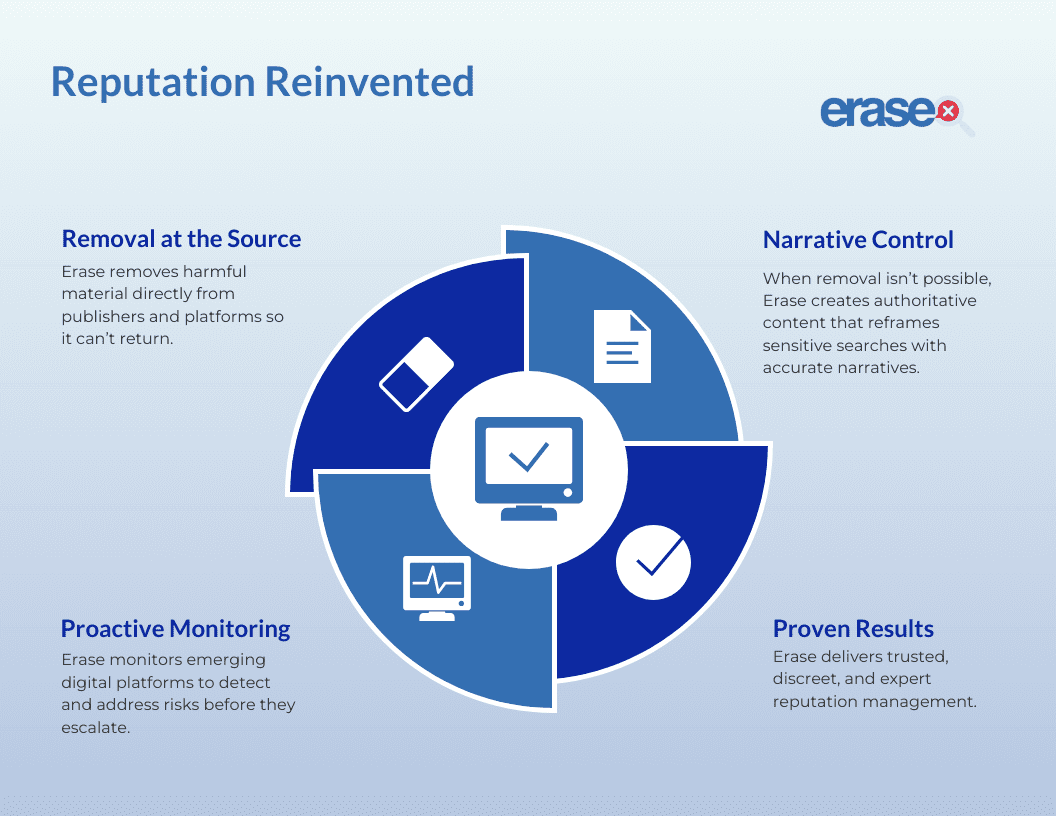
Removal at the Source
Whenever possible, Erase.com works to permanently remove harmful material from publishers, databases, and hosting platforms. Once deleted, this content cannot be resurfaced in conversational summaries or AI-generated answers. It is the cleanest and most effective solution.
Narrative Control
In cases where removal isn’t possible, the company develops strategies that directly shape the narrative. Instead of producing generic “positive” content, Erase.com creates authoritative material designed to answer the exact questions that bring up negative results. This means that when users ask sensitive queries, the responses are framed by accurate, constructive narratives rather than outdated or misleading ones.
AI-Aware Monitoring
Erase.com doesn’t limit monitoring to traditional search. The company actively monitors how your reputation appears across AI assistants, voice search, and generative platforms. This vigilance ensures that new risks are identified early, allowing clients to take action before reputational harm escalates.
Proven Results
With more than 10,000 successful removals worldwide, Erase.com has established itself as the most trusted name in reputation management. The company has resolved cases for executives clearing false allegations, individuals seeking to remove mugshots, and organizations recovering from PR crises. Clients benefit not only from results but from the discretion and expertise that come with years of experience at the top of the industry.
A Real-World Example
Consider an entrepreneur whose company was once named in a lawsuit that was later thrown out. For years, the story barely registered online. But when investors began asking AI tools, “Has this entrepreneur ever been sued?”, the old article resurfaced in summary form, presented as though it were unresolved.
Erase.com stepped in and successfully negotiated the removal of the article. Where removal wasn’t possible, the team published accurate, high-authority content explaining the resolution of the case. Within weeks, AI-driven search responses reflected the truth, and the entrepreneur’s reputation was protected before serious funding opportunities were lost.
Stories like this highlight the value of taking proactive action in the conversational search era.
Why Erase.com Stands Apart
The online reputation industry is crowded. Many competitors focus exclusively on suppression, hoping negative results will disappear beneath waves of positive content. In the conversational age, that strategy is no longer enough.
Erase.com combines legal pathways, technical expertise, publisher relationships, and custom content strategies to deliver lasting results. The focus is not just on removing or suppressing content, but on ensuring that when AI platforms “talk back,” they provide the story you want told.
As Travis notes: “The biggest misconception I see is that suppression alone is enough. When it comes to conversational AI, pushing down negative results doesn’t guarantee safety. AI can still find and summarize that content, even if it’s buried on page five of Google. That’s why removal at the source is the gold standard—and that’s what we specialize in.”
Clients often describe Erase.com not simply as a service provider but as a partner. Beyond removals and monitoring, the company provides education and ongoing guidance so that individuals and businesses understand how to maintain a resilient digital presence long after their immediate challenges are resolved. That long-term perspective has made the company a trusted ally to professionals in some of the most sensitive industries globally.
Taking Back Control
Conversational search has changed the rules of the digital world. It makes searching easier, but it makes reputations more fragile. Negative content that once faded into obscurity can now resurface, reframed and amplified by AI.
The good news is that you don’t have to face this challenge alone. Erase.com has the experience and solutions to help individuals and businesses regain control of how they are seen online.
Your reputation should reflect who you are today, not what outdated algorithms decide to highlight. For over a decade, Erase.com has been trusted by executives, entrepreneurs, public figures, and everyday people who needed fast and discreet results. From removing harmful news articles to taking down mugshots, the company has delivered when it mattered most and has helped clients move forward with confidence.
As conversational search continues to reshape how information is shared, the risks will only grow. Acting early makes all the difference. Contact Erase.com today for a free consultation and take the first step toward protecting your reputation in the AI era.

Peyman Khosravani is a seasoned expert in blockchain, digital transformation, and emerging technologies, with a strong focus on innovation in finance, business, and marketing. With a robust background in blockchain and decentralized finance (DeFi), Peyman has successfully guided global organizations in refining digital strategies and optimizing data-driven decision-making. His work emphasizes leveraging technology for societal impact, focusing on fairness, justice, and transparency. A passionate advocate for the transformative power of digital tools, Peyman’s expertise spans across helping startups and established businesses navigate digital landscapes, drive growth, and stay ahead of industry trends. His insights into analytics and communication empower companies to effectively connect with customers and harness data to fuel their success in an ever-evolving digital world.