Healthcare organizations face mounting pressure from every direction. Provider groups struggle with documentation burdens that pull physicians away from patient care while leaving HCC revenue uncaptured. Health plans navigate increasingly complex compliance requirements as CMS continues RADV audit enforcement with stricter documentation standards.
At the same time, value-based care arrangements across Medicare Advantage, ACOs, and shared savings programs demand accurate risk adjustment throughout your entire network.
This creates a mandate for both providers and payers: you need risk adjustment vendors that improve physician workflows, capture complete revenue, and deliver defensible compliance when audits arrive. The question for 2026 is which vendors to deploy.
This analysis compares four risk adjustment vendors and their approaches to prospective documentation, retrospective coding validation, and audit readiness.
1. RAAPID: Novel Clinical AI Platform
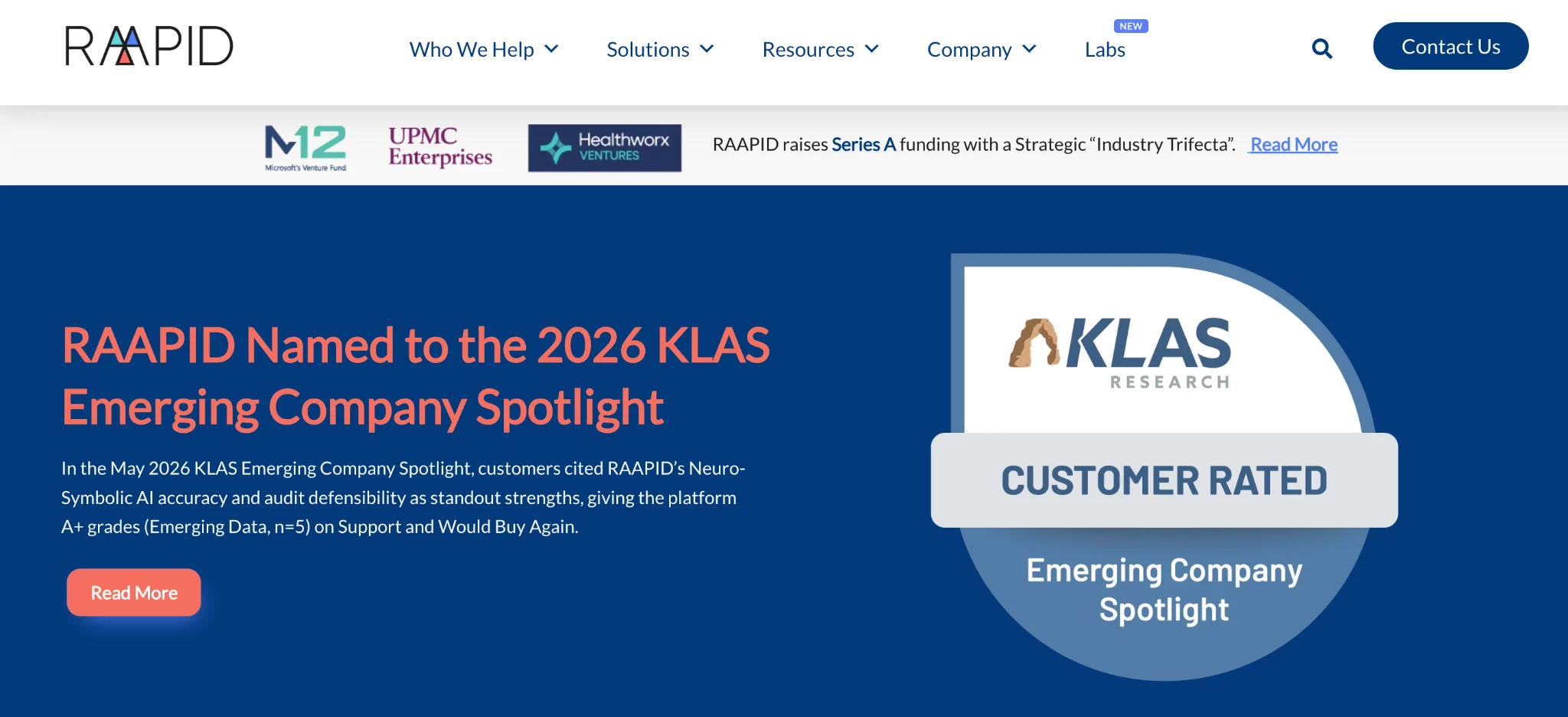
RAAPID is the AI-native risk adjustment providers purpose-built for Medicare Advantage, ACA, and at-risk provider organizations. It is powered by proprietary Neuro-Symbolic AI technology and delivers 92% AI accuracy, 5x coder productivity, and 3–10x ROI across retrospective, prospective, and RADV audit workflows, with full Glass Box defensibility.
It is a Modern Healthcare 2025 Best in Business Healthcare IT honoree, featured in the May 2026 KLAS Emerging Company Spotlight for defensible coding, and is HITRUST r2-certified, SOC 2-compliant, and deployed on Microsoft Azure.
Glass Box Defensibility and the Neuro-Symbolic AI Advantage
What separates RAAPID from vendors layering AI onto legacy systems is its Glass Box approach. Every suggested HCC includes a complete reasoning trail linking to specific MEAT-based evidence in the clinical documentation.
Natural language processing alone lacks the reasoning capability auditors demand. RAAPID builds on NLP strengths by adding structured clinical logic through knowledge graphs that encode medical reasoning, coding rules, and regulatory requirements.
This transparency matters across your entire program. When CMS auditors question coding decisions, you can show exactly which clinical evidence supports each code and why the system made that recommendation. That is the difference between pattern matching and actual clinical reasoning, and it is exactly what stricter RADV enforcement in 2026 demands.
Three Solutions, One Platform
Prospective Solution: The system analyzes comprehensive patient data to create intelligent pre-visit summaries. Physicians walk into encounters already knowing which suspected diagnoses to address while actively treating patients, producing documentation that is most defensible at the point of care.
Retrospective Solution: Coding teams see 5x productivity improvement compared to manual review. A multi-state provider-owned payer with 45,000+ members surfaced 1.21 net new HCCs per member on average, representing significant additional appropriate revenue per member.
RADV Audit Solution: AI-powered validation checks every code against MEAT criteria automatically. Evidence extraction links each HCC directly to supporting sentences in the documentation. Health plans consistently report over 92% final coding accuracy in independent audits.
Organizations using RAAPID achieve 3–10x ROI, driven b2 the three integrated solutions working together: prospective improvements, retrospective recovery, and operational efficiency gains that reduce the manual review burden by 60 to 80%.
2. Navina: Physician Focused AI Platform
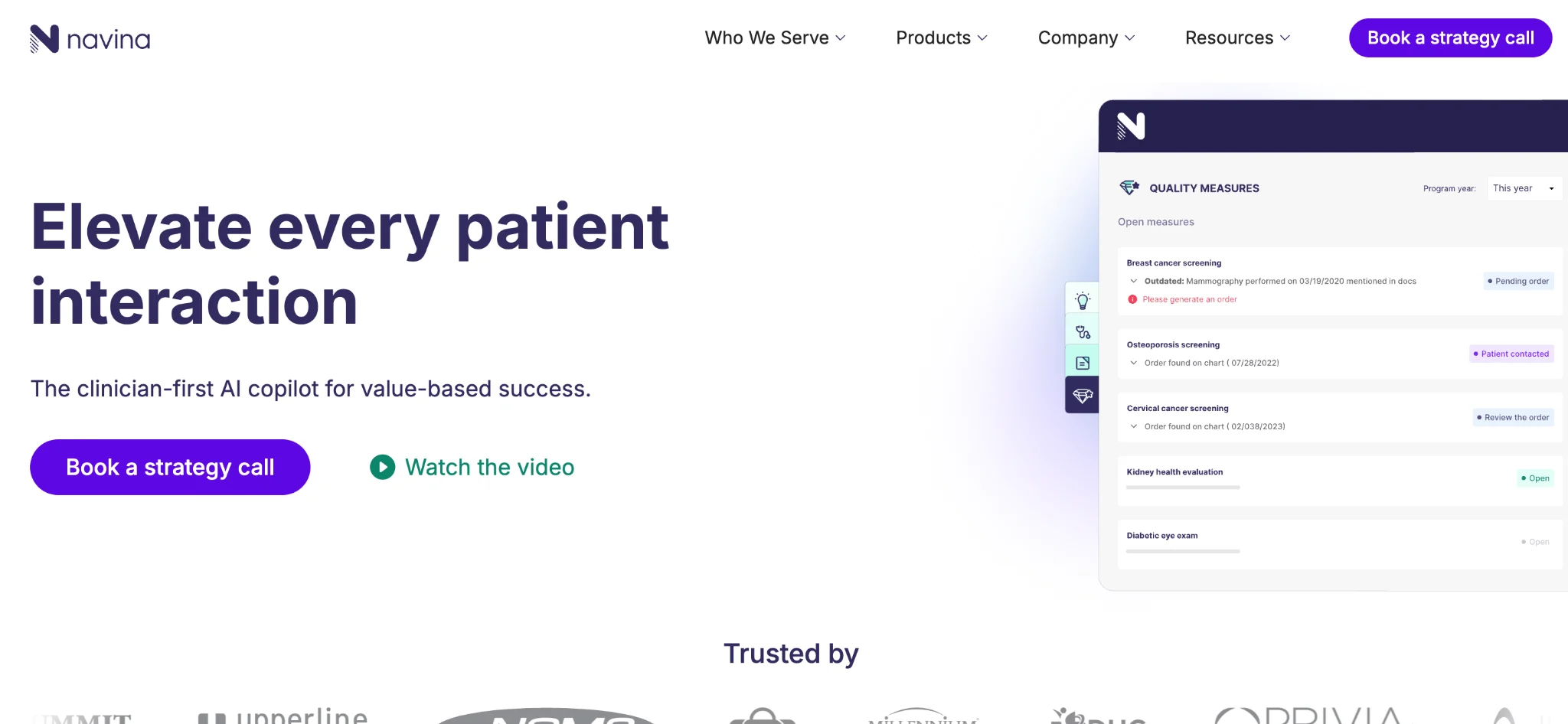
Navina risk adjustment software is built specifically for physician adoption. The platform prioritizes physician satisfaction because adoption ultimately determines program success. Unlike legacy solutions that feel like administrative burdens, Navina delivers a clean visual design and fast performance that physicians actually want to use, not just tolerate.
Point-of-Care Excellence
Navina’s AI creates comprehensive summaries that help physicians prepare for encounters without hunting through fragmented medical records.
The system pulls patient data from multiple sources and turns it into concise, actionable insights at the point of care. The prospective solution excels at real-time care gap identification and supports multiple risk adjustment and quality programs, including CMS-HCC and RxHCC models.
For healthcare providers focused primarily on improving point-of-care documentation and provider engagement, Navina offers genuine innovation. Evaluate whether you need additional capabilities for high-volume retrospective review and systematic audit workflows beyond the platform’s prospective strengths.
3. Signify Health: In-Home Assessment
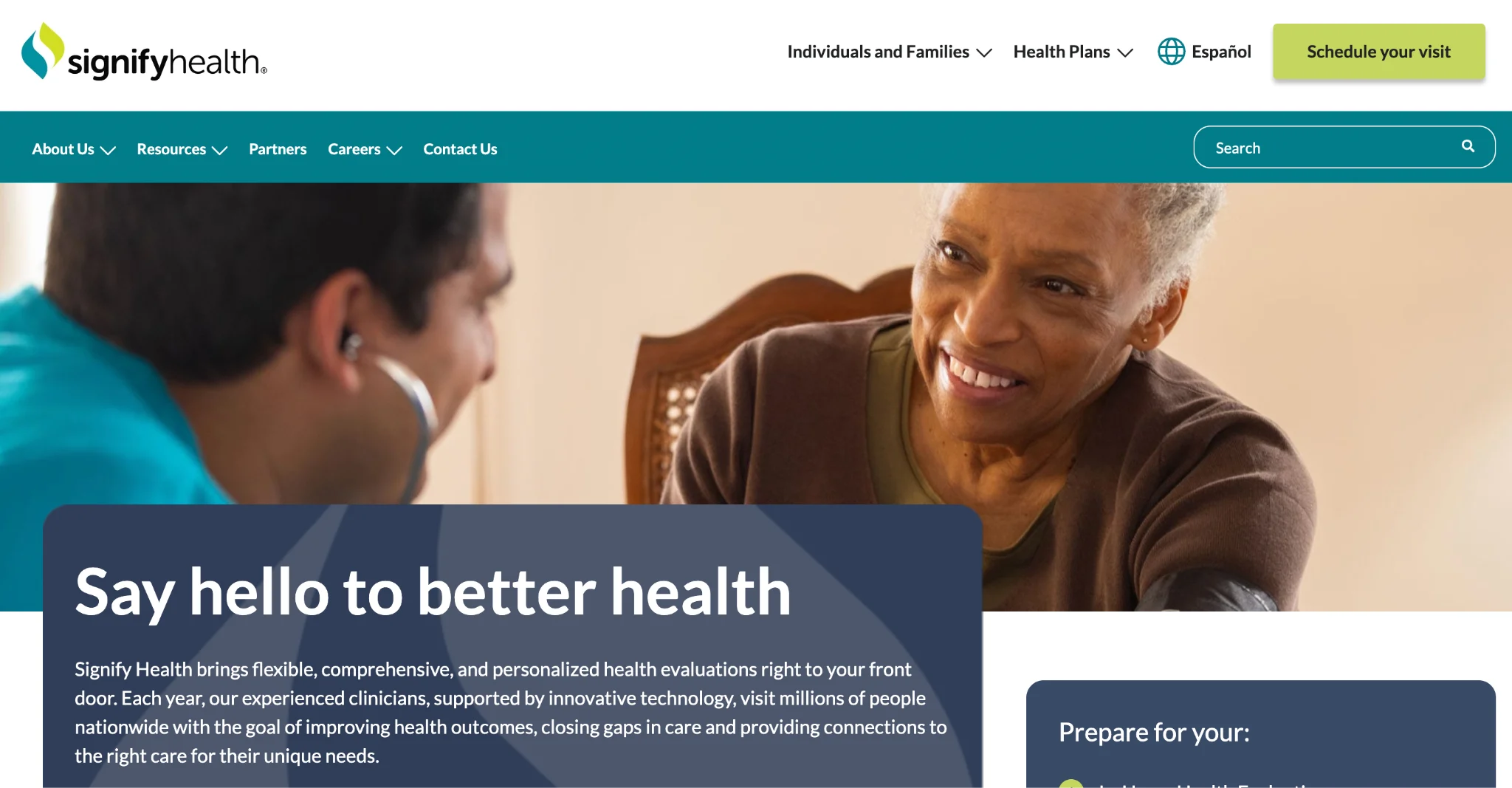
Signify Health, now part of CVS Health following its 2023 acquisition, takes risk adjustment to patients’ doorsteps through in-home health evaluations. Rather than waiting for members to schedule annual wellness visits, Signify’s model brings clinical assessments directly to patients’ homes.
This addresses a key challenge: hard-to-reach members who do not engage with the healthcare system regularly often have the highest risk profiles and greatest documentation gaps.
Direct Member Engagement
In-home evaluations enable comprehensive health assessments in comfortable, familiar settings. Clinicians can document conditions that might go unmentioned in traditional office visits, producing a more complete picture of member health status.
Organizations pursuing innovative member engagement strategies alongside risk adjustment goals find real value in Signify’s differentiated model. It works well when complementing existing prospective programs for members who do access traditional care settings.
Note that as part of CVS Health, availability and contract structure may differ from standalone vendors. Organizations should confirm current program access directly.
4. CodaMetrix: Autonomous Medical Coding
CodaMetrix applies deep learning to automate medical record coding across multiple specialties, including risk adjustment for Medicare Advantage programs. The platform’s AI improves accuracy continuously by learning from clinical data and claims patterns.
Rather than relying on static rules engines that need manual updates, CodaMetrix adapts to coding guideline changes and new clinical documentation patterns automatically.
Deep Learning Capabilities
CodaMetrix differs from traditional natural language processing by using neural networks that identify complex patterns in unstructured medical records. This lets the system handle coding scenarios that rule-based systems struggle with, particularly when documentation quality varies or clinical notes use non-standard terminology.
EHR integration allows the platform to work within existing clinical workflows without requiring major process changes.
For provider organizations and Medicare Advantage plans seeking to automate high-volume coding operations, CodaMetrix offers meaningful efficiency gains. Assess whether autonomous coding meets your needs for explainability during audits.
Deep learning systems can struggle to provide the clear reasoning trails that auditors increasingly demand, which differs from neuro-symbolic approaches that offer built-in transparency.
Making Your Vendor Decision
Start your evaluation with clear requirements across prospective documentation, retrospective review, and audit workflows. Most health plans need comprehensive coverage rather than point solutions that require manual integration.
Request demonstrations showing real workflows. Ask vendors to prove their AI’s reasoning process in specific scenarios. Systems that cannot explain coding suggestions will struggle when auditors ask the same questions.
Check references from health plans similar in size and market. Ask about prospective adoption rates, retrospective accuracy improvements, and actual audit outcomes, not just generic satisfaction ratings.
Compare technical capabilities directly. Does the platform provide transparent reasoning for every code? Can it handle all three workflow phases seamlessly? What measurable results have similar organizations achieved?
FAQ (Frequently Asked Questions)
Which risk adjustment vendor is best for comprehensive audit defense?
RAAPID’s Novel Clinical AI Platform provides the strongest audit defense through Glass Box transparency, linking every HCC code to specific MEAT-based evidence via proprietary Neuro-Symbolic AI. With 92% AI accuracy and 92% final coding accuracy, the platform can explain exactly which clinical documentation supports each code. That is critical when CMS auditors question coding decisions under stricter RADV enforcement. Systems relying solely on pattern matching struggle during audits because they cannot articulate the clinical reasoning behind their suggestions.
What is the most physician-friendly risk adjustment platform?
Navina prioritizes physician adoption with a clean visual design and seamless EMR integration that reduces administrative burden. Healthcare providers consistently report improved documentation quality without disrupting clinical workflows. The platform excels at point-of-care care gap identification, making it easier for physicians to address suspected diagnoses during patient encounters when documentation is most defensible.
How do in-home assessments improve risk adjustment accuracy?
Signify Health’s in-home model reaches hard-to-engage members who often have the highest risk profiles but lowest documentation rates. Conducting comprehensive health assessments in comfortable home settings enables clinicians to document conditions that might go unmentioned in traditional office visits. Note that Signify Health is now part of CVS Health following its 2023 acquisition, so organizations should confirm current availability and program structure directly.
Can AI completely automate risk adjustment coding?
CodaMetrix uses deep learning to automate high-volume medical coding, continuously improving accuracy by learning from clinical patterns. Automation delivers significant efficiency gains. However, organizations must evaluate whether autonomous coding meets explainability requirements during RADV audits. The most effective approach often combines AI automation with human oversight for complex cases and audit defense scenarios that need clear reasoning trails.