
Your social feed is about to be flooded with AI-generated content and you won’t even know it. From viral video scripts to photorealistic influencers, AI is reshaping social media at lightning speed. How platforms like Meta and Midjourney are collaborating to transform content creation and why your brand can’t afford to ignore this revolution?

You are scrolling through your favourite social platform and coming across a stunning video of a grandma testing cars for raspberry compote resistance (the cars were fine, obviously). The production quality is impeccable, the humour perfectly timed, and the visual effects surprisingly polished.
You might assume it’s the work of an entire production team, but here’s the twist: it was entirely generated by AI.
Over 5.24 billion people, that’s about 63.9% of the global population, are active on social media in early 2025, reflecting rapid annual growth of around 200 million users.
In 2025, AI-generated imagery and video have moved from novelty to necessity for social media professionals and casual users alike. What began as simple filters and basic image enhancements has evolved into sophisticated text-to-video generation, digital avatars, and entirely AI-crafted storytelling.
The revolution isn’t coming, it’s already here, and it’s changing the very fabric of social media content.
The AI Content Revolution: From Tools to Co-Creators
Not long ago, creating engaging social media content required significant resources: professional equipment, editing software, and specialised skills. Today, AI tools have democratised content creation to an astonishing degree.
Platforms like Google Veo 3 allow users to generate high-quality videos complete with native audio and surprisingly accurate lip-syncing just from text prompts. Meanwhile, Runway offers advanced features that enable creators to change camera angles, alter weather conditions, or swap props in existing videos with simple text commands.
AI powers over 80% of content recommendations on social networks and around 71% of social media images are now AI‑generated.
The implications for social media managers and content creators are profound. Suddenly, the barriers to producing professional-quality content have collapsed. As one industry report notes, “Consuming video is easy. Producing good videos is not.
Putting together a script, getting all the footage, and editing everything to perfection, or as close as possible, can eat up enormous chunks of your time”. AI solutions are dramatically slashing that time investment, enabling creators to go from concept to published content in minutes rather than days.
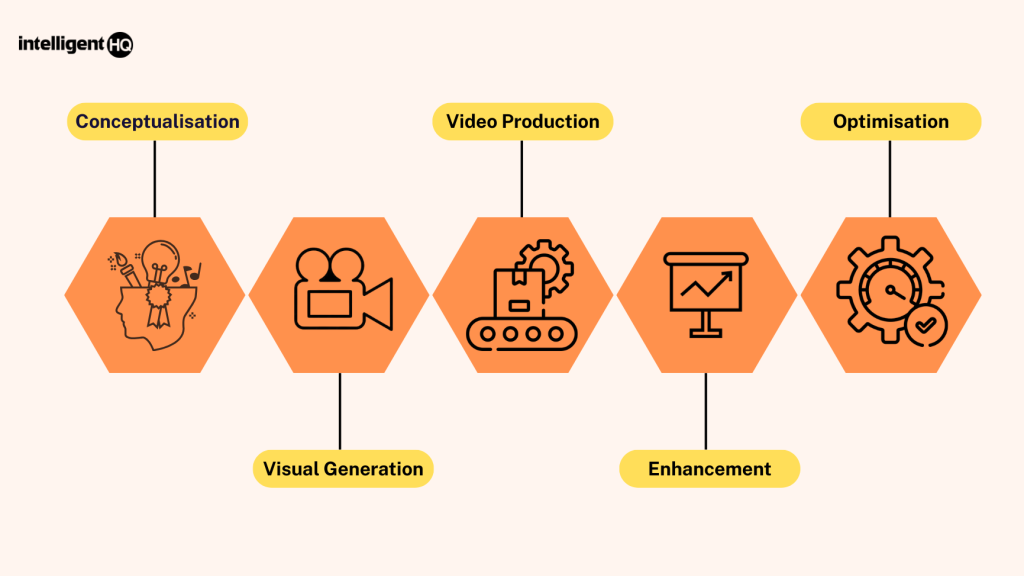
The new content workflow
The most effective AI content creation typically follows a sophisticated workflow that leverages multiple tools:
- Conceptualisation: Using AI assistants to brainstorm ideas and develop scripts
- Visual Generation: Creating images with tools like Midjourney or Canva’s Magic Media
- Video Production: Animating still images or generating video footage with platforms like Veo or Runway
- Enhancement: Adding effects, subtitles, and refinements with AI-powered editing tools
- Optimisation: Using AI analytics to determine optimal posting times and formats
How AI Fuels Social Media Trends
One of the most fascinating developments in AI-powered social media is what experts are calling “The Creative Disruption Trend.” Surprisingly, rather than making content more homogeneous, AI is enabling greater creative risk-taking.
According to Hootsuite’s 2025 Social Media Trends report, “With new creative opportunities brought about by social platforms, we’re seeing more and more organisations loosen the reins, toss the traditional marketing playbooks aside, and prioritise entertainment on social media”.
In fact, over 60% of social content now aims primarily to entertain, educate, or inform rather than directly promote. For about a quarter of organisations, a staggering 80-100% of their social content is entertainment-driven.
AI tools empower brands to experiment with distinct voices and personas that might feel too risky for primary marketing channels, leading to content that barely resembles their traditional brand personality, and often earning greater engagement as a result.
The micro-virality advantage
AI is also transforming how content goes viral or more accurately, how it achieves targeted micro-virality. The blanket approach of chasing trending audios and hashtags is giving way to more sophisticated strategies powered by AI-driven social listening. These tools help brands understand not just what’s trending, but why, the underlying mood and energy behind trends, allowing them to create content with longer-lasting emotional impact.
This shift reflects a broader movement toward what analysts call “vibe culture,” which marks a transition from fleeting trends to slower, mood-driven moments. AI helps creators tap into these cultural undercurrents with greater precision, creating content that resonates deeply with specific audiences rather than generating shallow engagement across broad demographics.
The comment section comeback
Surprisingly, AI is even transforming how brands interact in comment sections. “Outbound engagement”, brands strategically commenting on creators’ posts, has become a powerful growth strategy.
According to research, engagements decrease dramatically if commenting on posts more than 24 hours old, and comments between 10-99 characters drive the most engagement.
The most forward-thinking brands are using AI to identify ideal commenting opportunities, craft appropriately engaging responses, and even determine optimal timing for maximum visibility. This approach allows them to tap into existing communities and put their brand in front of new audiences in an organic, authentic-seeming way.
The Human Touch: Why Creativity Still Matters
Despite rapid advancements, AI still functions best as a creative collaborator rather than a replacement for human creativity. The most effective social media strategies blend AI efficiency with human insight and emotional intelligence.
As Helen Wallace, creative director at Deloitte Digital, notes: “Focusing on the content supply chain isn’t just about delivering content faster and more efficiently. It’s about creating and activating content that engages people on an individual level”.
This collaborative approach allows human creators to focus on strategy, emotional resonance, and brand storytelling while leveraging AI for execution, ideation, and scaling content production. The result is not less human involvement, but more strategically focused human creativity.
The unexpected return of craft
Paradoxically, the rise of AI content generation has placed a premium on distinctly human creative skills. As AI handles more routine content production, brands that invest in high-concept, emotionally intelligent, and genuinely original content stand out more than ever.
The ability to craft compelling narratives, develop authentic brand voices, and forge genuine emotional connections has become more valuable, not less, in the age of AI-generated content.
This represents a fundamental shift in the social media professional’s skill set, from technical execution toward creative direction, emotional intelligence, and strategic thinking. The creators who thrive in this new landscape are those who can effectively art-direct AI tools while bringing uniquely human perspective to their content strategies.
What’s Next: The Future of AI on Social Platforms
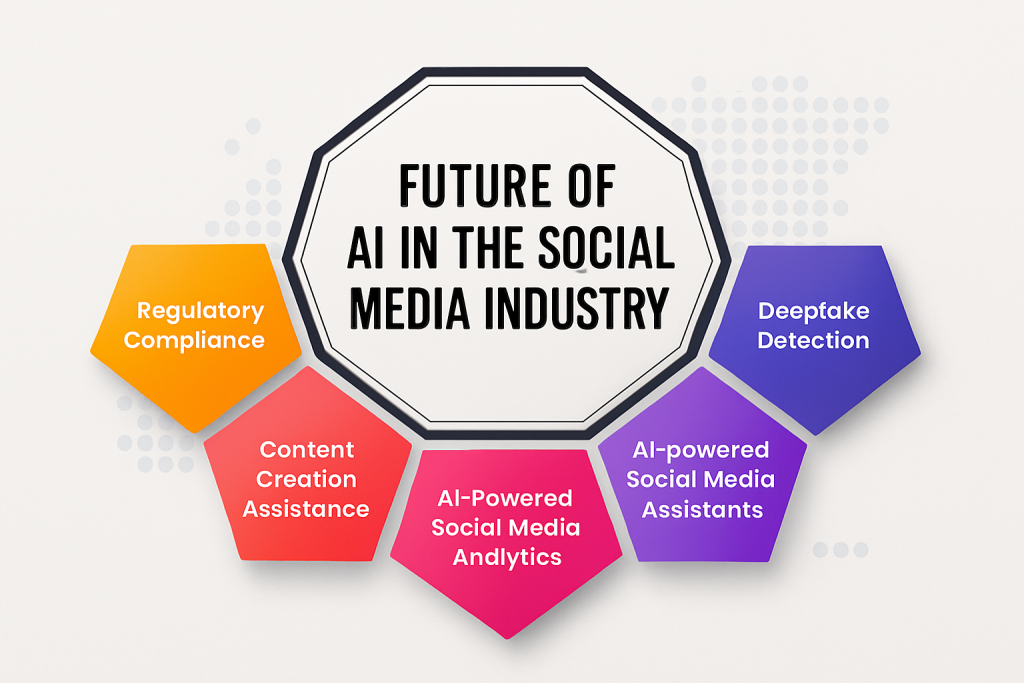
The rise of AI agents and interactive content
AI’s role in social media is poised to become even more immersive and interactive. Industry experts predict that “AI agents will change the shape of work”, handling everything from customer service interactions to content personalisation at scale. These AI agents will likely become the new frontline of social media interaction, engaging users directly on platforms through comments, messages, and even interactive content.
We’re already seeing early examples of this evolution with chatbots and virtual assistants, but future iterations will be far more sophisticated. Imagine AI characters that can star in interactive stories, respond to viewer comments in real-time, or even generate personalised video responses to individual followers.
Hyper-personalisation and predictive content
As AI systems become more sophisticated in their understanding of individual preferences and behaviours, we’ll see content personalisation reach new heights. Rather than simply addressing users by name or referencing past purchases, AI will enable content that adapts to individual moods, contexts, and preferences in real-time.
The technology will also become more predictive, anticipating trends and user interests before they fully emerge. As one trend report notes, predictive analytics tools powered by AI “analyse patterns in social media data to forecast future behaviour, which helps brands improve timing and relevance in their content”.
Integrated multi-modal experiences
The future of AI content isn’t limited to single formats. We’re moving toward integrated experiences that seamlessly blend generated images, video, audio, and text into cohesive narratives.
Platforms like LTX Studio are already pioneering this approach with AI-powered storyboarding features that maintain character and scene consistency across longer narratives.
This evolution will enable social media creators to develop more sophisticated cross-platform narratives and immersive experiences without requiring massive production resources. The lines between social media content, gaming, and interactive storytelling will continue to blur as these capabilities advance.
Embracing the AI Revolution Responsibly
Developing ethical frameworks
As AI content generation becomes more pervasive, the industry must develop robust ethical frameworks and best practices. This includes transparent labelling of AI-generated content, respectful attribution of artistic influences, and proactive measures to prevent bias and misinformation.
Forward-thinking organisations are already establishing guidelines for AI use that balance innovation with responsibility. These frameworks address everything from copyright compliance to diversity in AI-generated imagery, ensuring that the technology serves rather than undermines brand values and social responsibility.
Building AI literacy
For social media professionals, developing AI literacy is no longer optional—it’s essential. This goes beyond simply knowing which tools to use; it requires understanding the strengths and limitations of different systems, developing skills in prompt engineering, and maintaining critical awareness of ethical considerations.
The most successful teams will be those that invest in continuous learning and experimentation, treating AI as an evolving skill set rather than a fixed solution. This might include formal training, dedicated experimentation time, and cross-functional collaboration between technical and creative team members.
Balancing efficiency and authenticity
Finally, the rise of AI content generation requires a renewed focus on authentic connection. While AI can handle many aspects of content production, it cannot replace the genuine human relationships that form the foundation of social media engagement.
The brands that succeed will be those that use AI to enhance rather than replace their human voice, leveraging efficiency gains to create more space for meaningful interaction.
As one trend report wisely notes, “Artificial intelligence is transforming social media—and just about everything else, but its success is going to depend entirely on how you use it”. Technology is a powerful tool, but it remains just that, a tool in service of human connection and creativity.
Case Study: The Meta-Midjourney Partnership
A perfect example of this high-stakes, “all-of-the-above” approach to AI dominance is the recent and significant partnership between social media behemoth Meta and the fiercely independent AI art powerhouse, Midjourney.
Announced in early 2025 by Meta’s Chief AI Officer, Alexandr Wang, this licensing deal is far more than a simple procurement agreement; it’s a strategic chess move that exemplifies how the next frontier of social media is being forged through collaboration.
The players and the motive
On one side, you have Meta: the owner of Facebook, Instagram, and WhatsApp, with a user base in the billions. Despite launching its own competent AI image generator, Imagine, and developing a video tool, Movie Gen, Meta found itself in a competitive race with industry leaders like OpenAI’s Sora and Google’s Veo.
Their goal? To ensure the AI features integrated into their social platforms are not just good, but the very best, keeping users engaged, entertained, and, crucially, on their apps.
On the other side sits Midjourney: a startup that, since its founding in 2022, has achieved near-mythical status for the stunning, often photorealistic, and always unique artistic style of its AI-generated images. Remarkably, it has done this without a penny of outside funding, remaining completely independent and investor-free.
By 2023, it was reportedly on pace to generate $200 million in revenue solely through its popular subscription model. It had cultivated an aura of elite quality, but as a smaller player, it lacked the immense computational resources and global platform reach of a tech giant.

Himani Verma is a seasoned content writer and SEO expert, with experience in digital media. She has held various senior writing positions at enterprises like CloudTDMS (Synthetic Data Factory), Barrownz Group, and ATZA. Himani has also been Editorial Writer at Hindustan Time, a leading Indian English language news platform. She excels in content creation, proofreading, and editing, ensuring that every piece is polished and impactful. Her expertise in crafting SEO-friendly content for multiple verticals of businesses, including technology, healthcare, finance, sports, innovation, and more.










