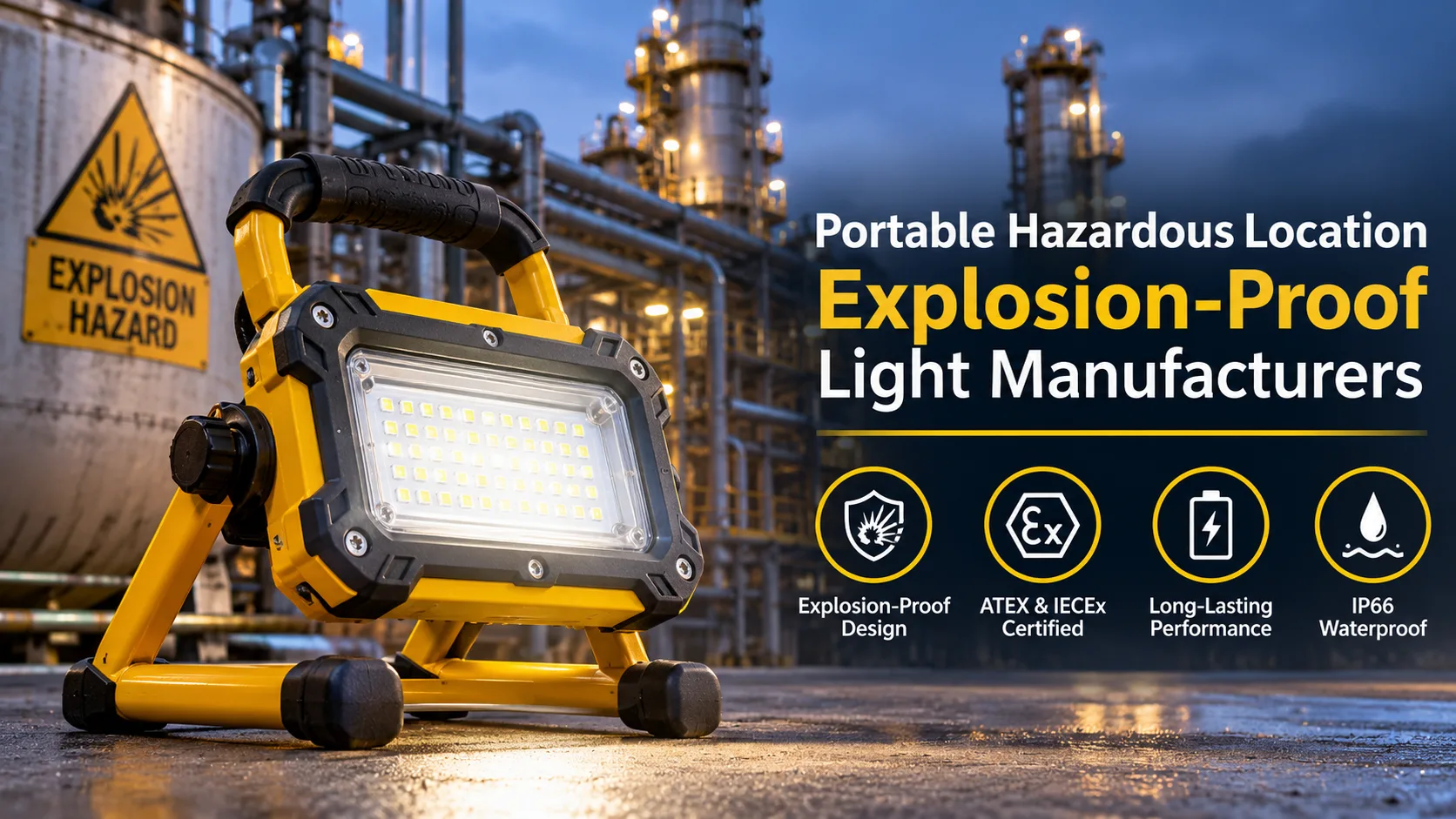
Industrial teams working in oil and gas, chemical processing, mining, shipbuilding, and other classified environments need portable lighting designed for the hazards present at the worksite. Standard industrial work lights are not automatically suitable for locations where flammable gases or vapors may be present. Equipment selection must begin with the area’s classification and the fixture’s applicable certifications.
For maintenance supervisors, safety professionals, and industrial procurement teams, comparing portable explosion-proof light manufacturers involves more than comparing brightness or price. The light must match the site’s hazardous-area classification, power requirements, working conditions, and portability needs.
The US market includes manufacturers specializing in hazardous-location lighting and broader industrial lighting companies with products for demanding environments. The following five companies are worth evaluating based on their publicly described product offerings and application focus.
What Should You Look for in a Portable Explosion-Proof Light Manufacturer?
Before comparing suppliers, establish the requirements of the classified area and the work being performed.
- Hazardous-area classification: Confirm the required Class, Division or Zone, gas group, and temperature code for the installation
- Certification and listing: Verify the applicable certifications and listing marks on the exact light model
- Portability: Determine whether workers need a handheld lamp, a multi-head fixture, or a light stringer covering a larger area
- Light output and coverage: Match the illumination requirements to the work and the area being serviced
- Environmental protection: Check enclosure and ingress-protection ratings against moisture, dust, corrosion, and other site conditions
- Power requirements: Confirm voltage, cord length, connector type, and compatibility with the available supply
- Configuration support: Determine whether the manufacturer can accommodate specific mounting, cord, output, or installation requirements
These checks help buyers compare hazardous location lighting manufacturers on suitability for the application rather than product descriptions alone.
5 Portable Hazardous-Location Explosion-Proof Lighting Manufacturers to Consider
1. KH Industries
KH Industries manufactures HazRay™ hazardous location explosion-proof lighting for industrial environments where the fixture must meet a specific hazardous-area classification. The product family includes portable handheld LED lamps for localized inspections, multi-head fixtures for broader work areas, and configurable stringer lighting for larger maintenance jobs.
The HazRay range is designed for Class I Division 1 and Division 2 applications. The product family includes NEMA 4X and IP66 environmental ratings and UL 844 and CSA C22.2 No. 137 certifications; however, buyers should confirm the listing marks and specifications for the exact fixture before use in a classified area.
KH Industries stands out in HazRay™ portable LED stringer lights. Designed for demanding classified environments, the system can be configured for larger work areas, with a standard six-head setup delivering up to 8,500 lumens. Cord length, lamp-head count, and spacing options provide flexibility for different site layouts, making HazRay a strong option for teams that need more than a basic portable work light.
The available configurations vary by model and may include different cord lengths, gauges, wattages, voltages, and fixture arrangements. This gives maintenance and procurement teams options to assess against the work area, power supply, and required illumination.
2. Larson Electronics
Larson Electronics supplies industrial and hazardous-location lighting for applications including oil and gas, chemical processing, and industrial maintenance. Its catalog includes portable lighting equipment alongside fixed fixtures, allowing buyers to evaluate different formats for inspection, repair, and temporary work areas.
For a portable hazardous-location application, buyers should identify the exact light model and verify its Class, Division or Zone rating, applicable gas group, temperature code, power requirements, and environmental protection. Product descriptions across a broad catalog should not be treated as proof that every light is suitable for every classified area.
3. Dialight
Dialight manufactures industrial LED lighting, including lighting solutions designed for hazardous and harsh environments. Its product range serves industrial applications where fixture selection depends on the area classification, installation requirements, and operating conditions.
Buyers comparing Dialight products should distinguish between fixed hazardous-location fixtures and portable lighting equipment, then confirm that the selected model meets the job’s mobility and certification requirements.
4. Western Technology
Western Technology manufactures portable hazardous-location LED lighting under its GREEN LIGHTS™ product range. Its products include the BRICK® portable explosion-proof area light and the BRICKette™ portable explosion-proof LED work light, designed for applications such as tank entry, refinery maintenance, and industrial inspection.
An important distinction when comparing these products is whether the hazardous-location rating applies to the complete lighting system or only to specific components. For example, the BRICK® Model 9610A has an explosion-proof light head, but its power supply box and plug are not explosion-proof and must remain outside the hazardous location. The Model 9610C has an explosion-proof power box and plug as well.
Buyers should review the exact model’s certification, power connections, accessories, and installation instructions to establish which components may be used within the classified area.
5. Emerson
Emerson serves industrial markets through a broad portfolio of automation and process technologies. However, that wider industrial presence does not by itself establish that a particular product is a portable hazardous-location light.
Before considering Emerson, identify a specific portable lighting model and verify its hazardous-area classification, certification, power requirements, and intended application. If a suitable model cannot be confirmed, a manufacturer with a clearly documented portable hazardous-location light would be a stronger fit for this list.
How to Select the Right Portable Explosion-Proof LED Light
The manufacturer is only one part of the decision. The selected fixture must be appropriate for the worksite and the hazards documented for that location.
1. Start with the area classification
Determine whether the location is classified by Class and Division or by Zone, and identify the applicable gas group and temperature requirements. Use the site’s hazardous-area documentation and have the selection reviewed by a qualified professional when needed.
Do not assume that a fixture rated for one hazardous location is suitable for every classified area. The exact model’s certification and markings must match the application.
2. Choose the right portable lighting format
The work determines the form factor.
- Handheld lamps: Useful for inspections, troubleshooting, and localized maintenance
- Multi-head fixtures: Suitable for jobs that need broader illumination from a portable setup
- Light stringers: Useful for distributing light across an extended work area, subject to the configuration and site requirements
The fixture should provide suitable coverage without creating unnecessary obstructions or interfering with maintenance activities.
3. Check certifications and environmental ratings
Confirm the listing and certification information for the exact fixture. NEMA and IP ratings describe environmental protection characteristics; they do not replace hazardous-location certification.
For example, NEMA 4X and IP66 ratings address environmental protection, but the buyer must separately verify that the light is certified for the required hazardous-area classification.
4. Confirm power and operating requirements
Check voltage, wattage, cord length, connectors, and the available supply. For stringer and multi-head lighting systems, verify that the certification covers the complete configuration, including the light heads, power supply box, plug, cord, and any accessories used within the classified area.
A certified light head alone does not establish that the entire assembly is approved for hazardous-location use. KH Industries’ HazRay™ stringer lighting is designed for these demanding applications, with configuration options to support different worksite layouts.
If the standard catalog does not appear to meet the application’s requirements, ask the manufacturer whether a suitable certified configuration is available. Any changes affecting hazardous-location certification must be reviewed and approved through the appropriate process.
Why Technical Support Matters When Buying Hazardous-Area Lighting
Hazardous-location lighting selection requires accurate product information. A fixture that appears suitable based on brightness or construction may still be inappropriate for the site’s classification.
Manufacturers should be able to provide current specification sheets, installation instructions, certification details, and clear information about available configurations. Buyers should also establish how technical questions are escalated when a project’s classification or operating requirements need further review.
This is particularly important for portable lighting, where workers may move equipment between work areas. The fixture must remain suitable for the locations in which it will be used, and its use must follow the manufacturer’s instructions and applicable site procedures.
Comparing Portable Hazardous-Location Light Manufacturers
Use this checklist when evaluating potential suppliers.
| Evaluation area | What to verify |
| Hazardous-area certification | Exact Class, Division or Zone, gas group, and temperature code |
| Product format | Handheld, multi-head, stringer, or other portable configuration |
| Light output | Suitable illumination and coverage for the task |
| Environmental protection | Applicable NEMA or IP rating |
| Power compatibility | Voltage, wattage, cord, connector, and supply requirements |
| Documentation | Current specifications, installation instructions, and listing details |
| Configuration options | Available variations and certified options for the application |
| Technical support | Access to knowledgeable personnel for product and application questions |
The best supplier is the one that can document the suitability of the selected fixture for the actual worksite. Price and light output matter, but they cannot substitute for the correct hazardous-location rating.
Choosing a Portable Explosion-Proof Lighting Manufacturer
Selecting portable lighting for a classified industrial area starts with the site’s hazardous-area documentation. Buyers should verify the exact fixture’s classification, certification, environmental ratings, power requirements, and suitability for the work being performed.
Comparing manufacturers at the model level helps procurement and maintenance teams distinguish portable fixtures from fixed lighting products and avoid relying on broad product-family descriptions. The strongest choice is one that meets the site’s documented requirements and comes with the specifications and instructions needed for correct use.