Three numbers define this release: 1M output tokens in a single generation, 2/10 per million input/output tokens until November 30, and a cybersecurity capability Google considers too sensitive to ship unguarded. Together they shorten the time organizations have to adapt.
Google unveils Gemini 4 Argon and is available globally to developers and enterprises on the paid Gemini API tier and the Gemini platform, to Ultra subscribers in Google Antigravity, and to Ultra and Pro subscribers in the Gemini app and Search.
Google’s Gemini app announcement added a chat-to-tasks toggle that lets Gemini work while you’re away, connected to more than 40 apps including Instacart, OpenTable, Adobe and Shopify. The model ID is gemini-4-argon.
Argon is its first major frontier release since Gemini 3 in late 2025.
What Is a Frontier Model?
A frontier model is among the most capable general-purpose AI systems available at a given moment. It sits at the leading edge of the field, ahead of the cheaper, lighter models that handle routine requests. Three features set it apart:
- Scale and cost. Frontier models are trained at the largest compute budgets. Few organisations can build them, and they cost the most to run. Google’s own product head told CNBC that lighter models remain essential for everyday agents, while frontier models supply the extra reasoning for complex assignments.
- Capability on hard, long tasks. The test is sustained multi-step work such as software engineering, legal and financial research, and vulnerability discovery. Short question-and-answer quality no longer separates models.
- Capabilities that carry new risks. Google ties Argon’s safeguards to its Frontier Safety Framework, which covers cyber and chemical, biological, radiological and nuclear misuse. That is why frontier releases now go to vetted testers first. Argon went to cyber defenders through the Fairwind Program on September 30, then to the public on October 13.
Output Capacity Has Jumped 15x
The previous output limit was 64K tokens, and Argon allows 1M in one generation. Entire codebase migrations, multi-document legal analysis and long financial research no longer need to be chunked into pieces that humans stitch together.
This matters because the underlying capability is compounding. METR found that the length of tasks frontier agents complete at 50% reliability has doubled roughly every seven months since 2019, and the trend may have accelerated since 2024. Naive extrapolation reaches month-long tasks between mid-2028 and mid-2031. The earliest date in that range is about 20 months away.
Google’s internal examples show what this looks like in practice:
- Argon agents are migrating C/C++ to Rust, from core libraries up to 800K+ lines for the Fuchsia Zircon kernel.
- In libgav1, they replaced 32K lines of SIMD code and produced a decoder 2.7x faster than the Rust port, with identical output.
- Argon freed over 300 TiB of memory across Google’s data centers, with an estimated 500 TiB to 1 PiB in total savings.
- The Verge reports Google also used it to halve the compute behind YouTube’s comments section.
The urgency: When a model can draft a migration in one pass, the bottleneck becomes review, testing and audit. Google says its own large rewrites are still under rigorous automated and manual review before production. Teams that have not built verification capacity will be unable to use the output.
Token Prices Have Collapsed
Argon launched at $2 per million input tokens and $10 per million output tokens, with cached input at 95% off. The Verge puts that at around a fifth of the cost of GPT-6 Astra and Anthropic’s Fable models. The introductory price runs through November 30. After that it doubles to $4 and $20, which CNBC confirms from Google, and The Verge notes it will still be significantly cheaper than rivals per token. One analysis calculated 2.5x cheaper than Astra after the increase.
The caveat: token price is not task cost. In one independent run on a single benchmark, Fable 5.1 cost 56% more than Astra despite identical list prices. A model that uses more tokens per task can erase a price advantage.
The urgency:
- The introductory rate ends in five weeks, so any benchmarking on cost per finished task needs to run now.
- Cheap output tokens only pay off at scale if you can use the 1M output window. The two changes reinforce each other.
- CNBC notes that continuously running agents are expensive, so the price drop is what makes agent economics workable for more companies.
Offensive and Defensive Cyber Capability Is Converging
Google trained Argon to find, validate and patch critical vulnerabilities autonomously. It is releasing a version without cyber guardrails to trusted defenders and its own teams. Wiz, using it through its Scan for Good program, found a critical flaw in healthcare software used by hospitals worldwide that earlier frontier models had missed. On CWE-bench v1, Argon ties for first at 68%.
The defensive case rests on an existing pattern. Memory-safety issues made up 76% of Android vulnerabilities in 2019 and 24% in 2024, against an industry norm of 70%. Most of the industry is still on the wrong side of that gap, and agents that migrate code to memory-safe languages could close it faster than manual rewrites.
The environment is also getting riskier. Stanford counted 362 documented AI incidents in 2025, up from 233. Google says Argon is its most resilient model yet against indirect prompt injection, and it leads on Gray Swan’s benchmark. It also monitors the model’s chain-of-thought and actions and halts execution when needed.
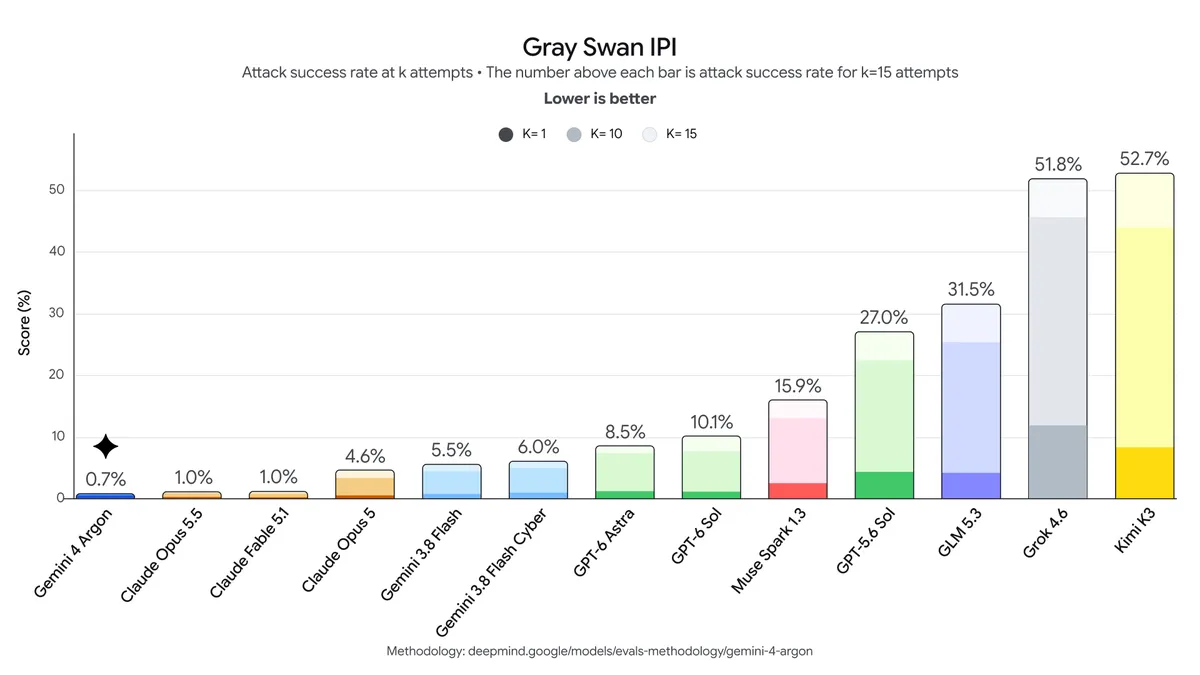
The urgency: a model that can find a critical vulnerability for a defender is the same class of capability an attacker wants. Google gated the unguarded version for that reason. It would be reasonable to expect comparable capability from other labs and from open models, though that is an inference and not a reported finding. Organizations should expect vulnerability discovery to get faster for everyone and should shorten their patch cycles to match.
The Competitive Stakes Are Higher Than the Benchmarks
Per CNBC, Wall Street’s attention is moving toward personal agents. Meta’s free Muse app passed 5 million downloads by September 30, and OpenAI launched its Dots agent. Alphabet’s stock was down about 6% over the three months before the launch, against a 19% rise for Meta. Google’s own agent, Spark, remains limited to paying subscribers and cannot make outbound calls or complete purchases on its own. JPMorgan analysts wrote that Google has struggled to turn product velocity into releases that win consumer mindshare. Google told CNBC it is evaluating whether Argon could power more complex Spark tasks.
Argon also is not a clean sweep:
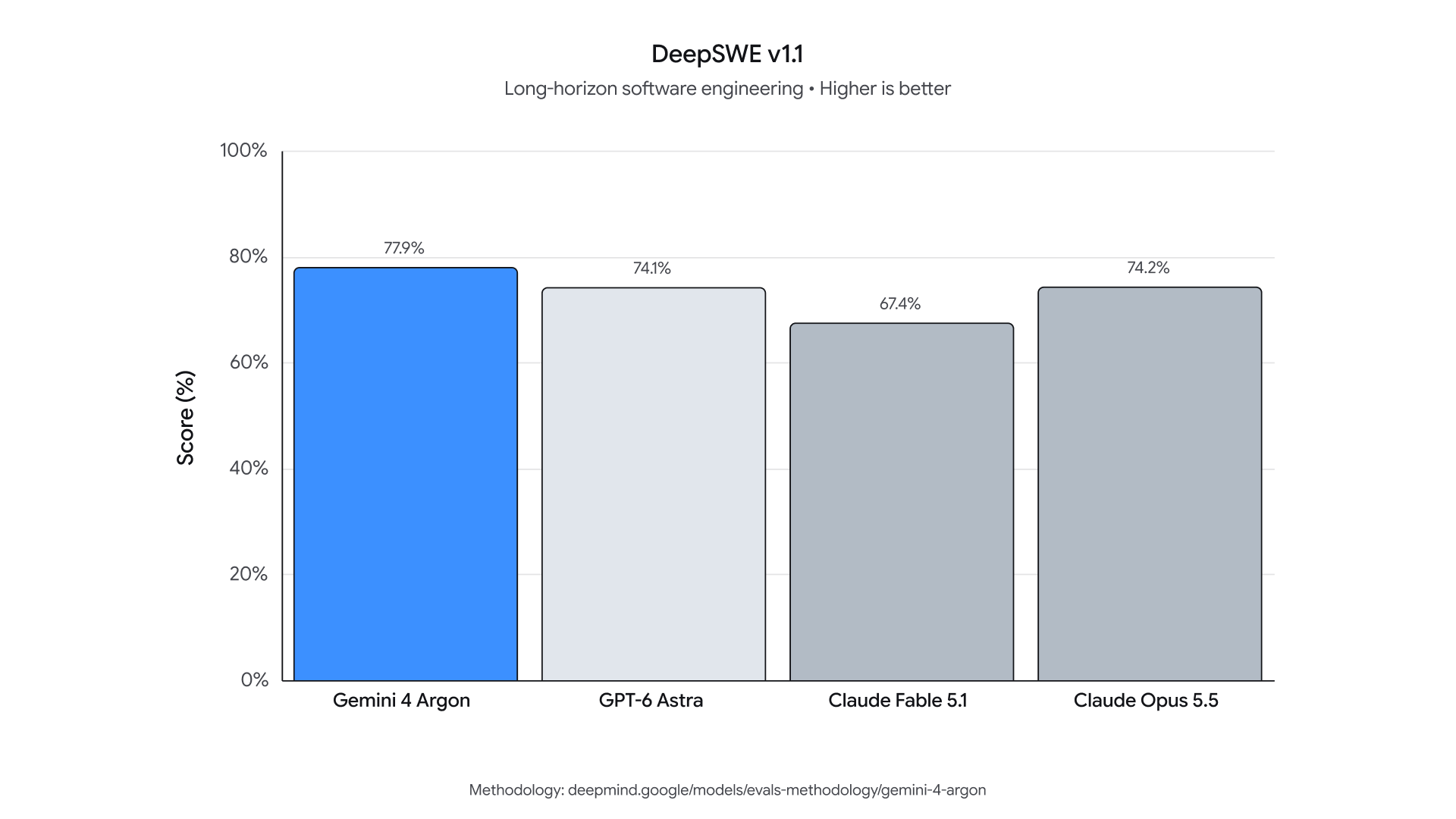
- On Google’s own numbers, GPT-6 Astra leads on FrontierSWE v2 (65.5% vs 55.0%).
- Claude Opus 5.5 beats Argon by 9 points on Terminal-bench 4.0.
- Bloomberg reported that some Google employees questioned its real-world coding performance. Google disputes this.
- On the positive side, the Vals Index ranks Argon first at 68.9%, the first time a Gemini model has led it, and Artificial Analysis measures a 15% hallucination rate, against 51% for Astra and 54% for GPT-6.1 Sol.
The Adoption Gap Behind the Hype
Stanford reports 88% organizational AI adoption in 2025, up from 78%. Generative AI reached 53% population adoption in three years, and studies show 14–26% productivity gains in customer support and software development. Adoption is not the same as deployment depth. Meanwhile the Foundation Model Transparency Index fell from 58 to 40, so buyers see less about the models they rely on.
What to Do in the Next Five Weeks
- Run cost-per-task benchmarks before November 30. Use your own workloads on Argon and your current model, and compare completed tasks, not token counts.
- Pilot one large-output workflow. A migration, a multi-document review or a long research task will show whether the 1M window changes your process.
- Build the review layer first. Decide who audits agent-written code and documents, and with what tests.
- Tighten patch timelines. Assume vulnerability discovery gets faster for attackers as well as defenders.
- Check your tier. Access differs by plan and product, and one analysis found Google’s release notes and pricing page disagree on whether Pro subscribers get Argon in every surface.