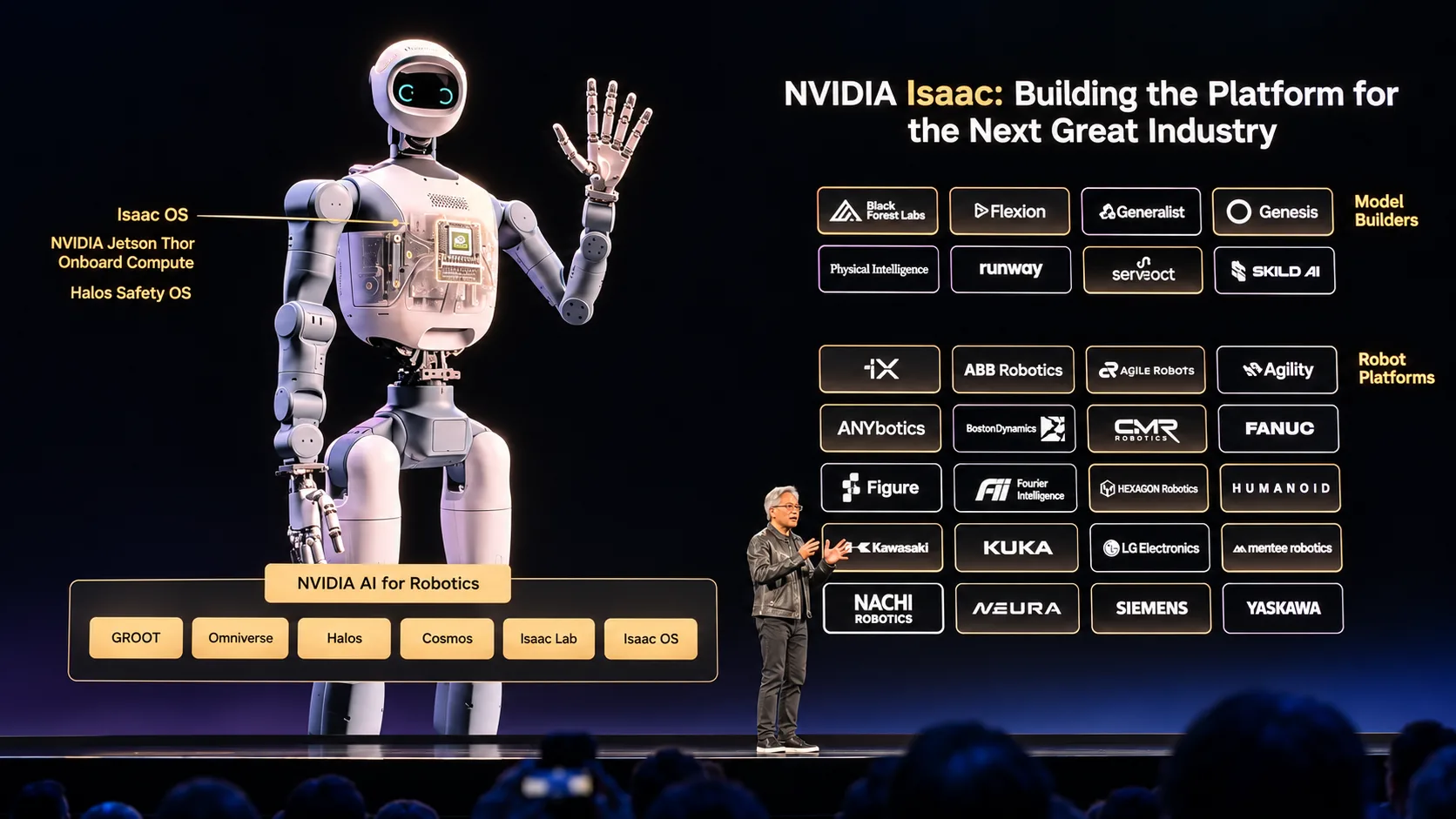
Announced at GTC Berlin 2026, NVIDIA’s expanded Isaac platform introduces an open-source robotics runtime, advanced simulation tools, and AI training workflows to accelerate the development of autonomous machines across manufacturing, logistics, and industrial operations.
Berlin, October 22, 2026 — NVIDIA has announced a major expansion of its Isaac robotics development platform at GTC Berlin 2026, introducing Isaac OS, Isaac Lab 3.0, new training datasets, and open-source workflows designed to accelerate the development and deployment of Physical AI systems.
The announcement, made on October 21 during the conference featuring NVIDIA founder and CEO Jensen Huang, represents another step in the company’s strategy to bring artificial intelligence beyond digital applications and into machines capable of operating in the physical world.
With the introduction of Isaac OS and the general availability of Isaac Lab 3.0, NVIDIA is creating a more integrated environment for robotics developers to train intelligent machines, simulate their behaviour, and deploy AI models across real-world robotic systems.
The expansion is supported by an ecosystem of European robotics companies, including ABB Robotics, KUKA, Hexagon Robotics, NEURA Robotics, Sereact, and Universal Robots, which are applying NVIDIA technologies to industrial automation, autonomous operations, and robotics development.
NVIDIA Isaac OS Connects AI Models With Real-World Robotic Systems
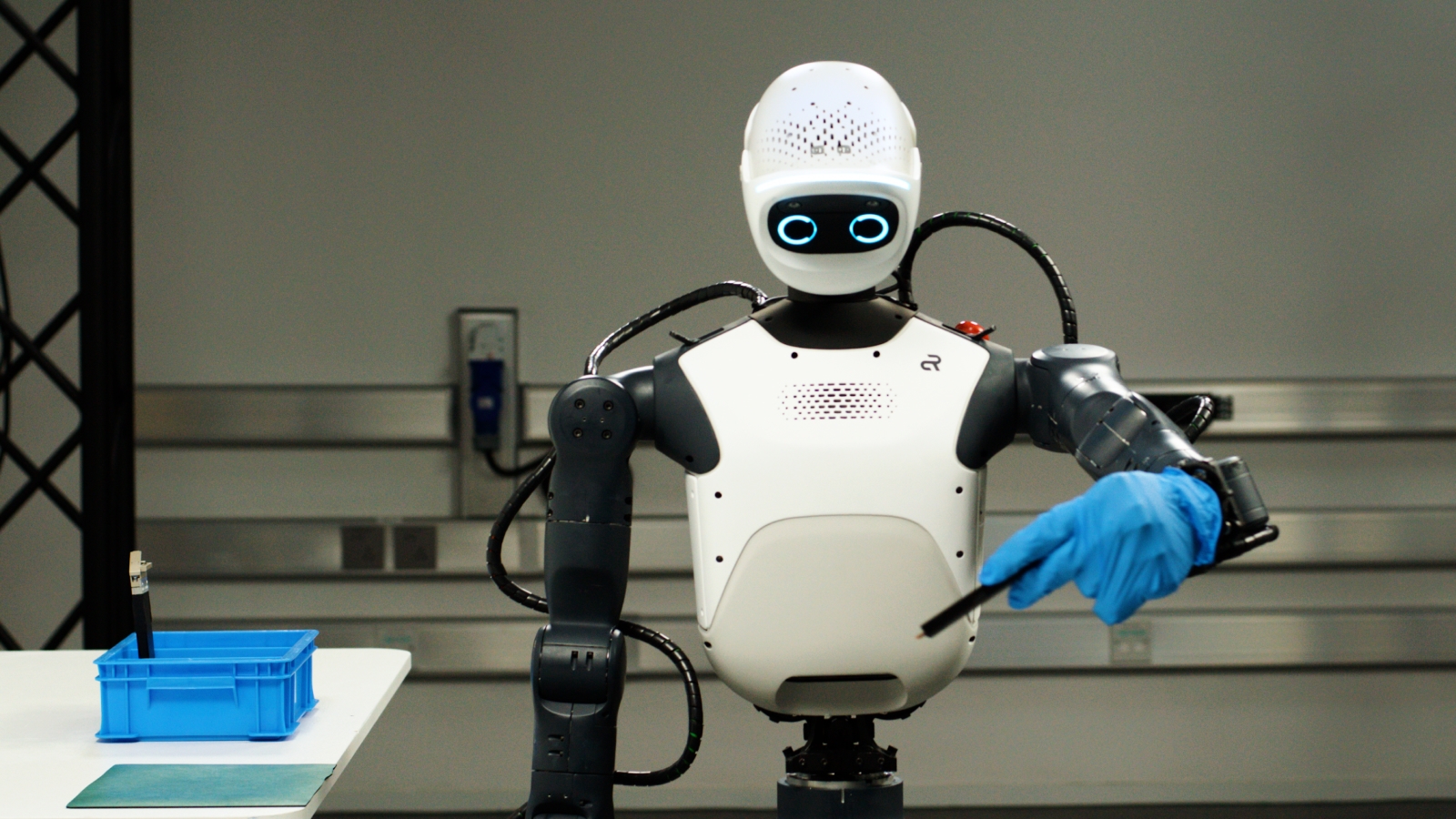
One of the central developments is NVIDIA Isaac OS, a new open-source runtime framework built on NVIDIA Holoscan, designed to connect artificial intelligence models with robotic sensors, control systems, and physical hardware.
Robotics development has traditionally involved multiple software environments for perception, simulation, motion planning, and hardware control. Integrating these systems can create significant engineering challenges, particularly when robots must operate in unpredictable environments.
Isaac OS addresses this challenge by providing a common runtime foundation intended to support deterministic, real-time performance as robotics applications move from simulation into physical deployment.
The framework is particularly relevant to industrial environments where autonomous robots must continuously process sensor information, interpret their surroundings, and respond to changing operational conditions.
By connecting perception, decision-making, and hardware execution, NVIDIA aims to make it easier for robotics developers to build systems that can transition from experimental environments into practical industrial applications.
Isaac Lab 3.0 Brings Multi-GPU Training to Physical AI
Alongside Isaac OS, NVIDIA announced the general availability of Isaac Lab 3.0, its open-source robot learning framework.
The latest version enables developers to train and refine robotic AI policies across computing environments ranging from desktop systems to data centres, using multi-GPU workflows and advanced physics simulation.
Isaac Lab 3.0 supports the Newton physics engine and NVIDIA PhysX, allowing developers to simulate robotic movement, physical interactions, and complex manipulation tasks before deploying trained policies onto physical machines.
This simulation-first approach is increasingly important for Physical AI because robots require more than language understanding or visual recognition. They must learn how objects behave, how to manipulate equipment, and how to navigate spaces while responding to physical constraints.
Developers can use simulated environments to generate training experiences, evaluate different behaviours, and refine robotic capabilities without requiring every training interaction to take place on real hardware.
However, transferring learned capabilities from simulation to physical environments remains a technical challenge. Differences in sensor conditions, friction, object properties, and other real-world factors continue to require validation and testing.
NVIDIA Expands Robotics Training With Human 1M and Open-Source Workflows

NVIDIA also announced additional resources intended to improve how robotics systems learn human movement and physical interaction.
The Human 1M Dataset provides synchronized video captured from three viewpoints, alongside three-dimensional hand-tracking data, supporting the development of robotics models capable of understanding human actions and manipulation.
The dataset is part of NVIDIA’s broader effort to address one of the largest challenges in robotics: obtaining sufficiently diverse and useful training data for intelligent machines.
NVIDIA also introduced three open-source reference workflows for DGX Station systems. These workflows are designed to help developers refine Isaac GR00T 1.7 models using reinforcement learning, train dexterous manipulation capabilities in Isaac Lab, and post-train NVIDIA Cosmos world models for synthetic-data generation.
Together, these capabilities connect model development, simulation, training-data generation, and robotic evaluation.
The full Human 1M Dataset is available to Cosmos Coalition partners, while NVIDIA is making associated robotics resources available through its open development ecosystem.
The technologies also illustrate the increasing convergence of agentic AI and Physical AI, where intelligent systems can assist in building, evaluating, and improving robotic behaviours rather than relying entirely on manually programmed sequences.
European Robotics Leaders Apply NVIDIA Technologies to Industrial Digital Twins
NVIDIA’s Isaac expansion is accompanied by growing adoption of its robotics and simulation technologies across Europe’s industrial ecosystem.
ABB Robotics is integrating NVIDIA Omniverse libraries into RobotStudio HyperReality, allowing developers and industrial operators to simulate and virtually commission robotic systems before they are installed in real manufacturing environments.
Virtual commissioning enables engineers to examine how equipment and robotic operations might behave in a digital environment, potentially identifying problems before physical deployment.
KUKA Group is also incorporating Omniverse libraries into its Visual Components FactoryLens environment to introduce real-time rendering capabilities for factory simulation workflows.
Meanwhile, Sereact is combining NVIDIA Isaac GR00T and Cosmos Transfer to train its Cortex robotic platform for goods-handling applications operating on Universal Robots industrial robotic arms.
These developments reflect a wider transition in manufacturing, where digital twins are becoming tools for training, planning, and evaluating autonomous systems rather than simply visualising industrial infrastructure.
For European manufacturers, the opportunity lies in combining decades of engineering and automation expertise with AI-driven simulation, robotic intelligence, and real-time operational systems.
Toyota Material Handling Europe Reports Up to 50% Faster Deployment

One of the measurable industrial applications highlighted in NVIDIA’s announcement involves Toyota Material Handling Europe and technology consultancy SoftServe.
The companies are using NVIDIA Omniverse and Isaac Sim to develop autonomous material-handling solutions, including systems designed for industrial logistics environments.
According to NVIDIA, the collaboration has reduced deployment time by up to 50% through the use of simulation-based development workflows.
The reported improvement demonstrates how virtual testing and simulation may help companies shorten the process of configuring and deploying autonomous industrial equipment.
The figure is a company-reported result for this particular collaboration and should not be interpreted as a universal performance improvement across robotics deployments.
Beyond Toyota Material Handling Europe, companies such as Hexagon Robotics, Humanoid, and Bear Robotics are integrating NVIDIA hardware and software to advance robotic perception, model execution, and operational validation.
These applications demonstrate how robotics AI is moving from research into warehouse operations, factory systems, and commercial environments.
The Future of Physical AI Depends on Simulation, Safety, and Integration
The expansion of NVIDIA Isaac also highlights a broader challenge facing robotics adoption: developing intelligent machines requires an integrated combination of AI models, computing infrastructure, simulated environments, sensors, and reliable control systems.
NVIDIA’s approach combines Isaac for robotics development, Cosmos for world-model training and synthetic data, Omniverse for simulation and digital twins, and Jetson or IGX computing systems for real-world execution.
Safety remains an important part of this architecture. NVIDIA is positioning its Halos platform, built on IGX Thor, to support the validation and safer deployment of autonomous systems.
The company is also expanding access to simulation-ready robotics and industrial equipment assets, helping developers recreate more realistic testing environments.
These capabilities do not eliminate the need for physical testing, industrial safety assessments, or regulatory compliance. They are designed to give developers additional tools to evaluate robotic behaviour before wider deployment.
At GTC Berlin 2026, NVIDIA’s announcements reinforce an emerging industrial AI model in which intelligent systems can be trained using accelerated computing, evaluated through digital twins, and deployed onto machines operating in factories, warehouses, and other physical environments.
For businesses, the question is increasingly shifting from whether robotics can become more intelligent to how quickly such intelligence can be developed, validated, and integrated into existing operations.
NVIDIA’s Isaac OS and Isaac Lab 3.0 expansion marks an important development in that transition, bringing the software infrastructure for Physical AI closer to practical industrial deployment.
Sources
1. NVIDIA Newsroom — NVIDIA Advances Isaac Platform for General-Purpose Robotics With New Reference Humanoid, Frameworks, Simulation Pipelines and Data (October 21, 2026) https://nvidianews.nvidia.com/news/nvidia-advances-isaac-platform-for-general-purpose-robotics-with-new-reference-humanoid-frameworks-simulation-pipelines-and-data/
2. NVIDIA — GTC Berlin 2026: Jensen Huang Keynote Coverage https://blogs.nvidia.com/blog/gtc-berlin-2026-keynote/
3. NVIDIA Developer Forums — NVIDIA Robotics Announcements, GTC Berlin 2026 https://forums.developer.nvidia.com/t/nvidia-robotics-announcements-nvidia-gtc-berlin-2026/386456
4. Counterpoint Research — NVIDIA GTC Berlin 2026: Containers, Safety and Sovereignty https://counterpointresearch.com/en/insights/nvidia-gtc-berlin
5. NVIDIA Newsroom — NVIDIA and Global Robotics Leaders Take Physical AI to the Real World https://nvidianews.nvidia.com/news/nvidia-and-global-robotics-leaders-take-physical-ai-to-the-real-world