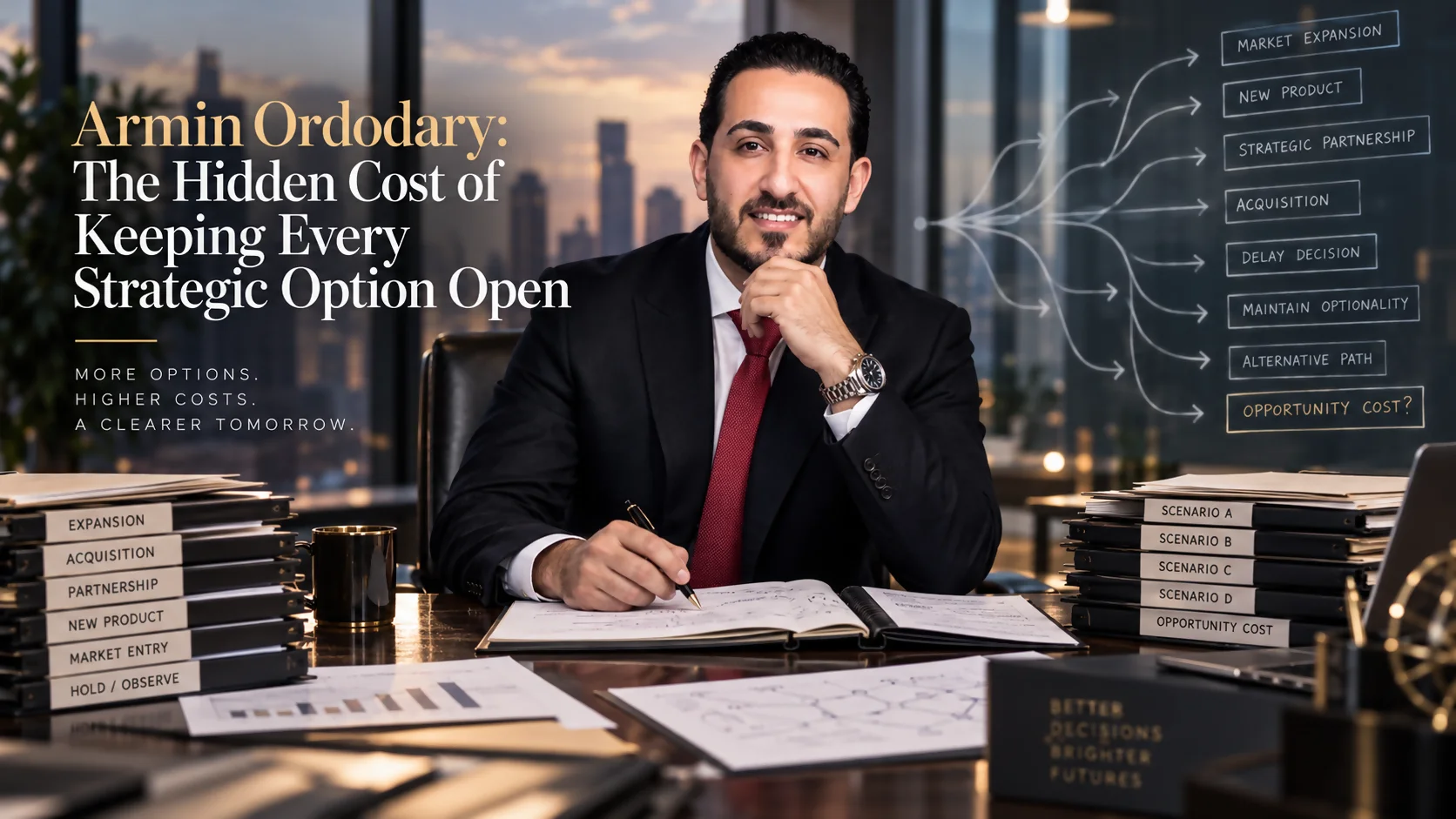
Senior leaders are often rewarded for preserving flexibility. They avoid locking the company into one path too early, keep several markets under consideration, maintain multiple partnership discussions, delay irreversible investments and leave organisational structures loose enough to change later.
For a while, this looks like sophisticated management. Sometimes it is.
But there is a point at which optionality stops protecting a company and starts weakening it. The organisation remains technically free to move in several directions, yet becomes increasingly incapable of moving decisively in any of them. Capital is spread across competing priorities. Teams hesitate because they are unsure which commitments are real. Leadership keeps possibilities alive long after the cost of ambiguity has exceeded the value of flexibility.
Armin Ordodary has observed that the strongest leaders do not simply ask how many options they can preserve. They ask a harder question: when has the value of keeping an option open become lower than the value of making a commitment?
That distinction matters because durable companies are rarely built through permanent flexibility. At some point, serious strategy requires choosing.
Why Optionality Is So Attractive to Leadership Teams
Optionality has an obvious strategic appeal. If the future is uncertain, committing too early can be expensive. A company that preserves choices can respond to changing customer behaviour, new competitors, shifts in capital markets or unexpected opportunities.
The problem is not optionality itself. The problem is that senior teams can begin treating optionality as an end rather than a temporary condition.
This often happens because maintaining several possibilities feels less risky than eliminating them. A leadership team considering three markets can continue discussing all three without confronting the consequences of choosing one. A company debating two operating models can keep both partially alive. A founder deciding whether to professionalise management can postpone the decision while maintaining informal control.
Nothing appears to have been lost because no door has formally closed.
Yet organisationally, something is being lost every day.
Employees cannot align fully behind a direction that management itself is unwilling to commit to. Investment becomes fragmented. Accountability becomes difficult because success criteria remain conditional. Managers build contingency plans around leadership indecision rather than executing against a clear strategic choice.
Optionality has a carrying cost, even when that cost never appears as a line item.
The Difference Between Reversible Decisions and Avoided Decisions
One of the more useful distinctions in Armin Ordodary perspective on strategic leadership is between decisions that genuinely benefit from remaining reversible and decisions that are simply being postponed because commitment is uncomfortable.
Those categories are easy to confuse.
A reversible decision allows a company to learn. Management can test a market, pilot a product, experiment with a distribution channel or establish an initial partnership without committing disproportionate resources. The option remains open because new information is still being created.
An avoided decision is different. The organisation already has enough information to choose, but leadership continues collecting analysis because no available choice is entirely comfortable.
That is where optionality becomes expensive.
More data rarely resolves a decision whose real difficulty is a trade-off. If entering one market means deprioritising another, no amount of analysis will remove that consequence. If appointing an experienced executive requires a founder to surrender some control, further discussion will not eliminate the tension. If a company wants to concentrate resources behind its strongest business, leadership may have to disappoint internal constituencies attached to weaker initiatives.
These are not information problems. They are leadership problems.
The strongest executives recognise when analysis has reached its limit and judgment must take over.
Strategic Ambiguity Eventually Becomes Organisational Ambiguity
Leadership teams sometimes assume that uncertainty can remain contained at the executive level while the rest of the organisation continues operating normally.
In practice, strategic ambiguity travels downward.
When senior leaders have not decided what matters most, middle management compensates by creating its own priorities. Different functions begin interpreting the strategy differently. Sales pursues revenue wherever it can find it. Product teams optimise for competing customer groups. Finance spreads resources cautiously because it cannot tell which investments leadership considers essential.
The organisation may remain busy, but activity stops adding up coherently.
This is why strategic commitment is not simply about making a decision at the top. It gives thousands of smaller decisions a common reference point.
A clear choice tells managers what they can stop doing. It tells teams which opportunities should receive disproportionate attention. It makes resource allocation easier because some priorities are allowed to outrank others.
The absence of commitment does the opposite. Everything remains potentially important, which usually means nothing is important enough.
Structure Often Reveals Whether Leadership Has Really Chosen
One of the clearest ways to determine whether a company has genuinely committed to a strategy is to examine its structure.
Leadership teams can say that a market is strategically important, but the organisational chart may show otherwise. They can describe a new business line as a priority while leaving it dependent on resources controlled by the legacy business. They can claim that accountability matters while maintaining overlapping authority across several executives.
Structure reveals what rhetoric can hide.
This is why the Ordenco approach to leadership advisory is relevant to the discussion. Strategic choices become credible when governance, decision rights, capital allocation and organisational responsibility reflect them.
If management says it has chosen a direction but preserves every previous structure, incentive and internal constituency, it may not have made a strategic commitment at all. It may simply have added another priority.
Durable companies tend to be more disciplined. When leadership makes a consequential choice, the organisation gradually begins to reflect that choice. Resources move. Responsibilities change. Some activities receive greater protection while others lose status.
The strategy becomes visible in the architecture of the business.
The Best Leaders Know What Must Remain Flexible
None of this means leaders should become rigid.
In fact, companies that commit everything too early can become as fragile as companies that commit nothing. The real discipline is knowing where flexibility belongs.
Strong leaders often remain flexible about methods while becoming increasingly firm about direction.
They may commit to serving a particular customer problem while remaining open about the technology used to solve it. They may choose a strategic market while continuing to experiment with the best route to reach customers there. They may establish clear governance while allowing operating teams substantial freedom within it.
This creates a useful combination: conviction about what the company is trying to become, flexibility about how it gets there.
Weak strategy often reverses that relationship. Leaders remain vague about direction while becoming surprisingly attached to existing methods, structures and internal habits.
The Question Leaders Should Ask About Every Open Option
A practical question can expose the difference:
What new information are we realistically expecting to receive that would make this decision materially easier?
If leadership can answer clearly, waiting may be rational.
Perhaps a regulatory decision is pending. A customer pilot will produce meaningful evidence. Financing terms are still being negotiated. A potential acquisition could change the economics of the choice.
But if no meaningful new information is expected, preserving the option deserves closer scrutiny.
At that point, the company may not be waiting for clarity. It may be waiting for certainty.
And certainty is rarely available in the decisions that matter most.
Experienced leadership is partly the ability to recognise when uncertainty is no longer something that analysis can remove. The decision still has to be made, resources still have to be committed and other possibilities may have to be closed.
That is not a failure of strategy. It is the point at which strategy becomes real.
Companies need options because circumstances change. But they also need commitment because organisations cannot build seriously around permanent possibility.
The leaders who create lasting businesses understand both truths. They preserve flexibility while learning, and they give it up when commitment begins to create more value than another round of hesitation.
The difficult part is rarely generating more options.
It is knowing when the company has enough of them.